
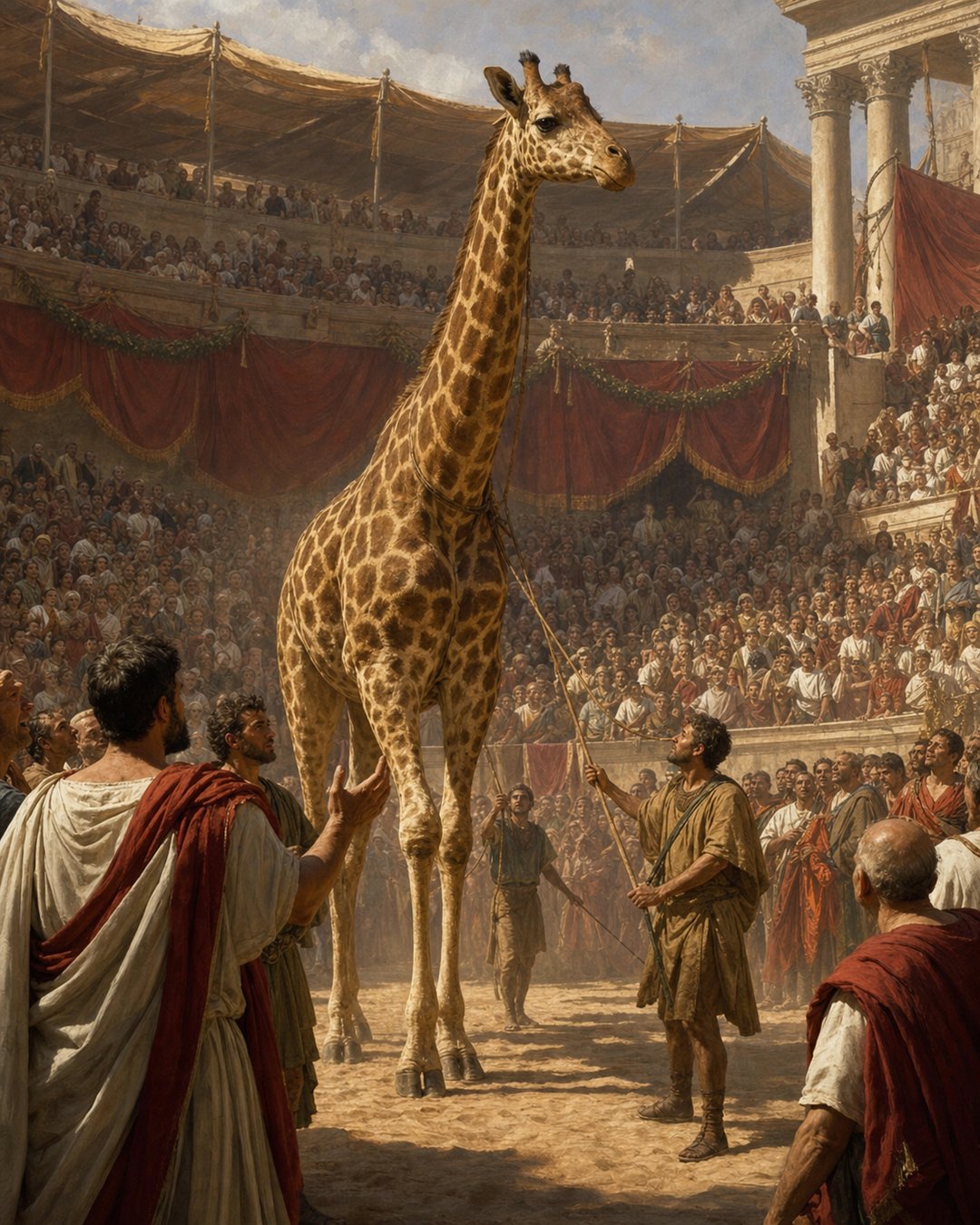
Nothing in the Roman crowd’s ordinary catalogue of animals prepared it for the neck. The creature entered Caesar’s games with the spotted hide of a great cat, the body of a browsing hoofed animal and a head lifted above the people around it. Cassius Dio paused his political narrative to describe the proportions. Rome had seen an animal that forced description before judgment.
Dio says Julius Caesar introduced this animal to Rome for the first time and exhibited it to everyone. The occasion belonged to the immense celebrations of 46 BCE, after victories that had made Caesar the dominant figure in the Roman state. A wooden arena, wild-beast combats, gladiators, cavalry, elephants and even a staged naval battle filled the programme. Yet the giraffe earned a separate explanation because novelty could carry its own kind of power.
Romans called it the camelopard: camel plus leopard. The name was not random ornament. It joined what spectators thought they recognized—the general form associated with a camel and a skin patterned like a leopard—into a verbal solution for an unprecedented sight. The giraffe became both a living trophy and a small demonstration of how Rome absorbed the unfamiliar.
Dio Stopped Counting and Described One Animal
Cassius Dio begins his account of Caesar’s spectacles by refusing to trust enormous totals. Numbers attached to public games, he observes, were regularly exaggerated by boastfulness. Rather than burden his history with an uncertain catalogue, he singles out one detail that seemed essential: the creature he calls the camelopard. That choice gives the animal unusual weight. It was memorable even within a festival designed to overwhelm memory.
The setting was political before the giraffe appeared. Caesar had completed a new forum and dedicated the temple of Venus Genetrix, the divine ancestor claimed by his family. Contests marked the dedication. Architecture, ancestry and entertainment were therefore presented together. The public moved through a city altered by one man and then watched a programme financed and arranged under his authority.
Dio says Caesar built a wooden hunting theatre with seats all around and no stage, explaining the form through the word amphitheatre. This was not the permanent Colosseum of a later dynasty. Timber, temporary construction and crowded seating created a purpose-built frame for animal display. The giraffe’s height would have made it legible across that ring in a way that a smaller novelty could not match.
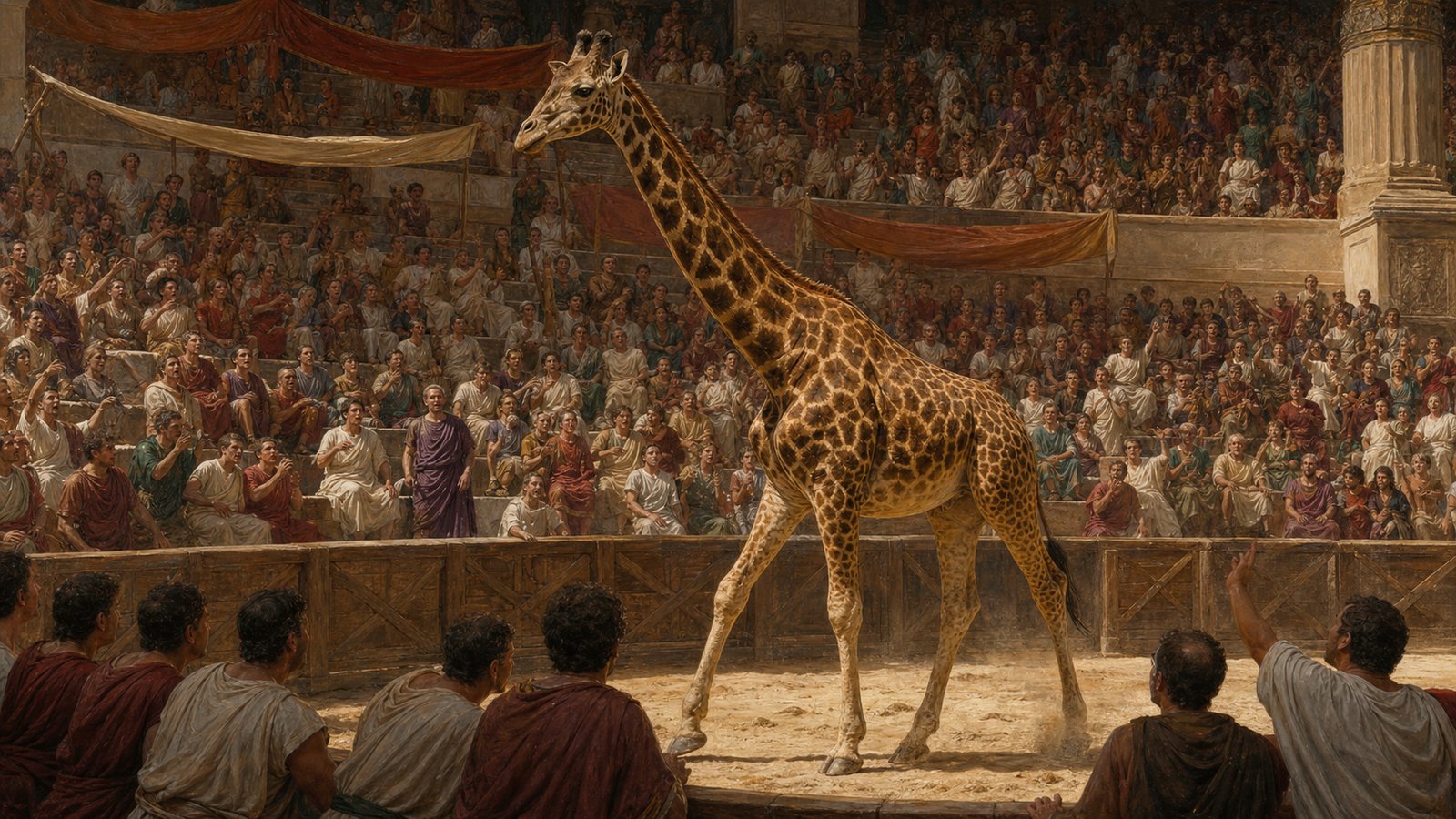
The animal did not need to attack or perform a complicated trick to hold attention. Simply walking within the enclosure revealed a silhouette unknown to most witnesses. In a programme crowded with violence and machinery, its strongest effect came from being itself.
A Name Assembled the Unknown from Familiar Parts
Dio describes the animal from rump to head. He thought the rear legs shorter than the front and saw the body rise as if it were climbing an incline. Above that slope, the neck lifted to an extraordinary height. Modern anatomy describes the stance differently—the legs are not built as two radically unequal pairs—but the passage preserves what the animal looked like to an observer trying to organize a startling profile.
The compound name completed the explanation. The body suggested a camel; the spotted coat suggested a leopard. Greek kamēlopardalis and Latin camelopardalis held those comparisons together. The same inheritance remains in the scientific name traditionally used for the giraffe, Giraffa camelopardalis, although modern taxonomy debates how living populations should be divided.
This method of naming did not require Romans to believe the animal was literally a hybrid. It was an act of analogy: take visible features, search the known world for comparisons, and make a new category from the result. The name carried a first impression forward long after the first crowd dispersed.
The giraffe itself sharpened every comparison. It was a hoofed African browser, not a cat or camel, with horn-like ossicones, a patterned coat, long legs and the tallest body of any living land animal. Ancient language captured appearance rather than biological kinship. That mismatch is precisely what makes the old name valuable evidence: it records the work of seeing.
The Journey Was Part of the Performance
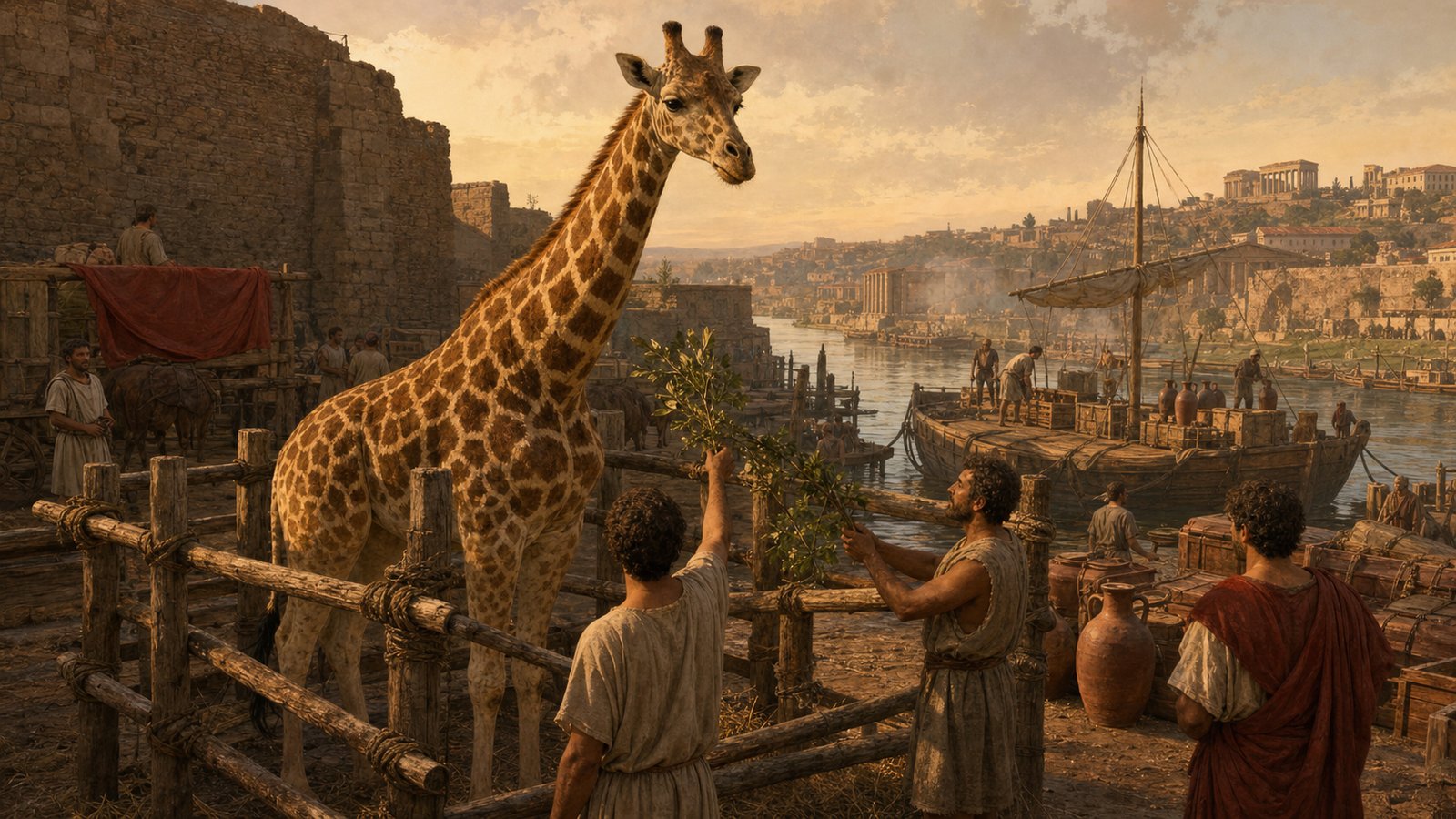
Before Rome could look upward, people had to move the animal across a continent and a sea. Dio does not supply an itinerary, ship design or handler’s diary, so the route cannot be reconstructed with confidence. The basic achievement remains unavoidable. A living giraffe had been obtained in Africa, kept alive through transport, landed, contained and brought into a crowded city.
Giraffes browse leaves, fruit and flowers from woody plants and are physically specialized for height. Their size makes transport harder, not easier. A shipper could not fold that neck into an ordinary crate or treat the animal like a sack of grain. Fencing, food, water, calm handling and clearance all became practical conditions of the spectacle, even though the surviving narrative notices only the public result.
The logistical silence served Caesar. Audiences saw the impossible arrival, not the chain of labour behind it. Rome often turned distance into a finished object: pepper at dinner, marble in a temple, a captive in a procession. The giraffe made that conversion breathe. Its presence implied access to landscapes beyond Italy and command over the people and resources needed to bridge them.
This is where the animal differs from the machinery in Caesar’s rapid bridge across the Rhine. The bridge advertised speed through construction; the giraffe advertised reach through survival. One made an army’s passage possible. The other made a faraway ecosystem stand inside a Roman enclosure.
Caesar Filled the Programme Until Scale Became an Argument
The surrounding contests amplified the display. Dio mentions combats of wild beasts and gladiators, cavalry fighting cavalry, infantry fighting infantry, men mounted on elephants, and a flooded basin on the Campus Martius for ships. He also notes criticism of both the killing and the immense expenditure. Spectacle could impress and disturb in the same afternoon.
The giraffe occupied a different emotional register. A lion could signify danger; an elephant could carry armed men; a naval battle restaged organized violence. The camelopard first demanded wonder. Its strange proportions let Caesar vary the rhythm of the festival while keeping the central message intact: his celebrations could produce sights unavailable in normal Roman life.
That message mattered in 46 BCE. Republican institutions still existed, but Caesar’s resources, victories and public prominence exceeded those of an ordinary magistrate. A crowd did not have to read a constitutional argument to understand asymmetry. It could see who built the forum, dedicated the temple, paid for the timber seating and populated the programme with beings drawn from distant regions.
Roman audiences were not passive decoration. As Pompeii’s arena riot shows in a harsher setting, spectators brought local loyalties and volatile reactions into entertainment spaces. Caesar could arrange the encounter, but he could not fully dictate each response. Wonder, revulsion at slaughter, fascination with the animal and resentment at expense could coexist.
The Camelopard Outlived Caesar’s One-Day Surprise
Dio wrote long after Caesar’s games, yet he expected the animal’s first Roman appearance to deserve explanation. His account preserves several layers at once: the event, the old compound name, an observer’s anatomical interpretation and a historian’s decision that this novelty mattered more than inflated totals. The giraffe survived in text because it broke the scale of the surrounding catalogue.
Later Roman rulers continued to display animals from distant territories, and exotic beasts became familiar instruments of imperial spectacle. The first appearance should not be read backward as routine. For Caesar’s audience, there was no established Roman visual memory of a giraffe in an arena. The comparison had to be built in real time from camel, leopard, slope, spots and neck.
The episode also warns against letting modern familiarity erase ancient astonishment. A giraffe now appears in children’s books, documentaries and zoos; its outline can be recognized in a fraction of a second. In 46 BCE, Roman spectators had no such reservoir of repeated images. A description that sounds awkward to modern readers records the difficulty honestly.
Caesar’s games tried to make power feel immeasurable. Dio resisted by distrusting the numbers, but the giraffe defeated that scepticism through specificity. One animal, precisely strange, could communicate more than a boastful total. It had crossed the Mediterranean, risen over the arena barrier and compelled Rome to invent a name from two animals it already knew.
The camelopard was therefore not merely a curiosity beside the serious business of politics. It was politics translated into scale, logistics and surprise. Caesar controlled the occasion; the animal controlled the gaze. For a few moments, the most revealing object in Rome’s victory festival was alive, spotted and looking down at the city that claimed to contain the world.