
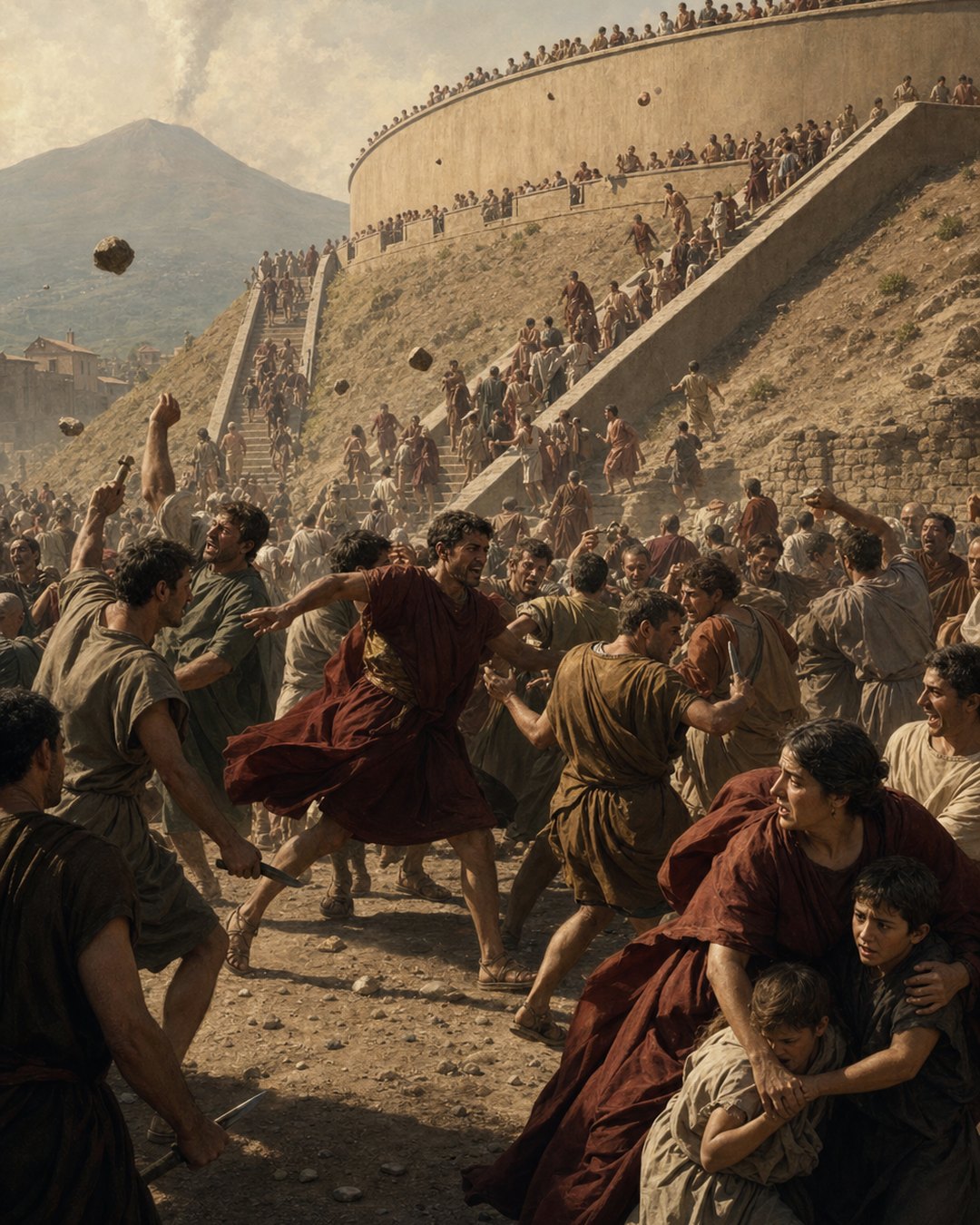
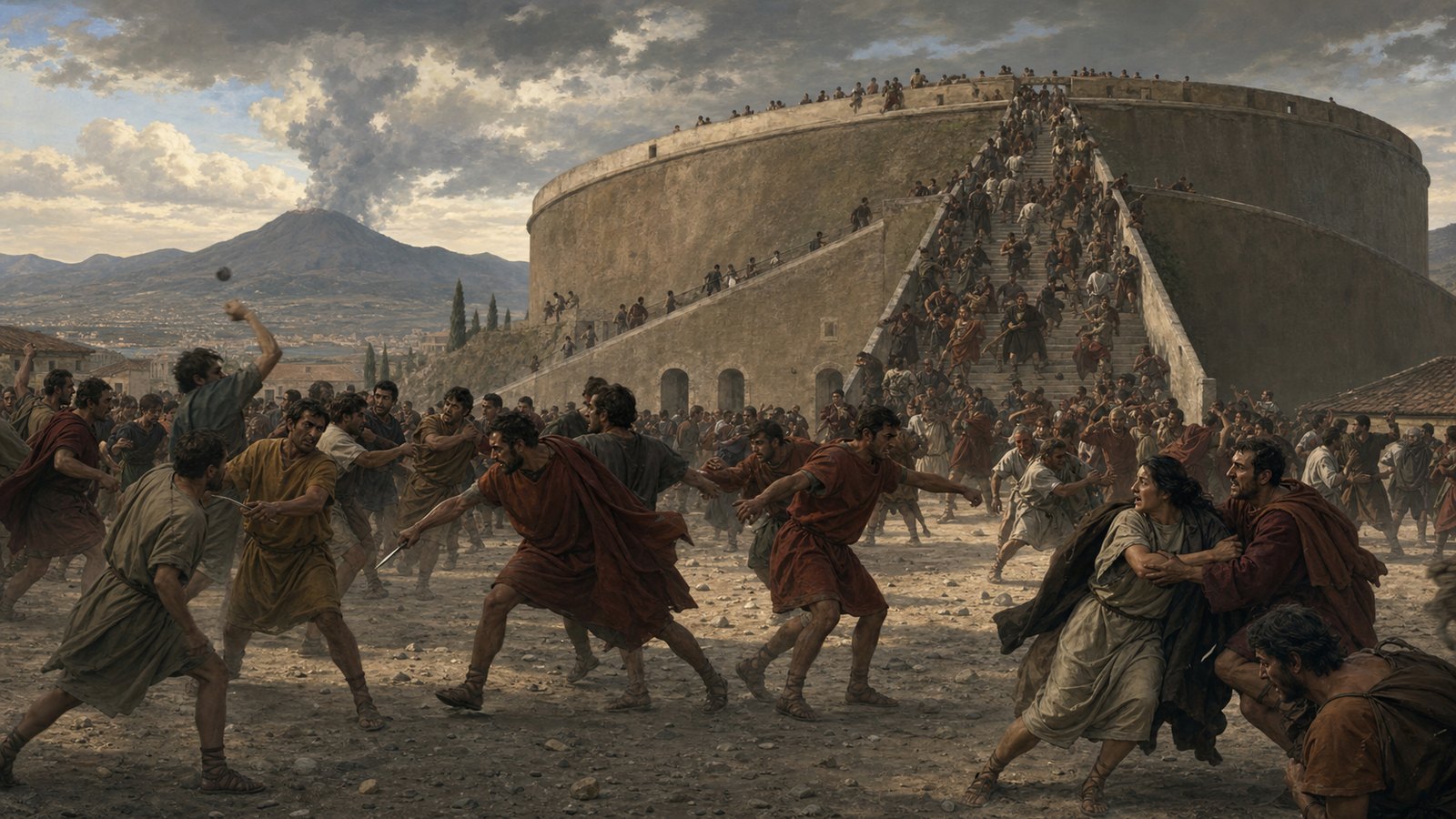
The gladiators were not the only armed men at Pompeii’s amphitheatre in AD 59. Visitors from neighboring Nuceria traded taunts with the home crowd. Insults followed. Then stones crossed the seating. By the time blades appeared, a show designed to stage controlled violence had produced uncontrolled violence among its spectators.
Tacitus compresses the escalation into three hard steps: abuse, stones, steel. Pompeians had the advantage because the arena and surrounding streets were theirs. Many Nucerians were carried to Rome maimed; others arrived grieving children or parents. A quarrel between towns had become evidence laid before the emperor, the Senate and the consuls.
Pompeii preserved another account on a house wall. A fresco shows the amphitheatre, its external stairs, the exercise ground beside it and tiny figures fighting across the open space. The painting is not a neutral diagram, but it confirms that the riot entered local memory. Text and image together reveal how quickly entertainment, civic pride and elite ambition could make a Roman crowd politically dangerous.
Livineius Regulus Put Two Towns in One Arena
The show was presented by Livineius Regulus, whom Tacitus says had previously been removed from the Senate. Sponsoring gladiatorial entertainment could display wealth and bind a local audience to its benefactor. Regulus supplied the occasion, but the crowd brought identities that the program could not contain.
Pompeii and Nuceria were neighboring Campanian communities with their own status, histories and local pride. Nuceria had received colonial settlement under Nero only a few years before the riot. Scholars have debated whether land and status tensions sharpened the hostility, but Tacitus does not give a single underlying cause. His account begins with the behavior of the two crowds.
The setting amplified comparison. A visiting group entered a building where Pompeians controlled the home ground, the seating approaches and the streets outside. Roman amphitheatres sorted viewers spatially, as the article on status in amphitheatre seating explains. At Pompeii, those ordered ranks did not prevent collective identity from crossing into confrontation.
The event also placed an elite sponsor between public favor and public risk. Games could make generosity visible, but the crowd was not a passive audience that a patron could simply own. Once spectators began fighting, Regulus’s name attached him to a crisis large enough for Roman authorities to punish.
The Quarrel Escalated in Three Visible Steps
Tacitus calls the beginning slight and the outcome murderous. First came mocking exchanges characteristic, in his dismissive phrase, of small-town insolence. Verbal rivalry turned into direct abuse. Stones then made distance dangerous; steel finally transformed a brawl into killing.
That sequence matters because it shows crowd violence accumulating rather than erupting from nowhere. A taunt could be answered without either group losing face. Each answer raised the cost of retreat. Once missiles flew, people outside immediate reach became targets, and weapons converted civic boasting into injuries that would last after the show ended.
Pompeians held the stronger position because the spectacle took place in their town. Tacitus does not describe formations or a single decisive clash. His brief sentence instead points to asymmetric control of space and numbers. Nucerian visitors had to escape through someone else’s arena approaches and streets.
The amphitheatre itself had stood for more than a century. Built around 70 BC, it was among the earliest surviving permanent Roman amphitheatres and could contain a crowd comparable to Pompeii’s population. The building gave civic spectacle a durable home. In AD 59, that capacity concentrated hostility as efficiently as enthusiasm.
The Wounded Carried a Local Fight to Rome
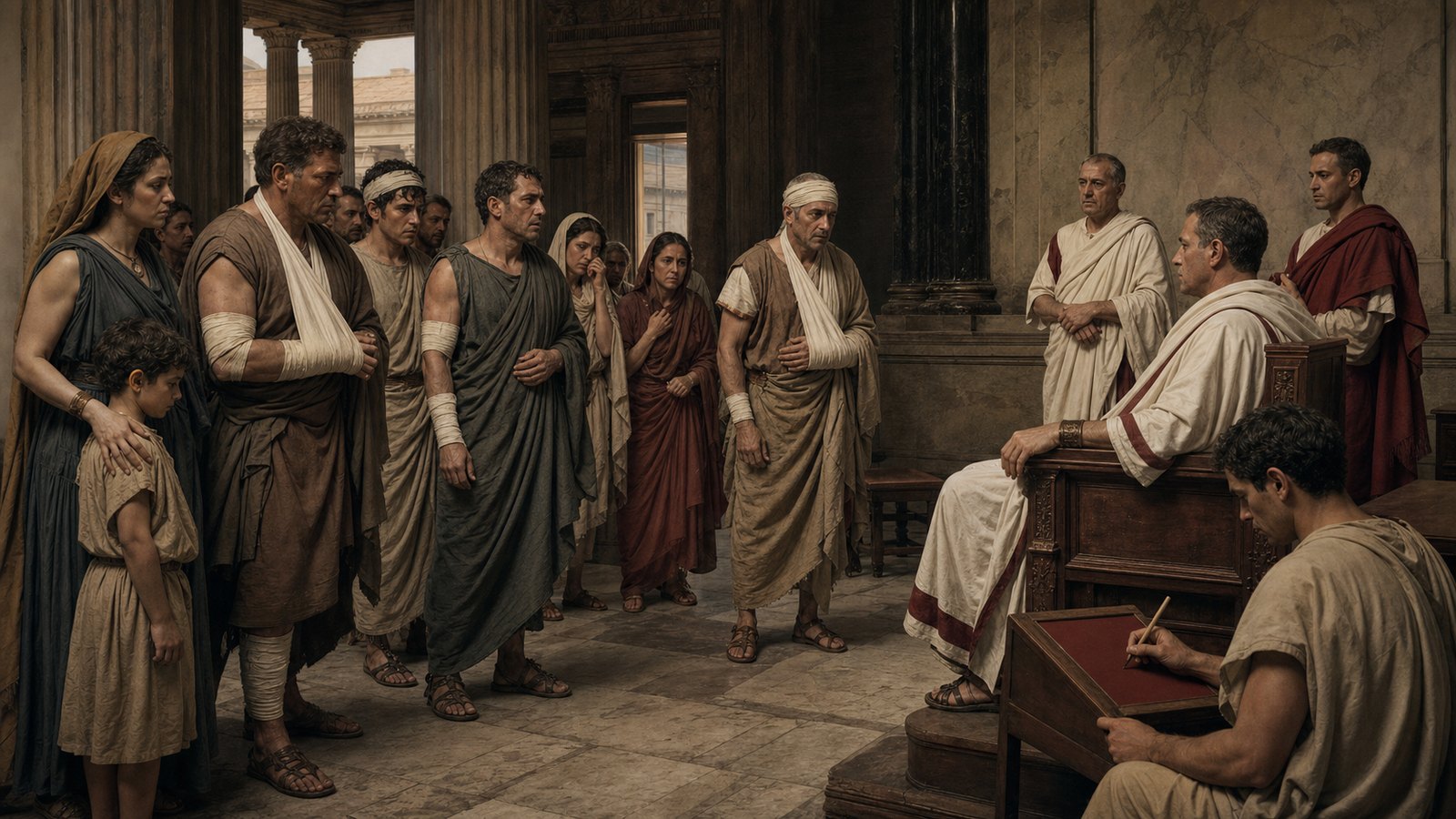
The aftermath moved beyond Pompeii because survivors and bereaved families made it visible at the capital. Tacitus says many Nucerians were brought to Rome with mutilated or wounded bodies, while many mourned children or parents. The language gives no exact casualty total, but it stresses both bodily damage and family loss.
Those arrivals turned rumor into a political scene. Wounds could be displayed; relatives could name the dead; a neighboring community could demand that a home-town advantage not decide the official story. The route to judgment ran upward from emperor to Senate, then from Senate to consuls, before the matter returned to the senators.
The institutional movement suggests difficulty as much as seriousness. Nero delegated the case to the Senate, and the Senate delegated it to the consuls. When the affair came back, the final ruling treated the riot as more than a collection of individual assaults. Pompeii’s public gatherings and organizations became targets.
Roman power often made itself concrete by assigning status, jurisdiction and punishment. Pliny’s exchange with Trajan shows provincial officials seeking an imperial rule for another kind of collective problem. The Pompeii case traveled the opposite direction: injured provincials brought local disorder to Rome for a central response.
The Senate Punished the Crowd, Its Associations and Its Sponsor
Tacitus says Pompeians were barred for ten years from assemblies of the kind that produced the riot. The exact scope of the prohibition is debated: it may have targeted gladiatorial gatherings rather than every use of the amphitheatre. The safe conclusion is that Rome suspended a major form of public spectacle for a decade.
The ruling also dissolved associations established contrary to law. Collegia could organize worship, burial, work and sociability, but authorities worried when voluntary groups became bases for coordinated public action. The sanction treated crowd formation itself as part of the danger, not merely the final use of weapons.
Livineius Regulus and other instigators were exiled. This linked elite responsibility to mass behavior. A sponsor gained prestige by assembling a crowd; after disaster, he could not claim that the assembled public had nothing to do with him. Roman punishment reached both organizations below and patrons above.
The decision was severe without being permanent. Ten years imposed a civic memory long enough to affect careers, festivals and local prestige, yet it left a path back to spectacle. Whether the full term was served is uncertain, especially after the earthquake of AD 62 damaged the city. The sentence nevertheless advertised that violence between communities could bring imperial control into local entertainment.
A House-Owner Turned the Riot into a Wall Painting
A fresco found in the House of Actius Anicetus gives the riot an archaeological afterlife. It depicts the amphitheatre at an angle, with its external stairways clearly visible. Beside it appears the palaestra and its swimming pool. Small human figures fight in the open areas around the buildings as well as near the arena.
The picture is valuable partly because its architecture is recognizable. This is not a generic mythic battle. The amphitheatre and exercise ground anchor the violence in Pompeii’s urban landscape. Weapons, thrown stones and scattered bodies make the crowd—not the scheduled gladiators—the image’s action.
Interpretation requires restraint. The fresco does not label every figure or tell us why the owner wanted the scene. It may express local pride, fascination with a notorious event or connection to performers associated with the house. What it securely proves is that the riot became a subject fit for domestic display rather than an embarrassment erased from memory.
Tacitus looks from Rome toward provincial disorder: Nucerian wounds, institutional referrals and senatorial punishment. The fresco looks from within Pompeii and turns the city’s built environment into the stage of a memorable victory-shaped melee. Neither perspective is complete alone.
Together they expose the unstable boundary inside Roman spectacle. The arena promised that violence would be bounded by sand, rules, performers and an audience. In AD 59, the audience carried rivalry across that boundary. Taunts became stones, stones became steel, and the people who came to watch a controlled fight forced Rome to control the town instead.