
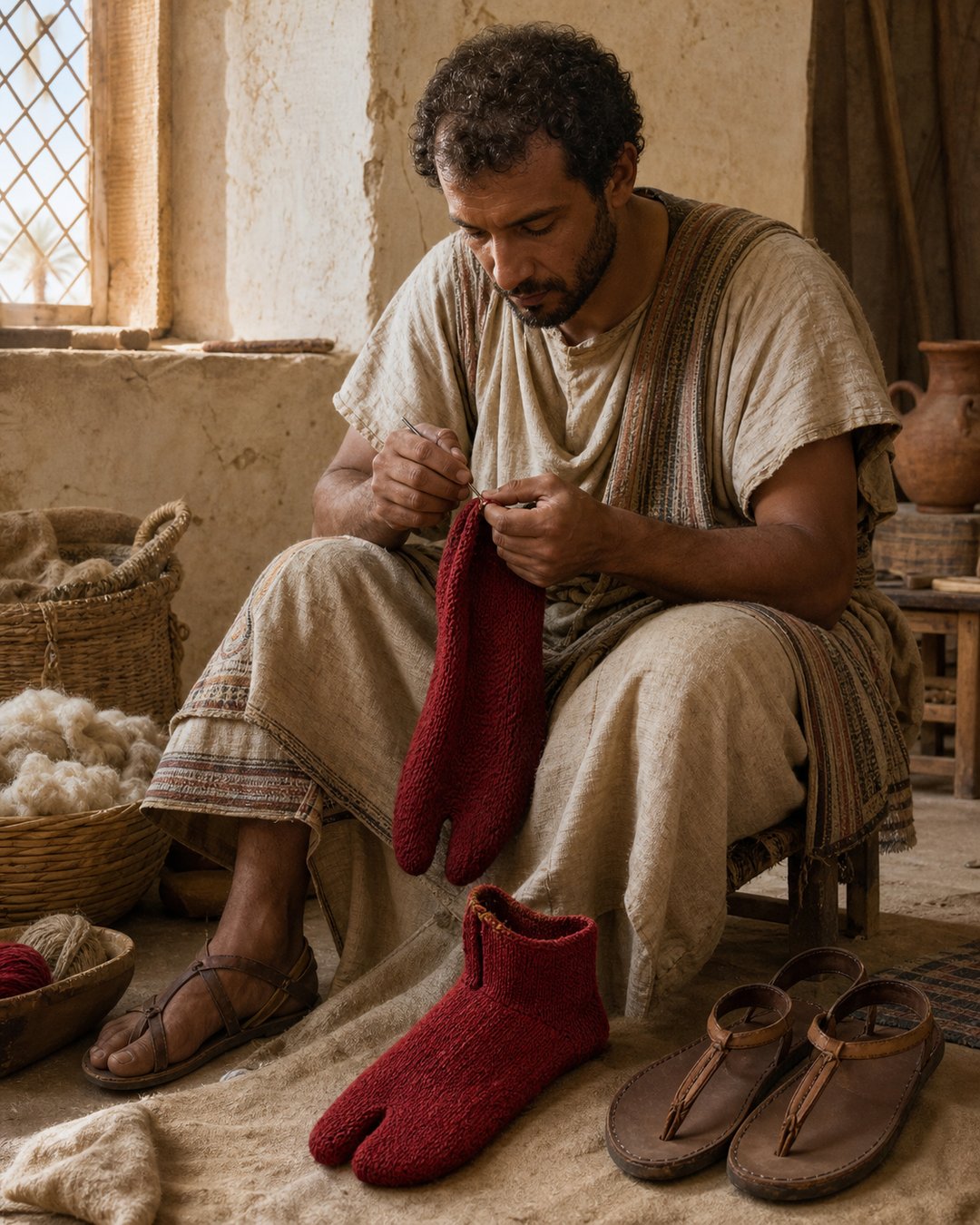
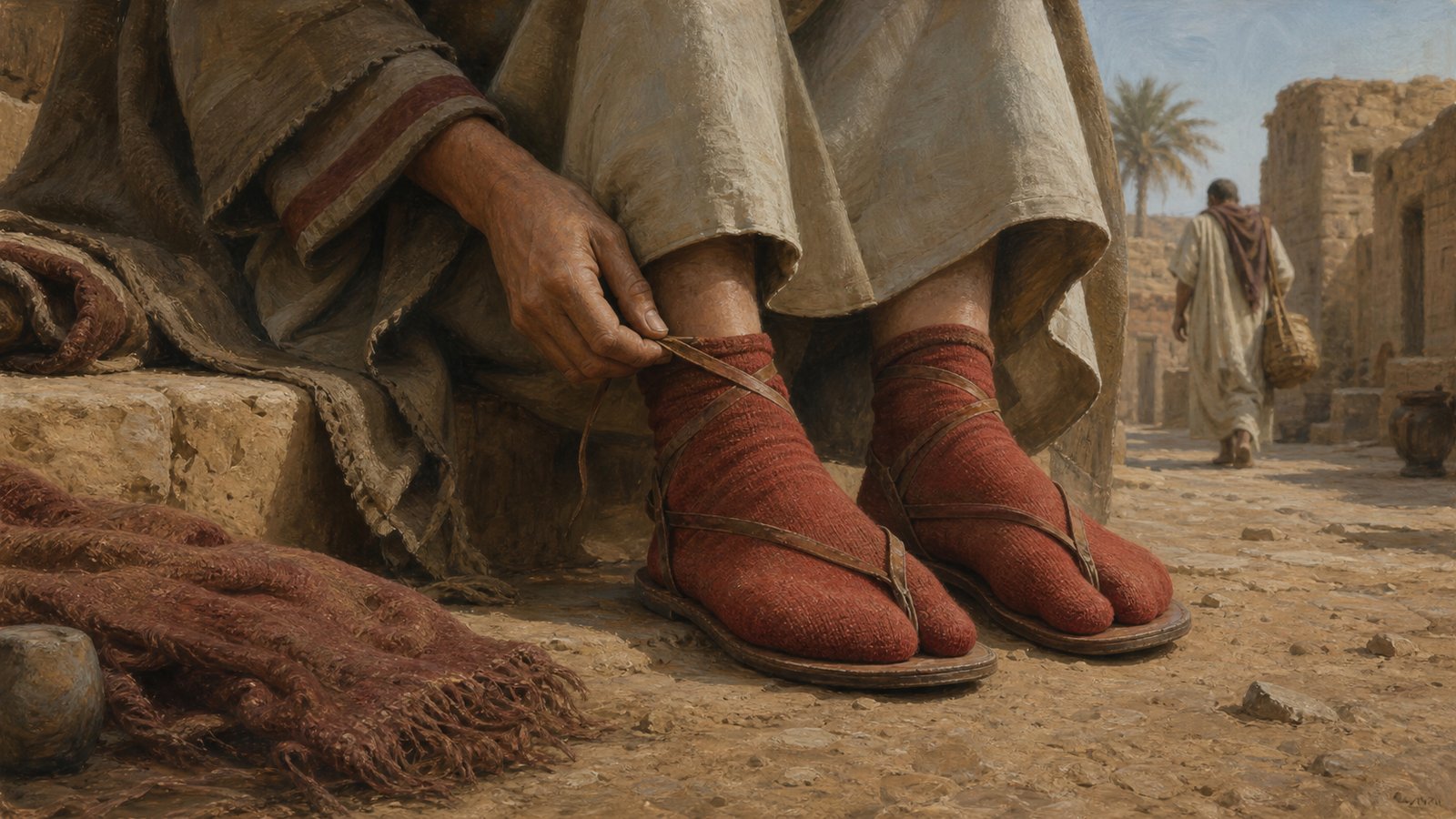
A pair of red wool socks in the Victoria and Albert Museum ends in four points, not two. Each foot has one pocket for the big toe and another for the remaining toes. The division looks odd only until a sandal enters the picture. A thong could pass through the gap while wool still covered the rest of the foot.
The socks were made in Egypt between about 250 and 420 CE and excavated at Oxyrhynchus late in the nineteenth century. Flat, each measures 25.5 centimetres high and 18 centimetres long. Those dimensions, the bright colour, the turned heel, the ankle slit and the surviving stitches allow an unusually close look at an ordinary problem in Roman Egypt: how to make footwear warm, fitted and compatible with what people wore outside.
They are often described as knitted, but the museum identifies the technique as nålbindning, or knotless netting. One needle carried yarn through interlocking loops. That difference matters. The object is not an early version of a modern factory sock. It is evidence of decisions made by hand, from the first toe loop to the last fastening point at the ankle.
The Sandal Strap Explains the Shape
The divided toe is the feature a modern viewer notices first, and it is also the quickest route to the maker’s reasoning. A conventional closed sock would put wool between the sandal thong and the foot, bunching where the strap needed to sit. Separating the big toe created a clean channel. The strap could meet the sandal sole while both parts of the forefoot remained covered.
The V&A describes each sock as bright red wool with a divided big toe. The museum explicitly connects that division to sandals. This was not decorative eccentricity added after construction. It altered the plan from the beginning because the two toe compartments had to be formed separately and then joined into one foot.
A second Egyptian example, a child’s sock now associated with Manchester Museum, shows that the solution was not confined to one adult pair. World History Commons describes its separate large-toe section and suggests a thong sandal of rush and leather. That smaller, multicoloured object differs in date, pattern and reported technique, but it confirms the practical relationship between sock and sandal across surviving Egyptian textiles.
The red pair therefore preserves an outfit rather than an isolated garment. Its absent leather is still legible in the wool. Like Roman military sandals built around leather and nails, it shows that footwear worked as a system. Covering, sole, straps and movement had to cooperate.
One Needle Built the Fabric in the Round
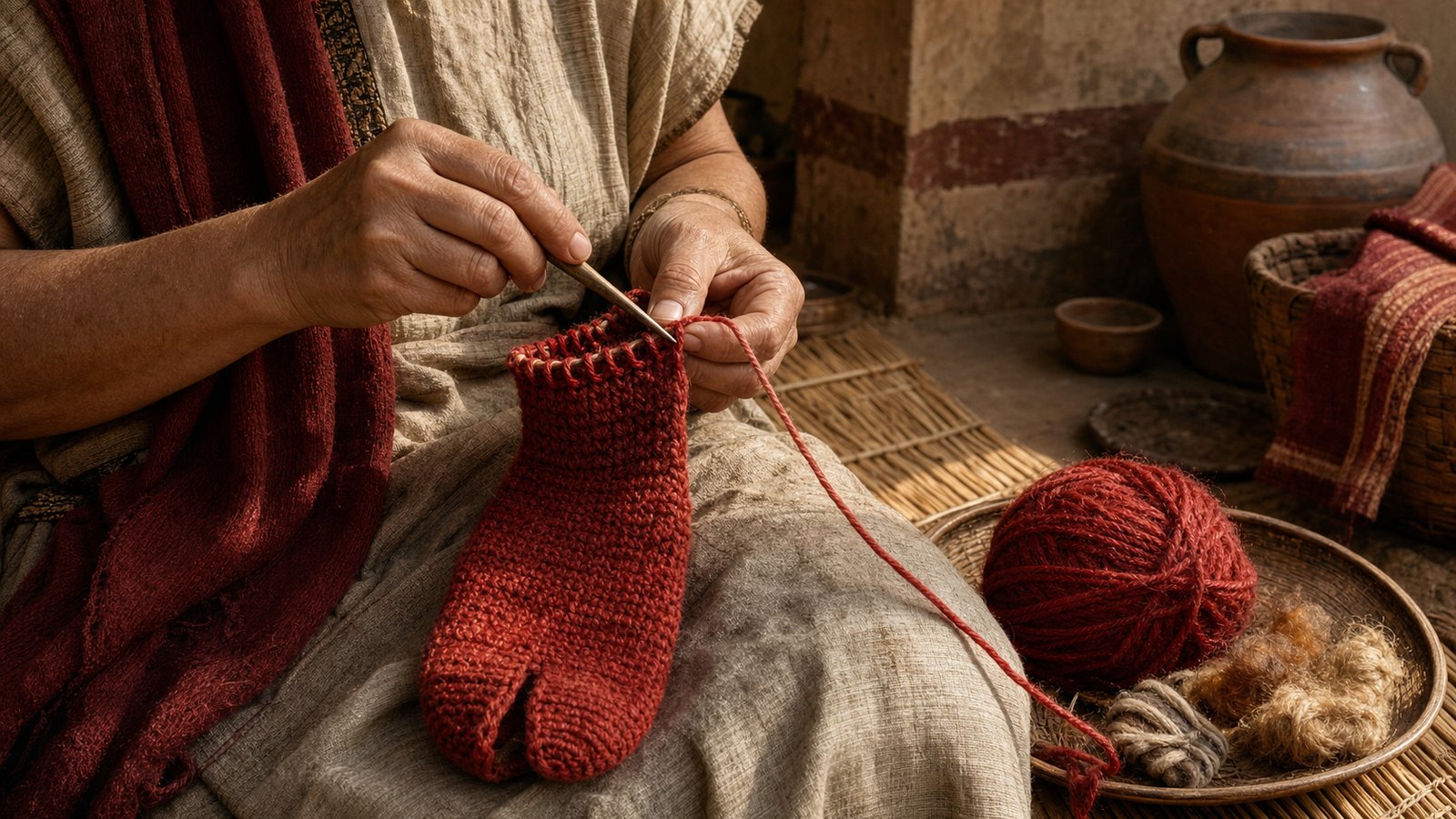
Nålbindning can resemble knitting after the work is finished, but its motion is closer to sewing. The V&A explains that yarn was threaded through the eye of a sewing needle and worked in the round through a series of loops. The maker pulled the working length through each connection rather than keeping an entire row of live loops balanced across two needles.
That distinction changes how we imagine the workshop. There was no pair of long needles clicking from side to side. A single needle, manageable lengths of yarn and repeated hand movements gradually produced a dense tube. The technique was laborious, but it could be shaped while it grew. A toe pocket could narrow, a heel could turn and an ankle could rise without cutting the finished fabric from a broad woven sheet.
The socks used three-ply wool. Twisting fibres into yarn and combining strands required preparation before the needle began its visible work. The finished surface therefore concentrates several kinds of labour: fibre cleaning, spinning, plying, dyeing and loop construction. The colour makes those stages easy to overlook because red dominates the eye, but the structure had to exist before dye could become a wearable form.
This was not the same process as cloth made on a Roman loom under continuous warp tension. Loom weaving organized crossing systems of thread across a plane. Nålbindning accumulated interconnected loops around a small shaped volume. Both demanded tension control, yet their tools, gestures and routes to the final object were fundamentally different.
The Heel Reveals the Order of Work
The V&A’s older gallery documentation records a specific sequence: construction began at the toe, formed a turned heel and finished at the ankle. That order can be read as a series of commitments. The toe established size and division first. The foot then extended far enough to locate the heel. Only after direction changed around that corner could the leg rise.
A turned heel is where a simple tube becomes fitted footwear. The fabric must make room for a projecting part of the body without leaving a loose sack beneath it. Loop construction allowed additions and changes of direction to build that pocket. The survival of the shape lets viewers follow geometry that written accounts of textile work rarely bother to explain.
At the top of each sock, an overlapping slit sits at the centre front. The museum notes three or four extra stitches forming an underflap, ending in a loop for fastening or tying. This is a small detail, but it completes the design. A narrow ankle opening could hold the garment in place; a slit could let the foot pass through; overlap and loop could close it again.
Every feature answered the next practical obstacle. The divided toe admitted the sandal thong. The shaped foot met the heel. The turned heel redirected the fabric. The slit admitted the wearer’s foot, and the fastening controlled the opening. The result was not merely fabric in the rough outline of a sock. It was a sequence of local solutions joined into one object.
Dry Ground Preserved What Daily Wear Usually Destroys
Textiles are vulnerable archaeological witnesses. Feet abrade them, dirt enters their fibres, insects eat them and moisture encourages decay. Common garments also tend to be repaired, reused and discarded after heavy wear. A stone inscription can survive neglect; a wool sock normally cannot. Egypt’s dry conditions are one reason such intimate evidence has endured.
The V&A records that this pair came from the burial grounds of ancient Oxyrhynchus, a Greek-speaking city on the Nile in Middle Egypt. Excavators recovered the socks near the end of the nineteenth century. The context moved them from bodily use and burial into the modern history of collecting, where documentation became part of their survival.
The pair reached the museum through Robert Taylor, executor of Major Myers’s estate, and was given in 1900. Museum records say the textiles were selected as useful examples, with unsuitable pieces available for other institutions. That language belongs to a different age of archaeology and collecting. It reminds us that the object’s present completeness depends not only on ancient climate but on later choices about excavation, division, ownership and display.
The child’s sock described by World History Commons makes the preservation problem explicit: ordinary objects are rare because they wore out in life and disintegrated after burial. The exceptional Egyptian record can distort modern intuition. Surviving socks do not prove that most Roman-period feet wore wool in this exact form. They prove that at least some makers possessed the technique and that some wearers wanted this carefully adapted solution.
The Pair Resists an Easy Story About Progress
Museum discussions often place nålbindning near the history of knitting because the finished surfaces can look related. The V&A says some regard it as a forerunner of faster knitting with two or more needles. Yet the same museum dates its earliest double-needle knitted object much later, to roughly 1100–1300 in North Africa. The Roman-period pair should not be treated as incomplete knitting waiting for a superior future.
Its technique was already capable of precise work. The maker controlled two toe compartments, a shaped foot, a turned heel, a rising ankle, an overlapping slit and a fastening loop. Calling the method laborious is fair; calling the object primitive would ignore what the labour achieved. Speed is only one measure of a textile system. Repairability, available tools, learned motions and the ability to shape fabric also mattered.
The socks also complicate a habit of imagining ancient clothing through statues and elite portraits. Marble preserves draped public bodies, not red wool wrapped around ordinary feet. This pair moves attention down to dust, straps, friction and warmth. Its strongest historical claim is modest: someone cared enough about the interface between skin, wool and sandal to build the answer one loop at a time.
That modesty is precisely why the object is memorable. No emperor ordered its shape, and no historian narrated its making. The evidence sits in measurements, fibres and construction. Two red socks survived because Egypt kept the wool dry, collectors kept the pair together and museum specialists learned to distinguish a single-needle structure from knitting. Their split toes still explain the missing sandals.