
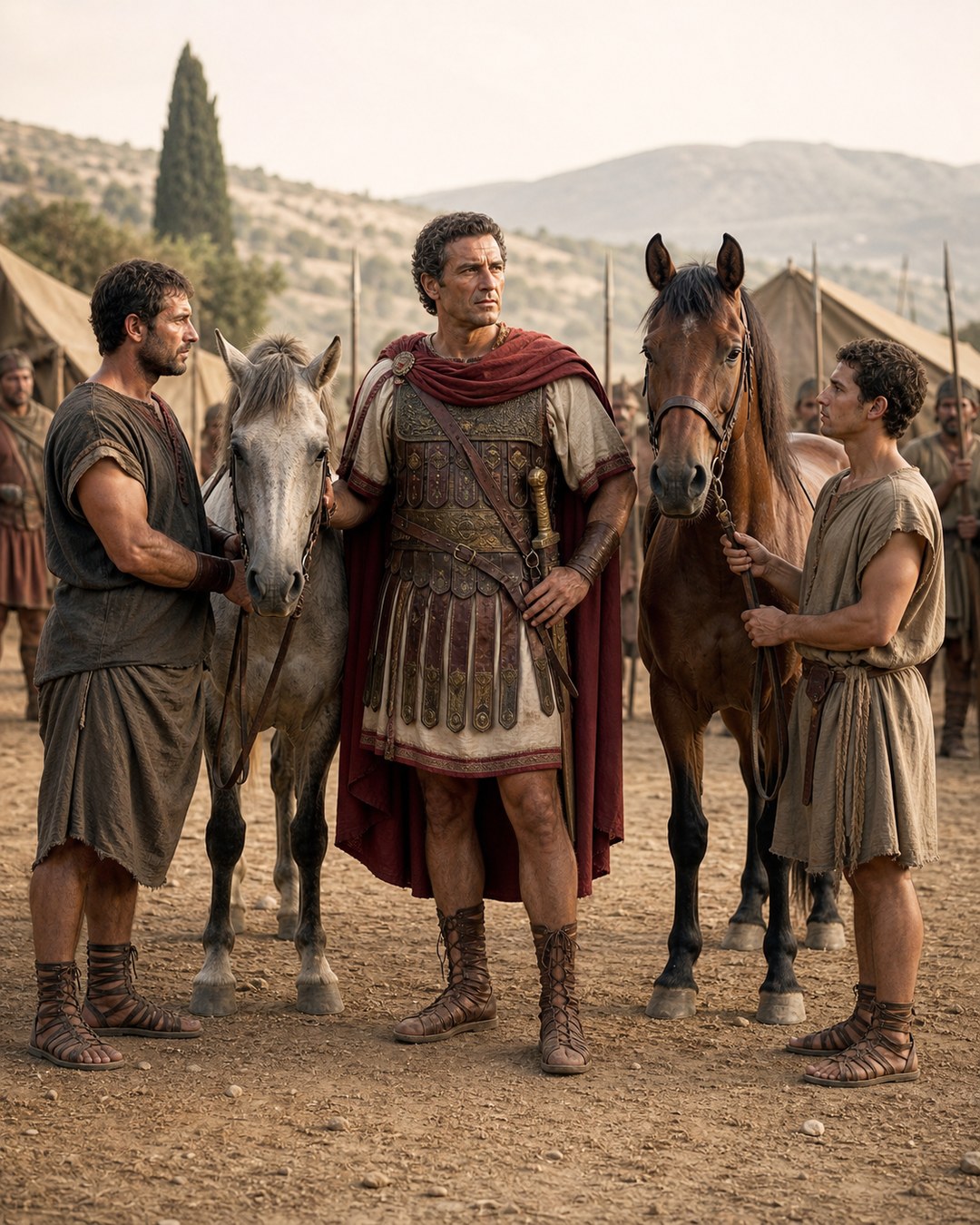
The strongest man in the assembly wrapped both hands around an old horse’s tail and pulled. He had height, muscle and what looked like the easier animal. The tail stayed where it was. Nearby, a much smaller man began taking hairs from the thick tail of a powerful horse, one after another.
Plutarch says the first effort produced plenty of strain and no result. The soldiers laughed as the strong man finally stopped. By then the smaller demonstrator had done what brute force could not: he had stripped the other tail by dividing the task into tiny acts.
Sertorius had arranged the contrast for an army that had recently demanded battle, ignored his warnings and been beaten. His lesson was not delivered from the safety of theory. He first let impatience expose its own cost, then rescued the retreat, restored the survivors to camp and waited for their shame to settle. Only afterward did the horses enter the assembly.
An Army of Numbers Still Refused to Wait
Plutarch begins the episode with apparent strength. Men were coming to Sertorius from every direction, and his army had become large. More followers did not solve his strategic problem. The allies were overconfident, poorly disciplined and loud in their demand that he attack.
The pressure fell upon delay itself. To the impatient soldiers, waiting could look like fear or indecision. Sertorius knew that numbers without timing could be consumed in an engagement chosen by the enemy. He tried argument first, but words did not pacify men who believed their combined strength had already settled the question.
Command inside this coalition could not rest on Roman office alone. Plutarch calls the troops allies and elsewhere emphasizes Sertorius’s dependence on forces far from Rome. He needed compliance from men capable of pressing their wishes upon him. An order issued without persuasion might survive for a day and fail at the next tempting sight of the enemy.
Sertorius therefore stopped trying to win the debate in advance. He allowed the eager contingent to fight. Plutarch presents this as a calculated risk: the commander expected them to be badly handled, but hoped they would not be destroyed. A reverse short of annihilation could teach what his argument had failed to establish.
The wager required control. Sertorius did not abandon the men to prove himself right. When the clash ended as he expected, he came to their aid, gave shelter to the fugitives and brought them safely back to camp. Their failure became survivable because the commander they had resisted still controlled the retreat.
Defeat Created Obedience but Also Dejection
The battlefield check solved only half the command problem. The allies had learned that confidence was not the same as readiness, but the experience left them dejected. An army cured of rashness by being stripped of all confidence would be no more useful than one drunk on its own numbers.
Sertorius waited a few days before calling the general assembly. That interval matters. Immediate rebuke could have sounded like triumph over his own men. A delayed demonstration allowed panic to subside while preserving the memory of what impatience had cost.
He also changed the medium of instruction. Earlier arguments had been too weak to restrain desire for battle. The assembly would receive no abstract lecture first. Two horses and two visibly mismatched men supplied a problem that every spectator could read from a distance.
The old horse looked vulnerable, and the robust man beside it looked capable of forcing an answer. The large horse looked more difficult, and the small man beside it looked unequal to the task. Sertorius built the scene so the army’s first judgment would favor the wrong method, just as its first judgment about immediate battle had favored mass and force.
Roman commanders could turn repeated physical work into discipline. Scipio’s troops built and demolished a camp each day while he rebuilt an army before Numantia. Sertorius worked in a different register. One brief spectacle made a strategic distinction memorable enough to travel beyond the assembly.
One Man Attacked the Whole Problem at Once
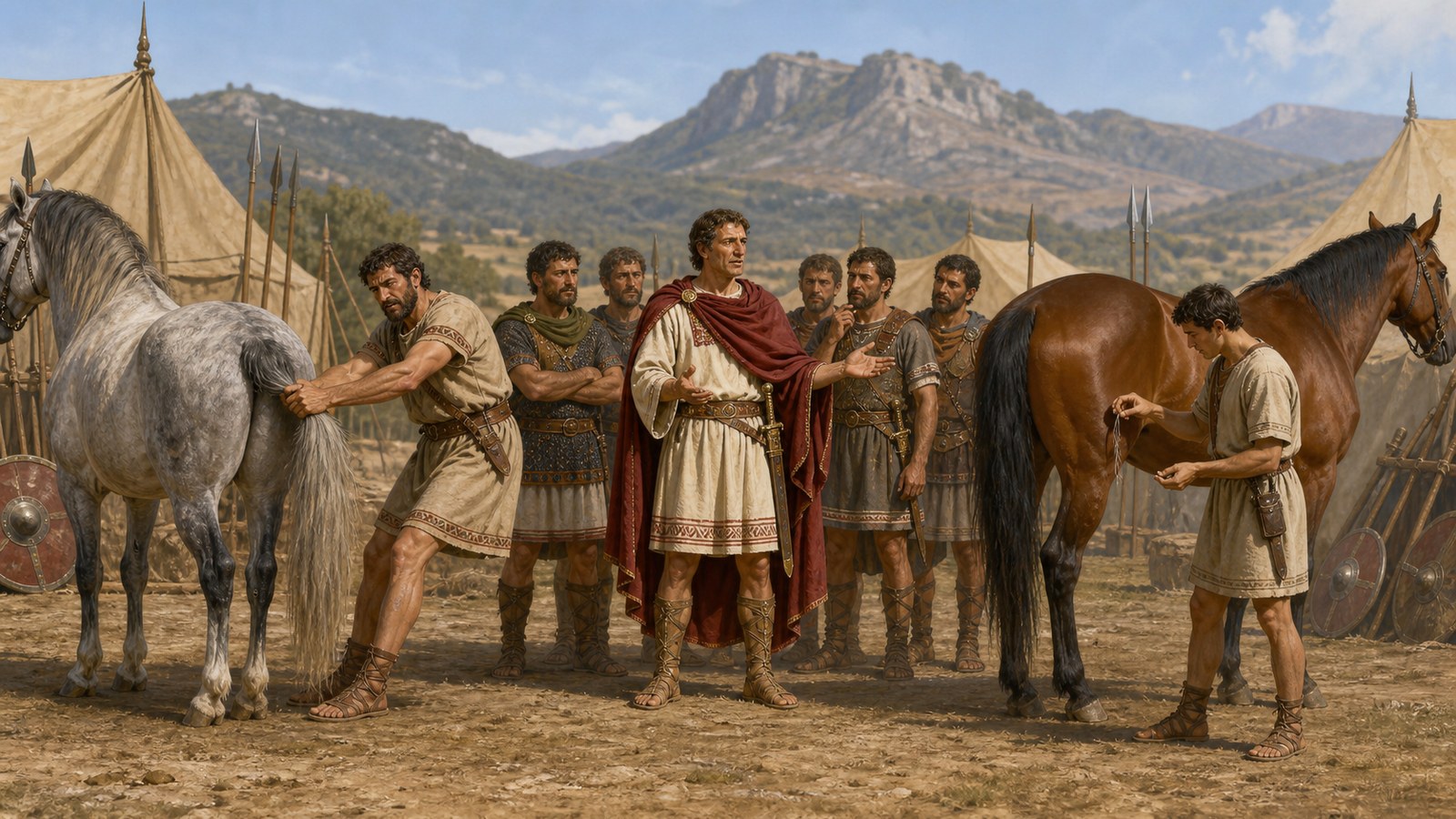
At the signal, the strong man seized the old horse’s tail in both hands. Plutarch says he pulled as though he meant to tear it away. The method concentrated strength, but it also made the entire tail one resistant object. Every hair remained bound to the attempt at the same moment.
The spectacle became comic because visible effort kept growing while progress remained at zero. The man exhausted himself, the tail held, and the soldiers laughed. Failure was not hidden in a distant wing of the battlefield. It unfolded before the whole assembly in a form that invited recognition without demanding a confession.
The smaller man used no comparable burst of strength. He plucked from the strong horse’s abundant tail hair by hair. Each removal was slight, but none had to overcome the resistance of the whole. Plutarch says he completed the task quickly and without trouble.
The comparison was deliberately sharper than a fair contest. The robust man received the feeble horse and still failed; the slight man received the powerful horse and still succeeded. Sertorius was isolating method from appearance. Great strength wasted against an undivided object could accomplish less than modest force applied in sequence.
The animals were not symbols floating free of military experience. The army had just reenacted the first method by demanding a direct engagement. It had tried to grasp the whole enemy situation at once. Sertorius wanted them to accept the second method: pressure divided across moments, opportunities and manageable parts.
Sertorius Made the Payoff Explicit
Only after the demonstration did Sertorius stand and explain it. Plutarch gives him a compact conclusion: perseverance is more effective than violence, and many things unconquerable while they remain together yield when mastered little by little.
The speech added time to the physical image. Continuity, Sertorius said, carried irresistible force. Advancing time could subdue power, acting as an ally to people attentive to opportunity and as an enemy to those who pushed at the wrong moment. Waiting was no longer the absence of action. It was the condition for joining actions into pressure.
That distinction defended his earlier delay without simply announcing that the commander had been right. The soldiers could laugh at the strong man, see the tail gradually disappear, and then map the contrast onto their own failed demand. The humiliation was displaced onto a staged contest, allowing the army to recover a shared perspective.
The lesson did not promise that every enemy could be defeated by endless delay. Plutarch’s wording is about attending to opportunity, not worshipping slowness. Gradual action worked because each small move was completed at a favorable moment and accumulated toward an aim.
A different commander once made ethics visible through a public return. Camillus had the children of Falerii drive their treacherous teacher back to the city, turning refusal into a spectacle both camps could understand. Sertorius likewise used bodies in motion to do what a private instruction could not: make a command principle public and difficult to forget.
The Demonstration Completed a Five-Part Command Sequence
The horse tails endure because the episode works as a self-contained fable. Yet the surrounding sequence is more revealing than the punch line alone. Sertorius warned the allies. He allowed a bounded failure. He rescued the defeated men. He gave dejection time to cool. Then he staged a demonstration that restored laughter while redirecting judgment.
Each stage corrected a different danger. Argument addressed ignorance but failed against overconfidence. Battle broke overconfidence but risked destruction. Rescue preserved the force. Delay prevented shame from hardening into despair. Spectacle translated a painful experience into a usable rule.
Plutarch says Sertorius repeatedly contrived exhortations of this kind to teach his allies to watch for opportunities. The verb matters more than the charm of the anecdote. Persuasion was made, arranged and timed. The commander treated the attention of an army as something requiring craft.
No transcript can prove exactly how every soldier understood the scene, and Plutarch writes biography with an eye for character. The account securely shows the kind of command he wished readers to associate with Sertorius: indirect, theatrical, patient and alert to the difference between possessing force and applying it well.
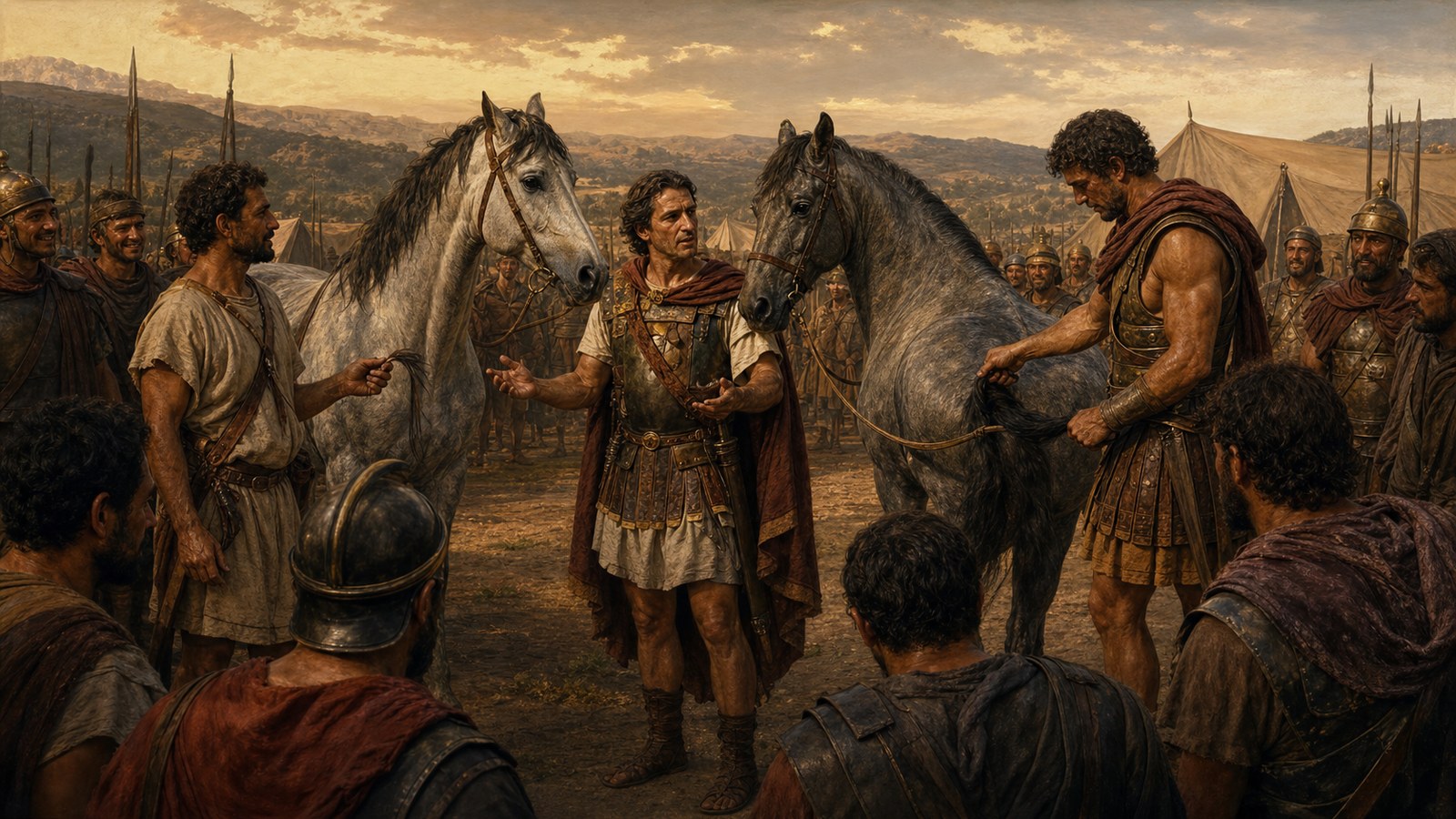
The final image reverses the assembly’s first expectation. The muscular man releases an intact tail. The smaller man stands beside a powerful horse whose thick hair has disappeared by increments. An army that had mistaken urgency for courage is offered another model of strength: not one violent pull, but a sequence that leaves less resistance after every act.
Sources
Plutarch, Life of Sertorius, 16.