

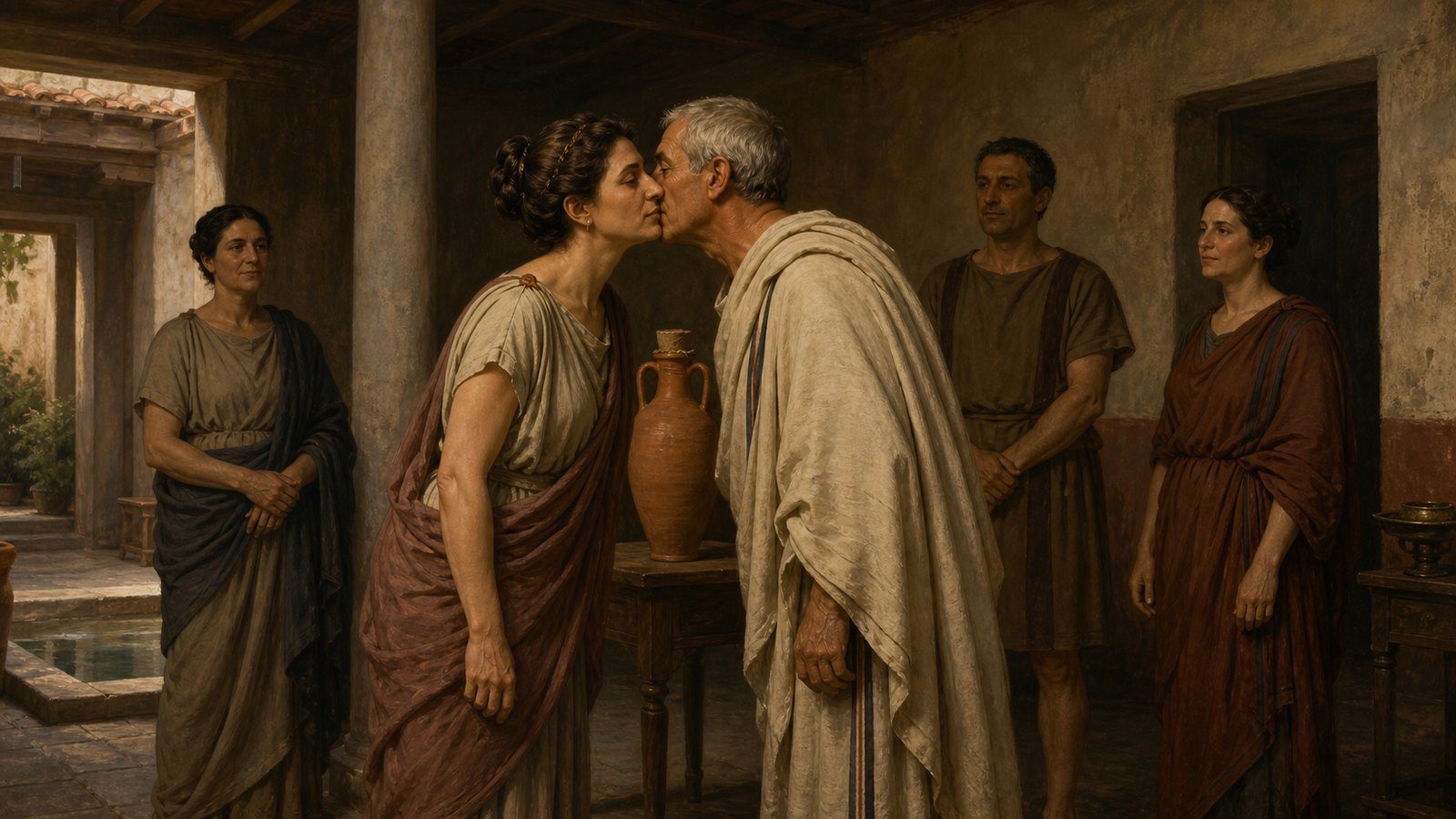
A greeting kiss usually looks like the least political gesture in a household. In one Roman account, however, it could become an inspection. Aulus Gellius says that women of Rome and Latium were expected to kiss their kinsfolk so that the smell of wine might expose anyone who had been drinking it. The face came close, the breath supplied the evidence, and ordinary relatives carried out the test.
That small scene is preserved in Book 10 of Attic Nights, where Gellius gathered older language, quotations and customs. He was not watching a living rule in an early Republican atrium. He was writing centuries later and reporting what writers on Roman life said about women “of the olden time.” That distance matters. The passage shows what Romans remembered, repeated and used as a model of ancestral discipline. It does not give us a census of every woman’s cup.
Even so, Gellius supplies unusually concrete machinery. He names the old word temetum. He explains the relatives’ kiss as a test by smell. He lists sweeter drinks that women were nevertheless said to consume. Then he moves from reported custom to the hard voice of Marcus Cato. A domestic greeting, a vocabulary lesson and a husband’s authority all meet in five short sections.
The smell test belonged to the family
Gellius begins with writers who said that women of Rome and Latium lived an “abstemious life.” He immediately explains what he means: they abstained from wine, called temetum in early language. The next detail turns an ideal into a procedure. It was an established custom, he says, for women to kiss their kinsfolk “for the purpose of detection,” because the odour would betray drink.
The passage does not describe a magistrate at a gate or an officer searching a market stall. Detection sits among kin. A relative needed no tablet, witness list or public hearing to notice a smell. The test could be repeated whenever greetings brought faces together. In Gellius’s compressed description, household intimacy provided both access and evidence.
That is what makes the anecdote more unsettling than a curious rule about wine. It assigns one group the burden of being detectable and gives the surrounding family a method of checking. The custom turned breath into testimony before a formal accusation existed. A woman could not keep the evidence at a safe distance because the expected greeting itself produced the inspection.
We should not invent details Gellius does not provide. He does not say how often the test occurred, which relatives performed it in every household, or how consistently anyone acted on the result. His sentence nevertheless preserves the logic clearly: kinship made surveillance possible, smell made consumption legible, and an ordinary social gesture concealed the mechanism.
Temetum did not mean every sweet drink
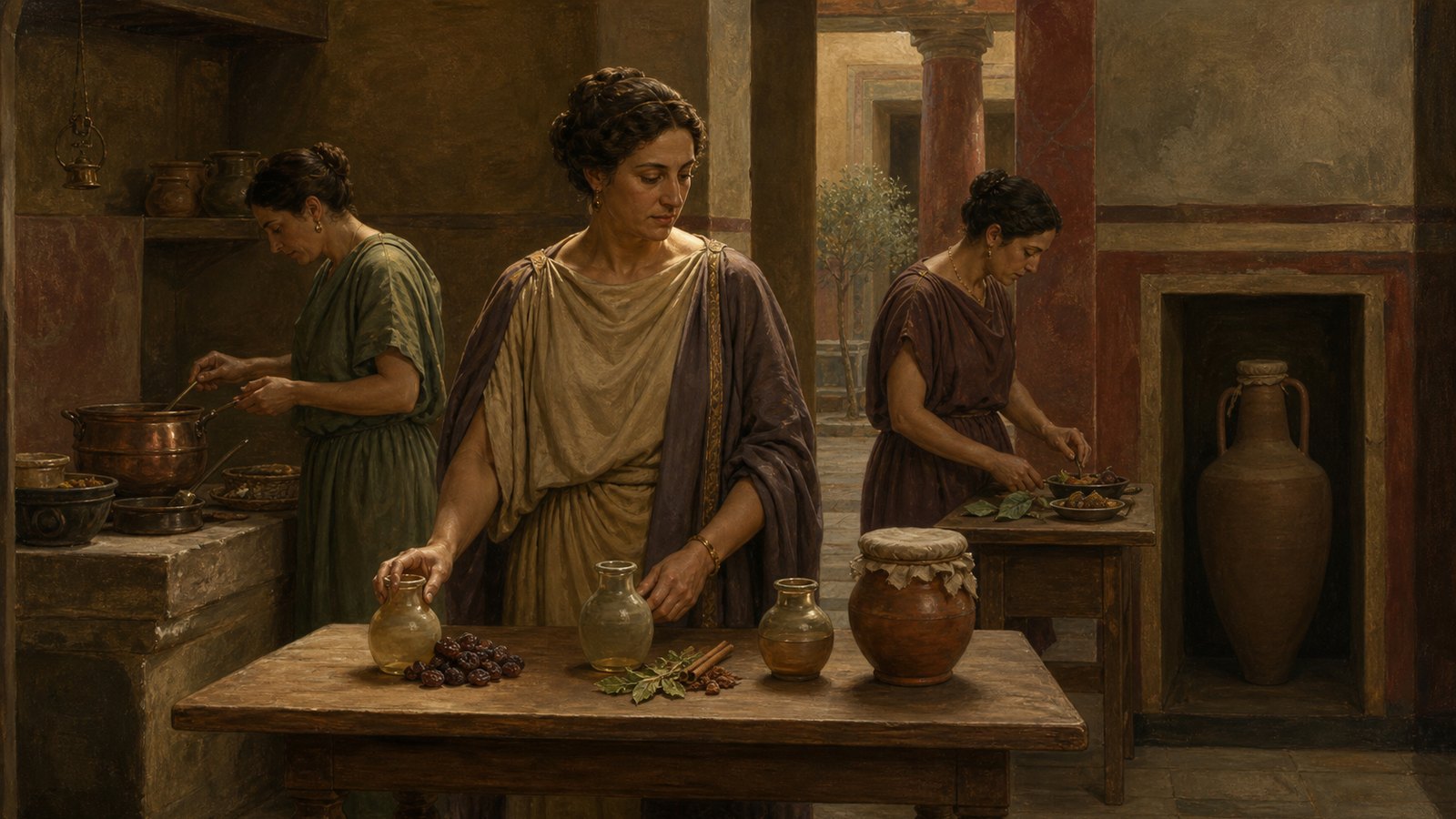
The vocabulary prevents the story from becoming a simple claim that Roman women consumed no alcohol of any kind. After mentioning temetum, Gellius says women were accustomed to drink a “second brewing,” raisin wine, spiced wine and other sweet-tasting drinks of that sort. Whatever exact boundaries different households drew, his own list creates a distinction between the forbidden or censured drink and permitted alternatives.
This is not modern nutritional classification. It is a Roman writer sorting old terms and remembered habits. Yet the contrast is central to the passage. If any fermented sweetness had triggered the same rule, the list would make little sense. Gellius instead preserves a hierarchy of beverages in which names, preparation and social meaning mattered.
Raisin and spiced drinks also return the story to the table. Roman wine was not one uniform liquid. Age, strength, additives and storage could transform what a cup signaled; the long afterlife of Roman wine in storage could make a celebrated vintage almost unrecognizable. Here the important distinction is social rather than chemical. Some sweet drinks could be acknowledged while temetum remained the substance whose odour relatives sought.
The exceptions reveal how household control worked. Rules are easier to enforce when they define categories, and categories invite interpretation. Was a particular cup a sweet preparation, a second brewing or the wine under suspicion? Gellius does not stage such an argument, so we should not pretend to hear it. But his list proves that Roman memory contained more than a flat prohibition. It remembered boundaries within drinking.
Cato made the household into a court
Gellius then changes evidentiary level. The first material comes from writers on Roman life whose books he has mentioned. He next quotes Marcus Cato from a speech titled On the Dowry. The surviving words are severe. When a husband puts away his wife, Cato says, he judges her as a censor would and possesses broad power when she has committed a wrong or shameful act.
The comparison to a censor is not decorative. Roman censors were associated with scrutiny of conduct and status. Cato’s household husband becomes assessor and judge in one person. The wine test therefore sits beside a much larger imbalance: who could observe, who could define misconduct and who could impose consequences.
Cato’s quotation says a woman was severely punished if she drank wine. It then places that act beside adultery and states a brutal double standard in which the husband’s conduct was not subject to the wife’s corresponding power. The passage should not be softened into charming etiquette. Gellius preserved language about coercion, unequal judgment and, in the adultery clause, lethal authority.
Nor should one quotation be expanded into a complete code valid in every Roman century. Cato was an orator making an argument, and Gellius selected the fragment for a chapter about older female manners. The text tells us directly how Cato framed a husband’s authority. It does not tell us how every dispute ended. The safest reading keeps both facts in view: the rhetoric is explicit, while its day-to-day reach is not measured.
Roman dining restrictions often reveal politics through the objects and occasions they counted. Elsewhere, Roman attempts to regulate the table used prices, utensils and special days to define acceptable consumption. Cato’s fragment moves the pressure inward. The relevant boundary is enforced through marriage and family judgment, with the cup becoming evidence of character.
Gellius preserved an argument about the past
By the time Gellius wrote, the “olden time” in his heading was already a constructed past. His book delights in antique words, old speeches and customs that needed explanation. Temetum appears because it was linguistically interesting, but the chapter does more than preserve a rare noun. It assembles a moral sequence: ancestral women abstained, relatives checked, alternative drinks occupied a lesser category, and Cato supplied punishment and authority.
That sequence is evidence for Roman memory as well as for Roman custom. Later readers could look backward and see a household imagined as stricter than their own. The remembered kiss dramatized discipline without requiring a courtroom. Cato’s voice then gave that discipline the weight of an exemplary Republican famous for severity.
This does not make the account useless or fictional. It tells us exactly what Gellius reported and exactly what words he attributed to Cato’s speech. The caution belongs at the next step: we cannot convert a literary report into proof that every Roman woman was tested at every greeting, that all regions followed one practice, or that sweet-drink categories stayed fixed through centuries.
The passage is strongest when read at its real scale. One early word shows that “wine” was not a transparent category. Three kinds of sweeter drink show that abstinence had boundaries. One breath test shows how family contact could become monitoring. One quotation shows how a Roman male moralist imagined household judgment. Together they reveal control operating not as an abstract slogan but through vocabulary, smell, proximity and unequal power.
A kiss could therefore carry two meanings at once. It acknowledged kinship, and in the story Gellius inherited, it allowed kinship to inspect. The unsettling part is not that Romans found an ingenious way to detect a forbidden cup. It is that the method required nothing extraordinary. The household already supplied the people, the closeness and the authority.
Sources
Aulus Gellius, Attic Nights, 10.23; Marcus Cato, On the Dowry (fragment quoted by Gellius).