
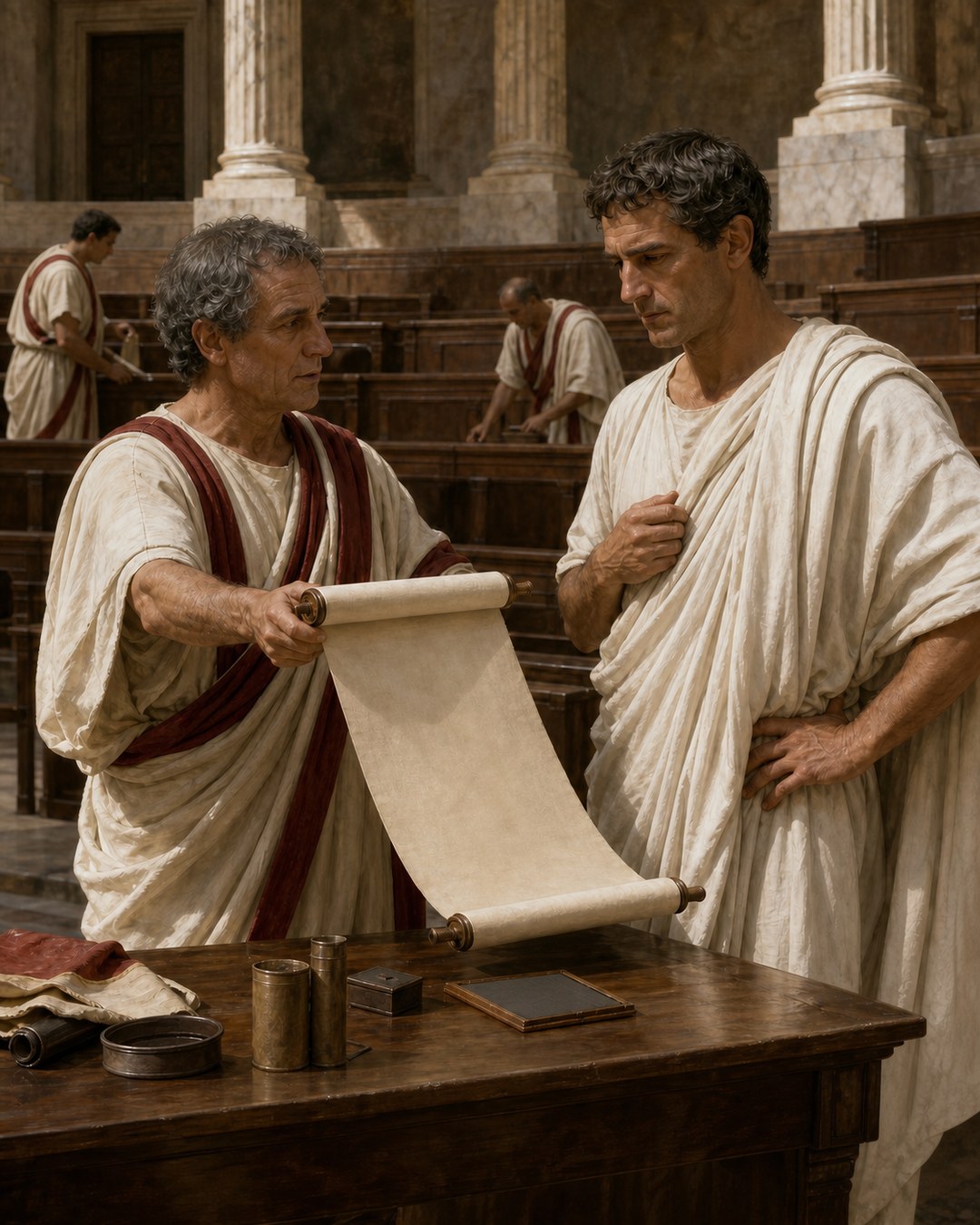
Pompey knew how to move an army, secure a command and turn victory into public stature. As he approached his first consulship, however, he admitted that another Roman institution could defeat confidence alone. Aulus Gellius says the consul-elect asked Marcus Varro for a handbook explaining how to convene the senate, consult it and bring a measure before the house.
The request was practical rather than philosophical. Pompey wanted to know what he should say and what he should do. Long military service, Gellius explains, had left him unfamiliar with senatorial procedure and city affairs. A man whose name already carried enormous weight still needed instruction in the sequence that converted rank into a lawful decision.
Varro’s original notebook did not survive even in antiquity. He later said it had been lost, then repeated much of its substance in letters to a man named Oppianus. Gellius preserved that summary. It reads like the skeleton of a parliamentary manual: who could call the senate, whose authority took priority, where a decree could be made, when daylight permitted business, which rituals came first, how questions and speakers were ordered, and how agreement became a vote.
A general entered office without the city’s operating knowledge
Gellius sets the scene before Pompey entered his first consulship alongside Marcus Crassus. His explanation is pointed. Pompey had spent so long in military service that he was unacquainted with the method of convening and consulting the senate and, more broadly, with urban political affairs. Battlefield achievement had not taught the choreography of a meeting in Rome.
The gap did not mean Pompey lacked influence. His career already rested on exceptional commands and political leverage; one popular vote had given Pompey authority across the Mediterranean. The handbook episode shows a different kind of power. Extraordinary command could be granted in a dramatic public act, while ordinary governing still depended on knowing which words, offices and formal steps made senatorial action valid.
Pompey’s response was to ask a specialist. Marcus Varro was not merely supplying historical trivia. Gellius calls the work introductory and says it told Pompey what to say and do when he placed business before the house. The lost document was therefore designed for use at the threshold of office, where ignorance could become visible in front of Rome’s senior political class.
That admission complicates the idea that Roman aristocrats absorbed government automatically through status. Family connections, military service and public reputation could take a man far without teaching every procedural boundary. Institutional knowledge had to be transmitted. In this case it moved from scholar to commander in the compact form of a manual.
Only certain magistrates could turn a meeting into a decree
Varro began with the right to convene. Gellius’s summary lists the dictator, consuls, praetors, tribunes of the commons, interrex and prefect of the city. These offices did not stand in an undifferentiated pool. If all their holders happened to be in Rome, precedence followed the order Varro supplied, with the earlier office enjoying the prior right to bring business before the senate.
The list made authority legible before debate started. A room could contain senators, but their presence alone did not create a lawful proceeding. Someone with the recognized power had to summon them and present the matter. The validity of the result began with the identity of the presiding magistrate.
Varro then linked procedure to conflict between officeholders. The right to block a decree, he said, belonged only to a person whose authority equaled or exceeded that of the magistrate trying to pass it. A veto was not simply the loudest objection in the chamber. Its force depended on a comparison of public powers.
For a new consul, this was operational knowledge. Before calculating how senators might respond to a proposal, he needed to understand who could act first and who possessed enough authority to interrupt. The handbook placed hierarchy around argument. It taught that persuasion took place inside rules about competence, precedence and restraint.
A senate house required the right space and the right light
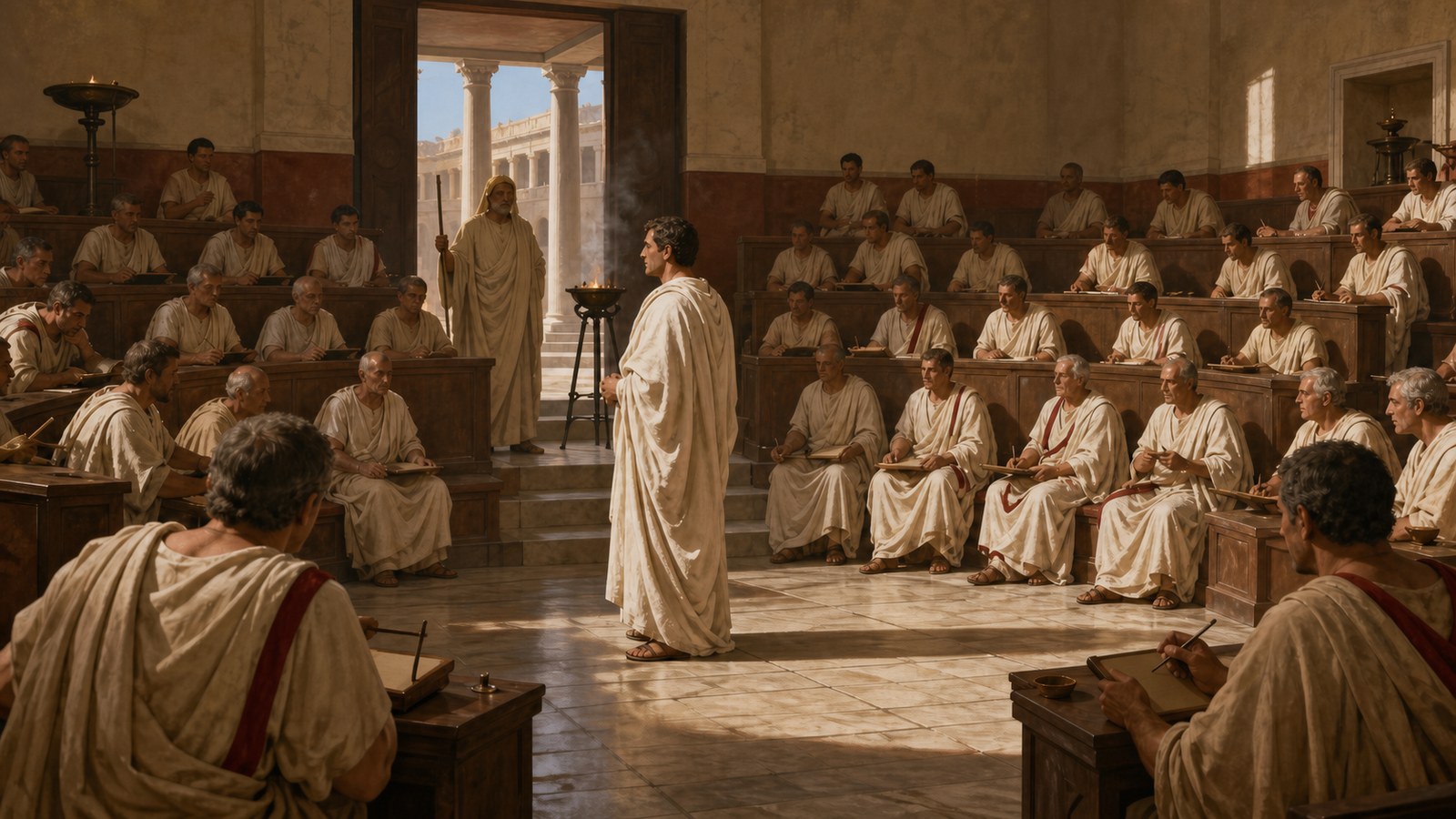
Architecture did not settle the meeting’s legality by itself. Varro said a decree could lawfully be made only in a place appointed by an augur and called a templum. Gellius names the Hostilian, Pompeian and Julian senate houses, explaining that augurs established temple-space within these otherwise unconsecrated structures so ancestral procedure could operate there.
The distinction was technical enough to surprise a casual observer. Not every sacred building was a templum, and Varro specifically noted that even the ancient shrine of Vesta did not have that status. A magnificent or holy setting could therefore be the wrong legal container, while an augurally defined area inside a civic building supplied what a decree required.
Time imposed another edge. A decree made before sunrise or after sunset was invalid. Gellius adds that those responsible for producing one at such an hour were considered to have committed an act deserving censure. Daylight was not background atmosphere. It bounded the senate’s capacity to create a valid result.
Imagine the pressure this rule could place on a disputed sitting. Speeches could consume the available day, but the deadline did not move because the argument mattered. Once the sun had gone, further persistence could not rescue the decree. We do not need to invent a particular late-running session to see the mechanism: deliberation occupied limited legal time.
The combination of augural space and daylight made procedure physical. The meeting had to occur here rather than merely anywhere senators assembled, and now rather than at any hour a presiding officer preferred. Institutional authority depended on boundaries that the body could enter, leave and outlast.
Sacrifice and sequence organized the business before debate
Varro’s instructions did not begin public business with a speech. The magistrate preparing to hold the senate was first to sacrifice a victim and take the auspices. Questions concerning the gods were then to be presented before questions concerning human affairs. Ritual and subject order stood at the front of the agenda.
These steps were not ornamental preliminaries added to an otherwise secular machine. In Varro’s account, they belonged to the method of holding the meeting properly. The same handbook that ranked magistrates and described voting also required signs to be taken and divine matters to receive precedence.
The arrangement reminds us that categories modern readers separate could share one procedural chain. Augurs defined the lawful place. Auspices preceded consultation. Questions about gods came first. Only then did the senate move through the human problem placed before it. Religion did not interrupt politics from outside; it helped construct the conditions under which politics proceeded.
Sequence also disciplined the presiding officer. Pompey was not being taught merely to command attention. He was learning when one kind of act had to happen relative to another. Skipping ahead could endanger the legitimacy of everything that followed, no matter how impressive the final speech sounded.
Agreement, disagreement and rank changed how voices were counted
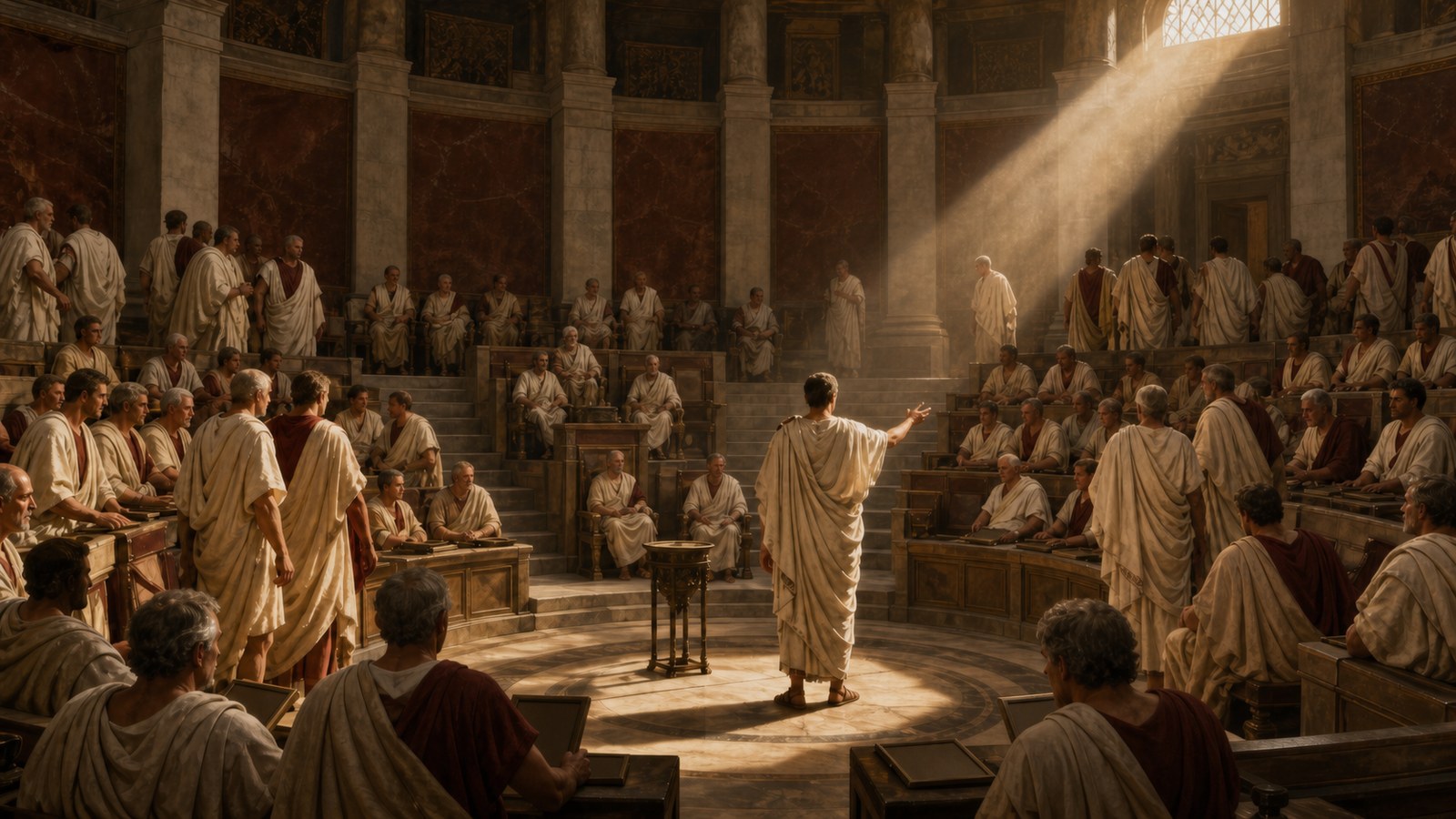
Varro distinguished ways of making a decree. Gellius says one route used division when there was general agreement; when the matter was disputed, the opinion of each senator was called for. Another authority quoted by Gellius complicated the distinction by insisting that division was necessary in every decree. The disagreement itself shows that Roman procedural writers scrutinized the mechanics rather than treating “the senate decided” as a complete explanation.
When opinions were requested, order mattered again. Senators were to be consulted by rank beginning with men of consular grade. Varro said the older custom had called first on the senator enrolled earliest, but he complained that presiding officers in his own time had begun choosing whichever consular they favored. Formal rank remained, yet preference could work inside it.
This is where procedure met political tactics. Calling one senior voice first could shape the terms in which later speakers responded. The familiar image of a decisive speech captures only part of that contest. Cato’s long senate speech survived through rapid shorthand, but Varro’s manual directs attention to the framework around such performances: who opened the matter, which speaker came first, and whether the house divided.
Attendance was enforceable as well. Varro discussed seizure of goods and fines for a senator absent when duty required him to attend. Membership carried an obligation to enter the procedural space, not merely a title to use when convenient. A functioning meeting required bodies on benches as well as authorized leadership.
Pompey’s handbook therefore mapped a system with no single master switch. Office authorized the summons. Relative power governed obstruction. Augural definition authorized the place. Sunlight bounded the act. Sacrifice and auspices preceded consultation. Subject matter and rank ordered proceedings. Agreement or dispute shaped the route to a decree. Attendance rules kept the institution populated.
Military command could train a leader to issue orders through a hierarchy designed for action. The senate demanded a different competence: guiding other powerful men through inherited constraints while preserving the validity of the result. Pompey’s need for instruction was not an embarrassing footnote to greatness. It is evidence that Roman government had operating knowledge dense enough to require study.
Varro’s original manual vanished, but Gellius rescued its table of contents in prose. What survives is not the drama of one famous vote. It is the quieter machinery that allowed any vote to count. Before Pompey could master a chamber, he first had to learn where its authority began, where it stopped and which sequence carried a proposal from summons to decree.
Sources
Aulus Gellius, Attic Nights, 14.7; Marcus Varro, lost introductory handbook for Pompey and letters to Oppianus (reported by Gellius).