
Augustus reduced regular meetings of the senate to two dates each month.
That economy came only after a far more dangerous operation: deciding who still belonged in a body of more than one thousand men.
Membership, security, ritual, attendance, and debate were rebuilt as parts of one system.
A Senate Above One Thousand Had to Be Recounted
Suetonius begins with scale and reputation. The senate had swollen beyond one thousand members after Caesar’s death.
Some entrants, admitted through favour or bribery, were mocked with the name Orcivi. The insult presented them as a posthumous or underworld addition to the order.
Augustus answered with two enrolments. The first used peer selection: each member named one other man.
That mechanism spread responsibility through the body. A senator’s place was no longer only his own claim; another member had to identify him as worth retaining.
The second enrolment was conducted by Augustus and Agrippa. Here the process became more visibly personal and more dangerous.
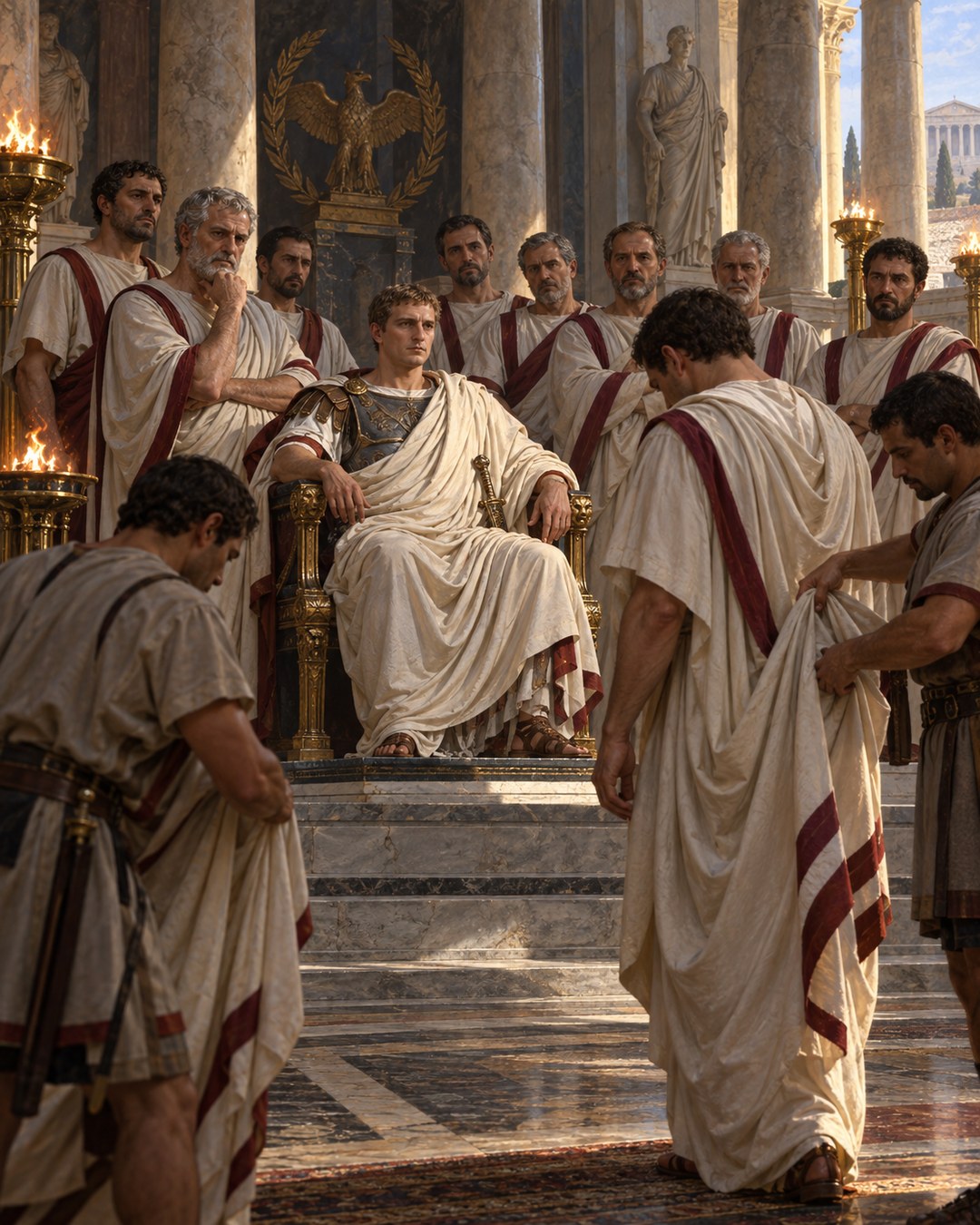
Suetonius reports that Augustus was thought to have worn a coat of mail under his tunic and a sword at his side. Ten of the strongest senatorial friends stood near his chair.
Men approached one by one. The folds of their robes were searched first.
The precautions show that a membership review could be experienced as a threat. Rank, public identity, and future influence were being judged in the presence of the ruler.
Some men were shamed into resigning. Yet Augustus let them keep senatorial dress, seats in the orchestra at games, and participation in the order’s public banquets.
The exit was humiliating but cushioned. Social signs survived even when deliberative membership ended.
That distinction between appearance and authority resembles other Roman struggles over status. A curule chair could force proud nobles to confront an officeholder they despised. Here clothing and privileged seating could remain while actual membership disappeared.
Ritual Marked the Start of Work
After the enrolments, Augustus altered the conditions under which approved senators performed their duties.
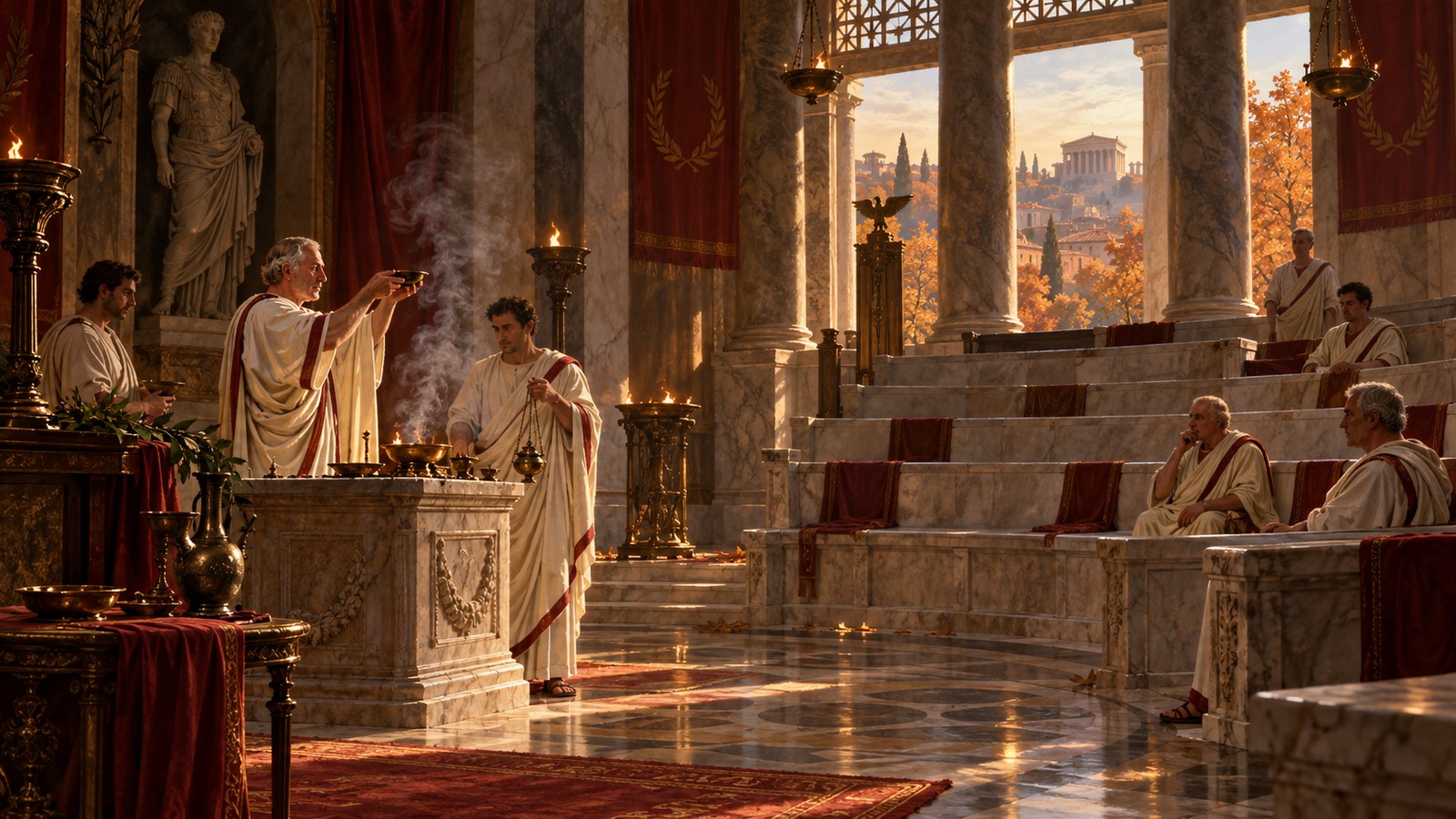
Before taking his seat, each member was to offer incense and wine at the altar of the god in whose temple the meeting was held.
The act tied deliberation to the sacred location. A senate meeting was not simply a collection of men around documents; it began by acknowledging the divine owner of the space.
That ritual also created a threshold. The senator approached, offered, and only then sat.
The sequence converted attendance into a visible action. A member did not drift anonymously into the chamber. His arrival formed part of the proceedings.
Augustus paired ritual with a reduced calendar. Regular meetings were to occur no more than twice each month, on the Kalends and Ides.
Fewer fixed dates could lessen inconvenience and concentrate business. Senators knew when ordinary attendance would be required instead of facing an open-ended succession of summonses.
The arrangement did not make the senate unimportant. It made its routine more scheduled.
A fixed calendar can strengthen control as much as efficiency. Whoever shapes the agenda for scarce meeting days determines which questions reach the floor and in what state of preparation.
The change therefore belongs beside the enrolments. Augustus narrowed both the membership and the ordinary opportunities for that membership to assemble.
Public finance could still provoke defiance inside this managed institution. Scipio’s remembered destruction of accounts showed how prestige could challenge senatorial scrutiny. Scheduling alone could not remove conflict, but it changed the channel through which conflict moved.
Lots Reduced the Autumn Burden
September and October received a special rule. Only senators drawn by lot were obliged to attend.
The selected number still had to be sufficient for decrees. This was not permission for the institution to lapse; it was a designed quorum.
The lottery distributed inconvenience without requiring the entire order to remain present during those months.
Chance offered a public logic for absence. A man excluded from the seasonal group was not being individually slighted, and a man included could point to the lot rather than a targeted command.
The rule also made attendance measurable. The administration needed to know how many senators were enough to transact valid business before it could determine how many names the lot should produce.
That turns quorum from an afterthought into a planning variable.
Suetonius says the reform aimed at conscientious service with less inconvenience. The two goals could pull against each other. Too broad an obligation exhausted members; too narrow a group risked making decrees look thinly supported.
The seasonal lot tried to balance them. It preserved validity while reducing the cost of universal attendance.
It also fit an Augustan preference for combining inherited forms with controlled selection. The senate still met, worshipped, debated, and decreed. Yet enrolment, calendar, and attendance now passed through new filters.
A body of more than one thousand had been reduced in membership and then made variable in daily presence.
Small Councils Prepared the Full Debate
The most consequential work could begin before the full meeting.
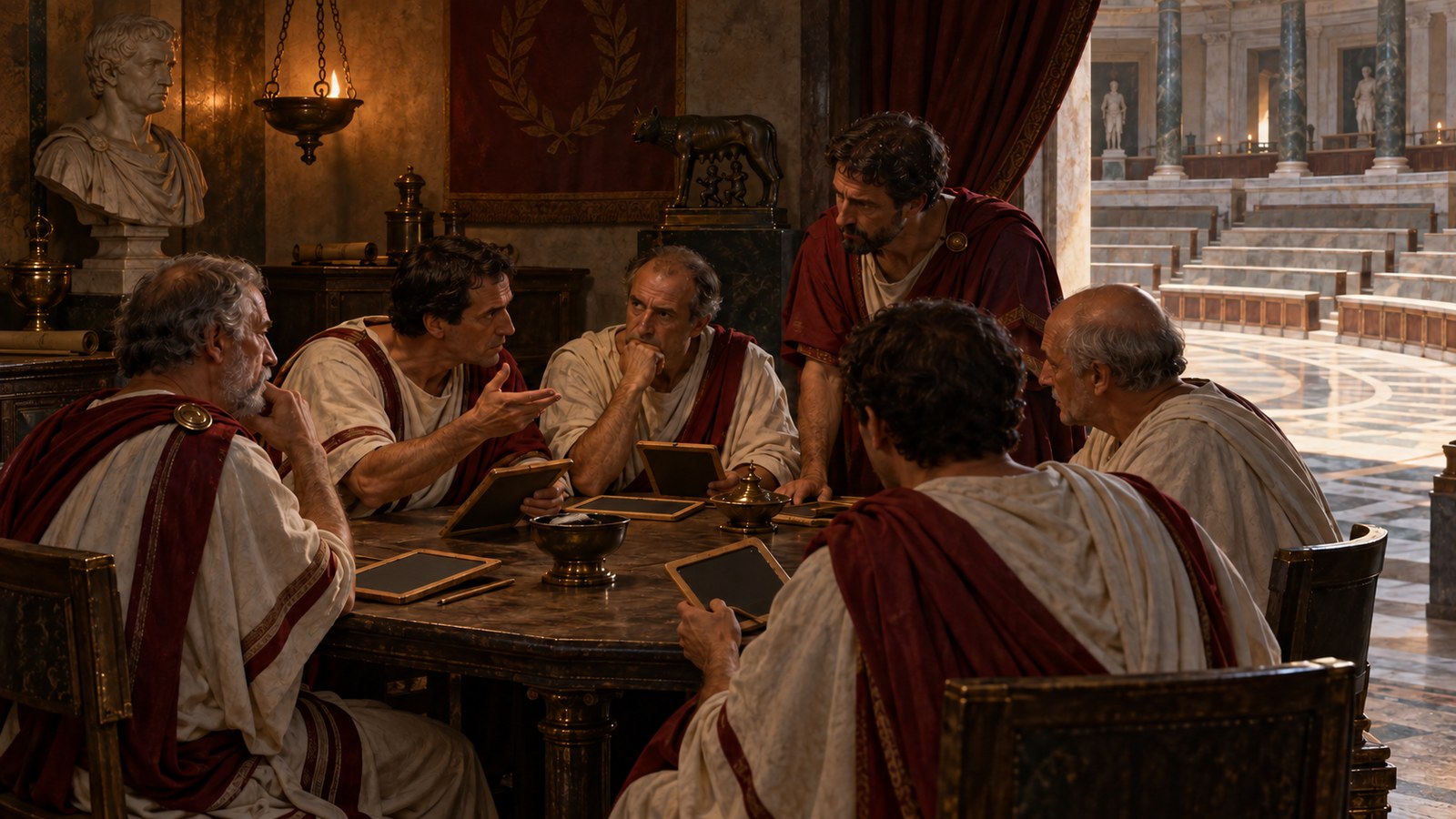
Augustus created privy councils selected by lot for terms of six months. These smaller groups discussed in advance matters destined for the entire senate.
Preparation and authorization were separated. A compact council could examine a question, expose difficulties, and shape alternatives before a larger chamber encountered it.
The lottery and fixed term prevented the council from appearing as one permanent hereditary committee, though Augustus remained central to its operation.
Advance discussion made the two-meeting monthly calendar more workable. Scarce plenary time was less likely to be consumed by the earliest, least organized stage of a proposal.
It also gave the ruler another place to test resistance. Objections discovered in a small room could be answered before the issue reached the whole order.
Suetonius then describes a device used inside the full chamber. On especially important questions, Augustus did not always call opinions in the order fixed by precedent.
He varied the sequence so that each senator had to remain alert, ready to begin a line of argument rather than merely endorse those who spoke earlier.
The tactic treated order as an influence on thought. A predictable sequence encouraged assent; uncertainty demanded preparation.
Yet the freedom to vary that sequence also belonged to Augustus. A method presented as intellectual vigilance increased the presiding ruler’s discretion over the moment each voice entered.
The reform was therefore neither simple restoration nor simple suppression. It preserved a senate capable of valid decrees while redesigning nearly every condition around those decrees.
Who belonged was screened. How members approached was guarded. Where they sat began with sacrifice. When they met followed a reduced calendar. Who attended in autumn depended on lots. What they considered had often passed through a small council. When they spoke could be unpredictable.
Twice a month was enough because much of the institution’s operation had already been reorganized before the senators took their seats.
The retained privileges of men pressed to resign sharpen the distinction. Augustus could remove a voice from deliberation without stripping away every visible sign of senatorial life. Dress, theatre seating, and banquet access preserved social dignity, while the roll of active decision-makers became smaller.
That compromise reduced the public cost of exclusion and made the institutional boundary more precise. The senate was not simply everyone who looked senatorial in public. It was the approved body that passed through the guarded enrolment, observed the meeting ritual, met on the fixed dates, and participated under the new rules of preparation and speech.
Suetonius’s details make institutional design physical: searched cloth, incense smoke, wine at an altar, empty autumn seats, and a smaller table where business was prepared.
Sources
Suetonius, Augustus, chapter 35.