
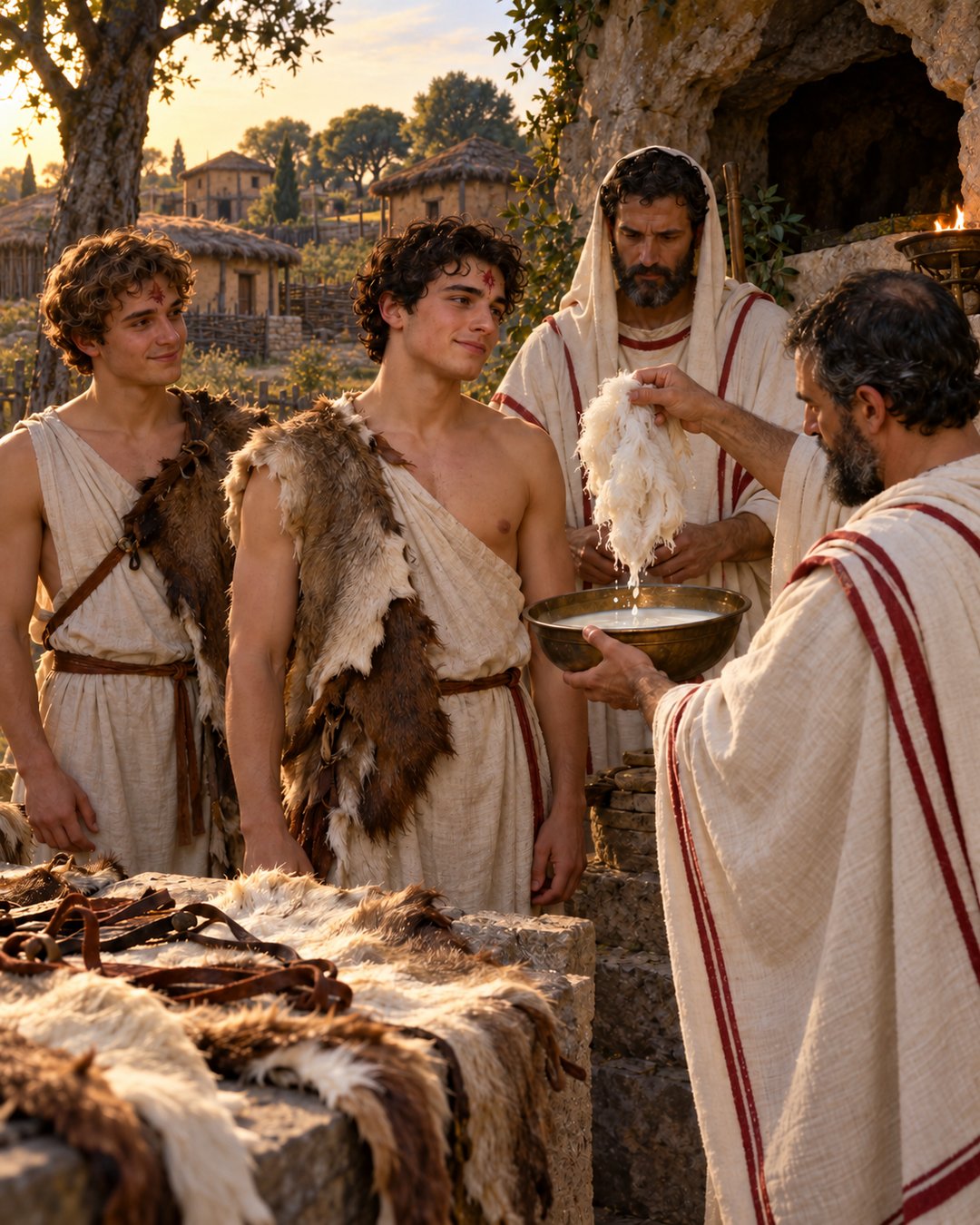
First came a knife stained with sacrificial blood. It touched the foreheads of two young men. Almost immediately, another set of hands erased the mark with wool soaked in milk. Then the youths had to laugh.
Plutarch’s description of the Lupercalia does not begin with a single explanation that makes those gestures neat. It gives the gestures first: goats, blood, milk, laughter, cut hides, running, blows, and the additional sacrifice of a dog. Only afterward does it display competing stories about what the festival meant.
That order matters. The ritual was visible and repeatable, while its origin remained debatable. A Roman spectator could know when the runners set out and what they carried without being able to choose between purification, the she-wolf, a victory race, or a search for lost livestock. The Lupercalia survived not because every observer agreed on one key, but because bodies performed the sequence again.
February made purification the first possibility
Plutarch places the Lupercalia among the customs discussed after Romans and Sabines had combined festivals and sacrifices. When he turns to its date, he sees a clue. It fell during what he calls the inauspicious days of February, a month whose name he associates with purification. He adds that the festival day had once been called Febrata.
This does not settle the question for him. The name could also sound like the Greek Lycaea, a wolf festival, and therefore point toward great antiquity and the Arcadian company of Evander. Roman memory supplied another wolf: the animal that fed Romulus and Remus. The runners, the Luperci, began their course where Romulus was said to have been exposed.
The location made the foundation story physically present. A route could pass through remembered ground even when its actions resisted a clean explanation. Plutarch says as much: the name could be connected to wolves, yet the ceremonies themselves made the reason for that name hard to guess.
This uncertainty separates the festival from the augural dispute in the story of Remus, the Aventine, and Rome’s sacred boundary. There, remembered birds helped explain why one hill stood outside an original line. At the Lupercalia, several explanations crowded around the same actions without eliminating one another.
A mark was made, erased, and answered with laughter
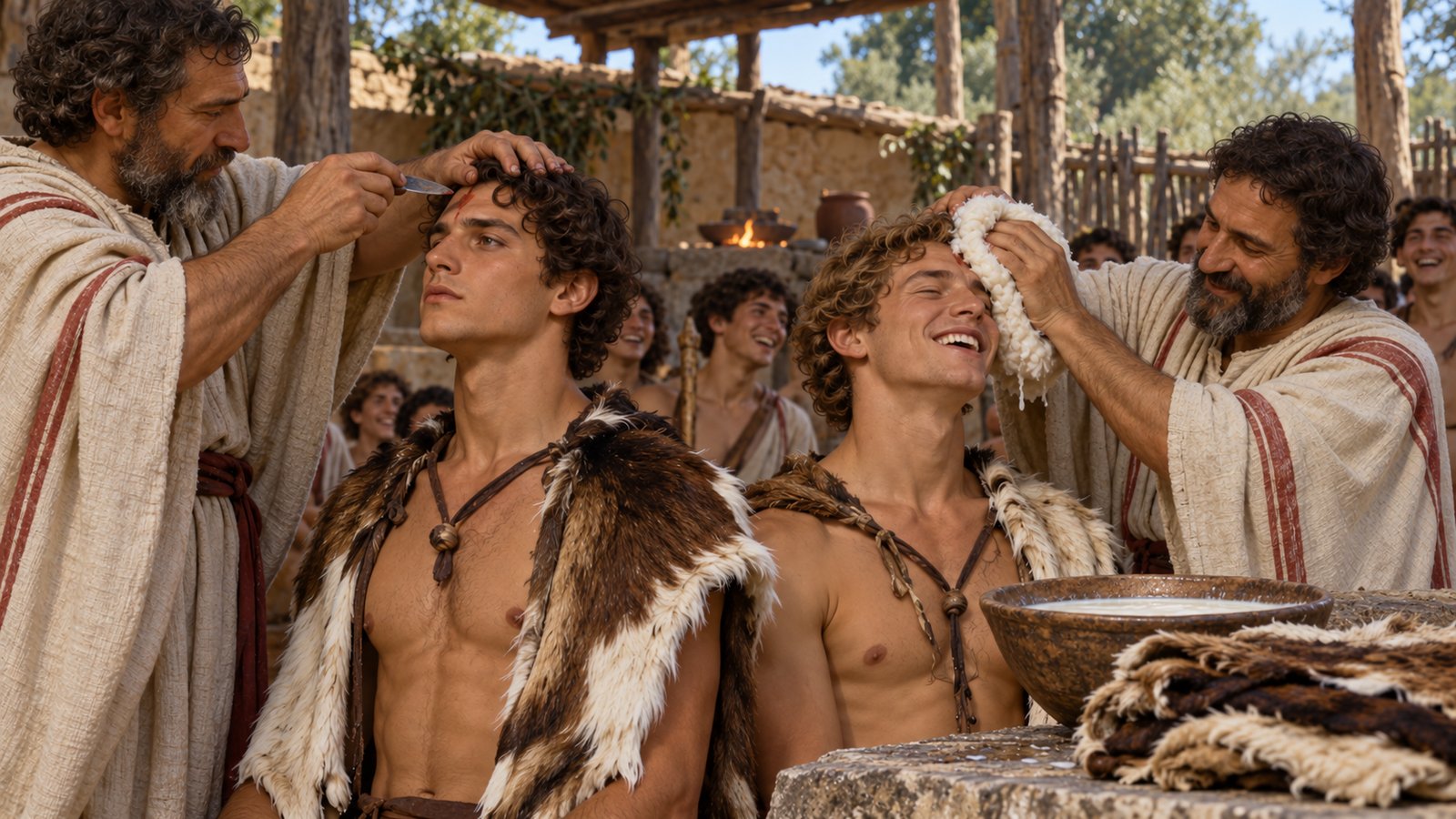
The priests slaughtered goats. Two youths of noble birth were then brought forward. Some participants touched their foreheads with a bloody knife; others wiped the stain away at once with wool dipped in milk. Once cleansed, the youths were required to laugh.
Each stage reversed or redirected the one before it. Sacrifice produced blood, but the blood did not remain. Milk removed it. A solemn mark gave way to laughter. The speed of the change is as important as the materials. Plutarch does not describe a long interval in which the youths carried the stain through the city. Application and removal belong together.
Butas, an author whom Plutarch says wrote fabulous explanations of Roman customs in elegiac verse, tied these details to Romulus and Remus. In his account, the brothers ran triumphantly after defeating Amulius, returning to the place where the she-wolf had nursed them. Blood recalled danger and killing; milk recalled the food that had saved them as infants.
That story makes the two substances biographical. Yet Plutarch presents it as one reported interpretation, not as an uncontested transcript of the rite’s foundation. The description of what happened is firm. The reason supplied by Butas remains attributed to Butas.
The demand for laughter is especially resistant to paraphrase. Plutarch tells us that it had to happen after the wiping. He does not tell us whether every laugh sounded joyful, relieved, theatrical, nervous, or dutiful. The rule fixed an audible response while leaving the experience behind it inaccessible.
Goatskins changed sacrifice into movement
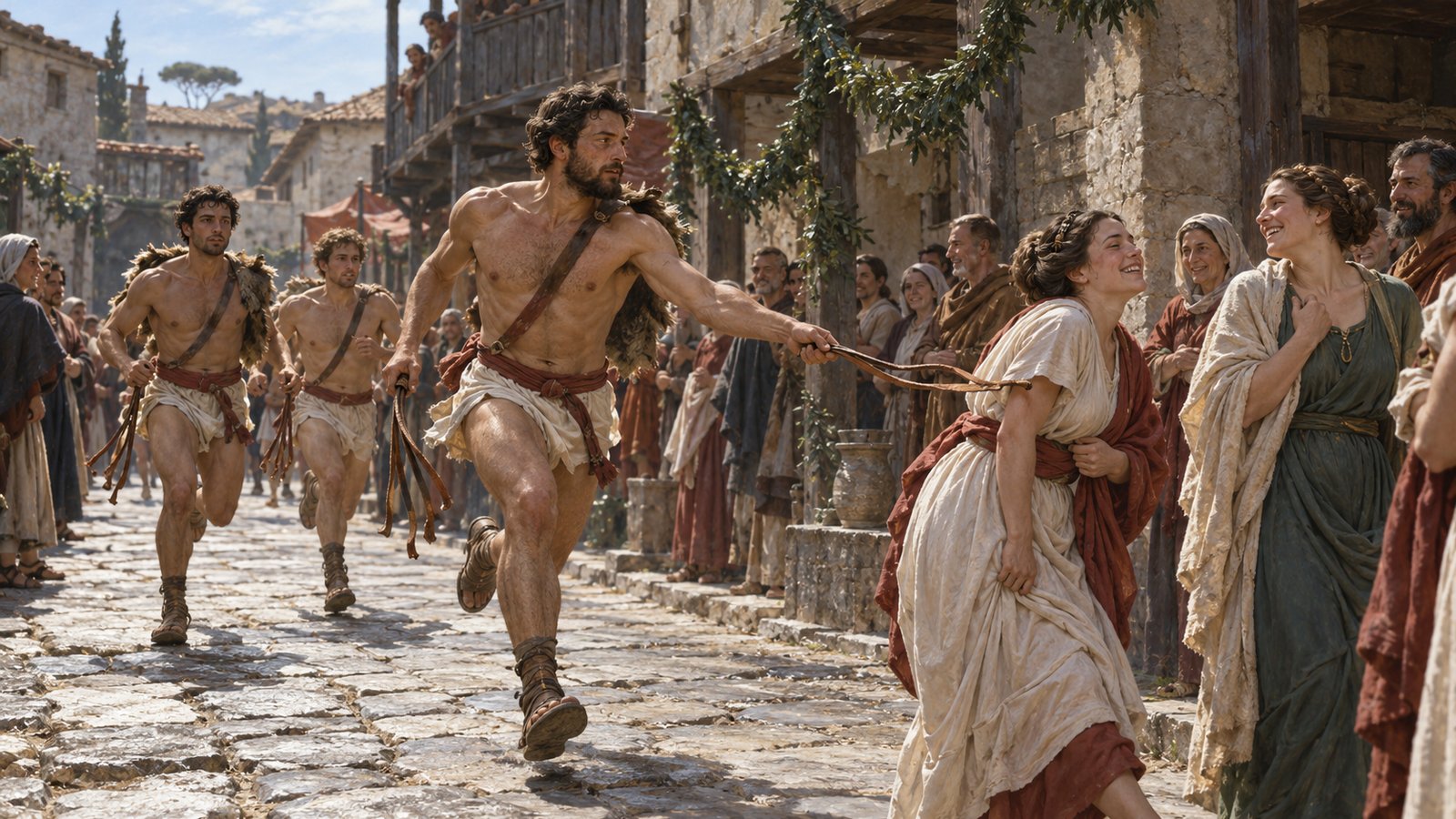
After the forehead rite, the goats’ skins were cut into strips. The Luperci wore only a girdle and ran, striking the people they met with those thongs. The sacrificed animal therefore remained active in the festival. Its hide became the flexible object carried through the route.
The blows were not described simply as attacks to escape. Young married women did not try to avoid them because they believed contact promoted conception and easier childbirth. A runner, a strip of hide, and a participant’s hope for fertility met in one brief impact.
The scene can look chaotic when reduced to naked running and whipping. Plutarch’s sequence gives it structure. Sacrifice preceded cutting; cutting produced thongs; the thongs belonged to the course; and the women’s reception of them supplied a desired effect. None of this requires pretending that every participant understood the chain in the same way.
The Lupercalia also differed from the offering prepared in the Roman rite that turned parched spelt into sacrificial grain. Both joined physical preparation to religious use, but here the transformed material did not remain at an altar. It ran through the city in human hands.
The dog kept every tidy theory unstable
Plutarch calls the sacrifice of a dog a peculiarity of the festival. It is the detail that makes a single-purpose reading especially difficult. Goats supplied the forehead blood and the running thongs. The dog did not fit that visible chain in the same way.
If the Lupercalia was chiefly purification, Plutarch suggests that the dog might suit such a rite. He compares Greek purification practices in which puppies were carried out for burial and other rites involving dogs. If the festival instead thanked the she-wolf that preserved the twins, a dog could appear because dogs are enemies of wolves.
He even preserves a more practical possibility: perhaps the animal was punished for getting in the runners’ way. The alternatives do not converge. They demonstrate how antiquarian reasoning worked around an inherited feature whose original logic was no longer obvious.
Caius Acilius offered a different explanation for the runners’ lack of clothing. Before Rome’s foundation, he said, Romulus and his brother lost their flocks. After praying to Faunus, they ran out naked to search, removing what might trap sweat and slow them. In this version, the course imitated urgency rather than a victorious return from Alba.
Plutarch does not force Butas and Acilius into agreement. One points to Amulius, the she-wolf, peril, and milk. The other points to missing animals, Faunus, sweat, and speed. Both try to attach narrative causes to visible customs. Their disagreement is part of the evidence.
Repeated actions outlasted a single explanation
The Lupercalia that emerges from Life of Romulus is not a riddle solved by choosing the most attractive origin story. It is a ritual whose actions could be described more confidently than their beginnings. February suggested purification. The name suggested wolves. The route touched the place of exposure. Blood and milk invited a story about danger and nourishment. Naked running invited a story about speed.
Each explanation catches part of the festival, but the full sequence exceeds it. Purification does not by itself explain the she-wolf’s place. A foundation legend does not fully explain the fertility blows. The goats explain the thongs, while the dog opens another set of questions.
What remained stable was choreography: sacrifice, mark, wipe, laugh, cut, run, strike. Materials changed roles as the ceremony advanced. Blood became a temporary sign. Milk became its eraser. Hide became a moving instrument. A public route turned remembered landscape into performance.
Plutarch’s uncertainty is therefore useful rather than disappointing. It prevents a late explanation from being mistaken for the rite itself. The Lupercalia’s strangeness lies not in one secret meaning, but in the way a city kept repeating a precise series of gestures after several stories had gathered around them.
Sources
Plutarch, Life of Romulus, 21.