

A public bath was cleared because a consul’s wife wanted the men’s rooms. The local official obeyed. It still did not happen quickly enough for her, and the rooms were not clean enough. By the end of Gaius Gracchus’s account, a stake stood in the forum and the official who had carried out the order was being beaten.
Aulus Gellius preserves this sequence while asking a literary question: did Gracchus speak with enough force? Yet the passage does more than compare famous orators. It catches unequal power moving through an Italian town one command at a time. A preference spoken by a magistrate’s household became municipal work; compliance failed to guarantee safety; punishment taught neighboring communities to anticipate what Roman visitors might want.
The episode is valuable precisely because Gracchus tells it so sparely. No surviving testimony lets us reconstruct every motive or verify each exchange independently. What survives is an attributed political accusation inside Gellius’s later criticism. Read with that limit in view, the speech shows how abuse could become routine before anyone wrote a rule authorizing it.
A private request arrived with public force
Gellius says the material came from Gracchus’s speech On the Promulgation of Laws. Gracchus was complaining that Marcus Marius and other prominent men from Italian towns had been beaten unlawfully by magistrates of the Roman people. His first example began when a consul came to Teanum Sidicinum.
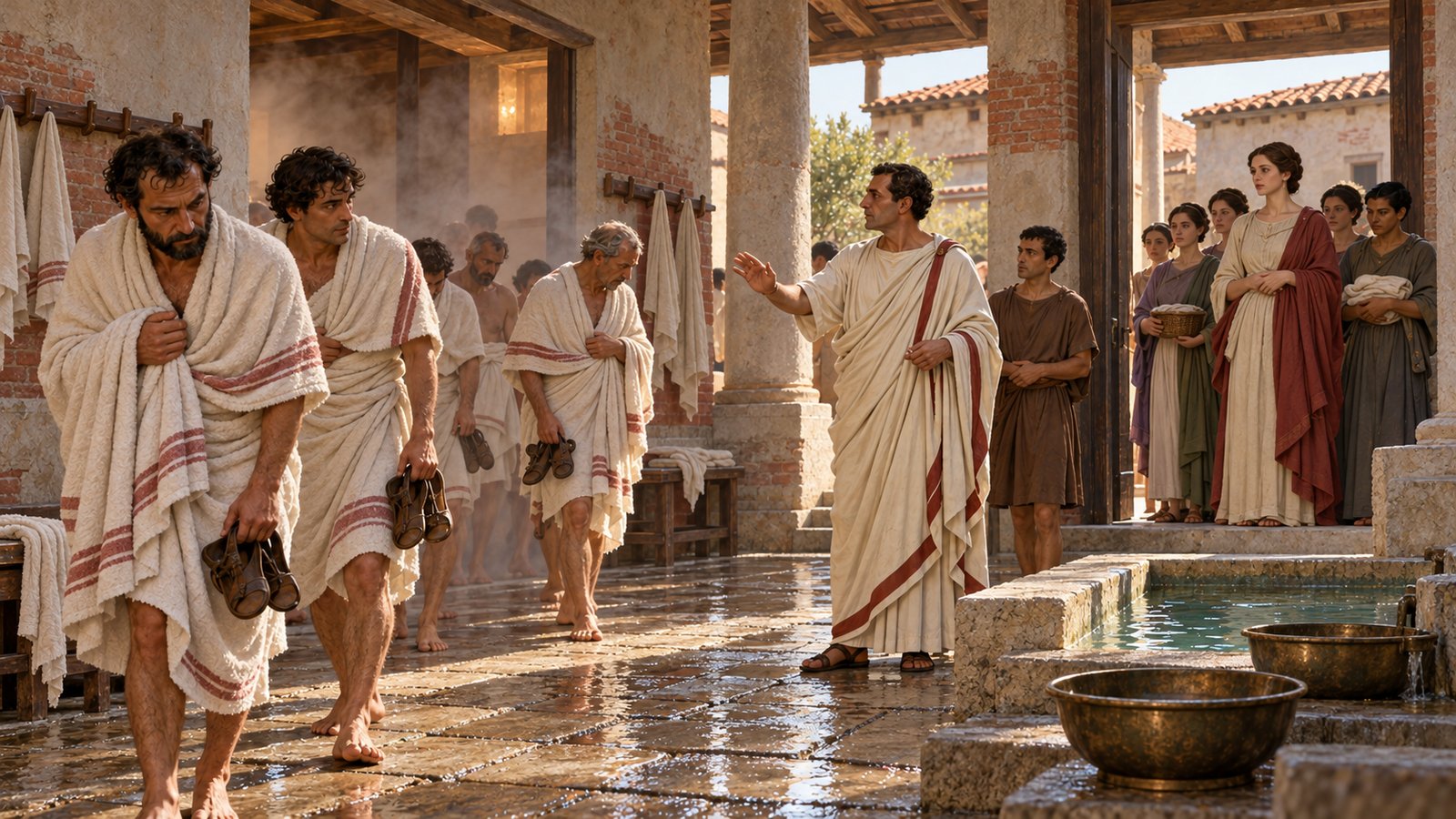
The consul’s wife wanted to use the men’s baths. Marcus Marius, whom the passage identifies as the quaestor of Sidicinum, received instructions to send the bathers away. That detail establishes a chain without needing a formal decree. A visitor’s domestic wish reached a local officeholder as something to be executed.
Marius did not refuse. He cleared the baths. The conflict began after obedience, when the wife complained that the rooms had not been yielded soon enough and were not sufficiently clean. The standard shifted from performing an extraordinary request to performing it with a speed and finish satisfactory to the household that had made it.
This was a different political space from the Roman morning in which clients carried public business through a nobleman’s front door. There, access depended on approaching a powerful house. At Teanum, the powerful house had travelled, and its expectations entered a municipal building.
Obedience ended at a stake in the forum
Gracchus’s next sentences are brutally compressed. A stake was planted in the forum. Marius’s clothing was removed. He was beaten with rods. The forum transformed the punishment from a private reprimand into a public demonstration, placing a distinguished local man where neighbors could see what Roman displeasure had done to him.
The surviving passage does not name the consul in Gellius’s quotation, and it gives no reply from Marius. Those absences matter. Filling them with imagined dialogue would make the scene smoother but less reliable. The sourced sequence is stark enough: the bath was cleared, the wife complained, and corporal punishment followed in the town’s civic center.
Office did not shield Marius. His quaestorship made him useful when the bathers had to be removed, but it did not make him an equal of the visiting power. The same local standing that allowed him to implement the order also made his humiliation legible. Spectators knew that the man at the stake was not an anonymous trespasser.
Gracchus’s accusation therefore turns on scale. Nothing begins as an imperial crisis. A bath schedule and a complaint about cleanliness are enough. The disproportion between cause and consequence makes the hierarchy visible more clearly than a battle or senatorial confrontation would have done.
Other towns learned before the next visitor arrived
The people of Cales heard what had happened. According to Gracchus, they passed a decree that no one should think of using the public baths whenever a Roman magistrate was in town. Teanum’s punishment became Cales’s preventive policy.
That decree is the passage’s clearest measure of fear. Cales did not wait for a wife to request a room or for a magistrate to complain. It made ordinary bathers disappear in advance. A local community absorbed another town’s experience and converted it into a standing precaution.
The building itself had become a political instrument. Public baths ordinarily gathered bodies according to a town’s schedule; the decree reorganized that routine around the possible arrival of an outsider. The cost fell broadly. People who had made no complaint and held no office lost access so that local officials would not have to test the visitor’s patience. Gracchus’s sequence thus moves from one punished man to a whole community’s altered behavior.
It also shows how precedent could travel without a court judgment. Cales needed only to hear what Teanum had suffered. The response did not challenge the visiting hierarchy or demand a clearer rule. It reduced exposure. That defensive logic is one reason the bathhouse detail belongs in a political speech: mundane civic administration became evidence of how communities managed Roman rank.
Gracchus then names Ferentinum. There, for the same reason, a praetor ordered the quaestors arrested. One escaped by throwing himself from the wall; the other was caught and beaten. The details differ, but the administrative pattern repeats: local officers faced bodily danger while dealing with demands attached to Roman rank.
This is coercion without the clean outline of a statute. It spread through examples, rumor, and anticipation. The nearby comparison with the tribune who could arrest a man he could not formally summon shows a different boundary between office and legal power. Gracchus’s towns expose what happened when practical dominance outran any reassuring boundary.
Gellius made plain narration part of the evidence
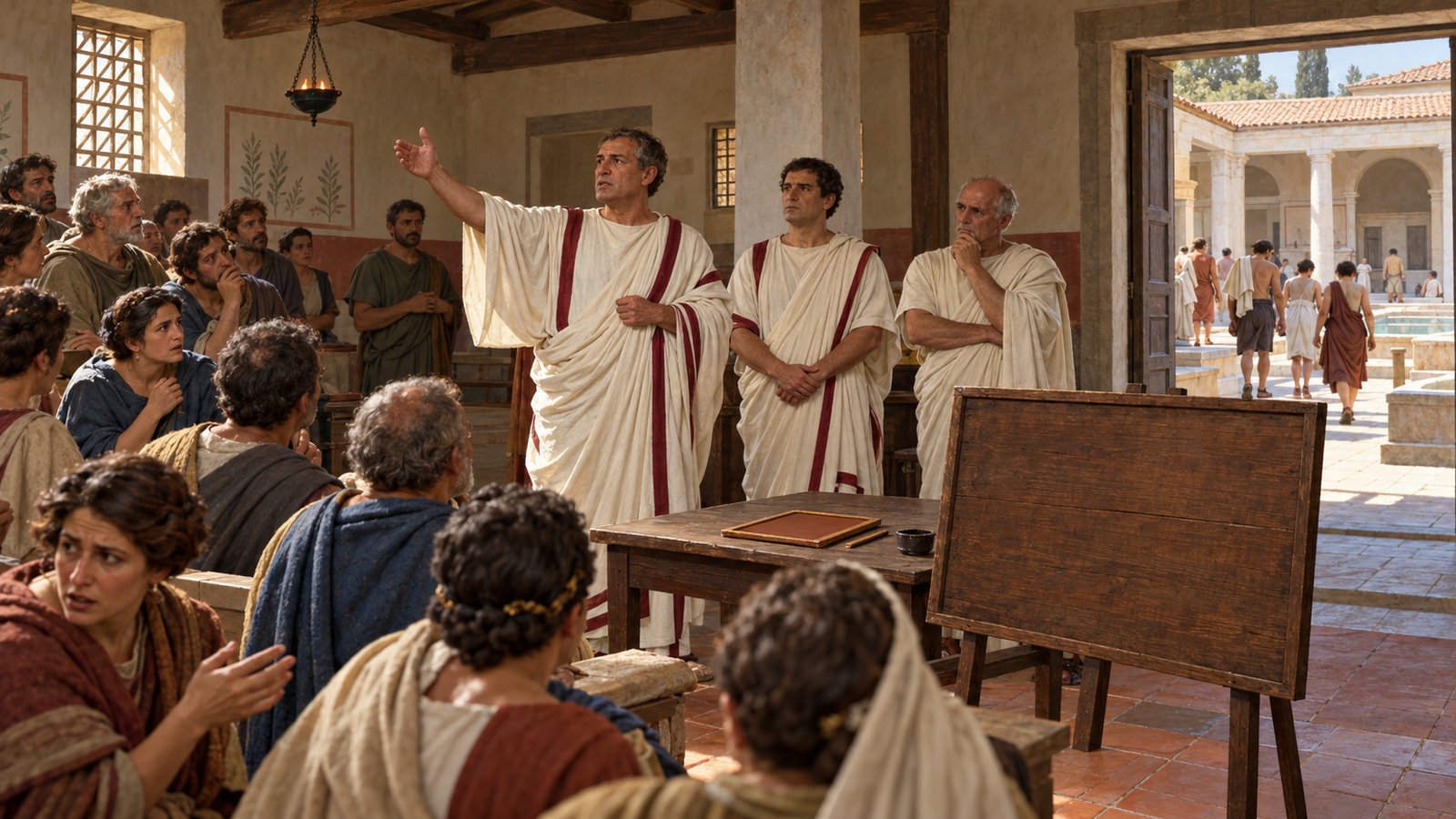
Gellius does not quote Gracchus simply to condemn official cruelty. He is judging prose. Gracchus, he says, was regarded as powerful and vigorous, but Gellius resists claims that placed him above Cicero. The Teanum passage becomes a test case because its subject should, in Gellius’s view, summon indignation and pity.
He acknowledges virtues in the account: brevity, grace, and a simple purity of expression. His complaint is that Gracchus sounds like a narrator rather than an advocate crying out. “A stake was planted,” the account proceeds; Marius was stripped; he was beaten. Gellius hears restraint where he expects heat.
A second example sharpens his criticism. Gracchus told of a young envoy returning from Asia in a litter. Near Venusia, a herdsman who did not recognize the passenger joked that the bearers seemed to be carrying a corpse. The envoy had the litter put down and, in Gracchus’s account, ordered the man beaten to death with the thongs that fastened it.
Again, Gellius finds the delivery too close to ordinary conversation. He contrasts it with Cicero’s attack on Verres, where a citizen beaten in the forum at Messana repeats “I am a Roman citizen.” Gellius says Cicero makes readers almost see and hear the blows. His comparison reveals what an ancient critic expected political language to do: not merely report injustice, but force an audience to experience its moral pressure.
Modern readers need not accept Gellius’s ranking to learn from it. Gracchus’s plainness can intensify the Teanum story by refusing decoration. The bath, complaint, stake, and decree arrive as successive facts in an accusation. Gellius then preserves the very sentences he faults, allowing their restraint to survive alongside his demand for greater emotion.
Sources
Aulus Gellius, Attic Nights, 10.3.