
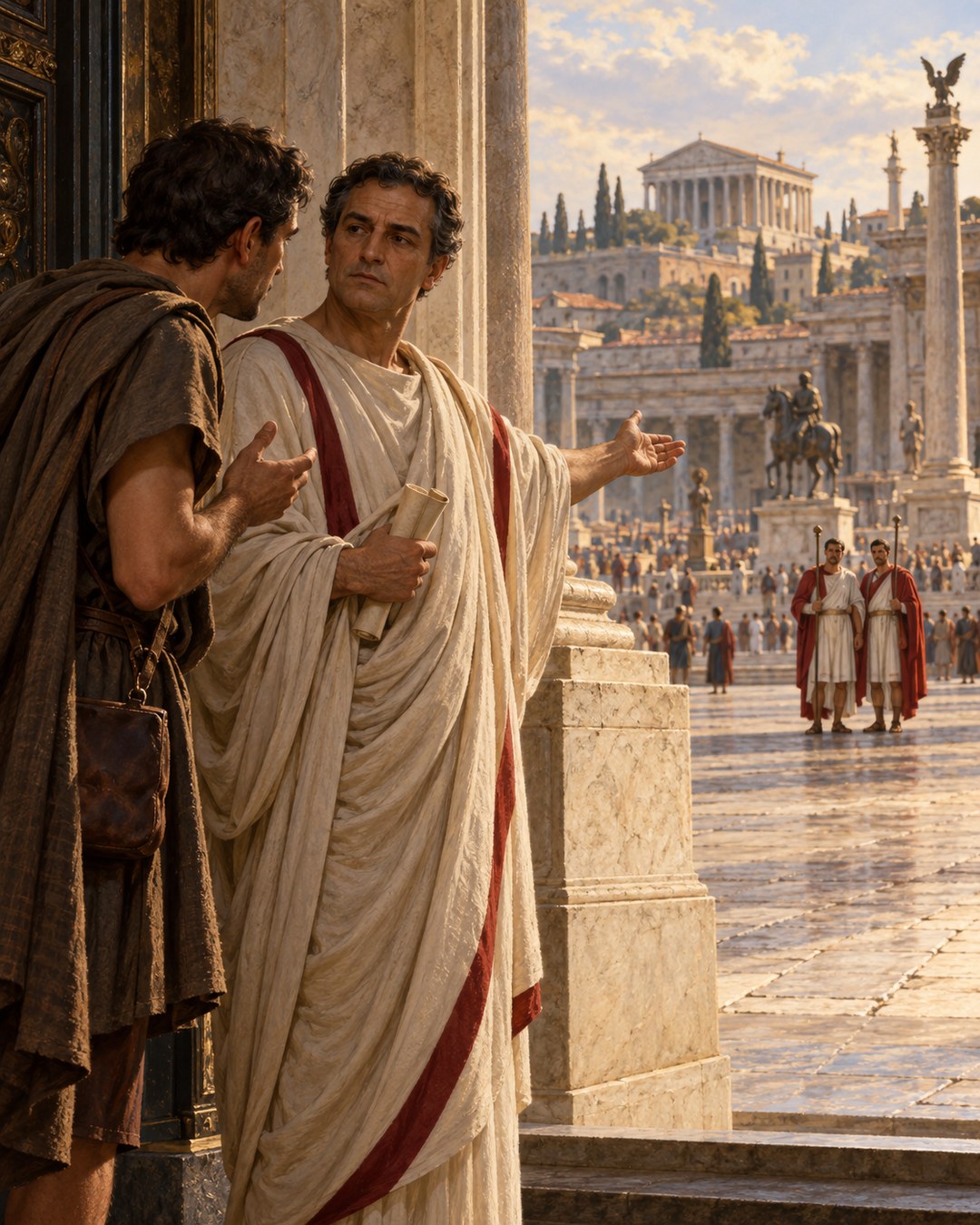
The messenger had an order, but Labeo wanted the magistrates themselves.
A woman had appealed to Rome’s tribunes of the commons, and they sent for the jurist Antistius Labeo at the Gallianum. He did not simply obey. The tribunes, he answered, could arrest him, but they could not summon him while he was absent.
If they wanted custody, they could come and take it.
The reply sounds like wordplay until Gellius lays out the machinery behind it. Roman authority was divided into particular acts. Sending for someone, seizing someone present and holding someone in prison were related powers, but they did not automatically travel together.
A Messenger Reached the Limit of His Office
Ateius Capito introduced Labeo as a formidable student of civil law and Roman custom. He also portrayed him as fiercely attached to older legality. Even while Augustus ruled, Capito said, Labeo accepted as lawful only what he could locate in inherited Roman rules.
That habit shaped his answer at the Gallianum. The surviving account does not identify the woman’s complaint, and its substance is not the point. What mattered was the route by which the tribunes tried to bring the accused man before them. They sent a messenger with an instruction to come and respond.
Labeo distinguished an instruction carried across space from coercion exercised face to face. Custom, he said, gave the tribunes arrest but not summons. Their messenger could report what they wanted. He could not transform that wish into the lawful call possessed by another magistracy.
The refusal did not claim immunity. Labeo explicitly acknowledged the more physical power. The tribunes could leave their place, approach him and order his arrest. He denied only that they could make his absence disappear through a command delivered by an intermediary.
That is what makes the scene sharper than a simple quarrel with authority. Labeo was not saying, “You cannot touch me.” He was saying, “To touch me, you must come.”
Roman Power Arrived in Separate Bundles
Gellius checked Capito’s story against Varro’s Human Antiquities. Varro divided magistracies into three groups: those with power to summon, those with power to arrest, and those with neither. The categories were defined by office and attendants, not by a general scale from weak to strong.
Consuls and other magistrates holding imperium could summon. Varro says that this capacity carried further powers with it: they could arrest, detain and lead a person to prison, whether the individual was already present or had been sent for under their order.
Tribunes occupied the second group. Their messenger accompanied an office of arrest, but not a lawful summons. Quaestors and certain other officials stood in the third group because they had neither lictor nor messenger. Their magistracy did not itself provide either coercive route.
The attendant therefore mattered. A lictor or messenger was not decorative staff. The kind of officer standing beside a magistrate signaled what acts the office could perform. Roman government became visible through bodies: the official who ordered, the attendant who carried or enforced, and the citizen whose location determined what could happen next.
This helps explain why a tribune’s cudgel could begin a camp’s punishment. Physical presence could turn a small gesture into immediate coercion. Labeo’s case asks what remained when that presence was replaced by a message.
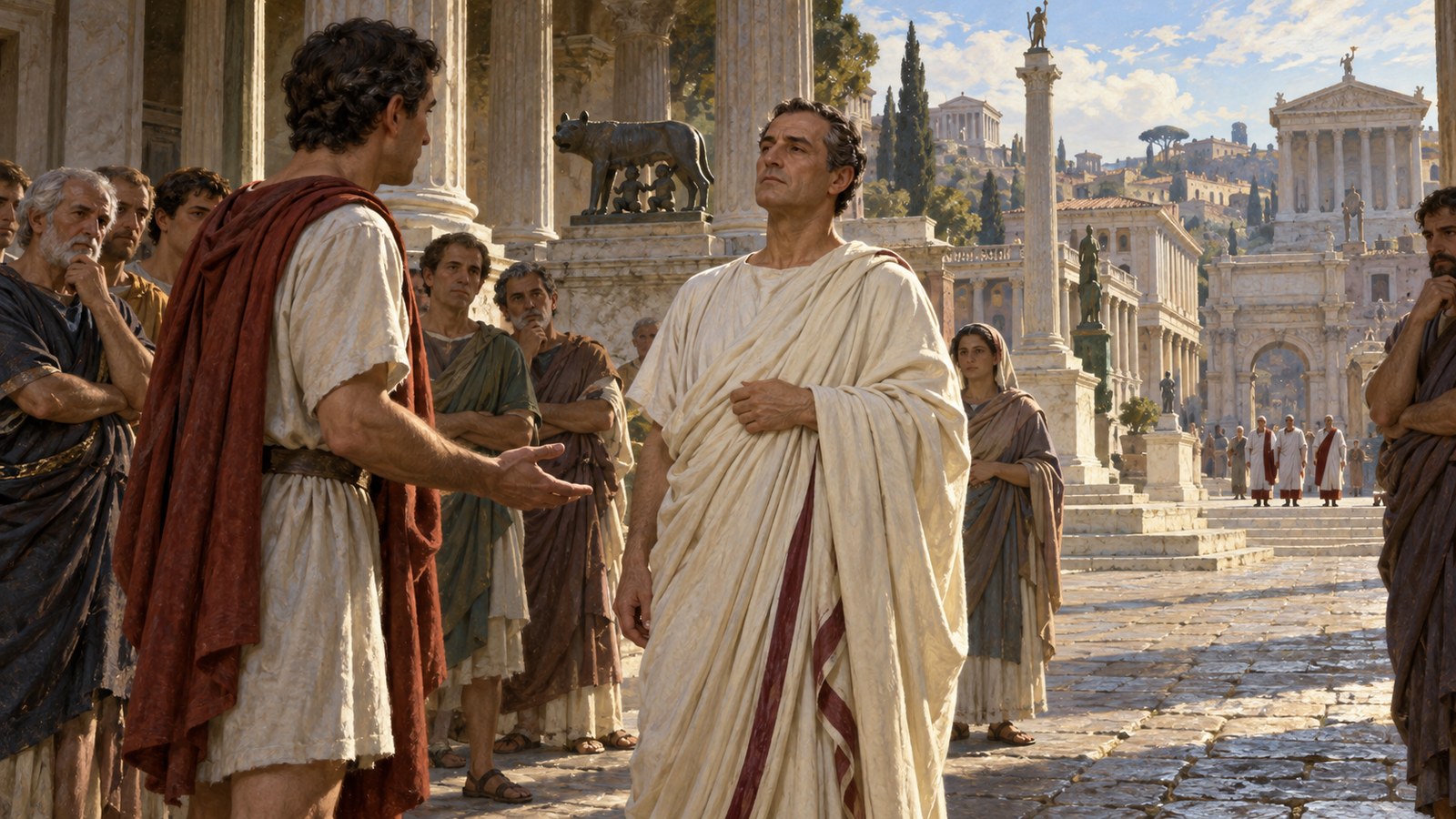
Labeo Won the Distinction, Not Safety
Varro knew that practice did not always respect the boundary. He said some tribunes, ignorant of the old rule, had ordered private citizens and even a consul to appear before the rostra. He also offered himself as an example from both sides of the office.
When Porcius, a tribune, summoned Varro during Varro’s service as a triumvir, Varro refused to appear and appealed to leading precedent. Later, while he served as tribune, he summoned no one and did not require obedience to a colleague’s summons unless the person came voluntarily.
Labeo therefore had an antiquarian and institutional case. Gellius nevertheless thought he had pushed it too confidently. If the tribunes could lawfully arrest him, Gellius asks, what practical security did refusal provide? A person arrested could be taken to prison. The narrower power could still produce the harsher physical result.
The question reveals two kinds of victory. Labeo could force officials to use the correct mechanism, but he could not erase their mechanism. A tribune inconvenienced by his refusal could walk to the Gallianum, confront him and convert disputed summons into acknowledged arrest.
Procedure mattered even when it did not guarantee freedom. Insisting on the boundary changed who had to move, which act became public and what justification observers could demand.
The Tribunate Was Built for Harm in View
Gellius ends by asking why an office with broad coercion lacked summons. His explanation looks back to the tribunate’s early purpose. Tribunes were not created primarily to administer cases involving absent parties. They existed to use veto and personal intervention when injustice threatened before their eyes.
That design favored immediacy. A person cried for help; a tribune saw or heard the danger; the tribune placed his body and office between citizen and coercion. The right to summon someone from another district belonged to a different model of jurisdiction, one prepared to call parties into a proceeding.
The same logic explains a restriction on the tribunes themselves. Gellius says they were not allowed to leave the city at night because constant presence and personal oversight were needed. Their usefulness depended on being close enough to stop violence as it emerged.
Presence could be protective or coercive. The office that had to stay near the people could veto an official, arrest an aggressor or seize the very citizen who challenged its message. These functions were joined by proximity rather than by a modern division between policing and representation.
When the Senate followed Cato toward prison, collective movement made an arrest politically expensive. Labeo’s smaller episode turns movement into doctrine: whether the tribunes came to him determined whether their command was an arrest they possessed or a summons they did not.
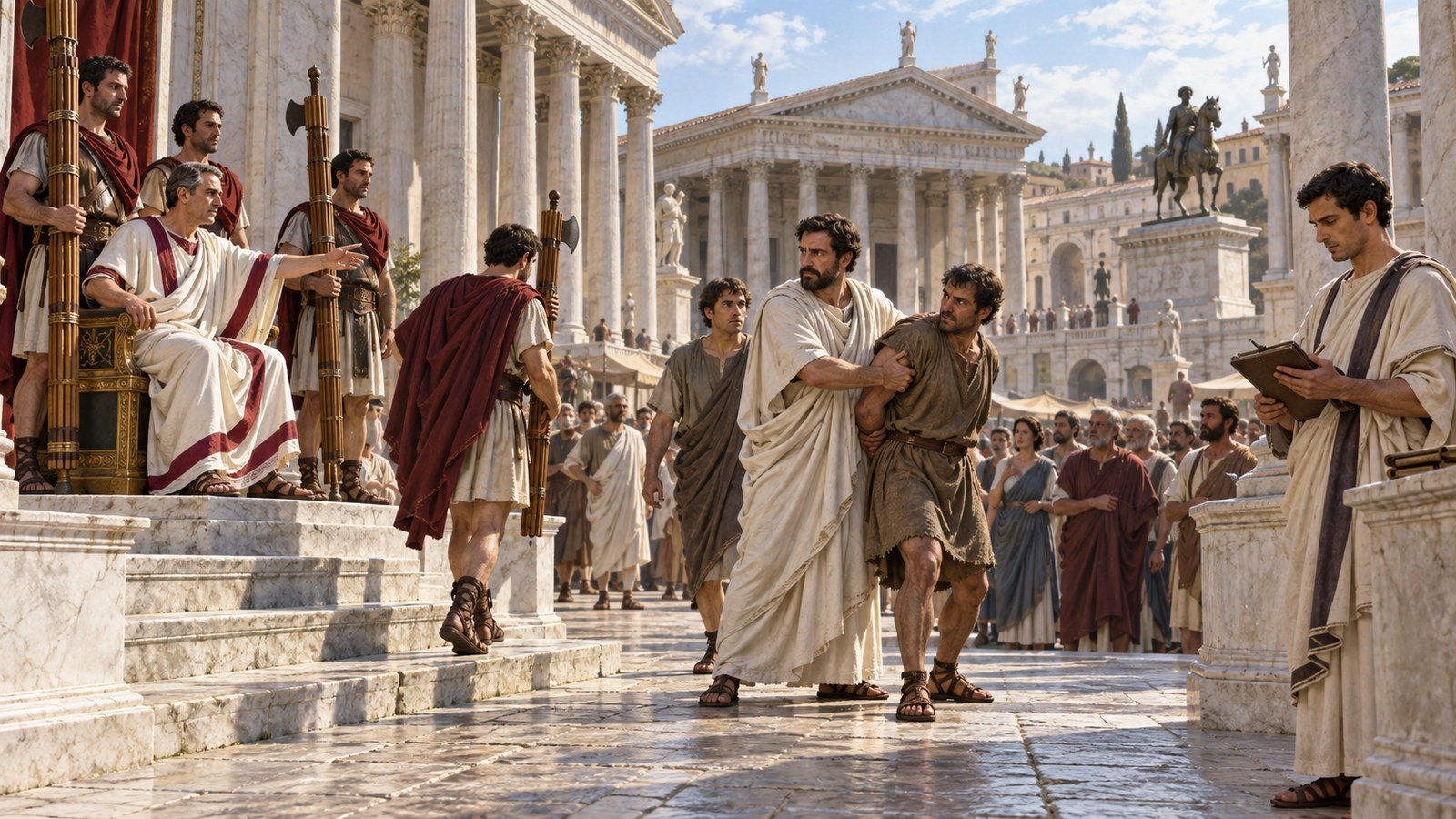
A Doorway Made the Constitution Visible
The Gallianum became a test site because Labeo stayed where he was. Had he followed the messenger voluntarily, no one needed to name the defect. Refusal forced each piece of authority into view.
The woman possessed a route of appeal. The tribunes possessed a messenger and immediate coercion. Labeo possessed technical knowledge and a willingness to demand the older form. Varro supplied categories that separated consuls, tribunes and quaestors. Gellius supplied the skeptical reminder that exact law could still end at a prison door.
None of these details turns Roman public law into a modern code. The surviving argument comes through antiquarian quotations, contested practice and memories of offices that changed over time. Its value lies precisely in the friction. Romans disagreed not only about what officials should do, but about which verb an office had the right to make real.
The sequence also shows why an apparently technical objection could matter to a private citizen. A remote order made compliance look routine and hid the moment coercion began. Requiring the tribunes to appear forced them to assume responsibility in the same place as the person seized. Witnesses could then see the office, its attendant and the act together. Form did not abolish domination, but it prevented one mechanism from quietly borrowing the authority of another.
A summons could travel without the magistrate. Arrest required the tribune’s authority to arrive in person. Labeo used that space between command and presence as long as it lasted.
He did not prove that power was absent. He made power walk across Rome and show its proper face.
Sources
Aulus Gellius, Attic Nights 13.12.