
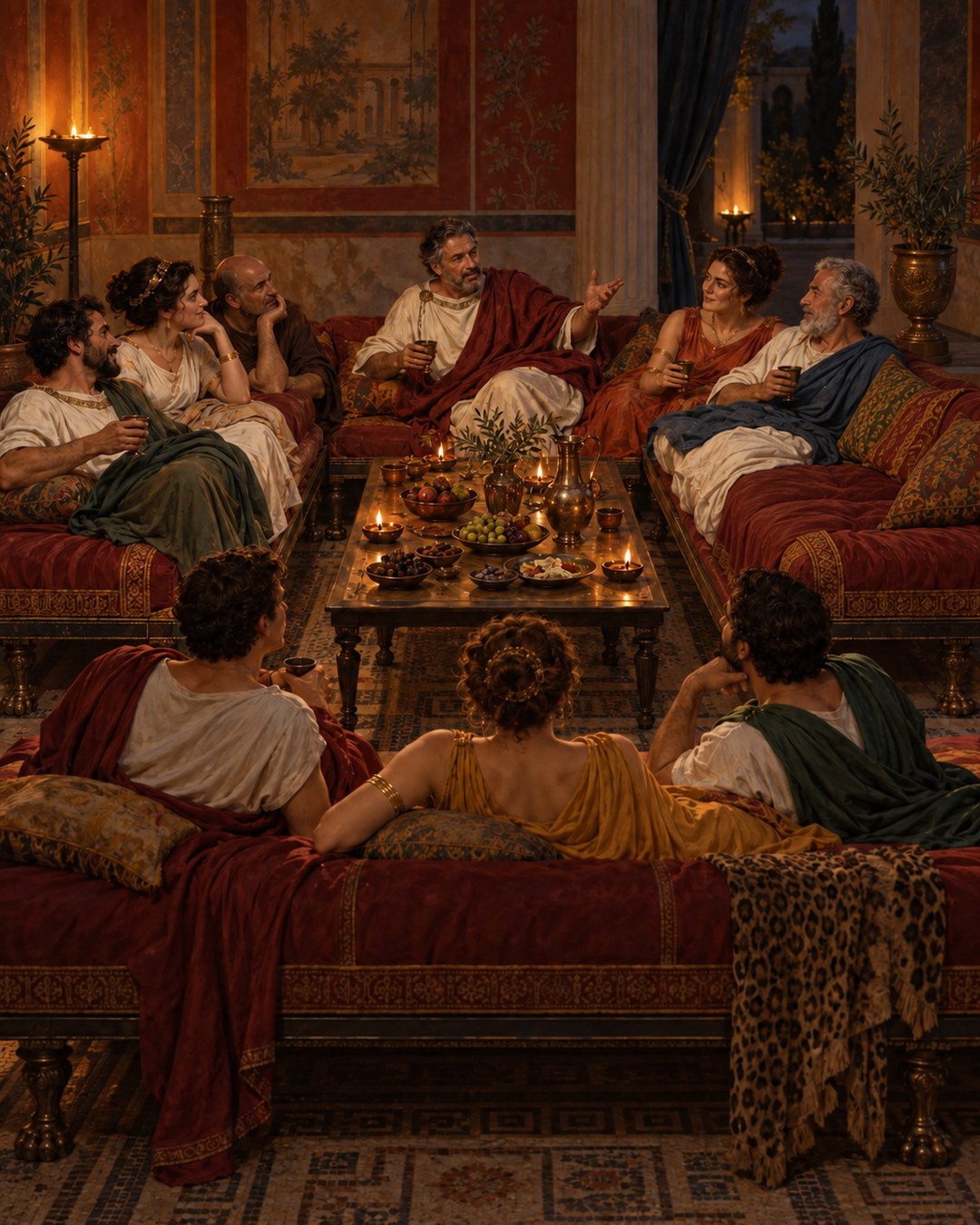
Nine was not a lucky ceiling. It was the point at which one conversation threatened to become a crowd.
Marcus Varro mapped the ideal Roman dinner between divine numbers. The smallest company matched the three Graces; the largest matched the nine Muses. Fewer did not make a dinner, and more no longer reclined as one social body.
Gellius preserves the advice because Varro’s rule reaches far beyond headcount. A banquet succeeded only when company, room, hour and preparation worked together. Speech needed limits, reading needed selection, and even dessert had to respect digestion.
The meal was a composition whose most fragile ingredient was attention.
The Graces and Muses Set a Human Scale
Varro placed the advice in a Menippean Satire whose title warned that no one knows what the late evening may bring. His range began with the Graces and ended with the Muses: three at the lower boundary, nine at the upper.
The mythological comparison made the numbers memorable, but his next sentence gave the practical reason. A large group was disagreeable because a crowd tended toward disorder. Varro joked that a crowd stood at Rome, sat at Athens, and reclined nowhere.
Reclining mattered. Roman dining couches arranged bodies around a shared center. A guest needed to see, hear and answer others without the room splitting into separate gatherings. Add too many people and the physical form continued while the social form collapsed.
This is different from saying that elite dinners always obeyed a fixed maximum. Varro was offering judgment through satire, not reporting a universal regulation. The value of his rule is the problem it names: hospitality had to preserve a scale at which mutual conversation remained possible.
The company was therefore counted by what it could do. Three voices could begin exchange. Nine could supply variety. Beyond that, the host risked managing circulation and noise instead of a dinner.
Four Conditions Had to Meet at Once
Varro called a banquet complete when it possessed four features. A suitable little group had to be assembled. The place had to be well chosen. The time had to fit. Preparation could not be neglected.
These conditions prevented food from carrying the whole burden. Excellent dishes could not repair a poor room, an awkward hour or incompatible guests. Likewise, charming company might forgive modest fare but could not dine comfortably if basic preparation failed.
The built setting shaped rank and exchange. As the architecture of the principal dining place shows, position on a couch could be part of the room’s design. Varro’s formula adds that arrangement alone was not enough. The chosen people had to animate it at the chosen moment.
A compact group also changed what preparation meant. The host could estimate couch places, vessels, serving pace and the amount of food around a known company. Guests did not need to wait while one end of an oversized room received a course before the other. The social number and the service plan reinforced each other.
Time also gave a meal its emotional temperature. A company dragged together while urgent Forum business remained unresolved would carry that pressure to the table. A host who ignored preparation would make guests wait, compete or notice scarcity.
Varro’s four parts work like a preflight. They ask whether people, place, hour and provisions support the same purpose before anyone tries to rescue the evening with display.
The Best Guests Knew When to Speak
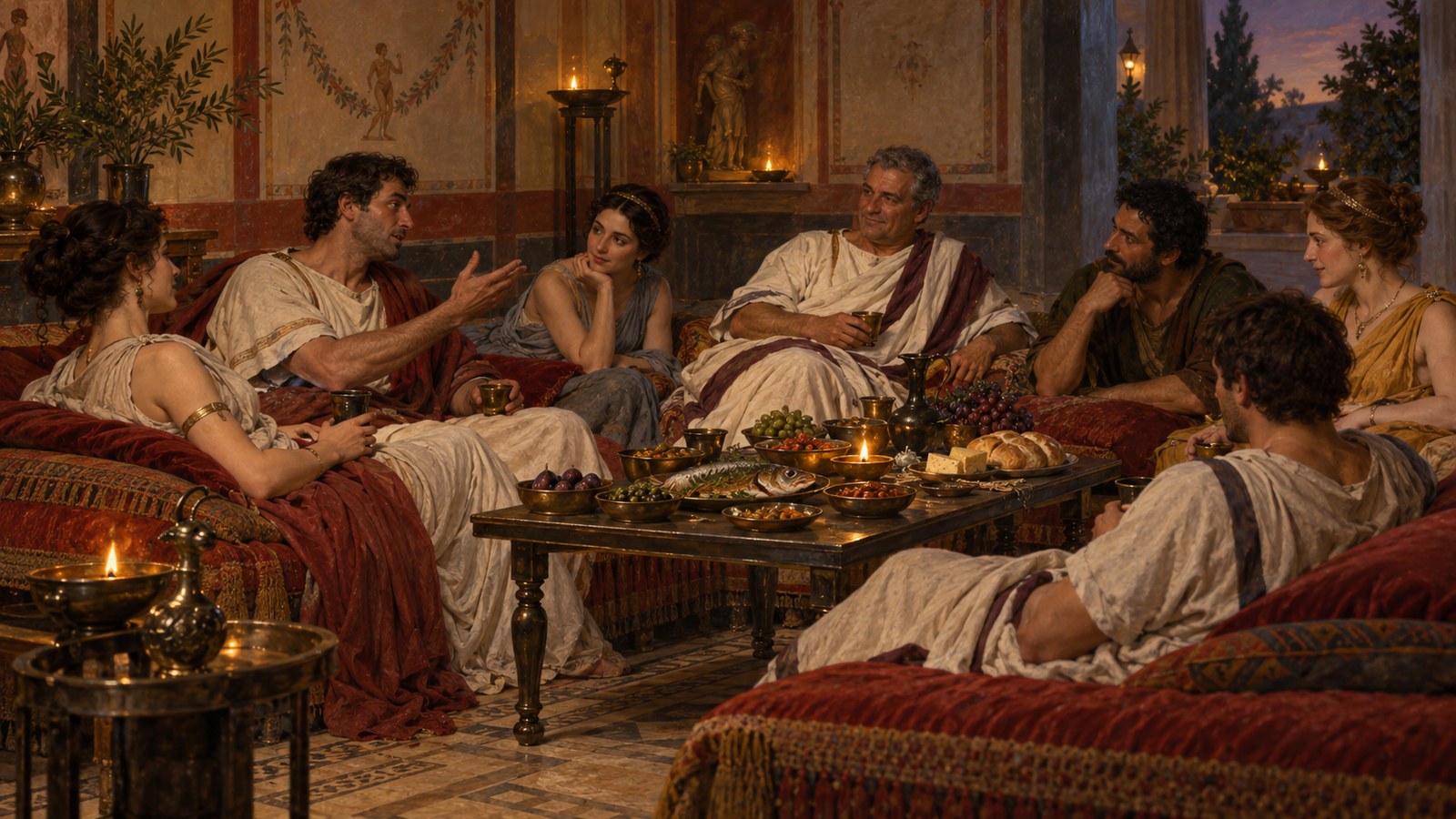
The guest list was not merely a count. Varro advised against inviting people who were too talkative or too silent. Either extreme broke reciprocity.
He assigned formal eloquence to the Forum and law courts. A dinner was not the place for one person to seize the floor with a public performance. Yet silence belonged to the bedchamber, not to a shared table. A guest who contributed nothing left others to carry the exchange.
The ideal was not bland agreement. Varro wanted talk that was diverting and cheerful while still useful. Interest, pleasure and benefit could coexist when guests discussed common human experience—the matters that public business gave them no leisure to examine.
Common experience offered every diner an entry point. Unlike a specialist lawsuit or a magistrate’s agenda, it did not belong solely to the most powerful or professionally eloquent person present. A remembered habit, household problem or observation about conduct could pass around the couches and gather different judgments without demanding a verdict.
This turns leisure into a different kind of seriousness. Anxious and perplexing affairs were poor material because they imported the strain of work without producing resolution. Everyday experience could refine character precisely because no vote, lawsuit or transaction forced the discussion toward a result.
The host’s task was not to script every sentence. It was to choose people capable of a shared rhythm: speaking without lecturing, listening without withdrawing, and moving from amusement toward reflection without converting supper into court.
Reading Served the Table, Not the Reader
Roman dinners could include recitation, but Varro insisted that not everything deserved to be read there. A text had to be both improving and enjoyable.
The two conditions protected the meal from opposite failures. A useful but joyless reading could turn guests into captive pupils. A delightful but empty performance might monopolize attention without leaving anything worth carrying away. Selection mattered more than the mere presence of literature.
Varro also defined the host by restraint. He should be free from meanness rather than excessively elegant. The contrast does not praise stinginess. It rejects the idea that hospitality improved without limit as ornament and cost increased.
Antonia’s famous pet fish, followed in the story of the lamprey with earrings, belongs to a world where household display could turn an animal into a marvel. Varro’s dinner advice aims elsewhere. The host’s success appears in proportion: enough generosity to remove anxiety, not so much elegance that display replaces company.
A reading at such a table was one course among others. It entered at the right length and tone, then released attention back to conversation.
The same test applied to the reader’s manner. The purpose was not to display endurance or trap the company in deference. Material chosen for pleasure and improvement had to remain proportionate to the evening. Once it had supplied an idea worth discussing, the scroll could close and the guests could reclaim their voices.
Unsweet Sweetmeats Closed the Argument
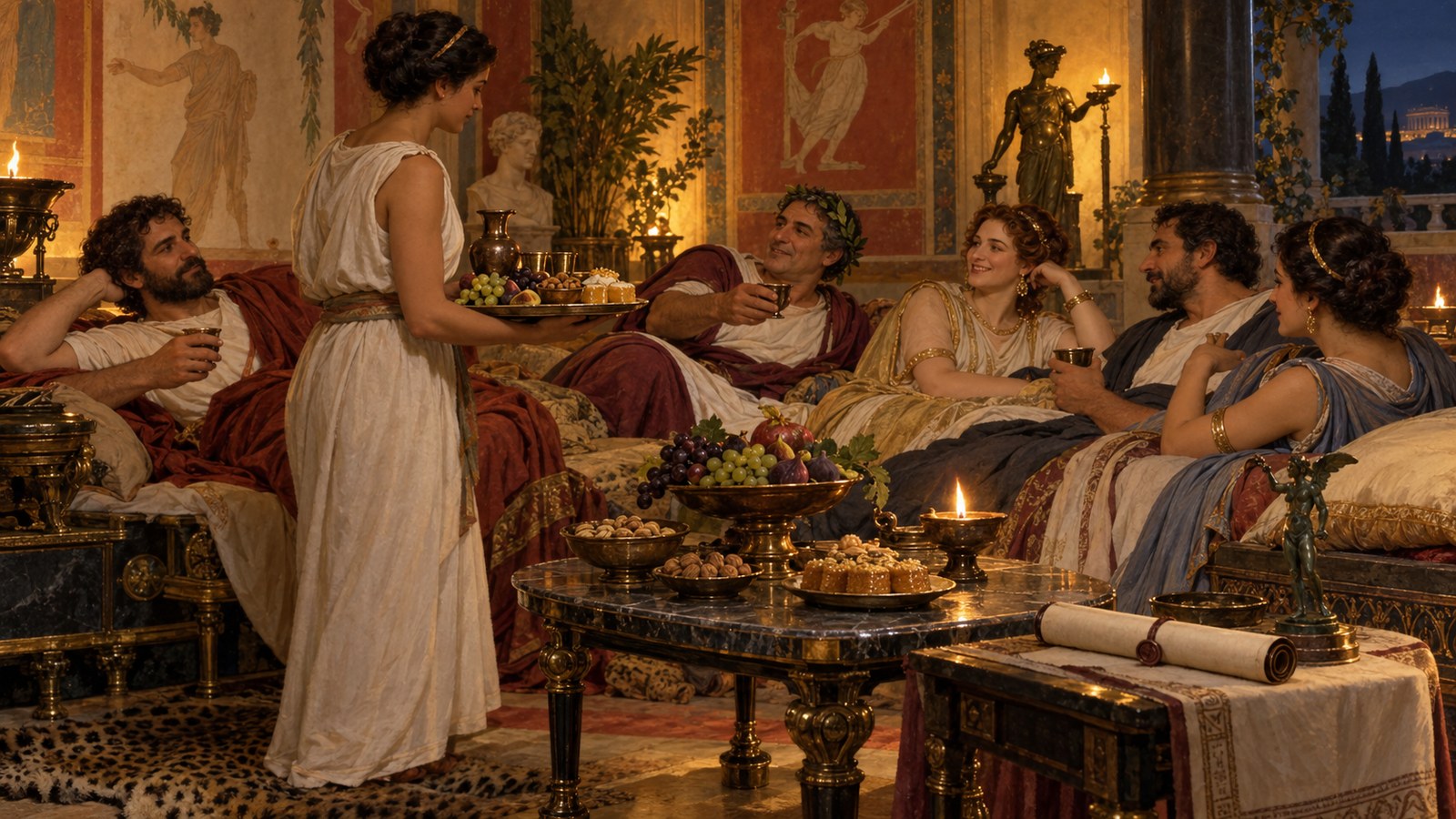
Varro finished with dessert and a joke. The sweetest bellaria, he said, were those that were not sweet, because delicacies and digestion did not naturally harmonize.
Gellius pauses to explain the word. Earlier Latin used bellaria broadly for desserts, while comedy could extend it to sweeter wines—the “sweetmeats” of Liber. The vocabulary covered the pleasant extras that arrived after the substantial meal.
The digestive warning completes the same logic as the guest limit. More pleasure did not always create a better result. Sweetness could become cloying; elegance could become vanity; eloquence could become domination; a company could become a crowd.
Varro’s banquet is not austere. It wants cheer, interest, refinement and pleasure. It simply treats each as something that depends on measure. The correct number allows conversation. The correct setting makes reclining sociable. The correct reading improves without punishing. The correct dessert finishes without overwhelming.
That is why three and nine mattered. They were the visible edges of a broader discipline: stop adding before abundance damages the experience it was meant to enrich.
A host could not guarantee what the late evening would bring. He could arrange the conditions under which surprise remained welcome.
Sources
Aulus Gellius, Attic Nights 13.11, quoting Marcus Varro.