
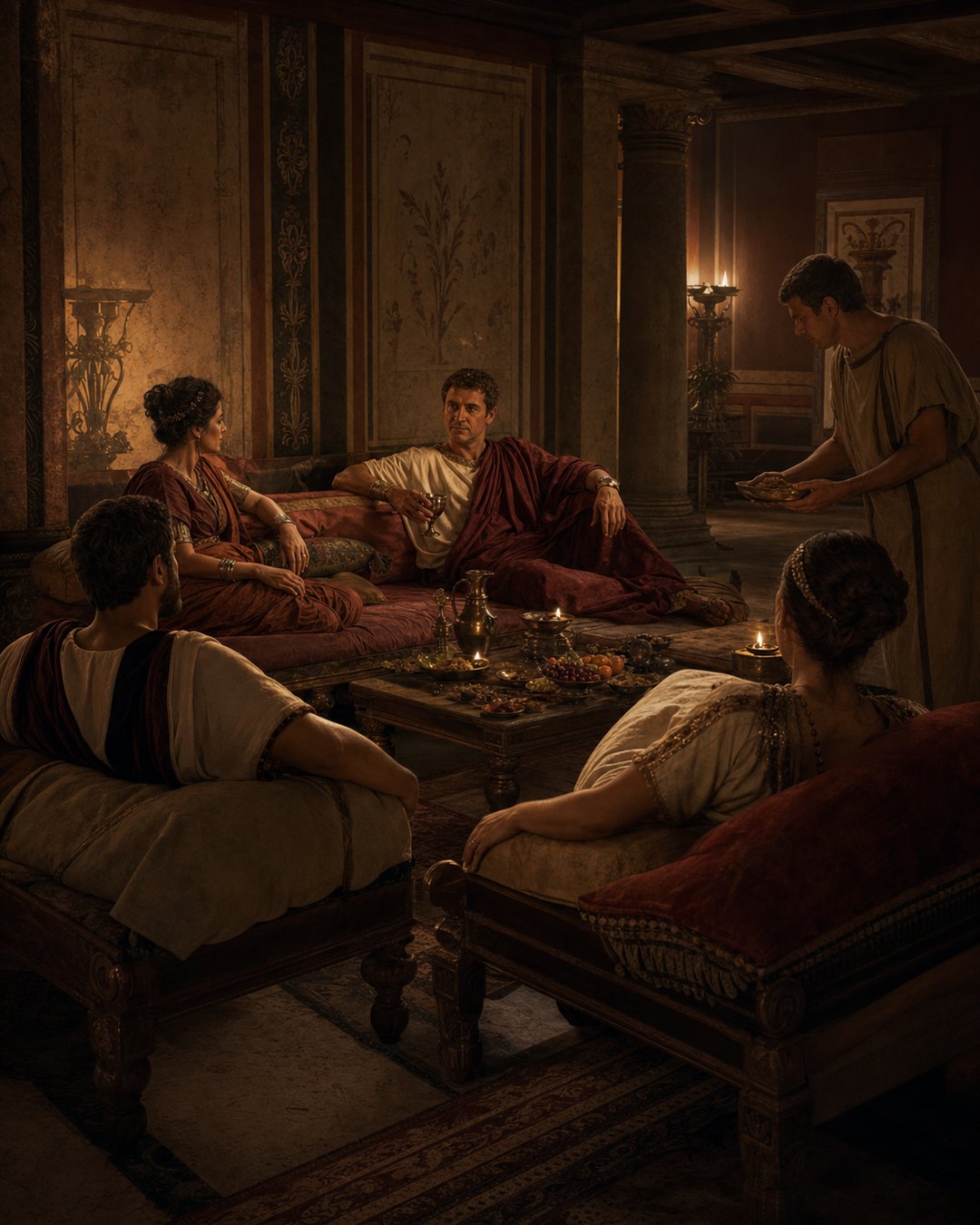
A Roman host did not need to announce which guest mattered most. The room could do it for him. Before the first dish arrived, the couches, the places on those couches, and the host’s own position had already turned hospitality into a map of rank.
The triclinium was not merely a comfortable room with food in it. Its name came from three couches, and its standard arrangement put bodies into a visible order. A guest reclined rather than sat upright, leaned on the left elbow, kept the right hand free, and occupied a place that other diners could read. At a formal dinner, architecture and etiquette worked together.
Nine Guests Formed a Social Diagram
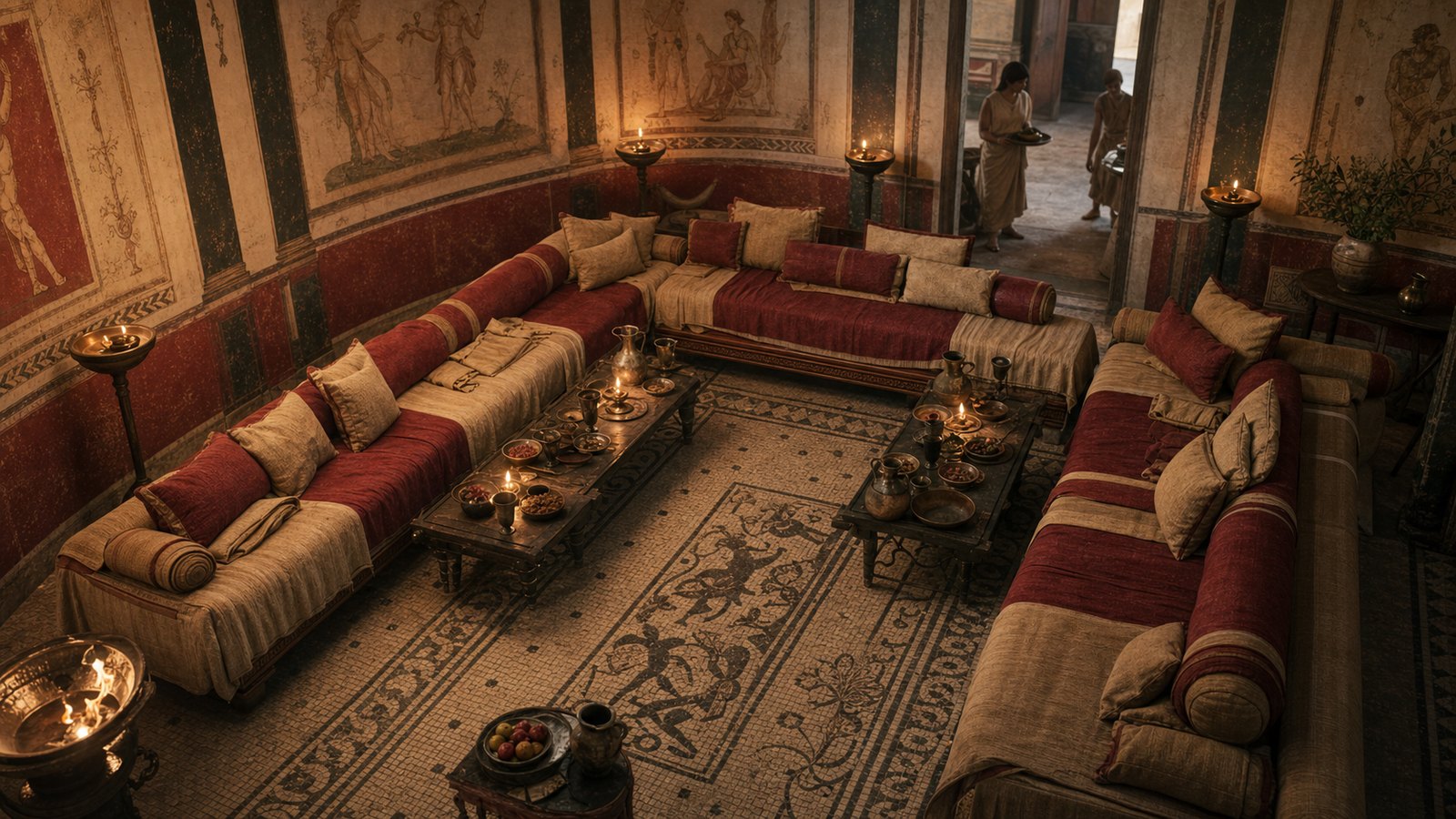
Smith’s Dictionary of Greek and Roman Antiquities describes the ordinary Roman arrangement with three people on each of three couches. That produced a party of nine: a compact number, but large enough to include friends, dependants, political allies, rivals, and carefully chosen newcomers. Varro’s rule, preserved by Gellius, made the ideal memorable. The company should be no fewer than the three Graces and no more than the nine Muses.
The number mattered because the room was not an open hall where everyone chose a chair. Three couches created a route around the tables and a sequence of places. Once a guest was shown where to recline, he joined a social diagram. The couch beside him, the person immediately above or below him, and the host’s line of sight all helped define the evening before conversation began.
Even the body followed the plan. Diners commonly leaned on the left elbow so the right arm remained free for food and drink. Two or three people shared a couch, close enough that ancient descriptions could speak of one diner lying near another’s chest. This was not the loose spacing of a modern restaurant. Proximity was built into the meal, which made every placement more noticeable.
Above and Below Were Literal Directions
Roman descriptions used the words supra and infra—above and below—for neighboring positions. Those terms were not vague compliments. They described how reclining bodies followed one another along a couch and how the three couches related within the room. A guest could therefore be socially and physically “above” someone at the same time.
The most honorable place at each table was ordinarily the middle one. This is the detail that changes how we should imagine an invitation. Being admitted to dinner was one favor; being assigned the place of honor was another. A host could include a guest without treating him as the evening’s center. The difference might be no more than a cushion’s width, but everyone sharing the arrangement could see it.
Smith’s entry reconstructs named positions from literary passages, including Sallust and Horace. The point is not that every friendly meal obeyed protocol perfectly. Etiquette can be ignored, joked about, or deliberately reversed. Its power lies in being understood. A placement only communicates favor or slight if the people in the room know what it means.
The Host Chose a Working Position
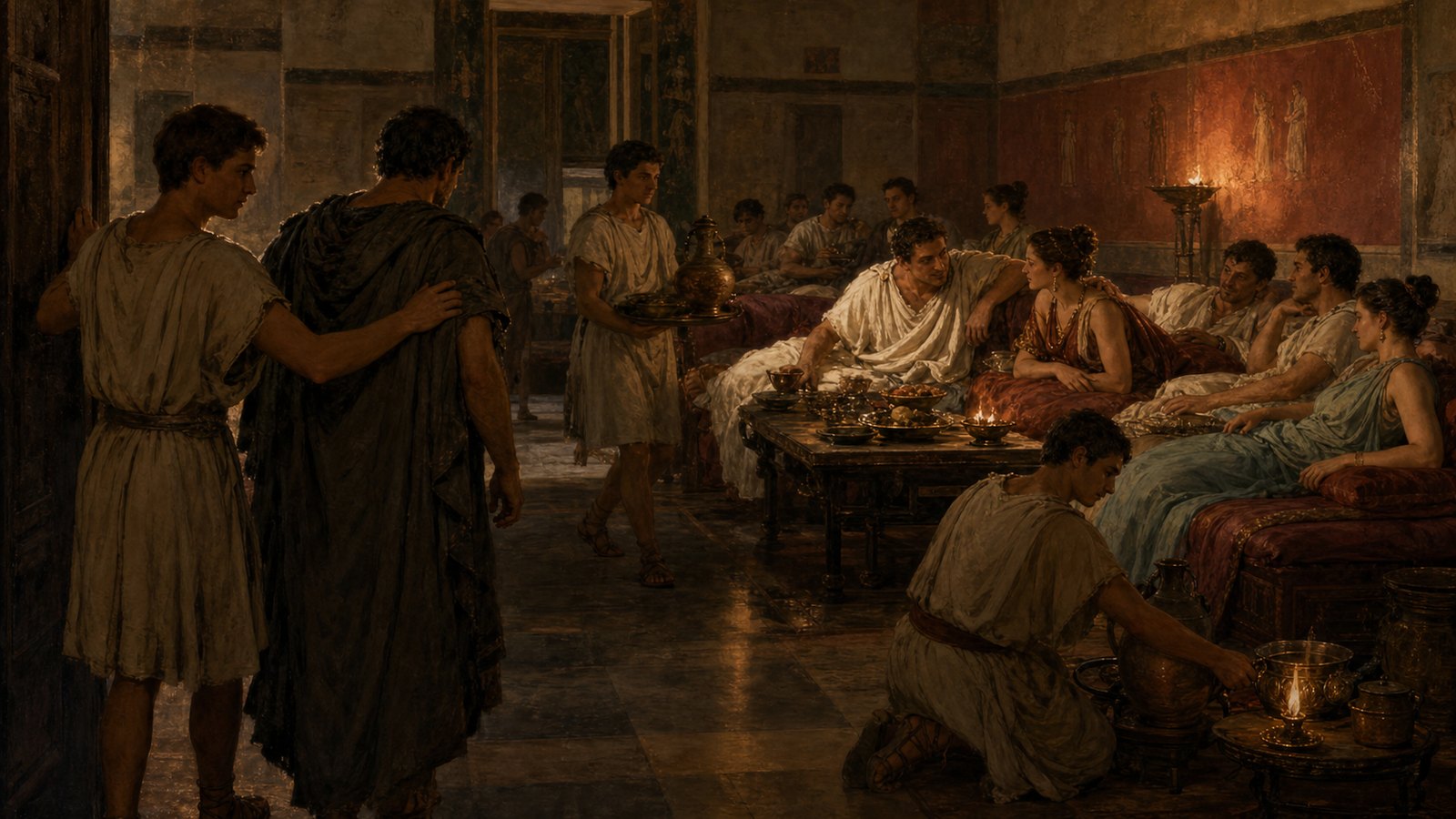
The master of the feast did not simply claim the grandest visible spot. In the example discussed in the Triclinium entry, the host occupied a place normally used by the master because it was convenient for giving directions and supervising the entertainment. Authority at dinner included work: watching service, pacing courses, receiving arrivals, and noticing whether a guest lacked attention.
That practical position resembles the daily machinery of Roman patronage. Status depended on being seen to receive, arrange, and respond. The dinner shifted that performance from the morning threshold to the evening room. The host controlled access, but he also had to make the invitation feel successful.
A great household added another layer of supervision. The tricliniarcha managed the dining room through slaves of lower rank. Guests saw polished order: tables arriving, lamps tended, cloths straightened, cups filled, and courses moving. Behind that ease stood a chain of commands. The host’s rank was expressed not only by where he reclined, but by how smoothly other people worked around him.
Furniture Carried the Cost of Display
The room’s message did not stop at seating. Dining couches needed coverings, pillows, and cloth. Smith’s Lectus entry notes that wealthy Roman bed and couch textiles could be purple and embroidered with gold figures. A formal arrangement could therefore display expense across a broad horizontal surface, directly beneath the guests whose positions were being judged.
Tables added another register of wealth. Sources describe maple, African citrus wood, ivory, white marble, carved legs, and simpler three-legged forms. The most valuable surface was not automatically the most useful one. Its value came from grain, color, rarity, workmanship, and the owner’s ability to place it where guests would look at it throughout the meal.
Small tables could be furnished with dishes and then carried to the reclining company. That physical movement made service part of the spectacle. The food did not simply appear. A loaded table crossed the room, attendants found a path between couches, vessels reflected lamplight, and each guest reached down from an elevated position. The arrangement separated those who reclined from those who moved.
A Dining Room Could Remember a Snub
Vitruvius recommended that a triclinium be twice as long as it was broad, and he described summer dining rooms open toward the north with garden-facing windows. Archaeology adds weight to the literary picture: the House of Actaeon at Pompeii preserved couches built in stone. Furniture that could not be casually shifted made the room’s social grammar unusually durable.
Imagine a late arrival stepping through the doorway. Lamps throw light across plaster, cloth, bronze, and faces. The three couches are already occupied except for one place. The newcomer does not need a written plan. An attendant’s gesture tells him where he belongs, while every reclining guest can watch the short walk from threshold to cushion.
If the placement pleased him, the host had honored him without a speech. If it disappointed him, the slight was equally economical. He still received food and company, but the room recorded a limit. Later, he could remember who lay above him, who received the middle place, and whether the host could easily speak to him.
The dining room also forced rank to coexist with intimacy. Nine people did not disappear into a crowd. They shared three couches, reached toward the same small tables, and watched the same attendants cross the floor. A favored guest could not be elevated at a remote dais; his distinction had to work inside close quarters. That made protocol useful. The words above, below, and middle gave an orderly vocabulary to a room where elbows, cups, cushions, and conversation were physically compressed.
The stone couches at the House of Actaeon sharpen the point. A movable chair can be shifted to flatter an arrival, but a built couch imposes a prior geometry. The household could change textiles and assign different people to each place, yet the basic arrangement waited from one dinner to the next. Rank was temporary, while the room that expressed it endured.
This is why Roman dining deserves attention beyond menus and luxury. The coena was the principal meal, but the food arrived inside a structure of bodies, furniture, servants, and sight lines. The most important seat was not important because it was softest. It mattered because everyone knew how to read the room.
Sources & Further Reading
- Smith Dictionary, Triclinium
- Smith Dictionary, Coena
- Smith Dictionary, Lectus
- Smith Dictionary, Mensa