
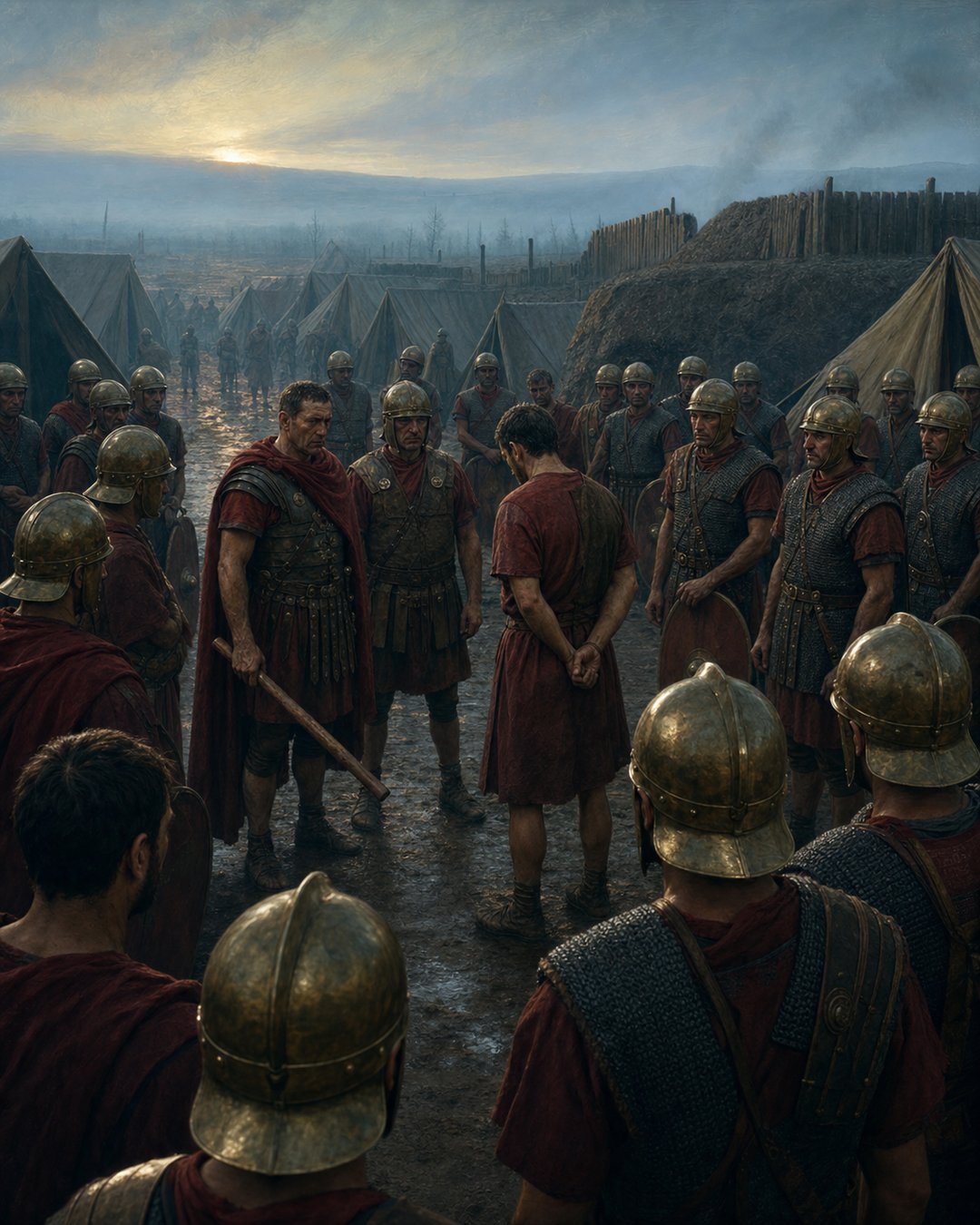
The tribune did not deliver the killing blow. According to Polybius, he touched the condemned soldier with a cudgel. The rest of the camp then closed in with clubs and stones. A small official gesture transferred a judicial decision into collective violence.
This punishment, usually called the fustuarium, appears in Book 6 of Polybius’s Histories inside a long explanation of the Roman military system. The Greek historian is not listing cruelty for its own sake. He has just described patrols, written checks and failed night watches; he will go on to collective punishment and public rewards. Terror sits inside administration.
The passage should not be treated as proof that every Roman army in every century followed one unchanged manual. Polybius describes the middle Republic and shapes his account to explain Roman effectiveness. Read on those terms, the cudgel touch reveals a precise mechanism: evidence moves upward, judgment returns downward, and the camp becomes both witness and executioner.
A Failed Watch Had to Produce Evidence
Polybius reaches the tribunal after explaining how night guards were inspected. Patrols moved through the camp and collected or checked the tokens associated with assigned watches. If a failure appeared, the question was not simply whether an officer felt suspicious. The patrol and the men accompanying it helped establish where responsibility lay.
That sequence belongs beside the repeated geometry of Roman marching camps. Ditches and streets could make a temporary settlement orderly, but layout alone could not keep a sleeping army safe. The system needed people to remain at assigned posts and a way to discover who had not.
Polybius says all the tribunes met as a court-martial. The plural matters. The accused watchman moved from a report inside one patrol chain to judgment by the legion’s senior officers. Only if found guilty did he face the punishment Polybius presents next.
This is a literary description of procedure, not a surviving case file. We do not hear a defendant’s argument or learn how often acquittals occurred. Yet Polybius deliberately places investigation before spectacle. His explanation of Roman severity begins with accountability for a specific task at a specific time.
The Cudgel Touch Changed Who Acted
The tribune took a cudgel and merely touched the condemned man. That contact announced the judgment without making the officer the principal executioner. Soldiers throughout the camp then beat or stoned the man, usually killing him there.
The distribution of action is the fustuarium’s central horror. Comrades did not simply watch a state punishment administered by specialists. The formation that depended on reliable watches was made to enforce the sentence. Polybius turns discipline into a collective obligation after the court has fixed individual guilt.
Escape did not restore ordinary life. Polybius says a survivor could not return home and that no relative would dare receive him. The claim extends military judgment beyond the ditch. Camp exclusion, civic exclusion and family fear combine so that physical escape still means ruin.
That language also serves Polybius’s explanatory purpose. He wants the penalty to appear unavoidable. His conclusion is explicit: extreme severity and certainty made Roman night watches scrupulous. Whether reality was always so faultless is a different question; the text presents fear as the force closing the gap between written duty and behaviour.
Responsibility Reached Up the Chain
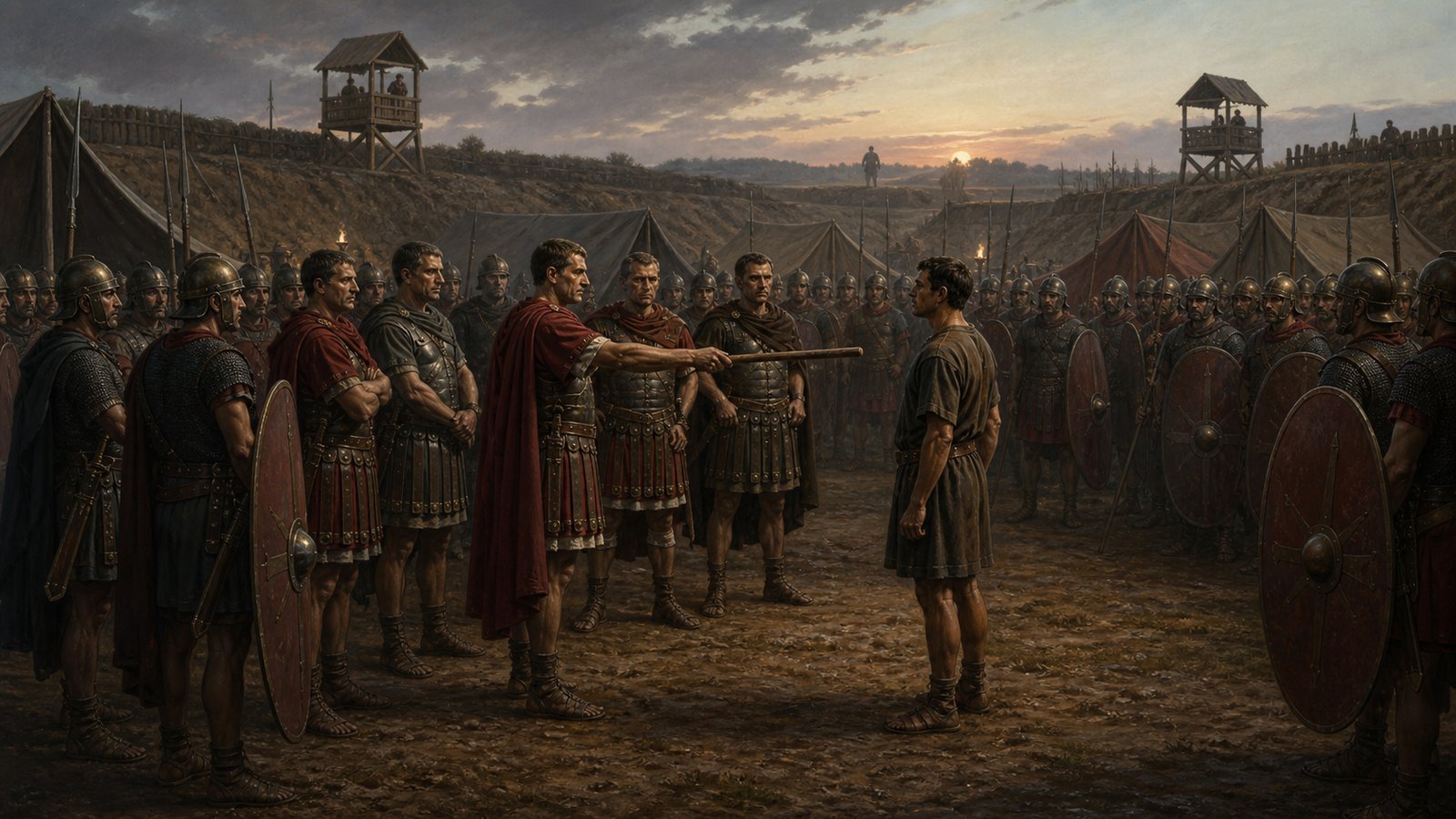
Polybius does not reserve danger for the lowest sentry. He says the same fate could reach an optio or a cavalry squadron commander if required orders were not passed to patrols or the next unit at the proper time. Command carried liability for timing and transmission.
Common soldiers answered to tribunes, while tribunes answered to consuls. Tribunes and allied prefects could impose fines, demand sureties and order flogging. The fustuarium therefore sat at the severe end of a broader scale rather than replacing every lesser sanction.
Polybius lists theft inside camp, false testimony and a third punishment for the same offence among crimes that could bring the cudgel penalty. One additional category in the ancient text concerns sexual conduct and is expressed through the moral language of its translator and era. It should be recognized as Polybius’s disciplinary world, not repeated as a modern judgment about identity.
The list links material trust, truthful evidence and repeated disobedience. A camp held weapons, pay, food and testimony in close quarters. Theft weakened internal security; false witness damaged judgment; recurring misconduct challenged lesser penalties. Polybius groups them because each made coordinated life less dependable.
Cowardice Created a Different Kind of Court
Other acts were described as shameful or unmanly rather than as the same class of crime. Polybius names falsely claiming bravery to obtain a reward, abandoning an assigned covering position through fear and throwing away weapons in battle. Reputation becomes a disciplinary instrument alongside formal punishment.
He claims soldiers sometimes remained at posts against overwhelming odds because they feared what awaited them if they returned. A man who lost a shield or sword might throw himself back into danger to recover it or escape disgrace through death. The picture is intentionally severe: courage can be produced by fear facing in both directions.
This differs from the sacred-chicken scandal before a naval defeat. There, ignored ritual became a language for explaining command failure after catastrophe. In Polybius’s camp discipline, assigned position and retained equipment are judged through routines that precede the next battle.
The historian’s admiration should not erase coercion. A soldier’s relatives, comrades and officers all appear as possible enforcers of shame. Roman cohesion in this account is not spontaneous patriotism. It is an environment designed so that deserting a duty threatens a person’s place in every community available to him.
A Fatal Lot Scaled Punishment to a Crowd
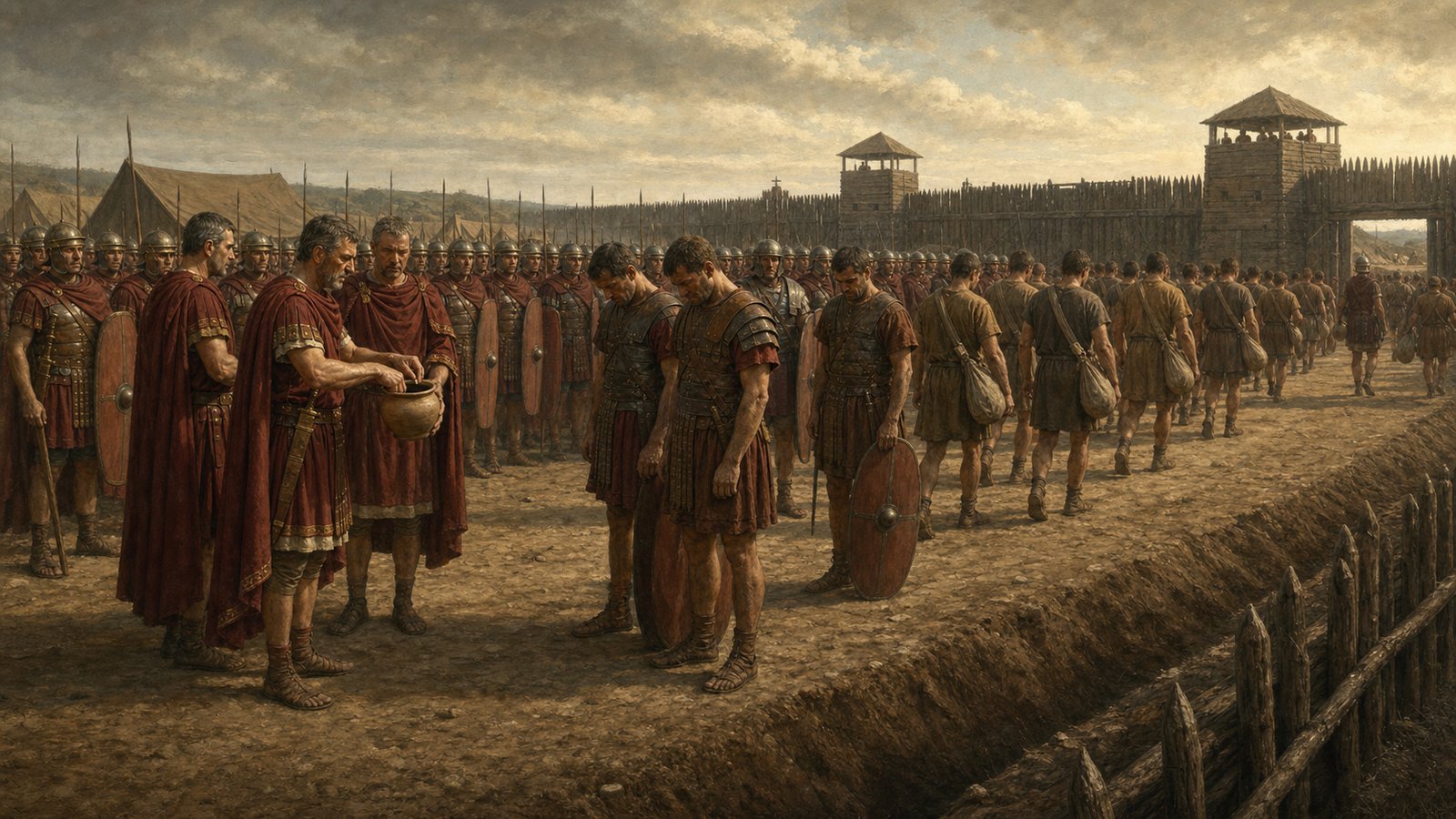
When an entire maniple or another large body abandoned its position, officers did not execute everyone. Polybius says the tribune assembled the legion, sharply rebuked the offenders and selected by lot a number intended to come close to one tenth—sometimes five, eight or twenty, depending on the guilty body.
Those selected received the fustuarium. The remainder were given barley instead of wheat and ordered to camp outside the fortified area. The lot made fatal danger uncertain but shared; the inferior ration and exposed sleeping place made disgrace visible among all survivors.
This is the mechanism later associated with decimation, but Polybius’s details resist a single dramatic image. Death, food and space work together. A sampled group pays the irreversible penalty, while the majority continue serving under deprivation and public vulnerability. The army preserves manpower without allowing collective flight to disappear into numbers.
Polybius then turns immediately toward encouragement. After battle, generals praised conspicuous acts before an assembly and distributed specified rewards: a spear for wounding an enemy in certain voluntary encounters, valuable objects for killing and stripping one, a gold crown for being first onto a wall, and honours for saving a citizen or ally. Such distinctions returned home through processions and displayed spoils.
Punishment and reward are therefore one argument. The cudgel touch, the fatal lot, barley, crowns and public praise all made conduct legible to other soldiers. Polybius attributes Roman success to attention paid to both sides. His explanation may idealize consistency, but its structure is clear: Rome’s camp did not merely issue orders. It organized witnesses, consequences and memories so that every soldier could see what obedience—or failure—would become.