
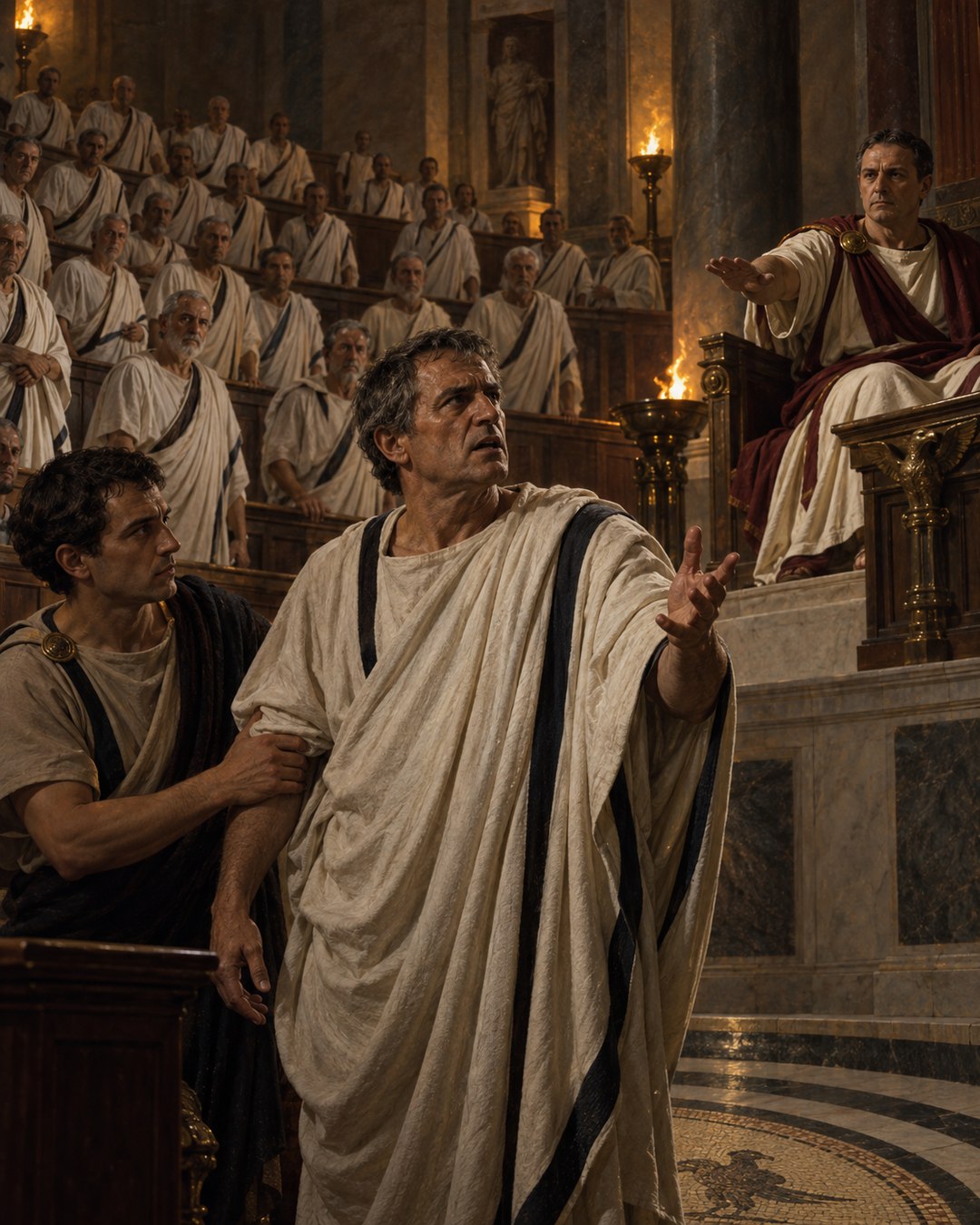
Cato was still speaking when Caesar called for the attendant.
The consul had asked for his opinion on a motion. Cato opposed it and used a senator’s procedural liberty to discuss another subject first, for as long as he wished. His aim, Gellius says, was to consume the whole day and prevent a decision.
Caesar answered by ordering him arrested in mid-speech and taken to prison. Then the chamber moved. The senators rose together and followed Cato out.
A dispute over speaking time became a contest over whether a Senate still existed when its members walked behind the prisoner.
Speaking Order Distributed Political Honor
Gellius begins before the confrontation by explaining who received the first request for an opinion. The order was not always fixed. At one time the senator placed first on the roll by the censors might lead. At another, the consuls-elect received precedence.
A presiding consul could also depart from customary order to honor a friend or relation. Even then, Gellius says, the first person called had to possess consular rank. Favor could rearrange prestige within a boundary; it did not make every senator equally eligible to open the debate.
The request mattered because it gave a senator the floor. Being asked first was both a compliment and an opportunity to shape what followed. Later speakers answered not only the motion but the arguments and atmosphere created before them.
During his consulship with Marcus Bibulus, Caesar reportedly called only four senators outside the usual order. Marcus Crassus came first among them. After Caesar’s daughter became engaged to Gnaeus Pompey, Caesar began asking Pompey first and explained his reason.
Gellius traces this information through Tullius Tiro, Cicero’s freedman, and through Ateius Capito’s work on senatorial conduct. The details reveal procedure as social architecture. Marriage, friendship, former office and formal rank could determine who spoke while the room was still most open to direction.
The Senate was therefore not just a crowd of opinions waiting to be counted. Sequence distributed visibility. Caesar could use the call as a mark of alliance, but calling a strong opponent also handed that opponent a procedural instrument.
An Opinion Request Opened a Larger Floor
Caesar called on Marcus Cato about a motion. Gellius does not identify that proposal in this chapter, and a careful account should not invent it. He tells us what Cato believed: the measure did not serve the public good and should not pass.
The normal modern expectation would be a direct answer followed by a time limit. The rule Gellius records worked differently. A senator asked for his view could speak beforehand on another subject of his choosing. He could continue as long as he wished.
That liberty made the question larger than its wording. “What is your opinion?” did not confine Cato to a brief declaration for or against. Once recognized, he could occupy the floor with preliminary matter and postpone the moment when the presiding consul moved toward decision.
Cato’s purpose was explicit. He tried to delay action by making a long speech and using up the entire day. The mechanism depended on the calendar of the sitting, not on persuading a majority sentence by sentence. If daylight and lawful meeting time expired first, the motion failed to reach its intended conclusion that day.
This was obstruction through a recognized right, not simply a man shouting over colleagues. Gellius presents the duration as something a senator was entitled to claim once called. Caesar had created the opening by requesting Cato’s opinion; Cato widened it until procedure threatened the agenda.
The episode adds another side to Cato’s argument that Rhodes should not be punished for a wish. There, speech separated intention from completed action. Here, speech itself became the action that prevented completion.
Caesar Replaced Procedure with Custody
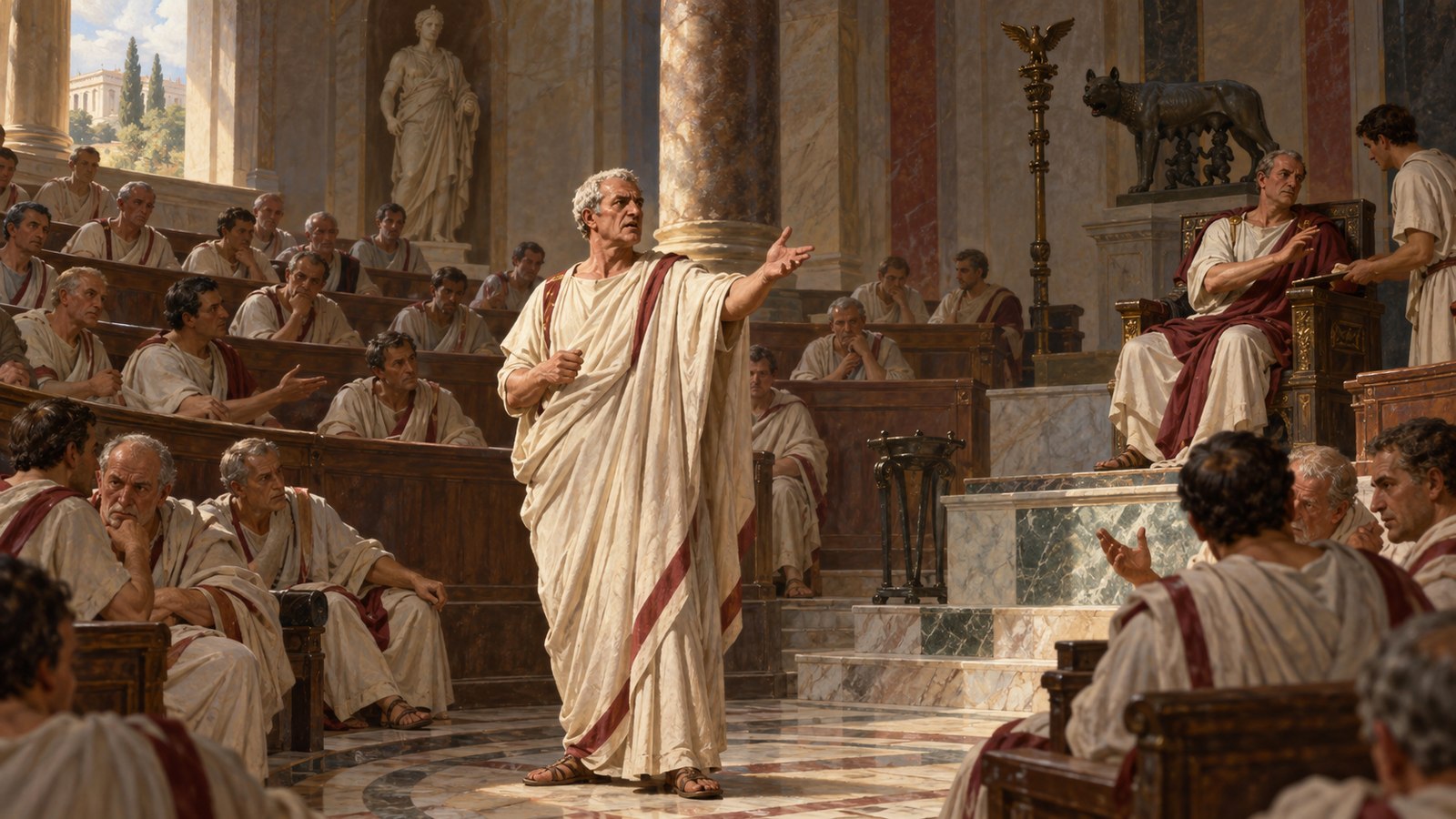
Cato would not stop. Caesar, acting as consul, summoned an attendant and ordered the speaker arrested while his words were still flowing. The instruction was physical and immediate: take him to prison.
That response attacked the source of delay rather than its argument. If the recognized speaker would not yield the floor, remove the speaker from the chamber. Custody could end in minutes what counter-speech might not end before the day was gone.
Yet arrest also changed Caesar’s position. He had been the presiding officer trying to advance a motion. Now he became the consul using coercion against a senator for exercising a procedural liberty attached to the opinion he had been asked to give.
Gellius’s phrase “in the full tide of his speech” preserves the rupture. There was no recorded conclusion, negotiated surrender or vote to close debate in this version. An attendant interrupted the body in the middle of the act that gave Senate deliberation its form.
The prison order was not merely a threat spoken for effect. Cato began to be taken away. The route out of the chamber forced every other senator to decide whether the sitting could proceed around the empty place.
Political force often seeks to isolate one opponent. Caesar’s order instead supplied the Senate with one unmistakable movement around which it could unite.
The Chamber Followed Its Removed Speaker
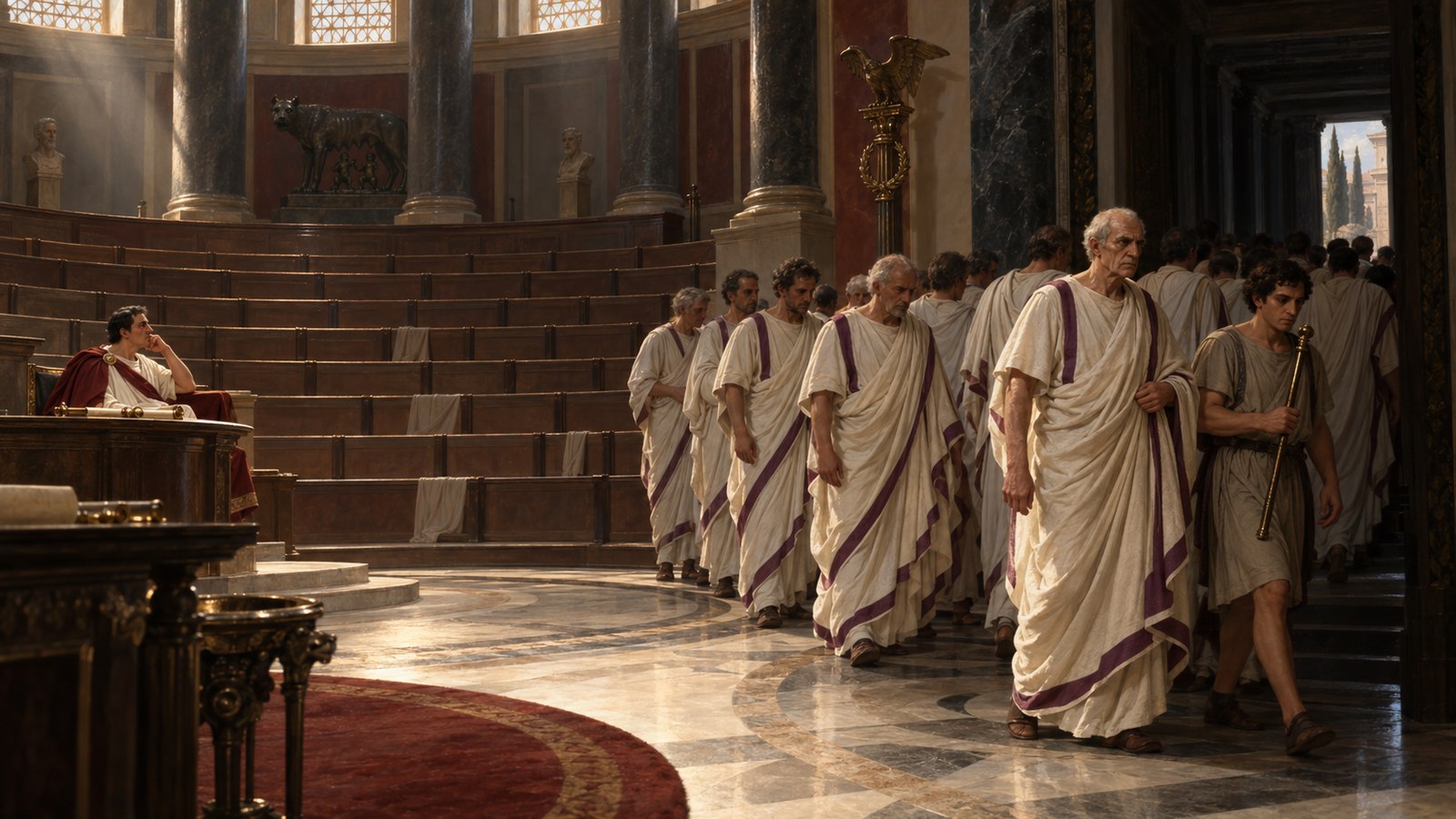
The senators rose in a body and accompanied Cato toward prison. Gellius does not describe a formal vote authorizing a walkout. The response took shape through coordinated movement.
That movement changed the practical meaning of arrest. Cato was no longer one obstructive senator removed so the remaining house could continue. He became the front of a departing institution. Benches emptied behind him, and the consul’s control of the room lost value as the room lost its members.
The Senate’s action also protected its own privilege. Members did not have to agree with every subject Cato chose or every minute he consumed. They could still recognize that arresting a senator for the duration of a lawful speech threatened anyone later called for an inconvenient opinion.
Following him was therefore both solidarity and self-defense. It turned an individual conflict into a question about the chamber’s capacity to deliberate without physical removal by its presiding magistrate.
A similar conversion of setting appears when Scipio redirected his trial day toward the anniversary of Zama. In each story, a political actor altered what the assembled crowd was doing. Cato’s case differs because the decisive redirection came from the senators behind him.
Caesar could command an attendant. He could not command the spectacle produced when an entire body chose the same corridor.
Release Admitted the Cost of an Empty Senate
Gellius says the arrest aroused such indignation that Caesar yielded and ordered Cato released. The source does not need a long description of negotiation. The sequence explains the pressure: arrest, collective accompaniment, public anger, reversal.
Cato’s speech had first threatened to consume the day. Caesar’s countermeasure threatened to consume the legitimacy of the sitting. Releasing Cato became the cheaper option.
No participant gained total control. Cato could delay but needed the procedural opening created when Caesar called him. Caesar could order arrest but needed senators to remain if the motion was to retain a functioning chamber. The Senate could follow Cato but turned protest into leverage only because its absence mattered.
The episode shows why procedure is not ornamental. Speaking order determined who acquired the floor. An open-ended right transformed recognition into time. Arrest tried to convert magistrate authority into silence. Collective withdrawal transformed silence into a louder political fact.
Gellius preserves the story in a chapter that begins with precedence and favor because the two halves belong together. The consul’s power to choose whom to ask could honor an ally or expose the agenda to an opponent. Once asked, a senator possessed tools that could exceed the presider’s intention.
Cato did not win by finishing an irresistible argument in Gellius’s telling. He won release because the attempt to stop his argument made the Senate stand up and leave with him.
Sources
Aulus Gellius, Attic Nights 4.10.