
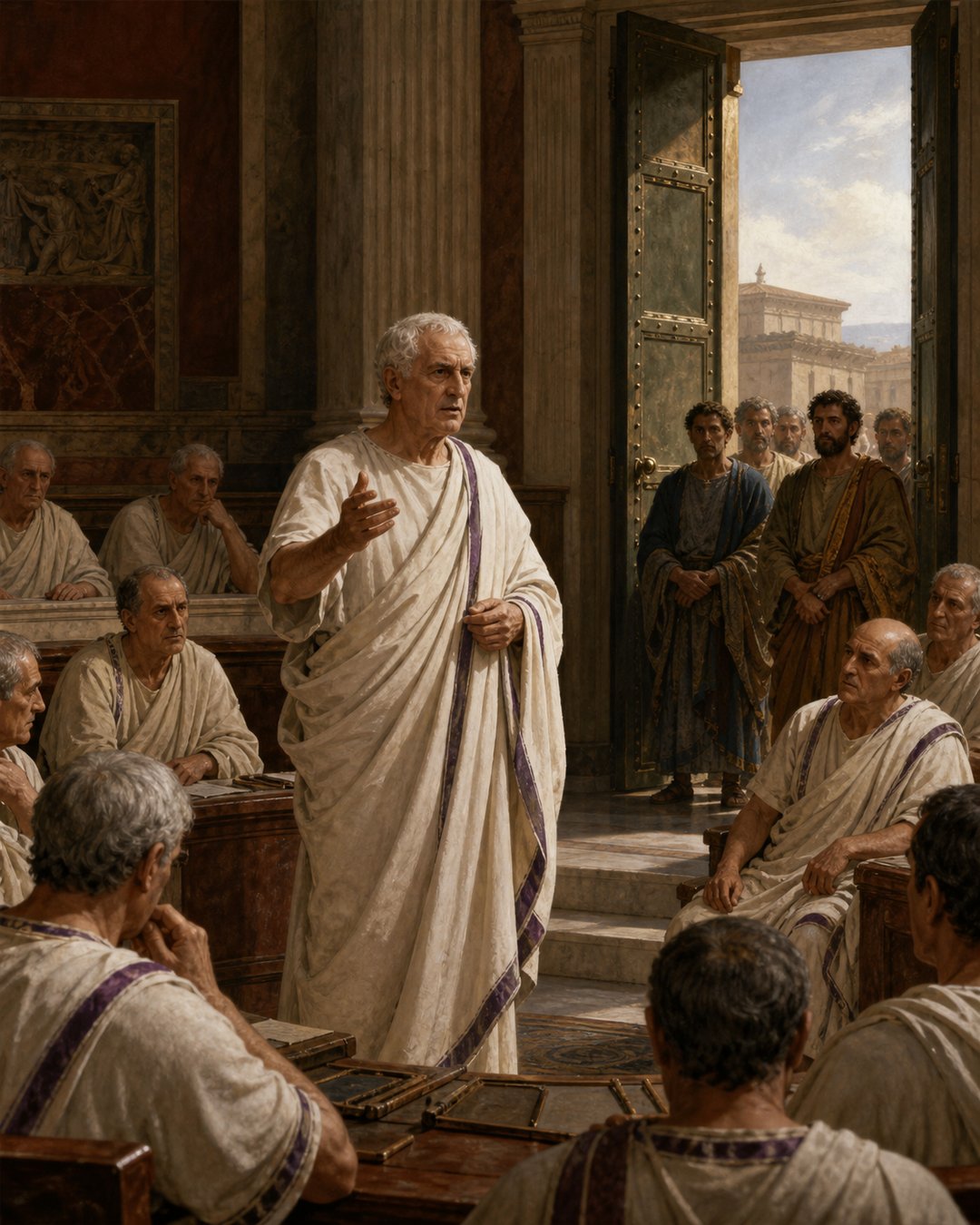
The Rhodian envoys had finished their plea and left the senate chamber. Behind them remained the consequences of words spoken at home: during Rome’s war with King Perses, men in Rhodian assemblies had urged support for Macedonia if peace could not be secured. Rhodes had taken no official action, but after Perses was defeated and captured, possibility itself became dangerous evidence.
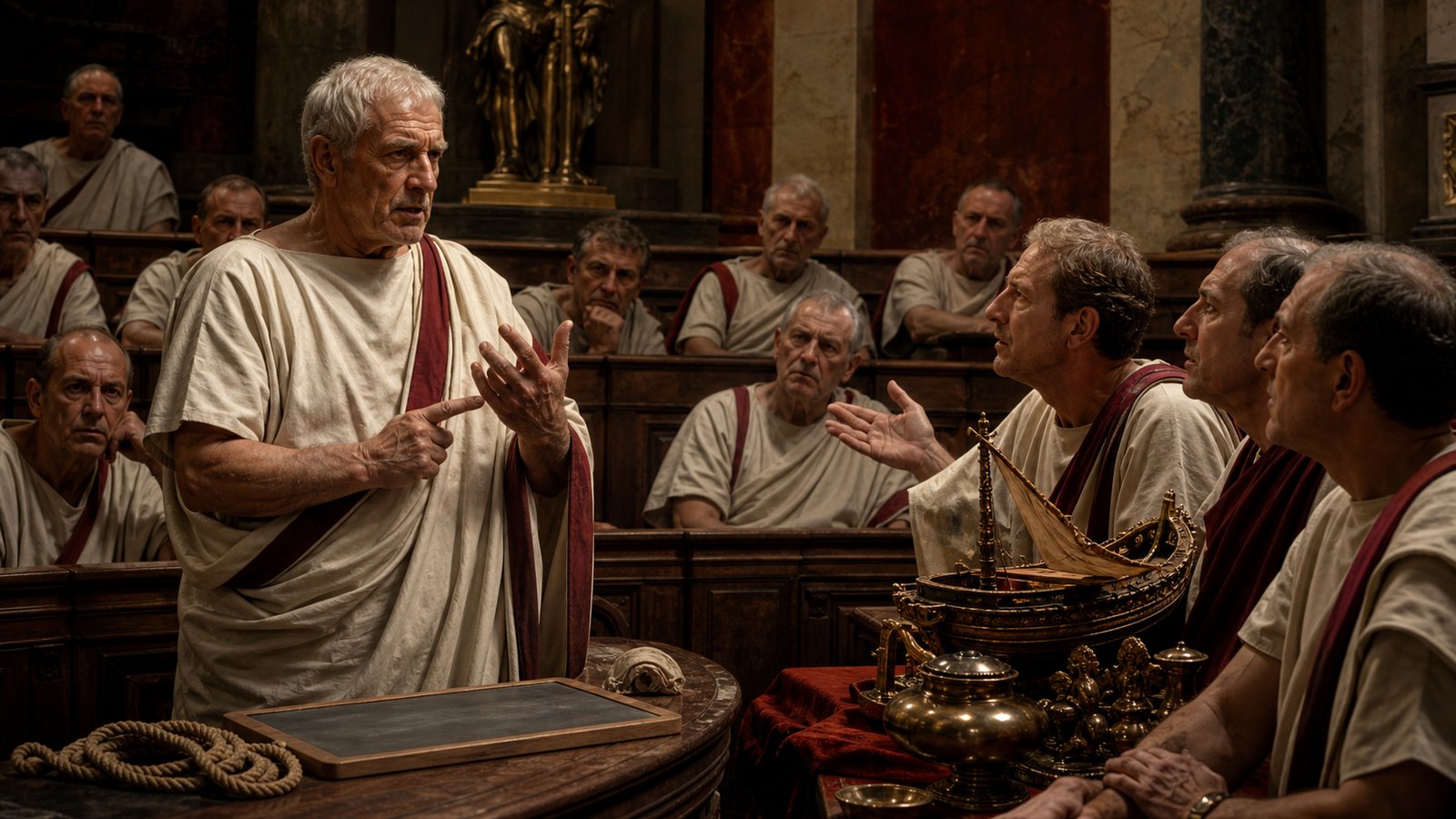
Some senators wanted war. Aulus Gellius adds an uglier incentive, saying that distinguished men were drawn toward the wealth they might seize. Marcus Cato rose in defence of the island. He did not pretend that every Rhodian had wished Rome well. Instead, he asked the victors to decide whether an unfriendly desire that never became public aid was enough to punish an allied community.
The question gave his speech its unusual engine. Cato moved the debate away from whether Rome could strike and toward what Rome would become if it treated intention as completed injury. His argument survived because it disturbed later readers too. Tullius Tiro, Cicero’s learned freedman, attacked it as dangerous cleverness; Gellius answered Tiro and preserved the fragments through their quarrel.
Victory Made the Senate a Dangerous Court
Rhodes entered the episode with more than one identity. Gellius calls it a friend and ally of the Roman people, celebrated for art, seamanship and naval victories. It also maintained cordial relations with Perses while Rome fought him. Its envoys repeatedly tried to reconcile the two sides, an effort that placed the island between powers whose conflict it could not control.
When peacemaking failed, some Rhodians argued in their public assemblies that the island should help Perses. The source draws a decisive line after reporting those speeches: no official measure followed. The words mattered enough to frighten Rhodes after the Macedonian defeat, but they had not yet become the action Rome claimed to fear.
The capture of Perses changed the balance. Rhodian diplomats came to Rome to apologize for the hastiness of certain fellow citizens and to defend the loyalty of the community. They pleaded humbly before withdrawing. Only then did the senate begin its internal decision, with voices accusing Rhodes of disloyalty and recommending war.
Cato’s first move was to question the judges’ state of mind. Prosperity, he warned, could puff up confidence and turn people away from sound counsel. Rather than praising the victorious senators, he suggested that joy had impaired them. He even advised waiting several days until Rome recovered self-command.
That opening distinguishes this scene from the senate speech captured in short strokes, where the marvel lies in preserving spoken language at speed. Here the pressure comes before any clerk could preserve an answer. Victory had made one outcome possible, and Cato tried to slow the moment when capacity hardened into policy.
Cato Conceded the Thought and Defended the Deed
Cato did not build his case on flattering innocence. He said he really thought the Rhodians had not wanted Rome to end the war as it did, with Perses defeated. Other peoples probably felt the same. If Rome no longer feared any rival, they could expect it to do whatever it chose and reduce their own freedom.
This concession was risky because it granted substance to the accusation. Tiro later complained that Cato had admitted a hostile motive instead of refuting it. Gellius replied that Cato was stating his own belief, not recording an official Rhodian confession. More importantly, the concession allowed the defence to turn on conduct rather than affection.
Rhodes had not publicly aided Perses. Its citizens could calculate their interests, fear Roman supremacy and still stop short of intervention. Cato compared that restraint with private behaviour: individuals fight fiercely to prevent what harms them, yet the Rhodians had permitted Rome’s victory to happen.
The distinction was not sentimental. An ally did not have to celebrate every expansion of Roman power to remain an ally. Cato treated reluctant inaction as politically meaningful. Rhodes had possessed reasons to prefer another outcome, but the state had not translated those reasons into the military assistance debated in its assemblies.
This placed the senate before a mirror. “Shall we be the first,” Cato asked in the fragment, “to do what we say they merely wished to do?” If Rome attacked because Rhodes might have attacked, the completed injury would belong first to Rome. Suspicion would not merely answer aggression; it would manufacture the deed whose absence made the case difficult.

Five Hundred Acres Tested Punishment for Desire
Cato then brought the rule down from relations between states to the private wishes of his listeners. Would any senator consider it fair to suffer punishment simply because someone accused him of wanting to do wrong? Cato answered for himself that he would not.
His examples were deliberately concrete. Suppose a law fined a person one thousand sesterces for wishing to possess something, provided the penalty stayed below half his property. Suppose desire for more than five hundred acres triggered punishment. Suppose wanting more cattle did the same. People wished for more, Cato said, and did so with impunity.
The analogy separated prohibition from mental appetite. Land and livestock could be limited by statute; an actual excess could be measured. Desire had no surveyed boundary stone. A magistrate could count cattle or acreage, but a wish reported by an opponent remained unstable material on which to build a penalty.
Cato sharpened the asymmetry with honour. Rome did not reward a person merely because he said he wished to act well but never performed the service. Why, then, should Rhodes suffer not for a wrong it had committed but for a wrong it was said to have wanted?
Tiro saw the weakness. Threatened injuries are not identical to promised benefits. A state that waits for an attack can lose the chance to prevent it. He also objected that wishing to exceed an agricultural limit was not equivalent to wishing an unjust war against Rome. The critic refused to let a familiar private desire make an international danger look harmless.
The objection keeps Cato’s argument from becoming a neat legal maxim. He was not drafting a general code of criminal intention. He was defending a particular ally in a senate fresh from victory, where unperformed desire could provide respectable language for senators who wanted Rhodian property.
The Speech Made Restraint Serve Roman Power
Gellius answers Tiro by describing Cato as a statesman rather than an advocate trapped by courtroom form. Cato had been consul and censor. He was advising on public safety, not trying only to charm jurors into pity. That role, Gellius argues, justified an opening that rebuked the senate rather than soothing it.
It also explains why the speech used several defences at once. Cato could say Rhodes had not wished for war, insist that empty wishes were not punishable, request forgiveness as though some fault existed, invoke friendship and argue that clemency protected Rome’s own greatness. The positions do not form a single polished theorem. They form layers around one political result.
The method resembles his better-known insistence that Rome keep returning to Carthage as a strategic question, but the direction is reversed. Against Carthage, repetition kept danger present. For Rhodes, distinctions prevented imagined danger from becoming automatic war. Cato’s severity could support expansion in one setting and restraint in another because the decisive issue was what he judged useful for Rome.
His defence therefore did not ask senators to forget Rhodian speeches. It asked them to rank evidence. Public aid to Perses would have been an act. Assembly proposals that produced no official decision were something less. Private fears about Roman domination were understandable calculations, not proof that an ally had crossed into war.
The surviving fragments leave a hard lesson about victorious power. Prevention can sound prudent even when the feared action never occurred. Once the possible enemy is wealthy, punishment can also reward the punishers. Cato interrupted that combination by forcing the senate to name the distance between suspicion, desire, decision and deed.
Rhodes was saved not by a claim that everyone on the island loved Rome, but by an argument that alliance could survive unwelcome thoughts. Cato made restraint look neither weak nor generous. It was a test of whether Rome could govern its own victory before claiming the right to govern everyone else’s intentions.
Sources
Aulus Gellius, Attic Nights, 6.3.