
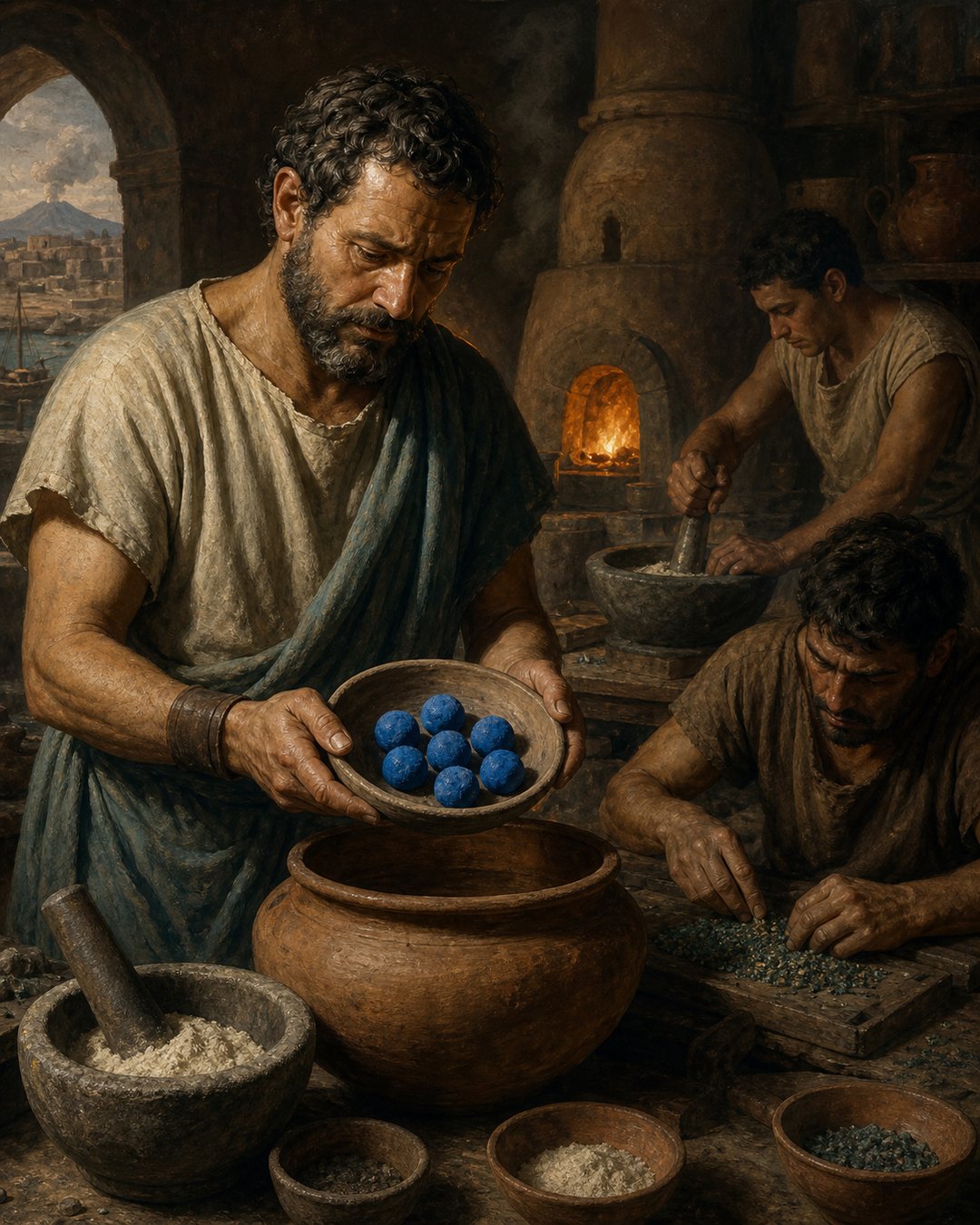
A worker at Puteoli could begin with a bench that hardly promised brilliance: pale sand, flower of natron, coarse copper filings and water. The blue appeared only later, after those materials had been ground, mixed, rolled into balls, dried, enclosed in pottery and fired. In Vitruvius’s account, color was not gathered ready-made. It was constructed through order.
He associated the first manufacture with Alexandria and named Vestorius as the man who later made it at Puteoli. That short geographical sequence gives the recipe a human route. A process linked with an Egyptian center of learning and production crossed the Mediterranean and became reproducible in an Italian port through ingredients, hands, containers and heat.
The value of the passage lies in its verbs. Each one changes what the next stage can accomplish. Coarse matter becomes flour-fine powder. Dry powder becomes paste. Paste becomes discrete balls. Wet balls become dry furnace charges. Inside an earthen vessel, heat finally makes sand and copper acquire a color neither displayed at the start.
Alexandria Supplied a Process, Not a Blue Stone
Vitruvius introduces the material as something manufactured. His language matters because it separates this blue from a mineral selected mainly for an existing hue. The recipe begins with substances whose final appearance cannot simply be sorted out of a quarry pile. Making is the central fact.
Alexandria stands at the beginning of his brief history. Vestorius comes next at Puteoli. Vitruvius does not tell us when Vestorius learned the process, who instructed him, how large his workshop was or how pigment moved from furnace to painter. Those omissions limit any biography we might want to build around the name.
What survives is still unusually concrete. The method could travel because it had a sequence. A craftsperson did not need to carry an Alexandrian landscape to Italy. The transferable object was knowledge about proportions of texture, the order of mixing, the shape of the charge and the conditions of firing.
Puteoli gives that transfer a plausible workshop setting without proving a particular building or trade network. It was a port where materials and people could meet, but Vitruvius’s sentence does not inventory Vestorius’s suppliers or customers. The safe claim is narrower: a blue first associated with Alexandria was subsequently manufactured there by a named maker.
That differs from the process in red ore sweating quicksilver before becoming wall paint. Both passages reveal color through handling and heat, yet the blue recipe is explicitly synthetic. Its ingredients do not merely yield separate products. They are made to exchange qualities in the furnace.
Flour-Fine Sand Met Coarse Cyprian Copper
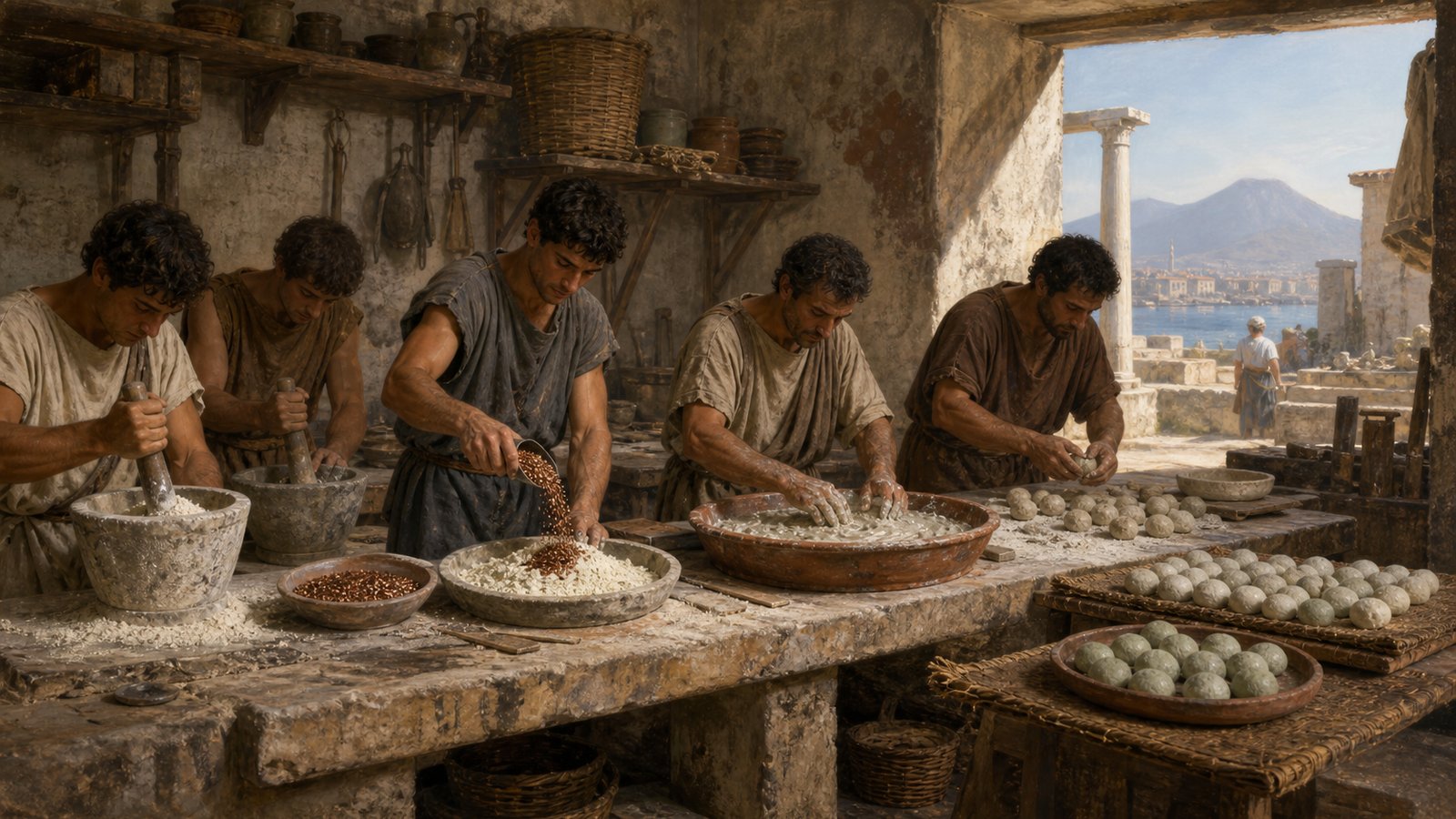
The preparation begins by grinding sand with flower of natron. Vitruvius supplies a tactile standard for completion: the mixture should become as fine as flour. He does not give a grain measurement, but the domestic comparison makes the intended texture legible to readers who knew what properly milled flour felt and looked like.
Fineness created uniform material for mixing. Large grains would have behaved differently from powder during wetting and shaping. Vitruvius does not explain that in chemical terms, so the source should not be made to speak as a modern laboratory manual. He simply makes the flour-like state a required checkpoint before copper enters.
The copper arrives in a different texture. The filings are coarse, and Vitruvius calls them Cyprian. The contrast is striking: sand and natron have been reduced together, while the metal retains visible particulate character. The recipe does not demand that every ingredient pass through the same degree of grinding.
That difference makes the bench easy to imagine without inventing machinery. Mortars and grinding labor produce one fine mixture. Filing produces another material. The maker judges each by a separate visible or tactile condition and then combines them only when both are ready.
Cyprian copper also embeds geography inside the mixture. Alexandria names the origin of manufacture; Puteoli names Vestorius’s later production; Cyprus remains present in the metal’s description. Vitruvius offers no supply contract, price or shipment record, but one line of recipe vocabulary preserves a material identity that reached beyond the immediate furnace room.
Hands Turned Wet Paste into a Furnace Charge
Water converts the dry ingredients into paste. This stage has no glamour, but it changes the material from something that scatters into something that can hold a chosen form. Vitruvius then specifies the tool: the mixture was rolled into balls by hand.
Shaping divided a loose batch into units that could be moved, dried and arranged. The text gives no standard diameter and no count per vessel. Any reconstruction must therefore resist rows of perfectly calibrated modern spheres. What it can retain is the practical logic of hand-sized portions sturdy enough to survive transfer.
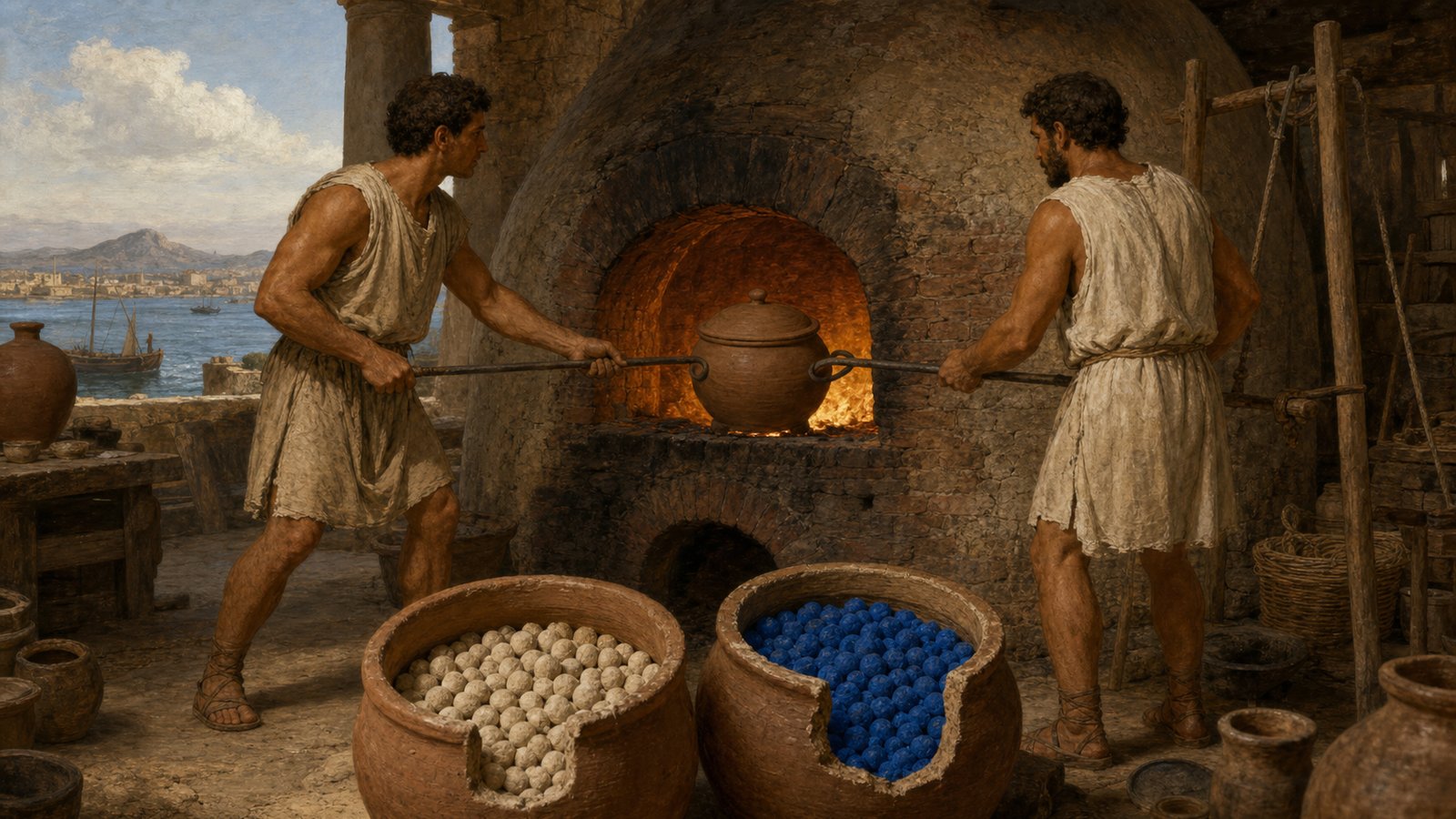
Drying comes before enclosure. The order prevents us from imagining wet paste pushed directly into the hottest part of the workshop. Time outside the furnace belonged to the process. A ball had to lose moisture and become a suitable charge before firing could begin.
The dried forms went into an earthen vessel, and that vessel went into the furnace. There were thus two layers around the transforming material: shaped bodies enclosed by pottery, and pottery enclosed by heat. Vitruvius does not identify a lid, atmosphere, firing duration or precise furnace design, so those remain questions rather than missing facts we may casually supply.
The container nevertheless deserves attention. The fire did not simply lick an exposed heap of sand and copper. The ingredients heated together inside a manufactured ceramic object. Potter, metalworker, grinder and pigment maker may represent separate skills, though the source does not divide the workforce. The recipe itself joins the products of those skills into one operation.
Fire Made the Ingredients Exchange Qualities
Vitruvius describes the decisive moment as mutual transformation. Copper and sand heated together in the intensity of the fire, imparted their different qualities to each other and acquired blue. His explanation belongs to ancient technical language, not modern chemistry, but it records an exact observation: neither ingredient could be understood alone once firing had done its work.
The furnace was therefore not merely a dryer. Drying had already happened. Nor was it just a convenient source of warmth. Intense fire created the condition under which the mixture became the product worth naming.
This separates the recipe from lead sheets changed by vinegar vapor into white pigment. In that process, vessels controlled exposure over time before roasting could create another red material. Vestorius’s blue depended on a prepared composite fired together, with sand, natron and copper entering one sequence.
For a painter, the finished blue may have seemed like a stable choice on a palette. Vitruvius makes its hidden history visible. Behind the color stood flour-fine grinding, coarse metallic filings, wet hands, patient drying, breakable earthenware and a furnace hot enough to complete the conversion.
That hidden labor is the article’s real subject. Calling a material “blue” describes what the eye receives at the end. The recipe describes how a workshop repeatedly arrived there. Every stage supplied a gate: wrong texture before mixing, unworkable paste, badly formed balls, incomplete drying or inadequate firing would interrupt the chain before color could emerge.
Vestorius’s achievement, as Vitruvius preserves it, was disciplined reproducibility. The craft did not wait for nature to present a finished lump of blue. It took ordinary-looking substances through controlled states until the furnace produced something new. Alexandria supplied the first location in the story; Puteoli proved that the process could live somewhere else.
Sources
Vitruvius, On Architecture, 7.11.1.