
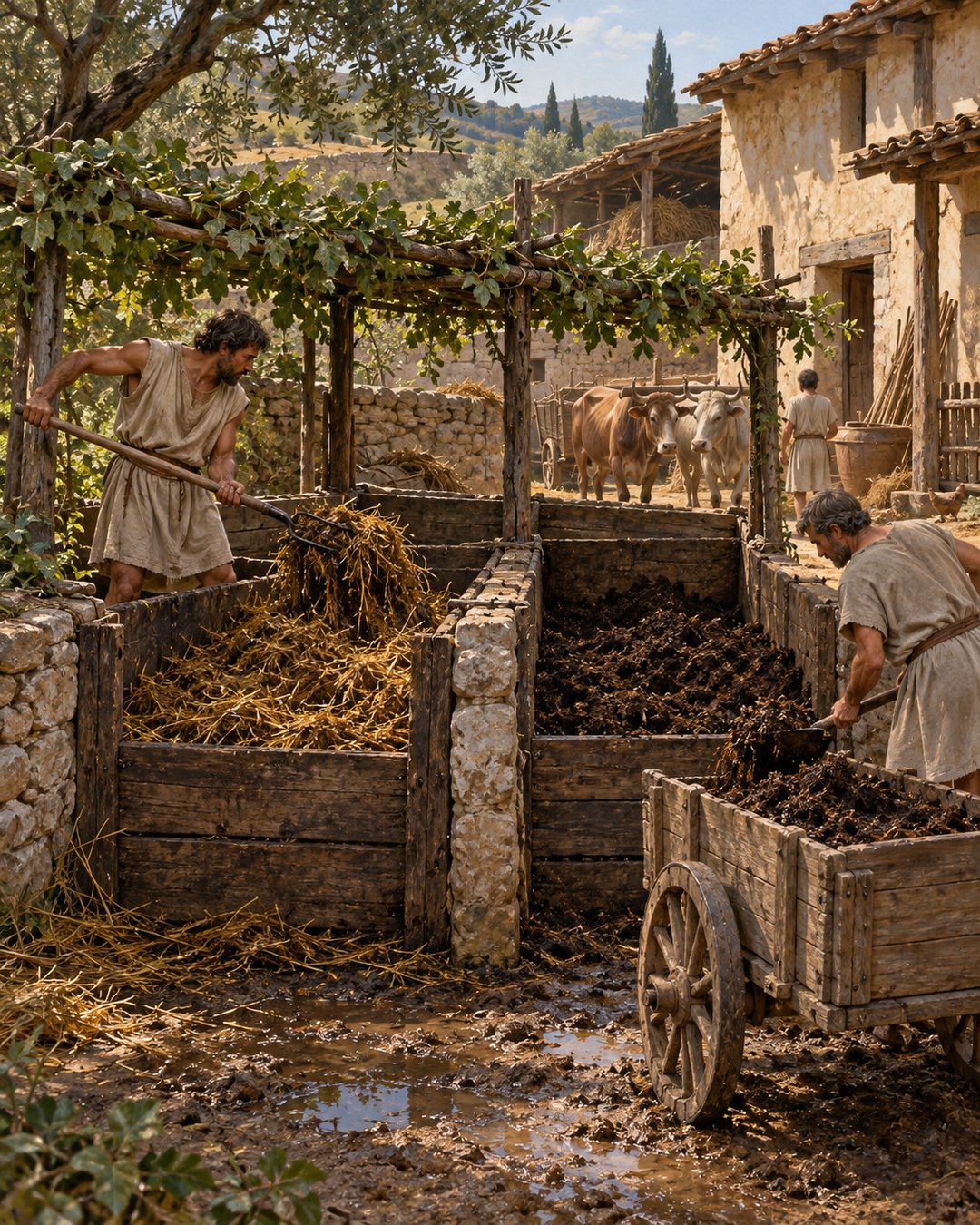
Fresh manure went into one compartment. Rotted manure left from another. Between those two movements stood a pit shaded with branches and leaves, damp enough to keep the sun from drawing away what a Roman farming writer called its “strength.”
Marcus Terentius Varro’s instructions turn an unpleasant heap into a sequence. The outer yard gathered chaff, straw, and animal waste under the feet of cattle. Workers cleaned that mixture away. Divided storage kept new material separate from the portion ready to haul to the fields. Even the pit’s position, cover, and water mattered.
This is not a modern chemical account, and Varro does not measure decomposition. It is an ancient prescription preserved in On Agriculture. Its value lies in the arrangement he describes: Roman farm waste was not necessarily thrown into one timeless mound. On the estate he imagined, collection, aging, protection, and application were different jobs.
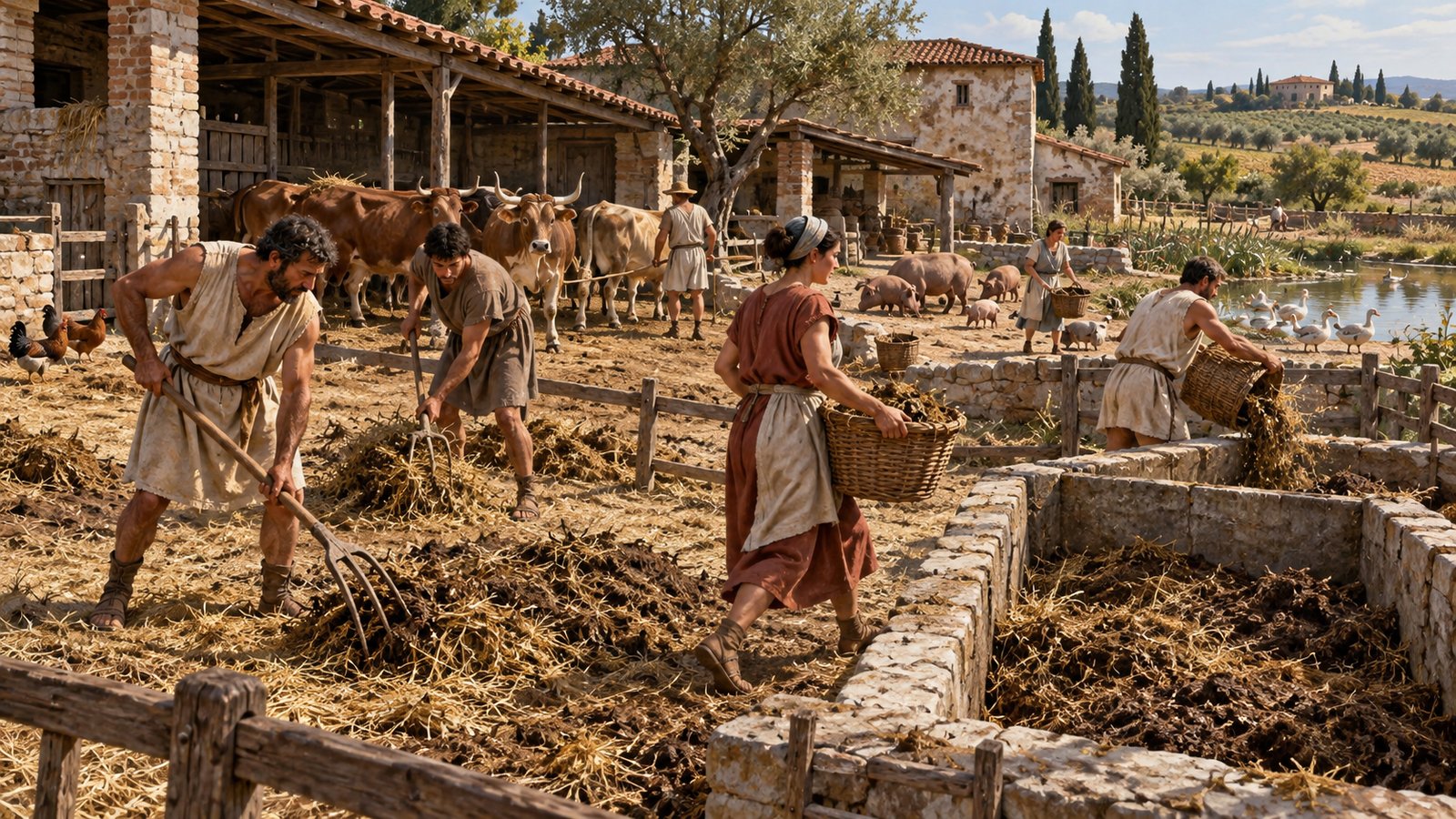
The yard became a collection system
Varro begins with the spaces around the farmstead. His outer yard could contain a pond where geese, hogs, and pigs bathed after returning from pasture. The same water served for soaking lupines and other products made more useful by immersion. Animals, crop handling, and storage therefore met in a working zone rather than in isolated buildings.
The ground of that yard was often covered with chaff and straw. Cattle trampled it. Varro says what workers cleaned from this surface made the yard a “handmaid” of the farm. The phrase is revealing because it assigns productive work to a place that could otherwise look like residue between the important structures.
Collection began before anyone reached the manure pit. Hooves pressed bedding and plant debris together with animal waste; sweeping or shoveling recovered it. The prescription does not tell us that every Roman estate followed the same plan, but it does show what an experienced author wanted readers to notice. A well-arranged yard captured material that careless circulation might scatter.
That concern fits the demanding rhythm in Cato’s list of duties for a farm overseer, where manure appears among many tasks competing for labor. Varro approaches the problem through layout. If the useful debris accumulated where animals already moved, and if storage stood close by, less effort was wasted carrying it across the estate.
Two compartments gave time a place to work
Hard by the farmstead, Varro wanted two manure pits, or one pit split into two parts. The distinction between them was temporal. Fresh manure was cast into one side. Well-rotted manure was hauled from the other side to the fields.
That division prevented the newest load from being confused with the material that had already waited. A single mixed heap would constantly receive fresh additions; the separated plan let one portion mature while the other filled. Varro states the practical judgment directly: manure applied fresh was not as good as manure that had rotted thoroughly.
The pit therefore acted like a calendar built into the farmyard. It required no written date on each basket. Location recorded status. Workers could see which compartment was receiving and which was supplying. The wall or gap between them translated elapsed time into a simple physical rule.
This modest structure also connected repeated small acts with a seasonal field operation. Yard sweepings arrived load by load. Rotted material later left in bulk for land that needed it. The two-part design held those different tempos together without pretending they were the same job.
Varro gives no universal dimensions. Size would have depended on the estate, its stock, and its fields. What he specifies is the relation between parts: near the steading, fresh separate from old, one side filling while the other side was ready to empty. The mechanism mattered more than a monumental building.
Shade and water were part of storage
The best pit, Varro continues, was protected from the sun across its top and sides. Branches and leaves provided the cover. His explanation is that sunshine should not dry out the “essence” the land required. Whatever we make of that ancient vocabulary, the operational instruction is unambiguous: do not let the stored mass bake dry.
Experienced farmers, he says, arranged the place so that water could collect there when possible. They believed moisture preserved its strength. Cover and water worked toward the same goal, limiting the drying that Varro associated with lost value.
The image is far removed from a random pile left wherever a cart stopped. Someone had to choose the site, construct or divide the pit, provide shade on more than one face, and consider drainage in reverse: here, some collected water was desirable. The storage area demanded maintenance because its contents changed while they waited.
Varro adds a detail that makes the farmstead’s circulation even more visible. Some people placed the servants’ privies over the pit. He offers the arrangement without sentiment. Household waste entered the same managed stream as material gathered from animals and the yard.
Different manures were not interchangeable
Later in Book One, Varro broadens the discussion from the pit to the kinds of manure placed on land. He reports Cassius’s ranking of bird dung above other kinds, while excluding marsh and sea birds. Pigeon dung stood out for what the text calls its heat and its ability to make the ground ferment.
Application changed with the material. Pigeon dung was to be broadcast like seed, not left in piles like cattle manure. The comparison shows that “manure” was not one substance with one handling rule. Source, concentration, and destination altered the recommended method.
Varro offers his own preference for dung from aviaries holding thrushes and blackbirds. Its value could enter a lease: tenants paid less when an owner reserved the aviary dung instead of letting them use it. The same bird-keeping economy appears from another angle in the specialized thrush rooms built for elite markets. The birds produced both a saleable flock and a by-product worth bargaining over.
The hierarchy continued. Cassius placed human excrement after pigeon dung, then the dung of goats, sheep, and asses. Horse dung came last in the general ranking, yet Varro did not call it useless. It suited grain land and was especially valuable on meadows when it came from draught animals fed on barley, because it encouraged abundant grass.
Such qualifications matter. They show a practice based on observed differences rather than a neat universal table. A material ranked poorly in one comparison could be preferred for a particular field. The farmer had to know both what entered the heap and where the finished load would go.
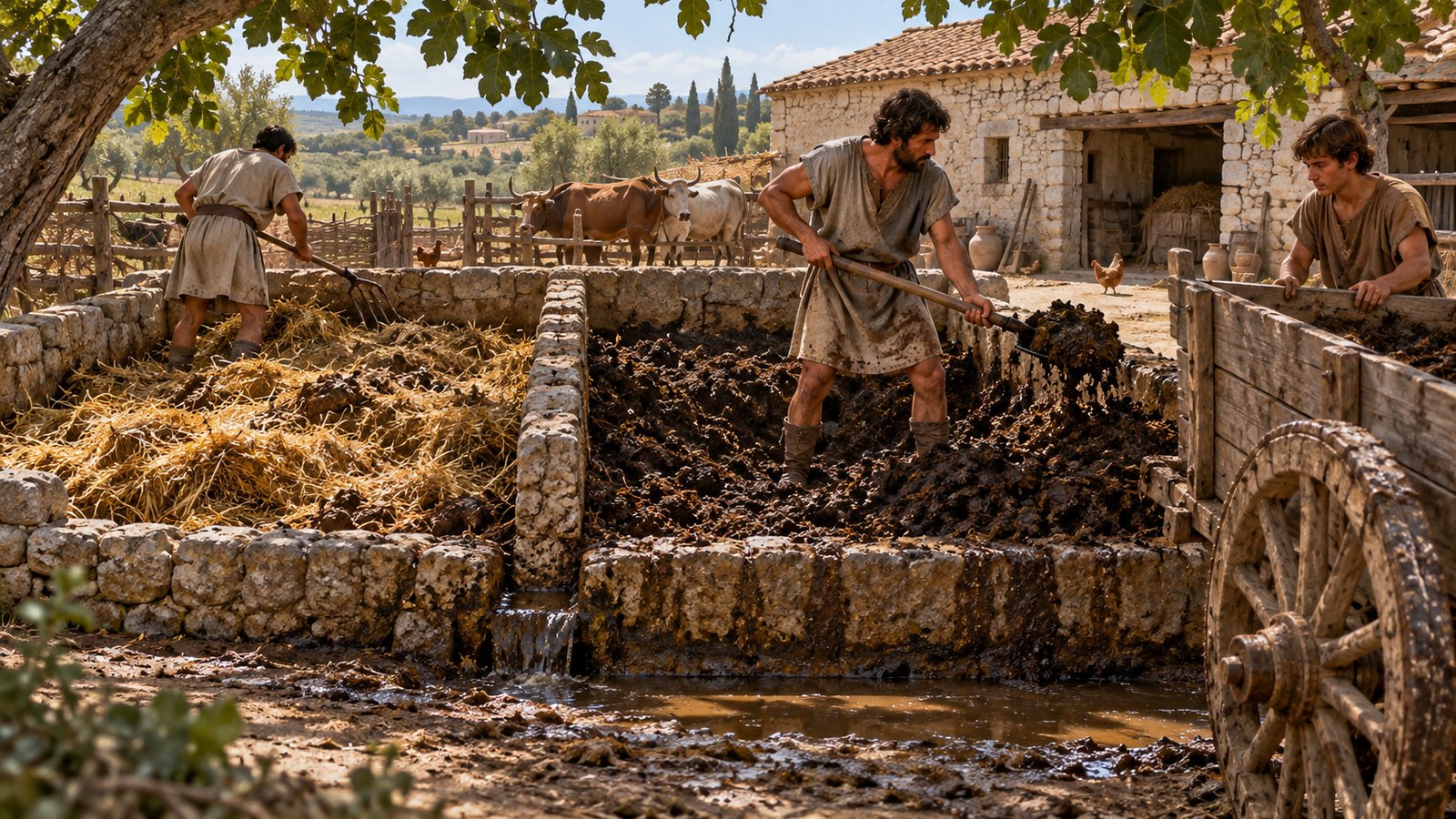
Placement still reduced work. Varro wanted the dung-hill close to the steading so it could be cleared with the least labor. He then records a belief that an oak stake driven into its center stopped serpents from breeding there. The report belongs to the ancient text, not to verified pest control. It reminds us that practical layout, inherited advice, and claims we would now treat skeptically could stand side by side in a Roman agricultural manual.
The durable lesson in Varro’s description is the sequence itself. The yard gathered. The compartments separated. Shade and moisture protected. Workers hauled only the rotted portion. Farmers then adjusted application according to the kind of dung and the ground receiving it. Waste became useful not through one clever trick, but through a chain of small decisions built into the farm.
Sources
Varro, On Agriculture, 1.13 and 1.38.