
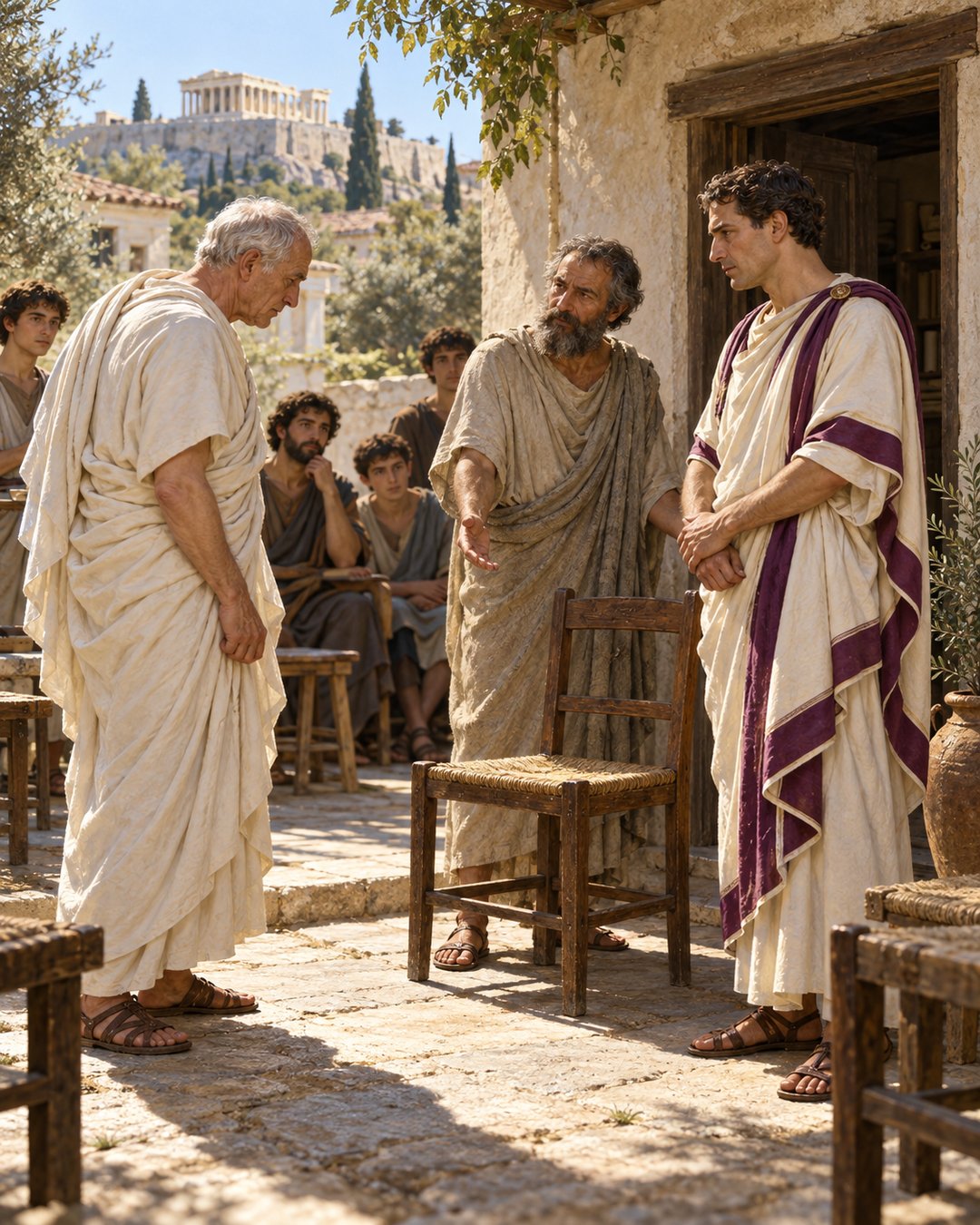
One chair made the difficulty visible. A Roman provincial governor entered the Athenian rooms of the philosopher Taurus with his father beside him. The son held magistracy; the father held the claims of age and parenthood. When a seat arrived before the others, even an ordinary gesture of hospitality required someone to decide which kind of honour came first.
Aulus Gellius records the conversation in Attic Nights. His answer is not that Roman rank always defeated family or that fathers always outranked sons. Taurus drew a boundary between settings. Public office governed public acts. In private company, natural seniority returned. Gellius then sharpened that distinction with a second scene in which a consul made his own proconsular father dismount before him.
The two episodes expose a practical grammar of status. Romans could carry several claims at once: age, kinship, office, prior office, and authority delegated by the people. Courtesy depended on knowing which claim the occasion activated.
A single chair forced the question
The first scene takes place far from Rome. A governor of Crete, described as a man of senatorial rank, had come to Athens to meet Taurus. His father accompanied him. Taurus had just dismissed his pupils and was seated outside his room, talking with Gellius and others, when the pair arrived.
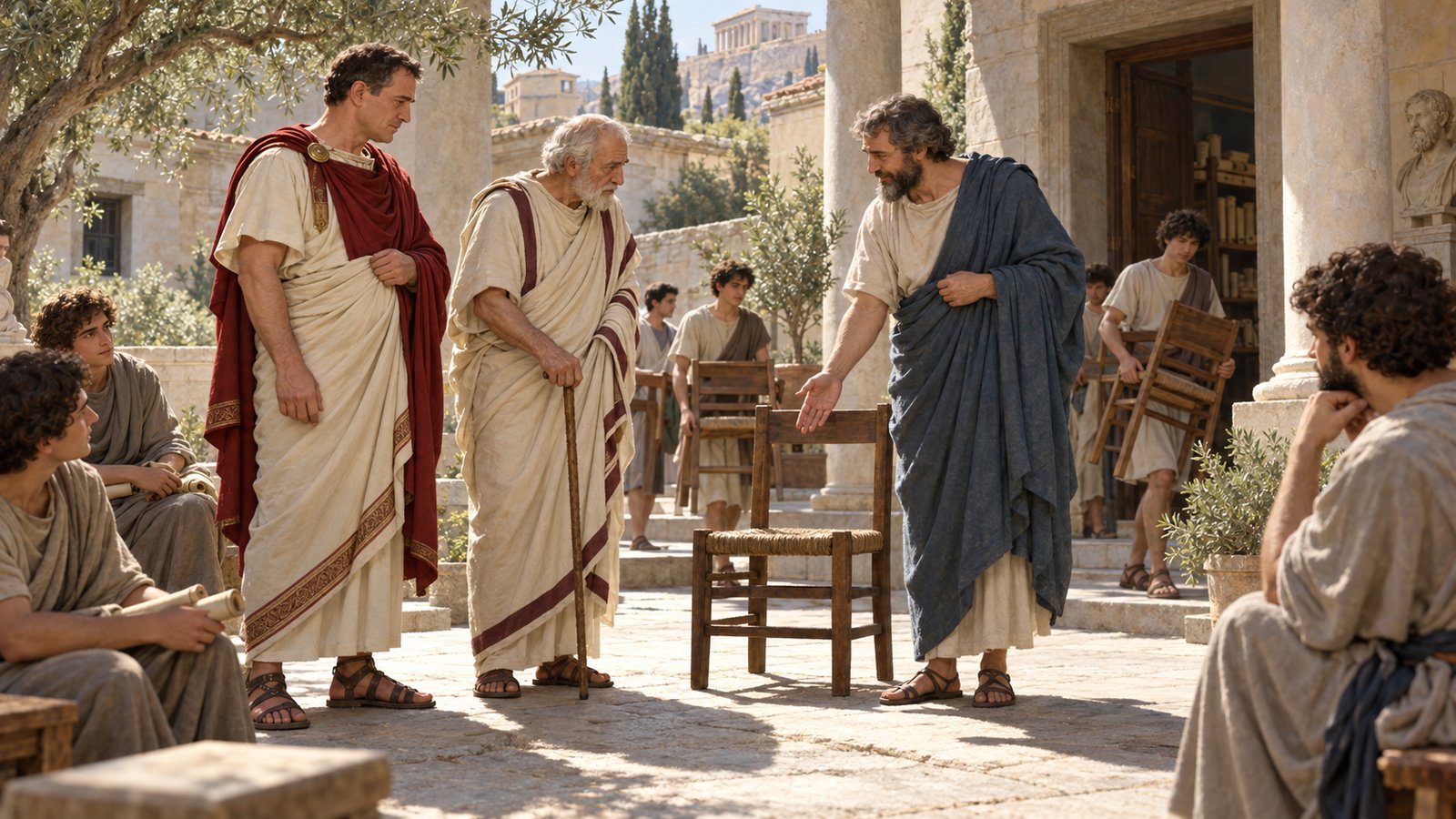
After greetings, one chair was brought while servants or attendants fetched more. Taurus invited the older man to sit. The father resisted the invitation. His son, he said, should take the seat because he was a magistrate of the Roman people.
That reply did not merely express parental modesty. It identified a real competing title to precedence. The son was not simply younger; he represented Roman authority. Yet Taurus refused to let the office settle every possible context. He asked the father to sit provisionally while the company considered whether the proper priority belonged to the parent or the magistrate.
The physical modesty of the room matters. There was no tribunal, procession, or official bench to announce the rules. There was one chair near a philosopher’s doorway. The uncertainty arose because rank had entered an unofficial space without shedding its public associations.
Taurus separated office from intimacy
Taurus’s solution depended on place and action. In public places, public functions, and official acts, he said, a father’s rights yielded somewhat before the authority of a son who was a magistrate. The qualification matters: Gellius does not erase fatherhood, but describes it as eclipsed for a defined purpose.
At home, while walking together, or while reclining at an intimate dinner, the official distinction ended. Natural and inherited distinctions then came into play. The older father recovered the priority that belonged to him in domestic life.
Taurus classified the visit in his own house as private. Their conversation and inquiry into duties were not acts of provincial government. The father could therefore accept the first chair without challenging Roman authority. He was being honoured as the elder man in the kind of setting where age and parenthood governed the order.
This distinction resembles the precise rules explored in the Julian law’s ordering of consular precedence, but it operates differently. The law counted children and marital status for a particular official priority. Taurus instead changed the governing rule when the participants crossed from public duty into private sociability.
A lictor turned family harmony into command
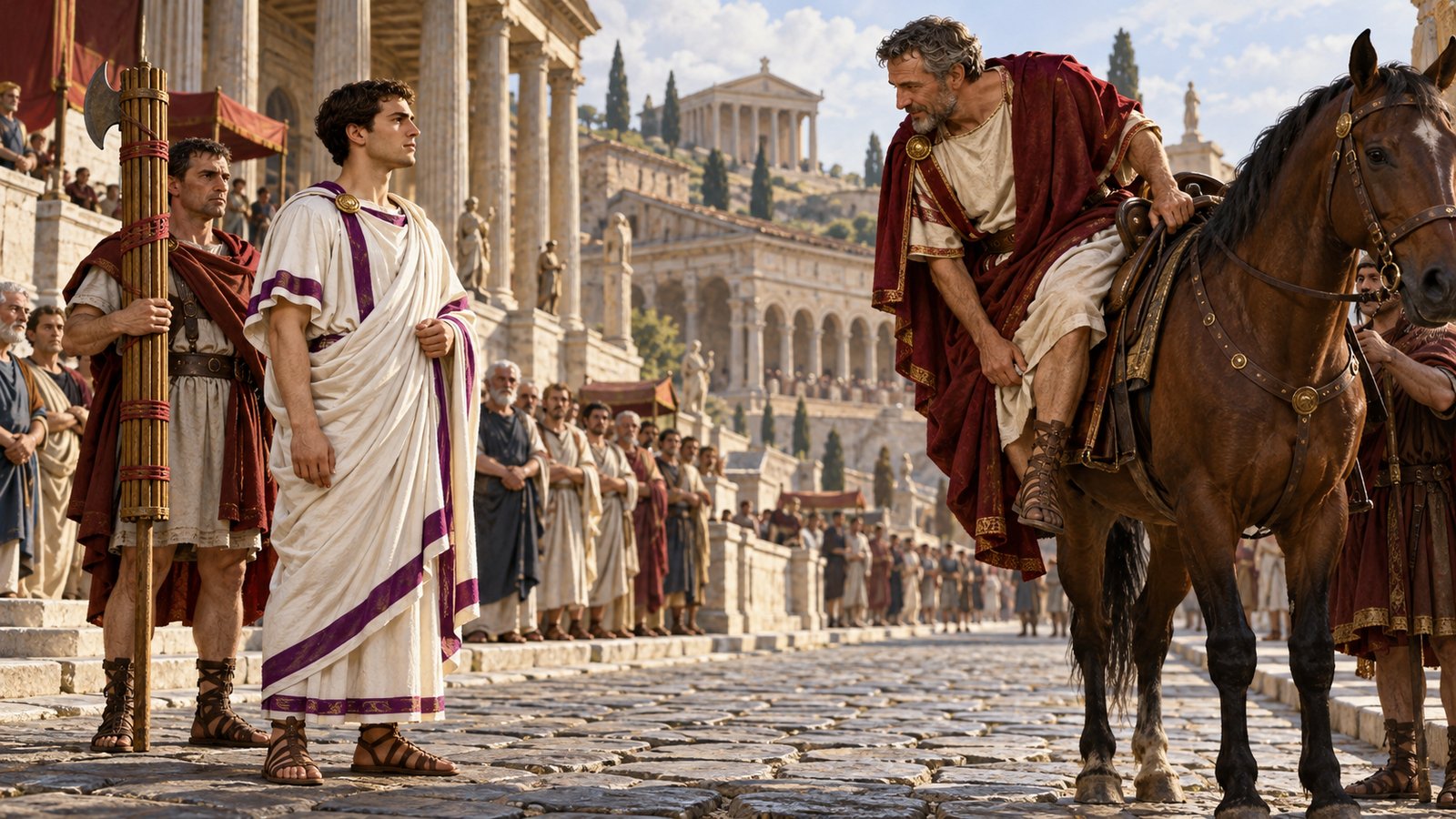
Gellius did not leave the argument at the level of polite theory. He added an annalistic story from Claudius Quadrigarius. Tiberius Sempronius Gracchus and Quintus Fabius Maximus had been elected consuls; Fabius was the son of the man who had held the consulship the previous year and was now serving as proconsul.
The father approached his son on horseback. Because he was the consul’s father, he did not dismount. The lictors knew the two men lived in exceptional harmony and hesitated to order him down. Their hesitation shows that the family relation was not invisible. It was precisely what made enforcement awkward.
The consul broke that pause with a short prompt: “What next?” His lictor understood and ordered the proconsul to dismount. The father obeyed. More than that, he warmly praised his son for defending authority given by the Roman people.
Here the setting was official, so Taurus’s public rule applies. The son did not demand personal submission from his father. He maintained the office’s precedence through its attendant. The lictor’s command made the distinction institutional: the person on horseback was a father, but the approaching official was also a proconsul meeting a consul.
The father’s praise closes the potential conflict. Family harmony was demonstrated not by suspending the public rule, but by accepting it. In Gellius’s telling, affection and office remained compatible because both men recognized where one kind of precedence ended and another began.
Roman rank changed with the room
These stories resist a flat chart of Roman hierarchy. A governor could outrank his father in one act and yield him a chair in another. A former consul and current proconsul could still be required to dismount before his consular son. The decisive question was not only who each man was, but what they were doing.
That situational quality also helps explain why procedure mattered so much in Roman political life. The senate’s meeting rhythm, for example, could be fixed with comparable care, as seen in Augustus’s rules for regular senate days. Office became legible through repeated signals: seats, attendants, movement, summonses, and the behavior expected in defined spaces.
Gellius writes as a collector of remembered distinctions. Taurus supplies a philosophical formulation; Quadrigarius supplies a Roman precedent. Together they show etiquette doing constitutional work at human scale. A chair and a horse carried no authority by themselves. They became tests because everyone present understood that sitting, remaining mounted, or dismounting expressed whose claim governed the moment.
The result was neither simple filial obedience nor simple official dominance. Roman honour could reverse as a group moved from a public approach to a private doorway. Good judgment consisted in noticing that change before courtesy became insult.
The contrast also explains why neither episode can be reduced to a lesson that sons should command fathers. At Taurus’s door, the son’s office did not vanish, but it supplied no official task for him to perform. The father’s first instinct was to honor the magistracy; Taurus’s judgment restored the domestic order because the meeting itself was private. In the road encounter, by contrast, the consul was already acting through a lictor. Refusing the public form there would have made a family exception visible inside an official act.
Gellius further divides authority from aggression. Taurus speaks “seriously and pleasantly.” The consul uses a brief prompt rather than a quarrel. The proconsular father dismounts and praises the correction. Each participant helps preserve the boundary. The philosopher names it, the lictor enforces it, and the father confirms that obedience to office need not signal a broken household.
That cooperation gives the story its force. A rule of precedence worked because observers could read the setting and because the people with rival claims accepted the same classification. If the chair had stood on a tribunal, or if the horse had approached a family dinner, the proper answer in Taurus’s scheme would have changed. Rank lived not only in titles but in relationships among place, action, and audience.
The two fathers also prevent age from appearing weak. The governor’s father is secure enough to offer the chair away. Fabius is secure enough to dismount and commend his son. Their deference is represented as judgment, not defeat. Gellius’s ideal is a hierarchy flexible enough to protect both civic command and paternal honour without pretending they always point in the same direction.
Sources
Aulus Gellius, Attic Nights, 2.2.