
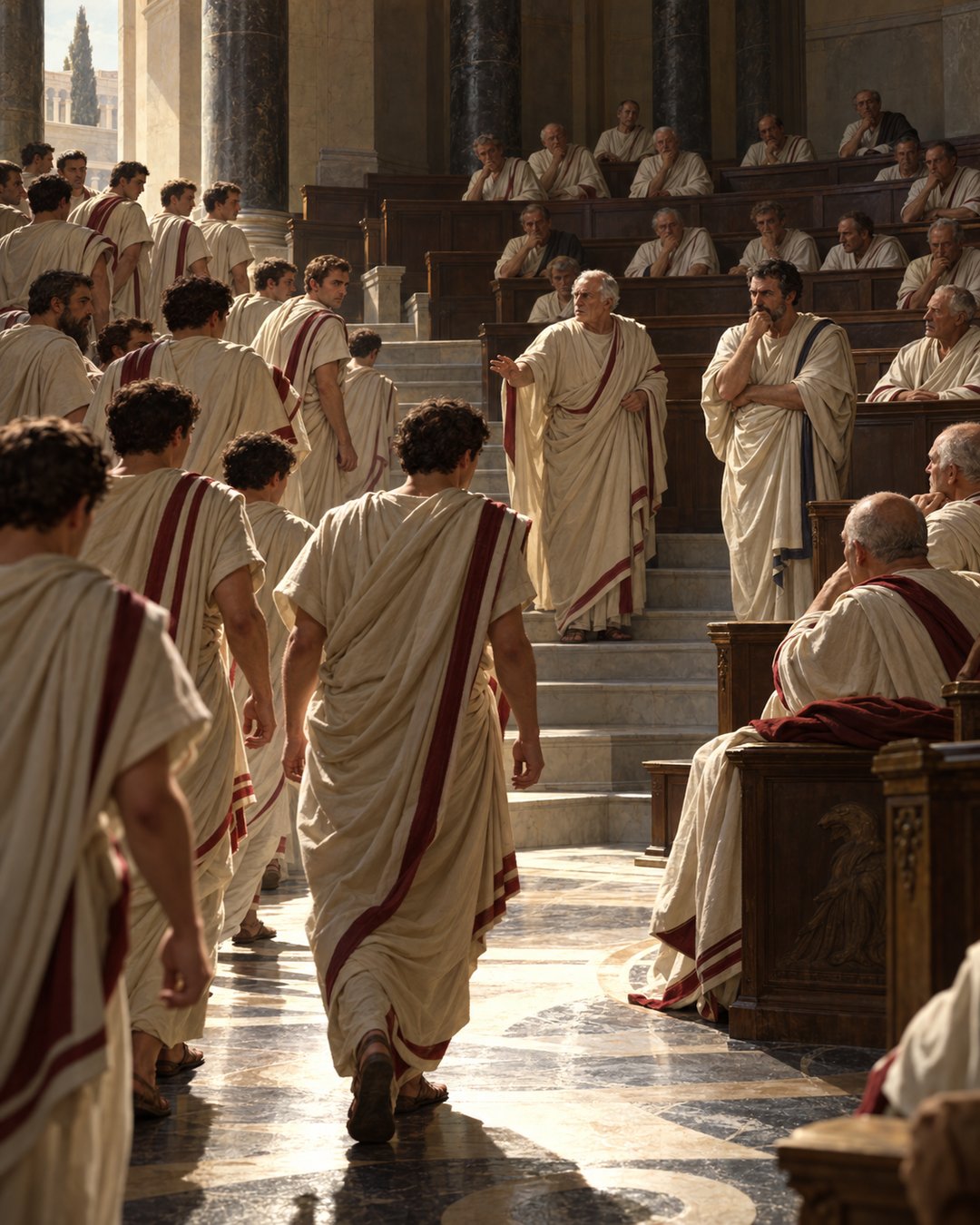
A Roman senator did not always cast a vote by delivering a speech. He could wait while greater names were asked for their views, then cross the chamber to stand with one of them. The feet made the choice visible after the tongue had remained silent.
Aulus Gellius explores these men through the disputed word pedarii. One explanation connected the name to voting by walking to a side. Another connected it to senators who came to the house on foot because they had not held the curule offices associated with an honorific chariot. A third complication involved elected officeholders who could attend and vote before the censors formally enrolled them as senators.
The argument is about a word, but the word opens onto procedure. Presence, formal membership, speaking priority, office, and voting power did not always coincide. Gellius preserves the seams between them.
A division turned position into movement
Gellius begins with the familiar explanation. Many people, he says, believed pedarii described senators who did not express an opinion verbally. Instead, they agreed with someone else by stepping to his side of the house.
The image is plausible because a division made support physical. A member did not need an individual ballot or a repeated formula if his place in the chamber declared which proposal he backed. Yet Gellius immediately notices a problem. Whenever a decree was decided by division, all senators voted through movement. Walking could not by itself distinguish one permanent class of men.
His objection does not deny the practice. It separates an action from an identity. Any senator might cross during a division; that fact alone could not explain why a particular group carried the name at other times.
The distinction is easy to miss when Roman politics is reduced to famous speeches. The senate also operated through order, waiting, grouping, and visible assent. A man who supplied no memorable sentence could still help form a majority.
An old chariot supplied a rival origin
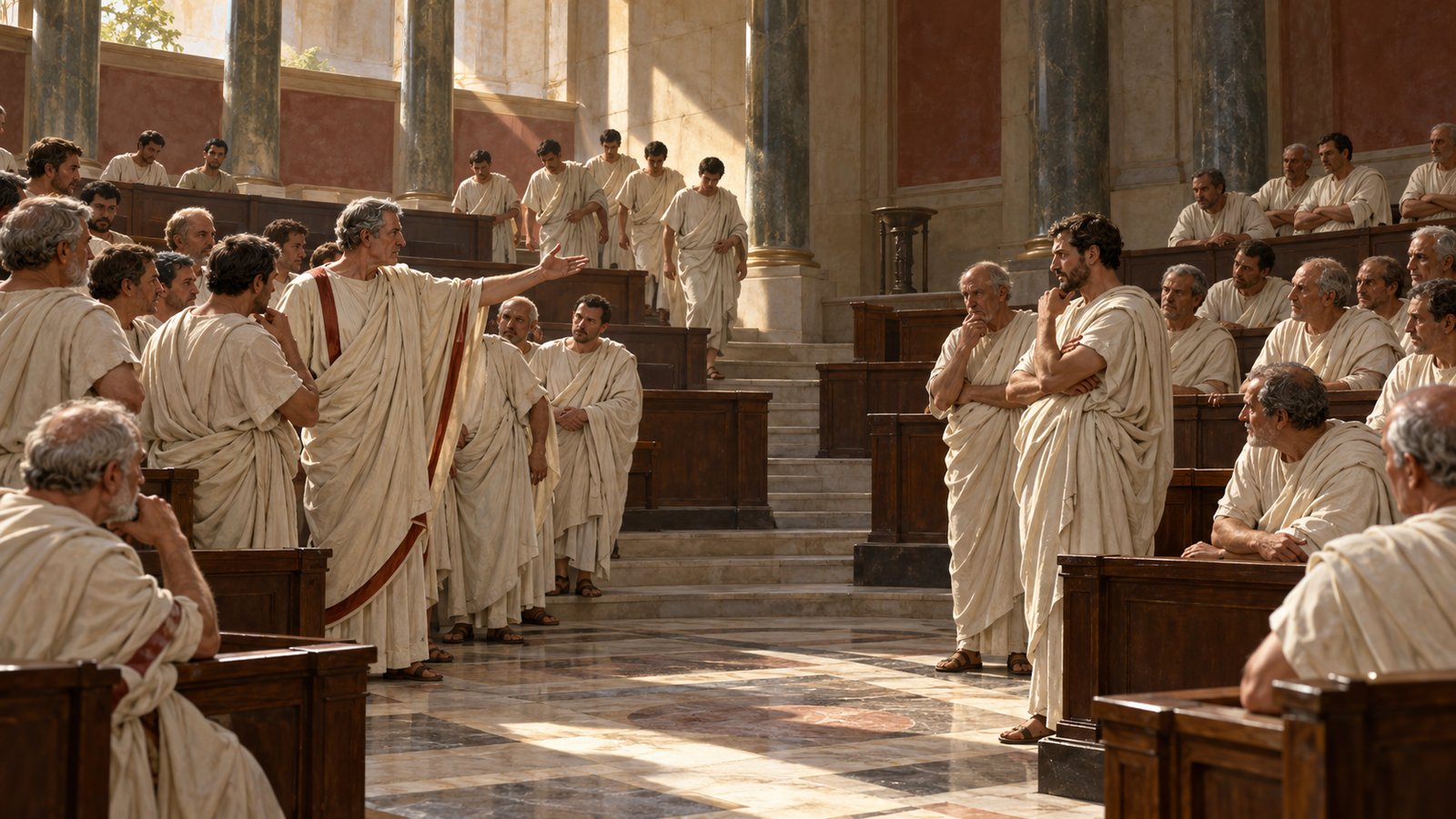
Gellius next reports an explanation from Gavius Bassus. In earlier times, Bassus said, senators who had held a curule magistracy rode to the senate house in a chariot as a mark of honour. The seat in that vehicle was associated with the adjective curulis. Men who had not reached a curule office went on foot.
On this account, the pedarii were “foot-going” senators: not men defined by a mute vote, but men whose route to the chamber revealed the level of office they had attained. The etymology tied political biography to transport and ceremonial display.
Gellius presents the explanation rather than proving it. That caution is important. Ancient antiquarians often preserved competing derivations, and the chapter gives us the debate itself. What survives securely is the social contrast Bassus thought meaningful: curule experience could be displayed by an honored ride, while others walked.
The senate house was therefore approached through rank before debate even began. Arrival could advertise a career. Once inside, however, further distinctions determined who was invited to state a view and whose role was to join one already stated.
Office could precede formal enrollment
Varro’s evidence complicated the category again. He wrote that some knights were called pedarii. Gellius interpreted this as a reference to men who had won offices by popular vote but had not yet been entered on the senatorial roll by the censors.
They were not formally senators in that interval, yet office gave them access to the house and the right to vote. Even former curule magistrates could occupy this waiting position. Their names came at the end; they were not asked to offer opinions, but they could go into a division on proposals spoken by leading members.
This is the chapter’s most revealing procedural edge. The right to be present, the right to speak when called, and the right to vote could be distributed differently. Formal enrollment mattered, but it did not erase the political consequence of an office already granted by the people.
The arrangement belongs beside other examples of a senate governed through exact conventions. Pompey’s need for procedural guidance before convening the house shows how little could safely be improvised. The pedarii problem exposes another layer: who entered, where a name fell, and whether a man spoke before he moved.
The summons remembered a layered house
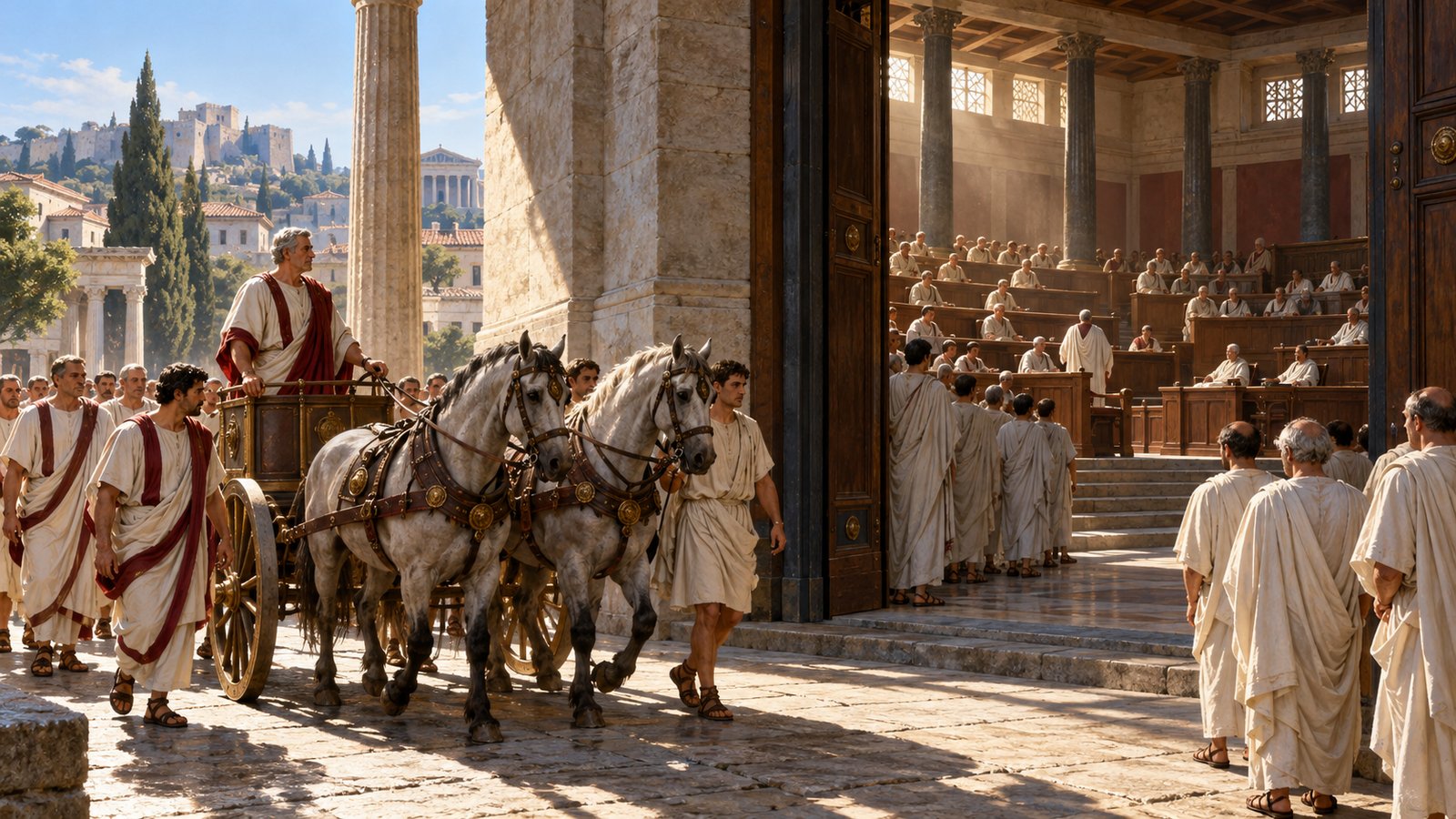
Gellius connects this history to a traditional consular proclamation. The summons addressed “senators and those who have the right to express their opinion in the senate.” He says consuls still used the formula in his day for the sake of precedent.
The wording separates categories that a modern summary might collapse. It acknowledges senators, but also people whose entitlement to participate came through a route not identical with completed censorial enrollment. An old formula carried the memory of a layered institution.
A line from the mime writer Laberius supplied a sharper image: the supporting voter was a “tongueless head.” The insult or joke depends on a real political function. Such a man increased the count without adding an independent speech. His silence did not equal absence.
Regular meeting rules likewise turned time into procedure, as Augustus’s twice-monthly senate calendar demonstrates. Gellius shows space doing comparable work. Rank shaped the approach to the building, name order shaped speech, and a division converted bodies in the room into an outcome.
He closes with a linguistic correction, rejecting pedanii for pedarii. That ending suits his antiquarian method. The spelling, the rival derivations, and the old summons all preserve fragments of practice. None gives us a complete constitutional manual. Together they reveal a senate in which political power was not exhausted by eloquence. Sometimes authority arrived on foot, waited at the end of the list, and voted by crossing the floor.
The chapter is especially useful because Gellius refuses the easiest origin story. He tests the explanation from division voting against the obvious counterexample that every senator could move during a division. He then preserves Bassus’s chariot account and Varro’s different use of the term without forcing them into one certain derivation. The uncertainty is part of the evidence: later Romans themselves were reconstructing how an old political label had formed.
Across those explanations, however, the same structural problem recurs. Political standing had several clocks. Popular election could grant office before the censors updated the roll. Curule experience could distinguish one career from another. The presiding magistrate’s order could let senior voices frame the choices before men at the end of the list joined a side. No single moment turned all of those statuses on at once.
Physical arrangement made those differences manageable. The late-listed member did not need to interrupt a senior speaker to remain politically consequential. A division gathered separate acts of assent into a count. His movement depended on options already articulated, but it still helped decide whether one became the house’s position. Repeated movement also made support observable to the presiding magistrate and to other members without pretending that each participant had delivered a separate argument.
Nor should the phrase “tongueless head” be taken as proof that every quiet voter lacked judgment. It is a comic line quoted by an antiquarian, not a neutral constitutional definition. Gellius’s own discussion shows that silence could result from speaking order and enrollment status rather than incapacity. The man at the rear might possess an office won from the people even while the house denied him an invited speech.
Sources
Aulus Gellius, Attic Nights, 3.18.