
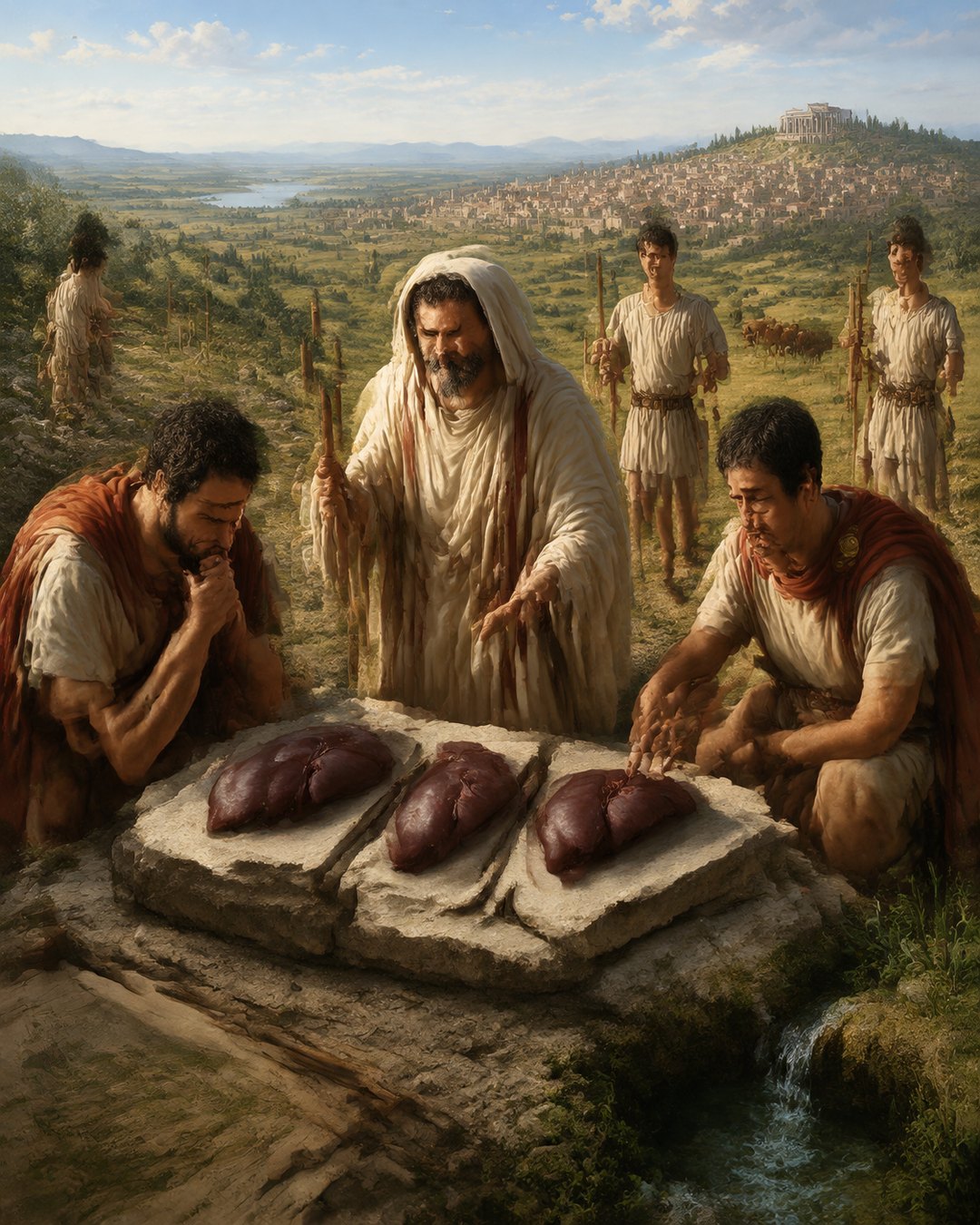
Before walls fixed a city to the ground, Vitruvius says the ancients could feed animals on the proposed site, sacrifice them, and inspect their livers. One livid organ did not settle the question. They tried others.
If repeated animals showed healthy livers, the site’s water and food were judged wholesome enough for a garrison. If unhealthy results predominated, the land was abandoned because the same pasture and water were expected to damage human bodies.
The procedure sits uneasily between sacrifice, empirical repetition, and ancient physiology. It should not be mistaken for a modern toxicology test. Yet neither should it be reduced to a free-floating omen: Vitruvius explicitly connects animal tissue with local diet, water, and the health of a future population.
A city site had to sustain bodies before it carried walls
Vitruvius discusses health before foundations, towers, and street grids. His sequence insists that sound masonry cannot rescue a population committed to damaging air, water, or food.
The proposed site might hold a city or a permanent camp. Both concentrate people and depend on supplies from surrounding land. Once fortifications and property lines are established, moving them becomes expensive and politically difficult.
Animals already grazing there offer a sample of what the landscape produces. Their bodies have consumed local plants and water over time rather than tasting them during a visitor’s brief inspection.
That makes the liver procedure a proxy. The inspectors cannot follow future inhabitants for years before founding the settlement, so they look inside animals whose exposure has already occurred.
Vitruvius frames the issue through balance in animal bodies. Excess or lack in constituent elements can cause illness and death, he says, so the city requires a temperate site suited to bodily constitution.
His framework is ancient and should remain so. The text does not identify microbes, heavy metals, or nutritional deficiencies. Its diagnostic language belongs to a different medicine even when its concern—environmental effects on health—feels familiar.
The procedure comes before Vitruvius’s effort to keep harmful winds from racing down city streets. Site selection and street orientation are consecutive defences: choose healthy ground, then arrange construction to avoid creating a new hazard.
One livid liver triggered another trial, not an immediate verdict
The most revealing detail is repetition. If the first inspected liver looked diseased and livid, the ancients tried other animals to learn whether accident or disease in one beast caused the defect.
A single observation could mislead. The animal might have suffered an individual illness unrelated to its pasture. More examinations were needed before the local environment was blamed.
Vitruvius does not provide a sample size, scoring system, age control, or rule for selecting livestock. “The greater part” is his threshold. This is not a protocol that can be reproduced with modern statistical precision.
Nevertheless, the logic distinguishes an isolated case from a recurring pattern. When most examined livers looked sound, water and food were accepted as wholesome. When the reverse held, the place was treated as dangerous.
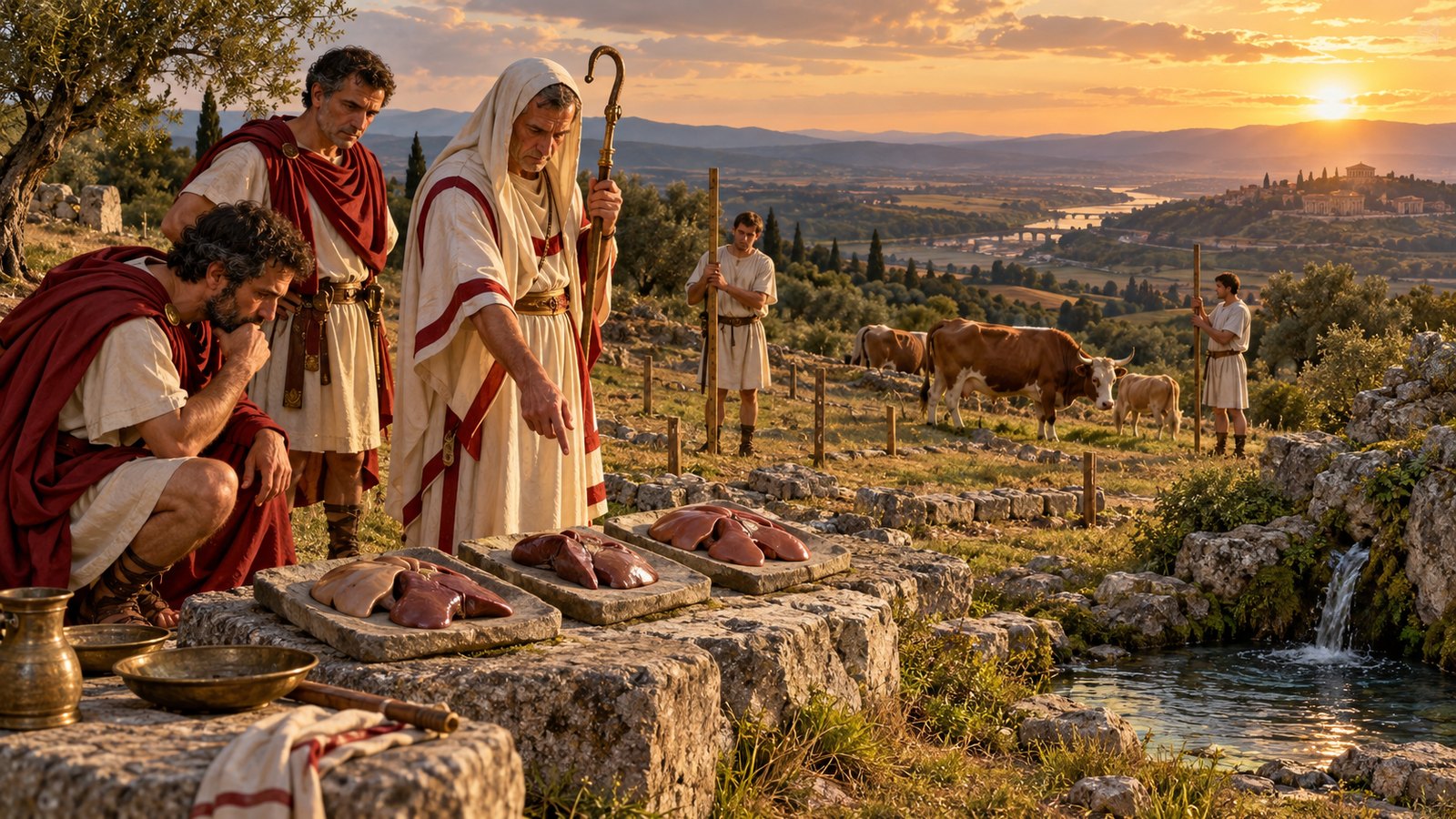
Sacrifice gave access to the organ, but environmental inference gave the result its architectural consequence. The question was not merely whether divine favour had been expressed. It was whether settlers should drink and eat from that terrain.
This differs from the Etruscan reading of a liver as a map of divine regions. There, markings carry a cosmological message. Here, colour and condition are evidence about pasture, water, and bodily health.
The two practices can inhabit the same sacrificial world without being identical. Vitruvius is selecting ground for construction, and the practical decision—build or leave—organizes his account.
Cretan cattle made pasture look powerful enough to alter organs
Vitruvius offers a Cretan example to show why food produced by land could reveal its qualities. Near the river Pothereus, between Gnosus and Gortyna, cattle grazed on both sides.
He says animals on the Gnossian side had normal spleens when opened, while those nearer Gortyna showed no appearance of one. Physicians sought an explanation in a local herb eaten by the cattle.
The reported plant received a name associated with the spleen and was used, Vitruvius says, for people suffering from enlargement of that organ. The anecdote links pasture, animal anatomy, and medicine in one causal chain.
Modern readers need not accept that chain exactly as written. We do not know from this passage what plants were involved, how the animals were compared, or what anatomical condition observers actually saw.
Its importance here is argumentative. Vitruvius wants the architect to believe that land leaves detectable changes inside bodies. The Cretan cattle make the hidden effect of pasture visible.
The example also broadens architectural expertise. Choosing a site is not only measuring slopes and hauling stone. It asks the architect to attend to husbandry, local testimony, physicians, vegetation, and animal condition.
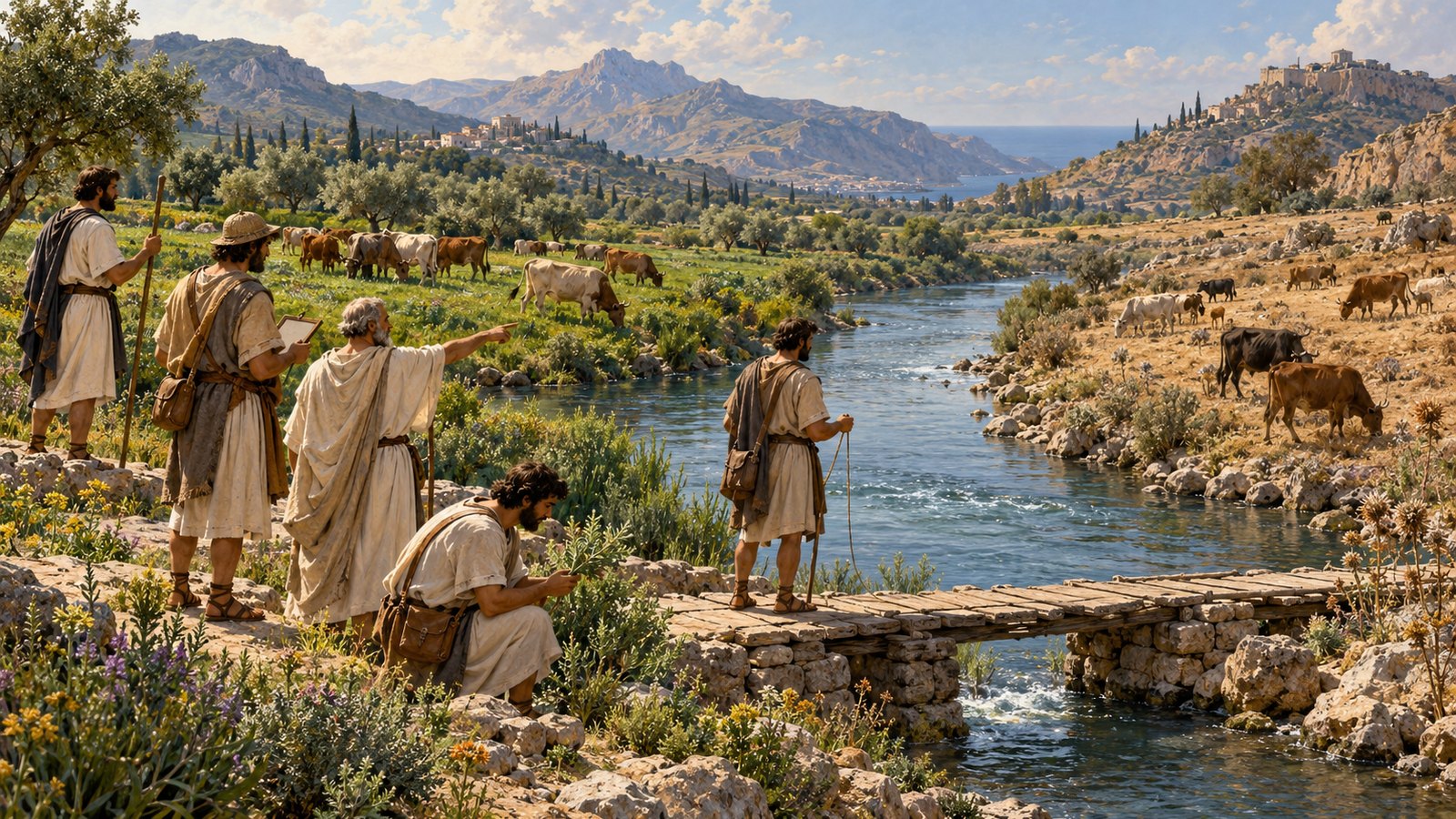
The river divides near neighbours rather than distant climates. That sharp border makes the story memorable: apparently similar ground can feed bodies differently, so broad regional reputation is not enough.
Health could reject a site even before engineering began
Vitruvius ends the liver procedure with a stark priority. When repeated organs indicated harmful water and food, the ancients abandoned the location and sought another, valuing health above all other considerations.
That is a stronger response than designing a better wall. The danger lies in the supply landscape itself. If daily food and drink are the suspected cause, construction cannot simply enclose the problem.
His next discussion complicates any simple ban on wet ground. Coastal marshes can be healthy when drainage carries water toward the sea and storm-driven salt water disrupts what Vitruvius considers harmful generation.
Stagnant marshes without outlets receive the opposite judgement. He describes putrid conditions and heavy pestilent vapours, then points to Salapia’s relocation.
The moved city already has its own story of a four-mile escape from unhealthy ground. The liver passage belongs earlier in the decision chain: detect the risk before a population requires relocation.
Vitruvius’s explanations mix observation with theories no longer accepted. Salt water, winds, organs, herbs, and vapours are fitted into ancient causal models. Responsible reading keeps that distance visible.
Even so, the planning principle is sharp. A city is an inhabited biological commitment, not merely a geometric composition. Food catchments, water, animals, air, and drainage determine whether monumental design can function at all.
The liver test embodies that principle in a scene both ritual and investigative. Several animals are opened because the first result might deceive. A pattern is sought. Then the city either begins—or the surveyors walk away.
Ancient architecture often reaches us as durable stone. Vitruvius starts this chapter with perishable evidence instead: colour in an organ, condition in a herd, and the health of bodies not yet living behind the walls.
The choice also shifts risk onto a preconstruction investigation. Once labourers quarry foundations and households acquire plots, abandoning the site becomes harder. An early negative result, however imperfect, can prevent sunk effort from becoming an argument for staying.
Vitruvius does not tell us who owned the test animals, how long they grazed on the proposed ground, or who had authority to declare the evidence decisive. Those missing details matter because a city foundation is collective and costly. The passage preserves the rationale more clearly than the administration.
Nor does a healthy liver prove every resource adequate. The same chapter still requires attention to air, provisions, roads, and navigation. Animal inspection is one gate inside a wider survey, not a magical approval for walls, harbour, and water supply.
Its memorable force comes from scale. A vast urban future is paused over evidence small enough to hold in the hands. Before streets fill with citizens, several cattle have already embodied the landscape’s claim to be safe.
Sources
Vitruvius, On Architecture, Book 1, chapter 4.