
A river can move a boundary without ever presenting a single moment when the boundary visibly jumps. Grain by grain, silt settles against a bank. The owner wakes to no dramatic event, yet over years the shape of the holding changes. Justinian’s Institutes called that process alluvion and made its slowness legally decisive.
The same text refused to treat every watery change alike. A recognizable parcel torn away by force, a new island in midstream, an abandoned channel, and a field hidden by a temporary flood each produced a different answer. The law followed the physical process.
This is less a catalogue of river curiosities than a decision system. Roman jurists asked whether change was gradual or sudden, whether old land could still be identified, whether water had created or merely surrounded an island, and whether the transformation endured.
Imperceptible growth transferred without a visible handover
The Institutes begin with the quietest event. Soil that a river adds by alluvion becomes the property of the owner whose land receives it. No sale, gift, or formal delivery marks the transfer. The bank itself grows.
The definition supplies the key: alluvion is an addition so gradual that no observer can identify the exact increase from one moment to the next. The rule fits a process that cannot be divided into a clean series of recoverable parcels.
That pace solves an evidence problem. If every film of silt retained a separate origin, cultivation along a river would become a permanent argument over particles. By attaching imperceptible deposits to the receiving bank, the rule lets possession track the land’s slowly changing surface.
The principle does not say that water may seize anything it touches. Its narrow condition is gradual accumulation. The change must defeat ordinary perception at the moment it occurs. That distinguishes growth from a chunk of bank whose former position and identity remain recognizable.
The concern is different from the surveyors who made a stable boundary measurable. A survey fixes lines on ground that can be observed. Alluvion addresses ground that alters after the line has been described.
Roman law therefore did not pretend that nature would respect a frozen map. It gave the map a rule for moving with one kind of natural process. The ownership change is automatic because the physical change is practically continuous.
A torn parcel kept its history until it took root elsewhere
The next case begins with violence rather than accumulation. A stream tears a parcel from one holding and carries it against a neighbour’s land. Because the parcel can still be identified, the Institutes say it remains the original owner’s property at first.
Speed preserves legal memory. Yesterday the earth occupied one holding; today the same recognizable mass lies against another. Unlike silt, it has not lost its identity through countless tiny additions.
Yet that answer is not permanent. If time makes the parcel firmly attached to the neighbour’s land, it is then treated as part of that land. The text does not give a calendar deadline. It points instead to a physical condition: attachment.
This creates an intermediate period in which geography and ownership do not yet coincide. The neighbour may stand beside the soil, while title follows the place from which it was torn. Once incorporation becomes durable, law and landscape come back together.
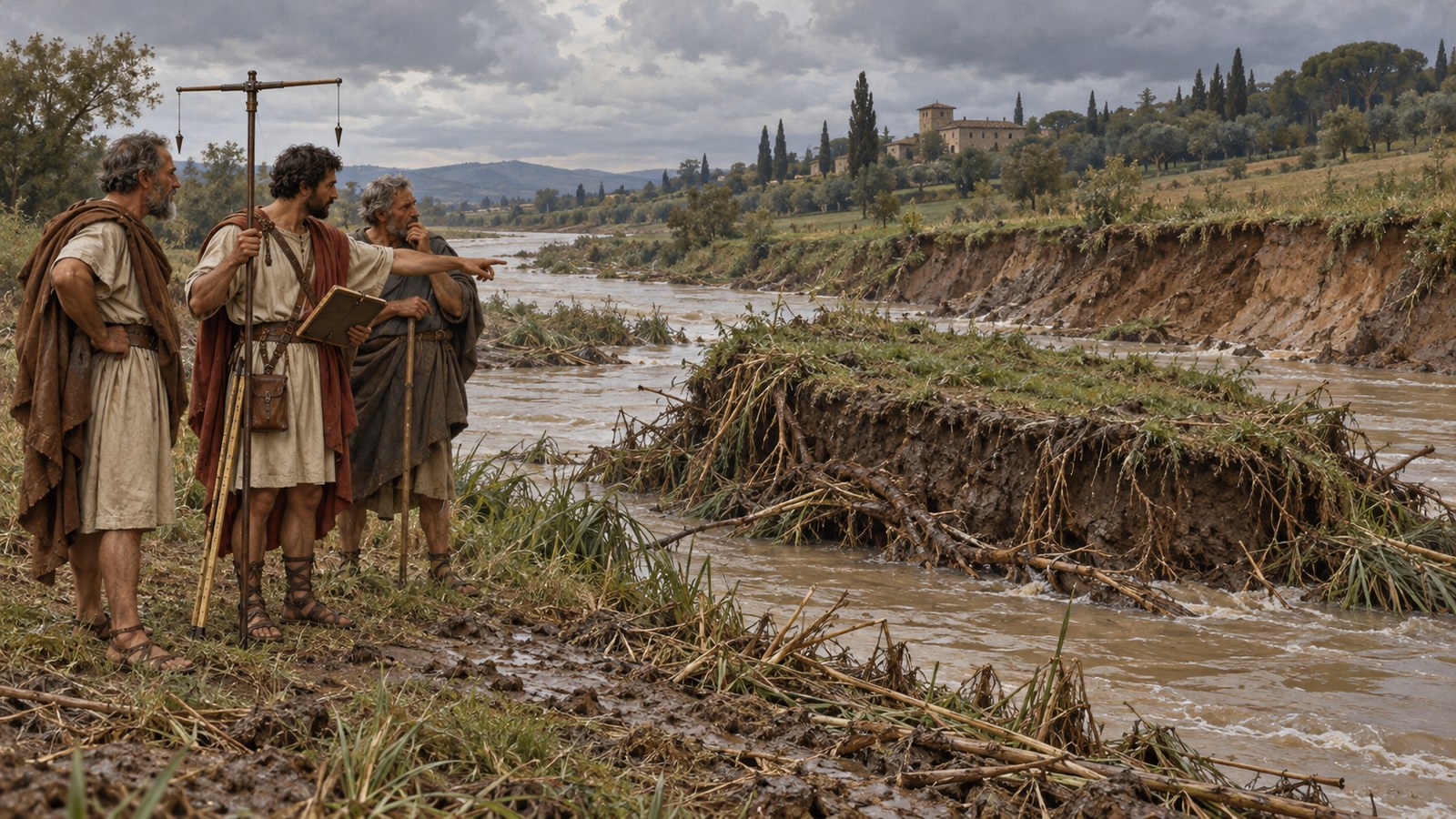
The contrast with alluvion is exact. In one case there is no perceptible unit to return; in the other, the displaced earth is initially a distinct thing. The river’s speed changes the quality of proof.
Attachment also prevents title from floating indefinitely after the land has become physically inseparable from its new bank. The rule waits before accepting the new reality, but it does not ignore that reality forever.
New islands forced law to draw a line through moving water
An island that rises in the sea belongs to its first occupant, the text says, because before occupation it belongs to no one. A river island is handled differently. Its ownership is derived from the land along the banks.
If the island forms in the middle of the stream, owners on both banks share it in proportion to their riparian interests. The imagined centre line of the river turns a new piece of earth into divided property.
If the island lies nearer one side, it belongs to the landowners on that bank. Distance becomes a legal instrument. The rule translates a shifting channel into a geometry that can allocate land without pretending the island existed in an earlier deed.
But not every island is new. When a river splits into two channels around someone’s existing land and later reunites, ownership does not change. Water has surrounded the holding, not created it.
The distinction protects continuity. A landowner does not lose a known field merely because the river temporarily gives it water on both sides. The shape becomes insular while the title remains anchored to its previous history.
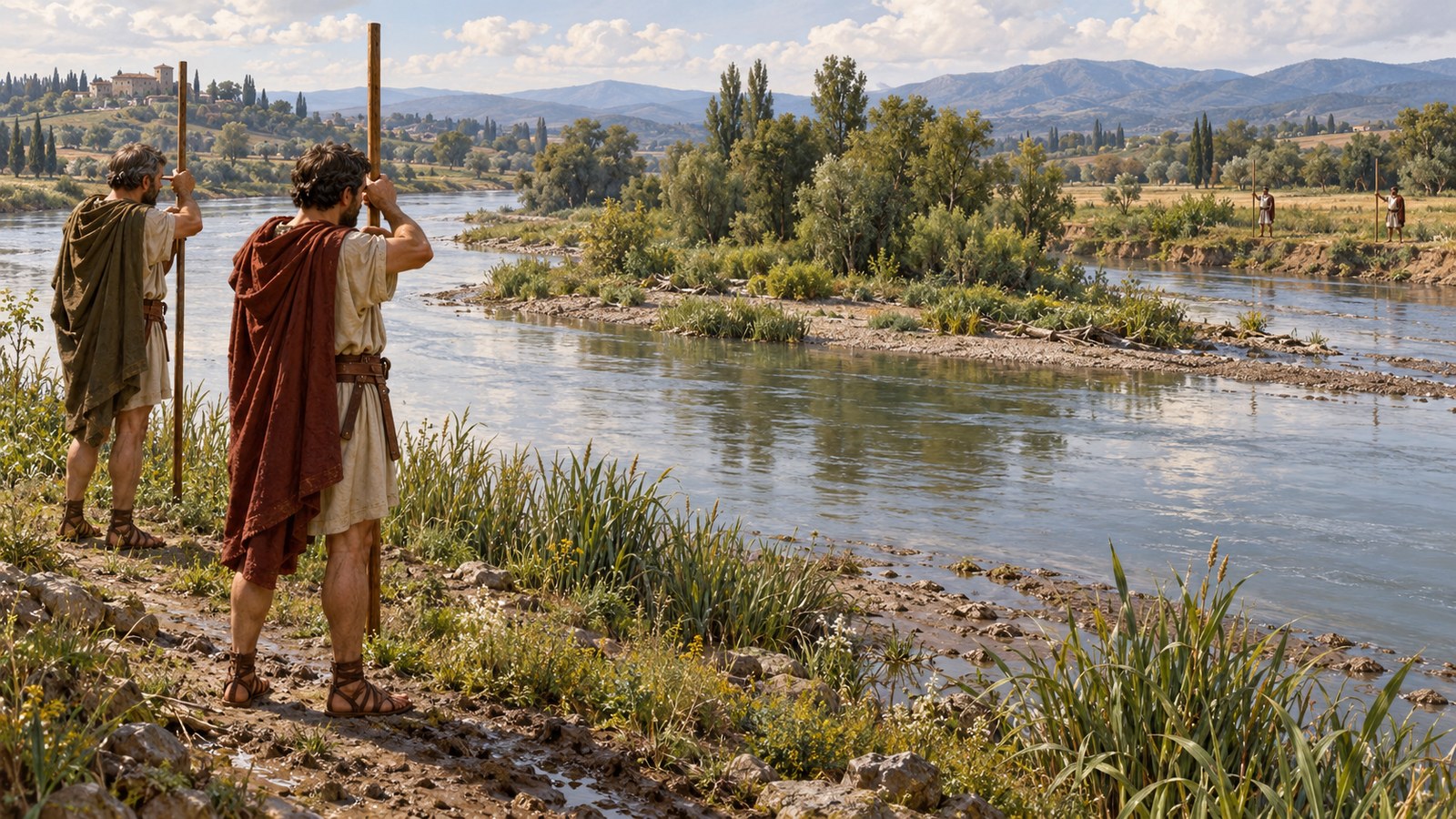
These cases reveal why a bridge could make a river look governable without making the river legally simple. Beneath the crossing, banks deposited soil, channels divided, and new ground demanded classification.
The island rules do not require knowledge of every grain’s origin. They use position and prior identity instead. Midstream creation, near-bank creation, and an existing field encircled by water are three separate factual patterns.
Abandoned channels and floods tested whether change would last
A river may leave its bed completely and begin flowing in a new channel. In that event the old bed is divided among the landowners on either side in proportion to their interests along the bank. Ground that had carried public water becomes available to neighbouring holdings.
The new channel takes on the river’s public legal character. This is an uncomfortable but practical consequence: the river’s course, not the previous private boundary alone, determines where the public waterway now exists.
The text then lets the system reverse. If the river returns to its old channel, the newer channel, now abandoned, becomes the property of those who hold land along its banks. Ownership follows the durable location of the river while preserving a formula for the dry bed it leaves.
Flooding receives a sharper limit. Land wholly covered by water does not permanently change its nature merely because it disappears from view. When the water goes back, the soil remains with its previous owner.
A flood is occupation by water without legal erasure. The field may be unusable and invisible for a time, but those facts alone do not make it riverbed or ownerless land. Duration and permanence matter.
Placed together, the rules create a vocabulary for change. Imperceptible deposition transfers at once. Violently moved soil carries its old title until firm attachment. A new island is allocated by position. A channel’s legal character moves with the river. A temporary flood leaves ownership untouched.
The system is not a claim that rivers are predictable. It is a way to keep their unpredictability from collapsing every boundary dispute into the same question. Roman law made the water describe what it had done before deciding who owned the result.
The sequence also tells a landholder what kind of evidence matters. A fresh scar in a bank can identify a parcel; a firm join can show later incorporation; distance from the banks can allocate an island; retreating floodwater can reveal the same field. The law reads traces rather than treating every wet surface as a new beginning.
Sources
Justinian, Institutes 2.1.20–24.