
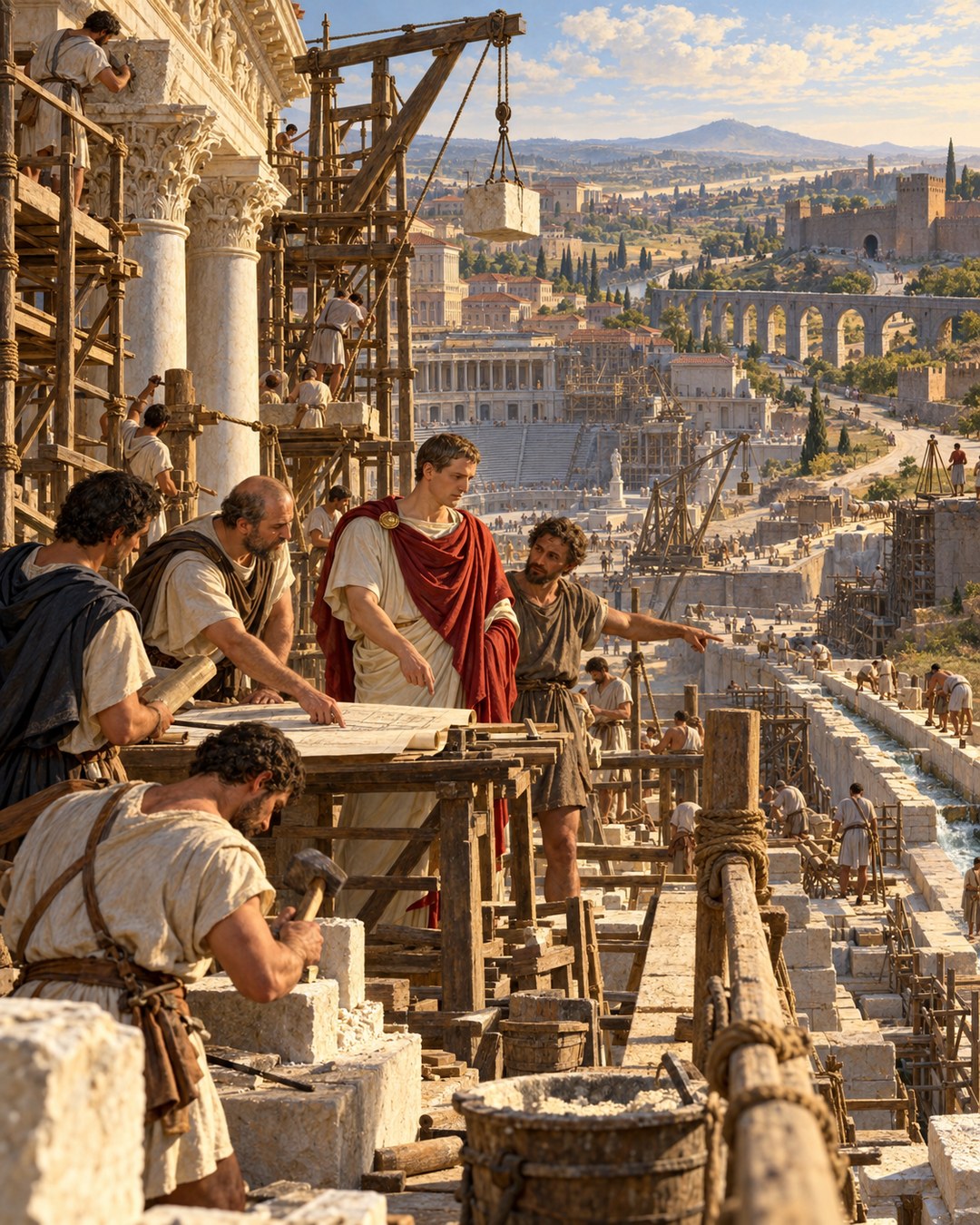
Augustus claimed eighty-two temple repairs in one sentence. The number is arresting, but the verbs around it matter more. He rebuilt, restored, doubled, completed, enlarged, purchased, named, and ordered heirs to finish. His city was not produced by one kind of building work.
The Res Gestae presents a ruler moving between old structures and new claims. Pompey’s theatre kept Pompey’s name. A burned basilica rose on a larger site under the names of Augustus’s sons. The Aqua Marcia received another spring. A road to Ariminum brought bridges into the same inventory as temples.
Maintenance became political because Augustus selected what continuity should look like. Repair could honour a predecessor, absorb an inherited project, announce family succession, or make ancient infrastructure perform at a new scale.
New monuments established the inventory’s starting point
Augustus’s list includes the Senate House and an adjoining Chalcidicum, the temple of Apollo on the Palatine with its porticoes, the temple of the deified Julius, and the Lupercal. These were not anonymous repairs. They placed his building activity beside institutions, cult, family memory, and Rome’s legendary landscape.
A list flattens years of planning into consecutive phrases. Land had to be available, labour organized, materials moved, and use assigned. Yet the inscription’s compact form makes the works appear as a coherent programme rather than a succession of separate building sites.
The temple of Apollo joined sacred space to the Palatine. The temple of the deified Julius made an adopted father’s new divine status architectural. The Senate House connected the programme directly to public government.
That mixture prevents a simple division between religious and civic construction. A portico shaped movement, a shrine shaped ritual, and a political building shaped assembly, but all contributed to the ruler’s account of a city made orderly.
The inventory is also selective. It is Augustus’s public summary, not an excavation report or neutral municipal ledger. Its value lies partly in how it groups works and assigns agency.
Compared with the gilt ball that made an obelisk’s shadow easier to read, this passage does not linger over the operation of one object. It scales upward, presenting districts and systems as achievements that can be counted together.
Pompey’s name survived while Augustus controlled the repair
Augustus says he restored the Capitolium and Pompey’s theatre at great expense without placing his own name on them. The omission is prominent because he records it himself.
Repair without renaming let Augustus claim restraint and expenditure at once. Pompey’s theatre remained legible as an inherited monument, while the new regime became responsible for its continued existence.
The gesture did not erase authorship; it changed its form. Augustus’s name was absent from the building’s inscription but present in the imperial text announcing that absence. He received credit for allowing the old name to remain.
This was a practical strategy for a city crowded with memories. Replacing every label would advertise rupture. Repair could instead make earlier Rome appear safely contained within Augustan stewardship.
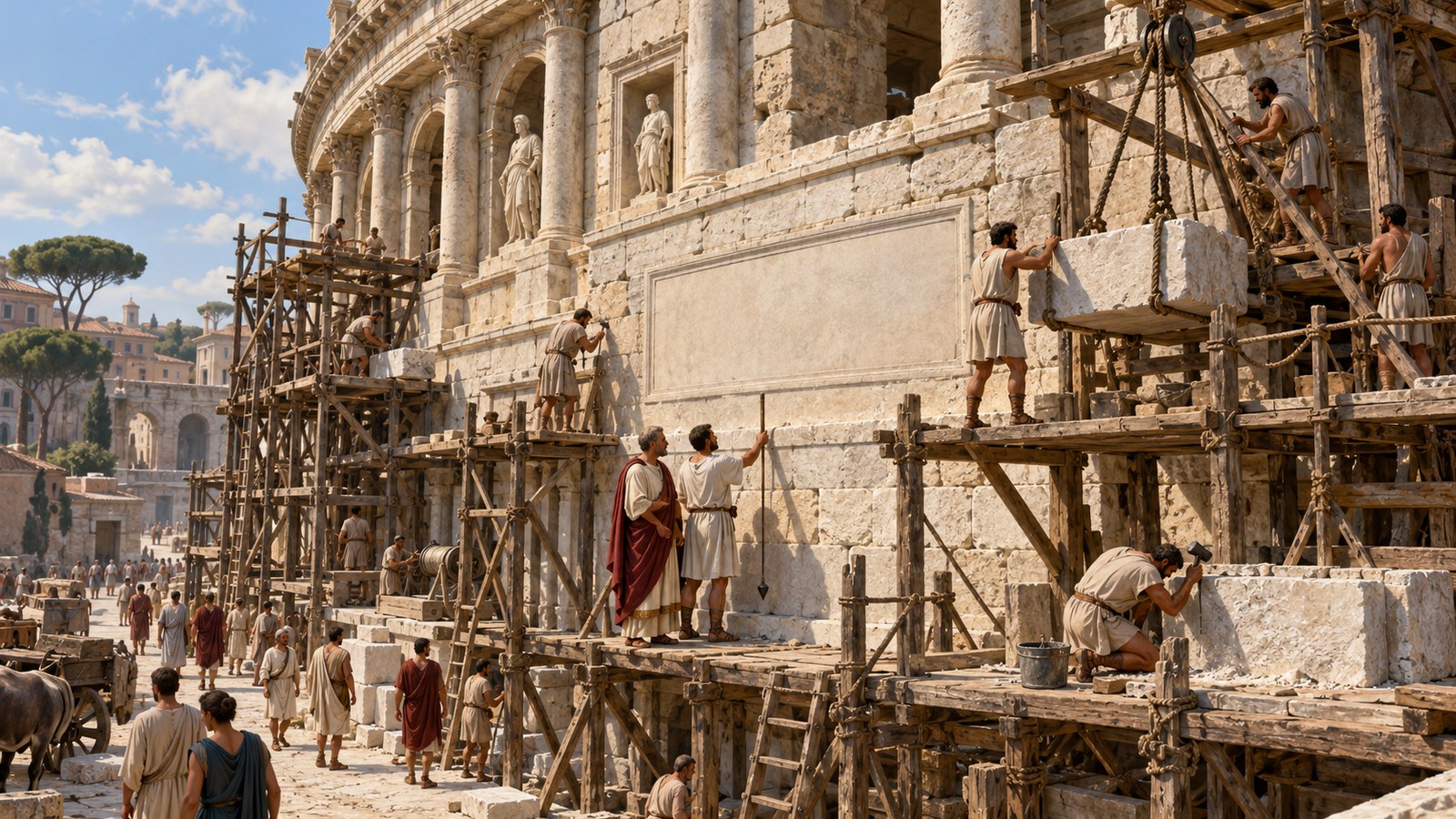
The passage also repairs aqueduct channels that were failing through age. Here continuity is less symbolic and more immediate: damaged channels lose water. Augustus then says he doubled the Aqua Marcia by introducing a new spring into its course.
Restoration and expansion sit side by side. One verb returns a system to function; the other increases what it can carry. The political claim depends on both—respect for inherited infrastructure and capacity beyond its previous condition.
The water work provides a useful contrast with Nicomedia’s two abandoned aqueduct attempts. There sunk cost exposed stalled administration. In Augustus’s inscription, repair is narrated as completed command over age, leakage, and supply.
A burned basilica turned completion into a family timetable
Augustus completed the Forum of Julius and the basilica between the temples of Castor and Saturn, works begun by his adoptive father. Completion made inheritance visible in stone. He did not need to pretend the projects began with him.
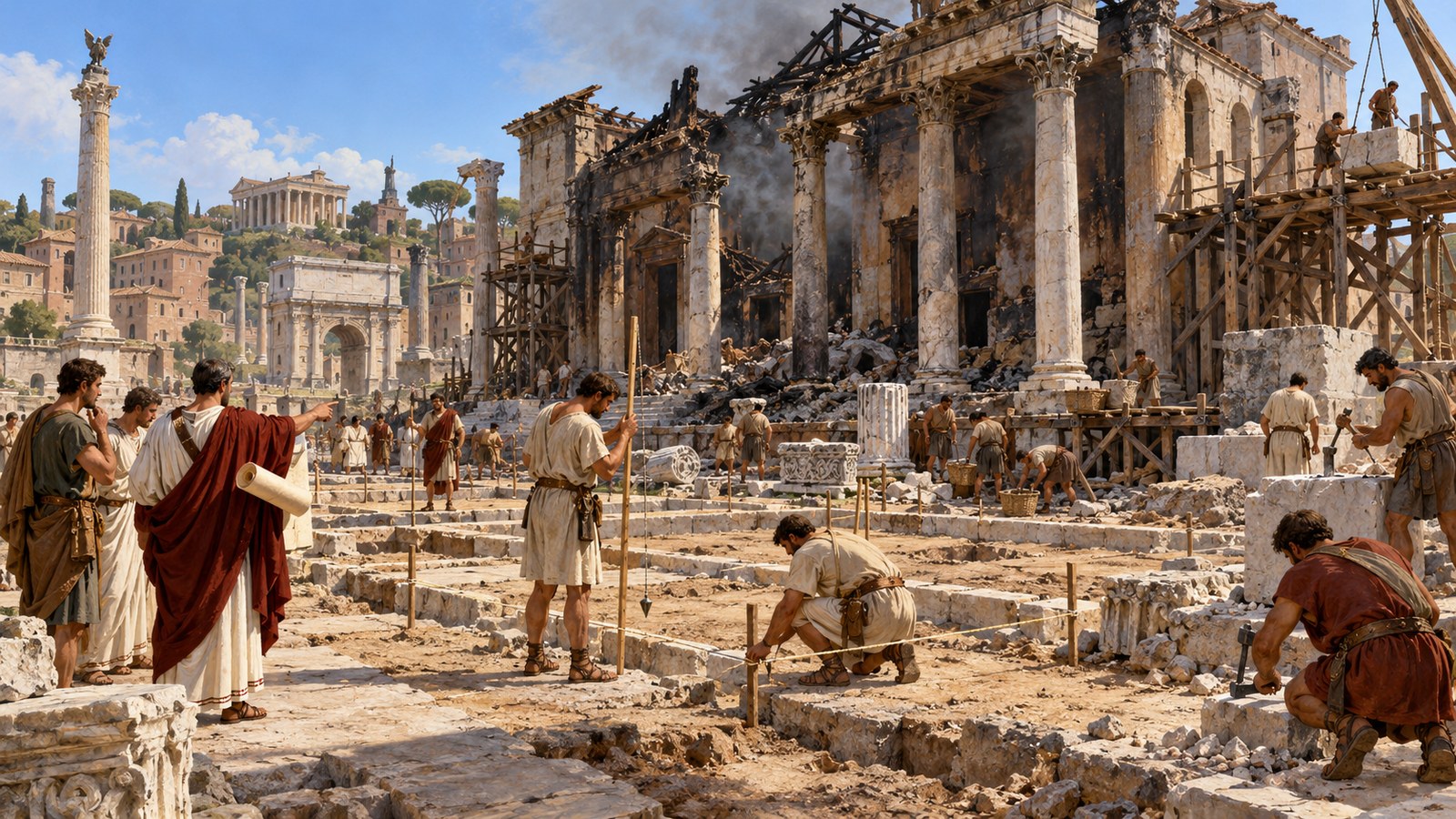
Fire then forced the basilica back into process. Augustus began another version on an enlarged site, this time under the names of his sons. A building inherited from one generation became a naming surface for the next.
He also ordered his heirs to complete it if he died first. That instruction accepts a truth hidden by monumental façades: rulers may not live as long as their construction schedules.
The project therefore links three temporal positions. Julius began; Augustus completed and began again; heirs might finish. The basilica’s continuity depends on succession being organized before the work is done.
Naming was not applied uniformly. Pompey’s theatre kept an earlier name without Augustus’s inscription, while the enlarged basilica carried the sons’ names. The difference reveals choice rather than a single rule of modesty.
Built space could preserve a rival’s monument, continue an adoptive father’s initiative, and prepare descendants’ public identity. Restoration did not merely conserve old surfaces. It edited relationships among the dead, the living, and expected heirs.
The inscription’s first-person voice keeps these layers under one narrator. Even when another name remains on the façade, Augustus chooses the sentence that explains why it remains or who will replace it.
Eighty-two temples joined roads and bridges in one claim
In his sixth consulship, acting under a decree of the Senate, Augustus says he repaired eighty-two temples in Rome. He adds that none needing repair at that time was omitted.
The claim converts dispersed maintenance into a citywide achievement. A single new temple can dominate a skyline; eighty-two repairs are harder to see at once. The inscription gathers them into one imagined inspection.
The senate decree matters. Augustus describes authorization as well as action, attaching institutional form to the scope of the programme. The sentence makes completeness—not novelty—the source of distinction.
His next consulship carries the inventory beyond Rome. He records work on the Via Flaminia from the city to Ariminum and on all its bridges except the Mulvian and Minucian, which did not need repair.
The exceptions sharpen the claim. They imply assessment before intervention. A bridge that remained sound was not rebuilt merely to inflate the list. At least in the inscription’s logic, need determined the work.
Road, bridges, aqueduct, theatre, basilica, and temples belong together because each makes continuity usable. Worship, water, movement, assembly, and spectacle all rely on structures surviving beyond their first dedication.
Augustus also distinguished construction on different kinds of ground. The temple of Mars Ultor and his forum rose on his own land from war spoils. The theatre near Apollo’s temple stood largely on land purchased from private owners and bore the name of Marcus Marcellus.
Money, land, and naming explain how new work entered an already occupied city. Spoils could fund a forum; purchase could assemble a theatre site; family names could organize memory; repair could preserve an earlier dedication.
The eighty-two temples are therefore not an isolated boast about piety. They sit inside a theory of government by fabric. A regime proves command when old channels flow, old theatres remain usable, burned halls return larger, roads reach their destination, and shrines no longer display neglect.
The list cannot tell us how evenly the work was executed or how every Roman experienced it. It does show how Augustus wanted repair understood. Maintenance was not background labour beneath the dignity of rule. Properly counted and narrated, it was the visible grammar of a new political order.
Sources
Augustus, Res Gestae 19–21.