
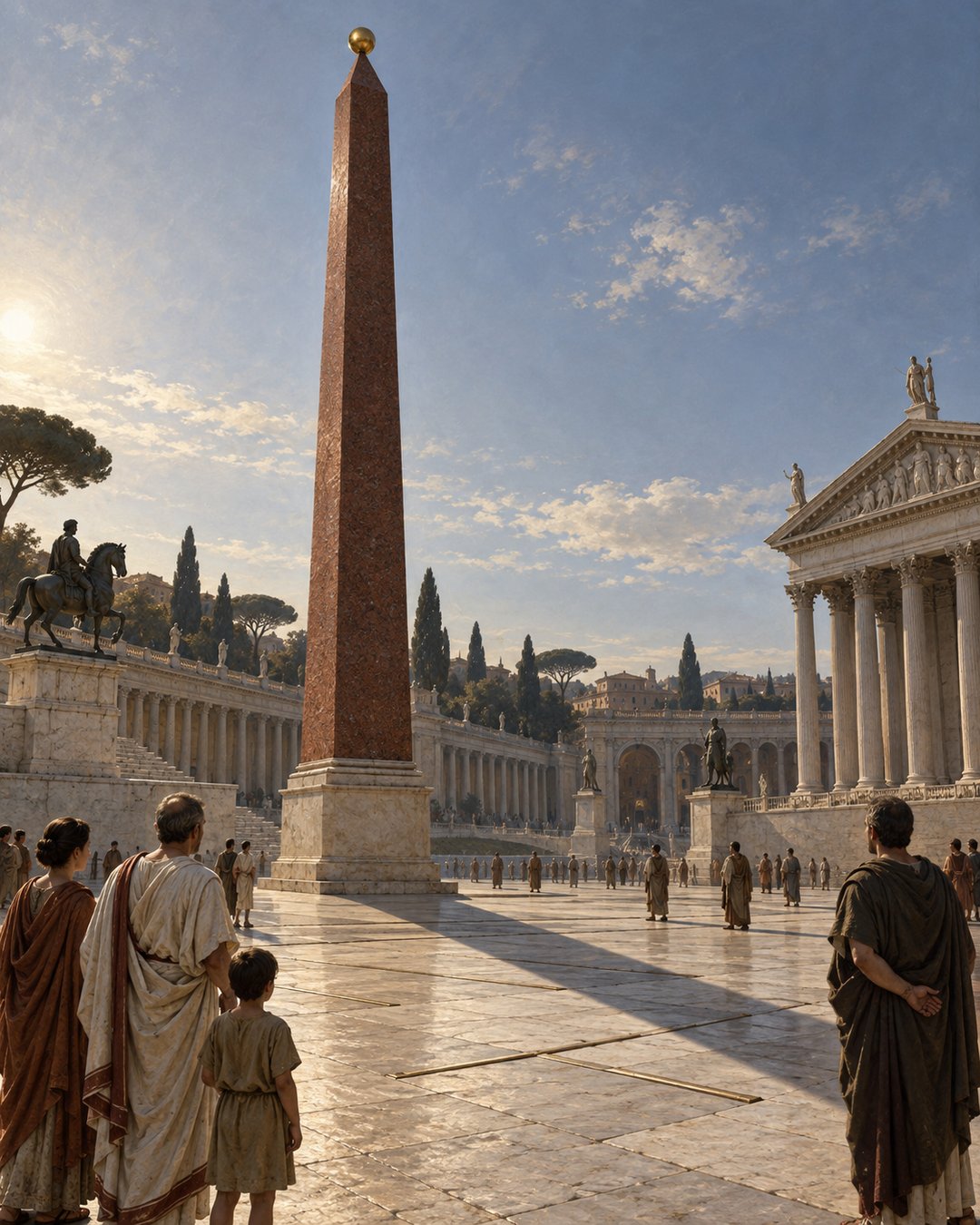
At noon on the shortest day, an immense shadow was supposed to reach one exact limit in the Campus Martius. The object casting it was an Egyptian obelisk, but its point was not left alone against the Roman sky. The mathematician Novius Facundus placed a gilt ball at the summit so that the shadow ended more cleanly on the pavement below.
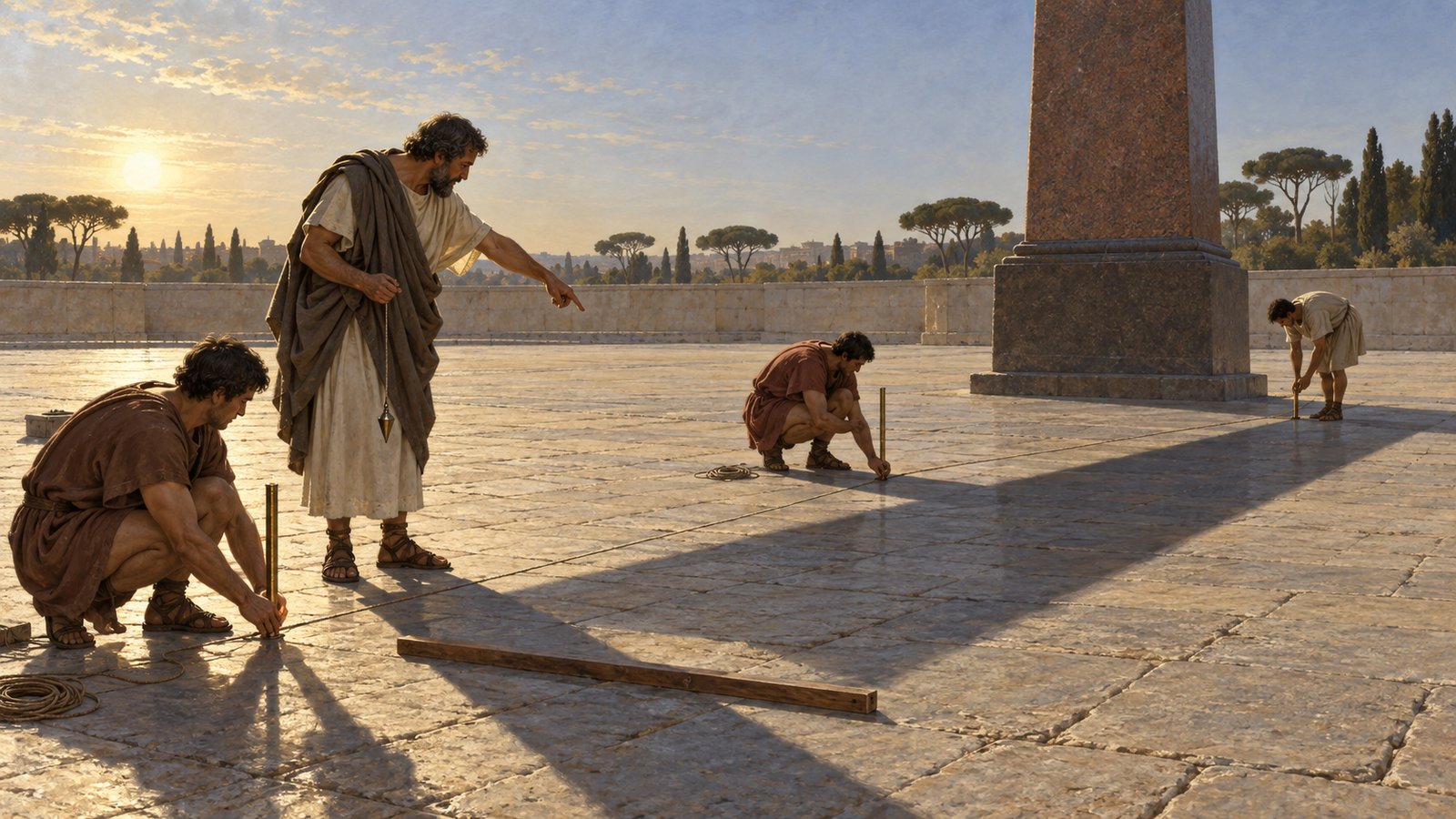
Pliny the Elder describes bronze rods set into that pavement to follow the shadow as it shortened and lengthened through the year. Stone, metal, sunlight and a measured ground plane became one public instrument. The arrangement joined a monument taken from Egypt to a practical Roman question: how could seasonal change be made legible at civic scale?
The answer did not remain reliable. By Pliny’s time, the readings had disagreed with the calendar for about thirty years. His attempts to explain the drift move from the heavens to the soil beneath the obelisk. The failure is not an embarrassing footnote. It shows what the original precision required—and how many parts of a monumental instrument could move even when the stone looked immovable.
The Pavement Turned Height into a Calendar
Augustus’s obelisk supplied the vertical line, but the shaft alone did not make a measuring system. Pliny says a pavement was laid out for a distance appropriate to its height. The ground therefore had to be planned with the monument. Every useful reading depended on the relation between a fixed summit, the sun’s position and a marked surface receiving the shadow.
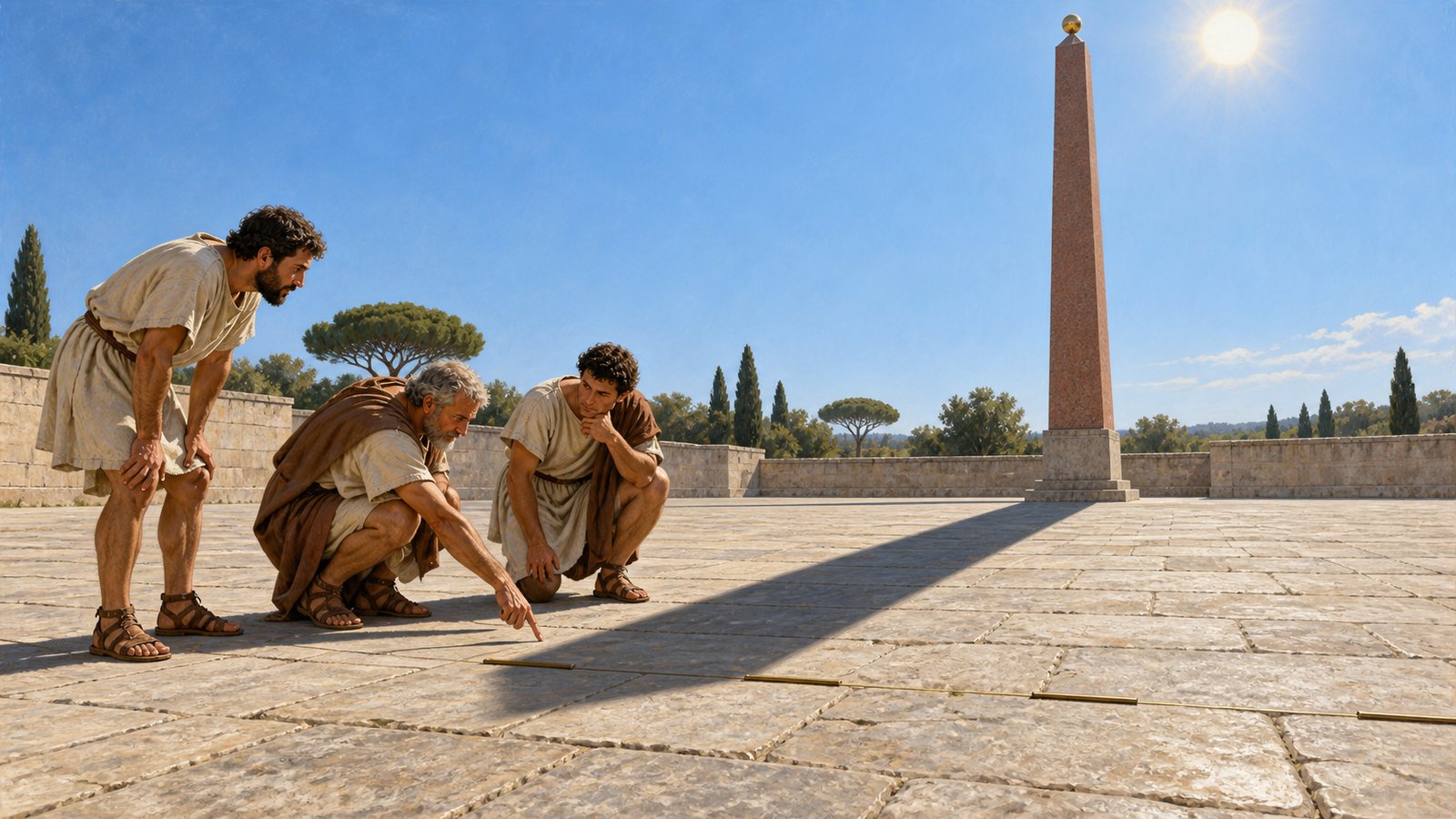
The shortest day provided a boundary. At noon, when that winter shadow stretched furthest, it was meant to coincide with the pavement’s limit. From there, bronze rods let observers follow the end of the shadow as it withdrew and later lengthened again. The annual cycle appeared not as an abstract table but as a moving line across stone.
This was related to a sundial, yet its scale changed the experience. A handheld or courtyard dial can be read by someone standing close to it. An obelisk makes the act architectural. The viewer walks on the receiving surface, while the pointer rises far above nearby bodies and roofs. The installation made the movement of sunlight share space with the movement of the city.
Its seasonal logic belongs beside the way Roman sundials made unequal hours visible. Both depended on observing a shadow rather than treating time as mechanically uniform. Here, however, the emphasis in Pliny’s description is the changing reach of noon through the year: a long winter line, a retreat, then a return.
The pavement was therefore not decoration around a trophy. Its dimensions and bronze inlays carried the reading. Remove the marked ground and the shaft would still cast a dramatic shadow, but observers could no longer compare today’s endpoint with the expected place in the cycle.
A Gilt Sphere Gave the Shadow a Usable Edge
A pointed obelisk seems as if it should produce a precise point below. Pliny says otherwise. The shadow cast by the tip lacked definition, so Novius Facundus mounted a gilt ball on the pinnacle. The top of that sphere concentrated the shadow and made its boundary easier to judge.
The detail reveals a problem hidden by the monument’s silhouette. Measurement needs a repeatable place to read, not merely a visible dark area. At ground level, atmospheric haze, the sun’s apparent disk and the great distance from summit to pavement could soften the end. Two observers might agree that the obelisk cast a shadow while disagreeing about exactly where it stopped.
The sphere changed the geometry of that endpoint. Pliny says Novius understood the principle from the shadow of a human head. That comparison moves from ordinary bodily observation to monumental engineering: a rounded form seen every day suggested how to make the top of an imported monolith function more clearly.
Gilding also made the attachment visually belong at the summit. It caught the sun while its curved form shaped the shadow below. Yet the important effect was not ornamental brilliance alone. A small object relative to the shaft addressed the last fraction of uncertainty where the reading met a bronze marker.
Roman instruments often depended on similarly modest interfaces. Vitruvius’s road cart turned wheel movement into counted distance by connecting a large journey to a small repeated release. Novius’s sphere worked in the other direction: it altered a vast shadow through one carefully chosen shape at the highest point.
Thirty Years of Drift Turned the Monument into a Problem
Pliny reports that the readings had failed to correspond with the calendar for about thirty years. His wording matters because the failure was comparative. The shadow still appeared. The obelisk still stood. Bronze remained in the pavement. What had broken was agreement between the observed endpoint and the expected date.
That discrepancy opened several levels of explanation. Pliny first entertains changes in the sun’s course and even a slight displacement of the earth from its central position, something he says had been detected elsewhere. These ideas belong to the natural philosophy available to him, not to a modern account of orbital mechanics.
He then comes closer to the installation. Earth tremors in Rome might have shifted the shaft locally. A movement too small to look dramatic at the base could be magnified across the length of a shadow. The obelisk could remain upright to ordinary sight while no longer occupying precisely the alignment assumed by the pavement.
Tiber floods supplied another suspect. Saturated or disturbed ground might have allowed the enormous mass to settle. Pliny notes the claim that the foundations descended as deep as the height of the load they supported, but that impressive depth did not end his uncertainty. A foundation can be immense and still belong to changing soil.
The list is valuable because Pliny does not force one cause. Heaven, earth, masonry and river remain in competition. The instrument had no single detachable part that could be blamed without investigation. A calendar mismatch was the visible symptom of a system whose reference points were distributed from sunlight to summit, shaft, foundations and pavement.
Captured Stone Became a Test of Roman Maintenance
Augustus transformed an Egyptian royal and sacred monument into a Roman measuring surface. The obelisk still carried the history of its quarrying, inscription and transport, but the Campus Martius gave it a new relationship with daily observation. Its authority came partly from size and antiquity, and partly from the promise that its shadow could agree with the year.
That promise linked imperial display to the calendar. Augustus’s rule was deeply concerned with public time, and his addition of court days reorganized civic availability in another register. The solar installation did not issue legal schedules, but it made the order behind dates appear on a monumental pavement.
Pliny’s failed readings complicate any simple claim that the monument permanently mastered nature. Precision survived only if the shaft, ground markers, foundations and calendar kept their relation. The gilt ball could solve the optical edge, but it could not prevent a flood, diagnose a tremor or prove that a subsiding base was responsible.
The installation should therefore be remembered as both achievement and maintenance problem. Novius Facundus designed a clever visual interface. Workers set bronze into a pavement calculated against an extraordinary height. Observers could compare the noon shadow across the seasons. Later observers also noticed that comparison going wrong.
Monuments often invite people to treat endurance as stability. Pliny’s account refuses that shortcut. The granite endured, but the measurement drifted. A tiny gilt sphere made the shadow sharper; thirty years of disagreement made the system more revealing. Rome had built a way to watch the year, and in doing so had also built a way to notice when stone, ground, river and expectation no longer lined up.
Sources
Pliny the Elder, Natural History, Book 36, sections 71–73.