
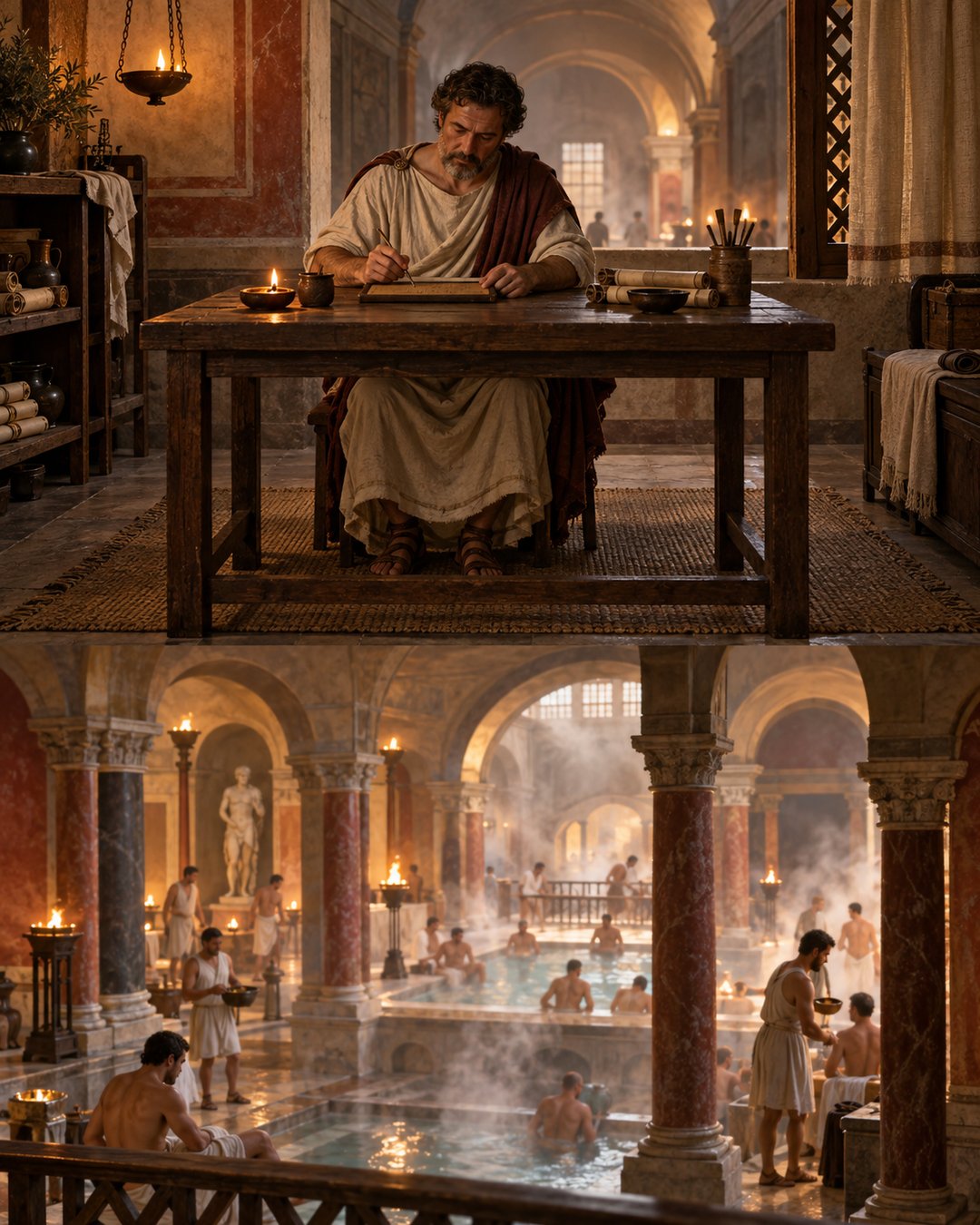
Seneca tried to work above a Roman bathhouse, and the building refused to disappear beneath him. Lead weights rose and fell. A massage hand landed with one sound when flat and another when hollow. A ball player called the score. A swimmer hit the water hard enough to announce his entrance. Vendors competed with the room itself.
Letter 56 turns that address into an experiment. Seneca claims the uproar can reach his ears without carrying his mind away. Yet he does not flatten the noise into one vague roar. He identifies bodies, trades, impacts and voices so precisely that the bathhouse becomes visible through sound.
The result is both philosophy and urban evidence. Seneca wants to distinguish hearing from attention, but his argument depends on admitting how aggressively the street and baths demand notice. Quiet is not simply a property of a room. It is a relationship between the room, the work being attempted and the disturbances already moving inside the listener.
The Ceiling Delivered Every Bathhouse Sound
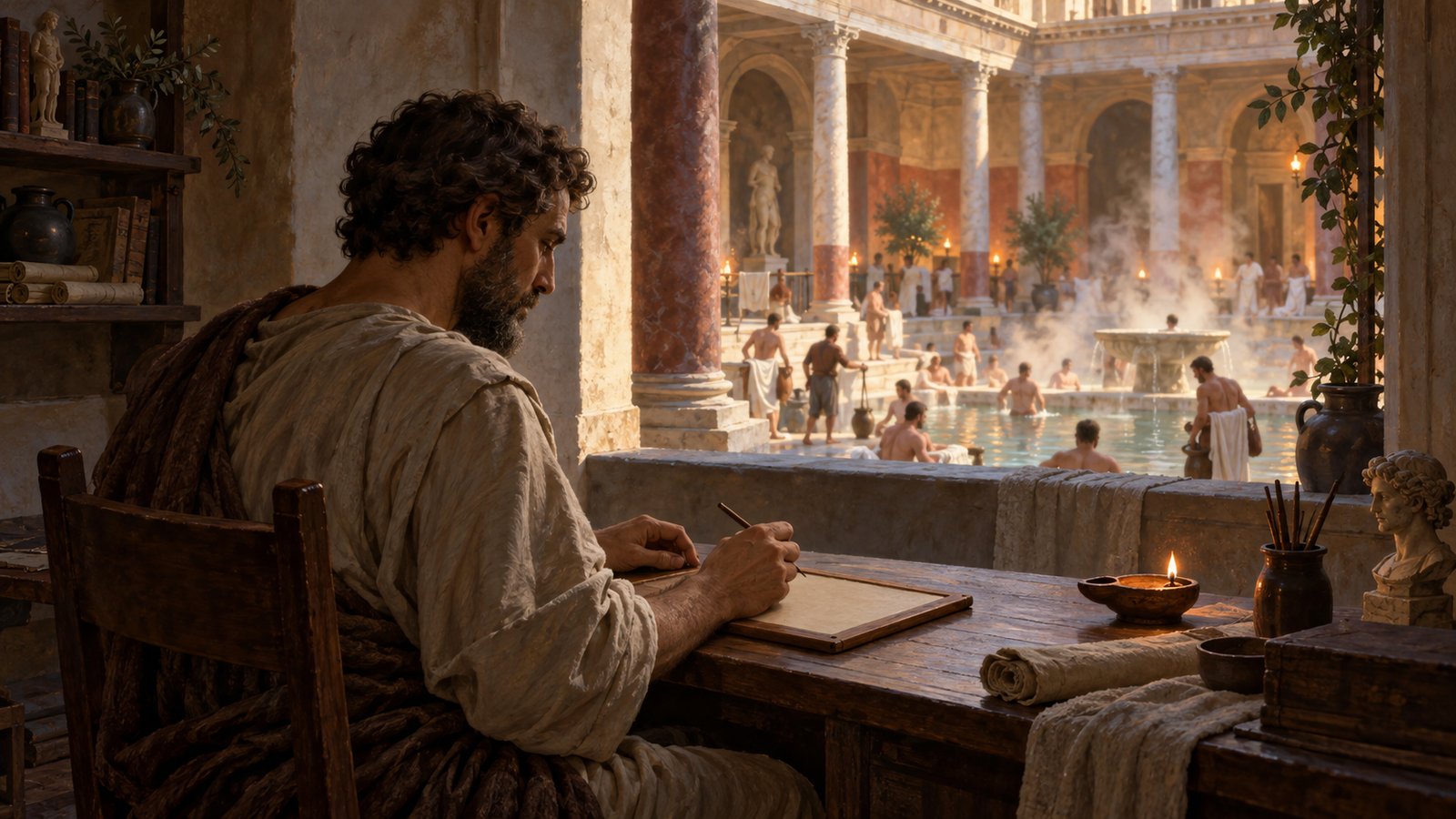
Seneca says he is lodged directly over the baths. That position matters. He is not remembering a public building from a tranquil villa or choosing a busy corner for literary color. The activity is physically beneath his working space, transmitted upward through a shared structure.
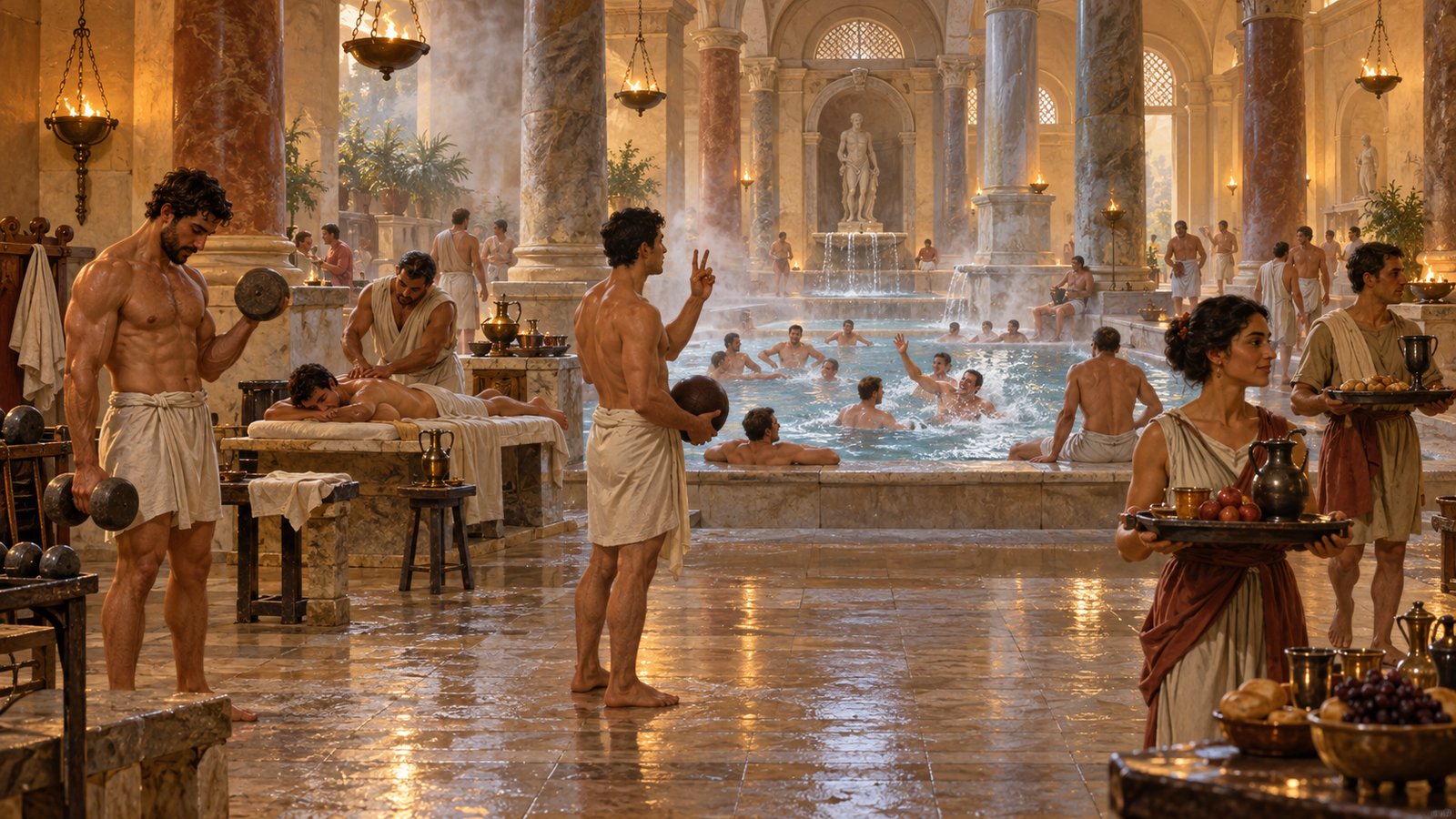
His first examples are strenuous. A strong man exercises with lead weights, and Seneca hears both the effort and the breath. The athlete’s grunt changes when he holds the strain or releases it. Repetition makes the interruption rhythmic: exertion, impact, breath, then another attempt.
Massage creates a different percussion. Seneca distinguishes the smack according to whether the masseur’s hand lands flat or hollow. The detail is almost technical. It tells us that the writer above can separate one bodily service from another without seeing the work.
Then a ball player begins to count the score aloud. Numbers organize play for the participants, but each call also reaches the unwilling listener upstairs. A quarrel and a thief caught in the act add sharper human drama. Someone sings because he enjoys hearing his own voice. A swimmer chooses a noisy plunge.
These are not interchangeable signs of a generically crowded Rome. Each has its own timing. The score returns in intervals; the splash arrives once; the massage beats; the dispute rises unpredictably. Seneca’s ceiling gathers them into one room even though the actions belong to different corners below.
A Depilator and Three Vendors Joined the Chorus
The most cutting joke belongs to the depilator. Seneca hears the worker’s shrill advertising voice until the service itself begins. At that point the salesman falls quiet and the customer cries out instead. The sound changes speaker, but it does not leave the building.
Commerce extends beyond bodily care. Drink sellers, sausage sellers and confectioners each promote their goods with a distinctive cry. The bathhouse was therefore not only a sequence of hot and cold rooms. It was also a place where appetite followed exercise and bathing, and where a seller’s voice was part of the method of finding buyers.
The catalogue lets us hear work that architecture often hides. A surviving bath can show furnaces, pools, drains and vaults. Letter 56 adds the calls that moved through those spaces and the impacts made by services that left little durable material trace.
That social density belongs beside the political and competitive life concentrated in Roman baths. Seneca supplies a different scale. Instead of a patron’s monument or civic program, he catches the minute acoustic negotiations of athletes, attendants, customers and sellers sharing a busy complex.
His comedy should not be mistaken for indifference to labor. The depilator and food sellers are funny because their techniques are recognizable. They need to attract attention in a room already full of it. Seneca’s complaint borrows their success: two millennia later, their cries still interrupt his philosophical sentence.
Hearing Was Not the Same as Surrendering Attention
After piling up interruptions, Seneca makes his claim. Noise surrounds him, but he says his mind does not have to leave itself. The ear receives a sound; attention decides whether to follow. That distinction is the hinge of the letter.
It is also more modest than pretending the sound does not exist. Seneca has heard enough to classify tiny variations in massage and breath. His point is not that disciplined people become deaf. It is that awareness of an event need not give the event command over the next thought.
The bathhouse tests this claim because its noises are meaningful. A sudden splash suggests a body entering water. A shouted score invites the mind into a game. A cry from a customer hints at pain. These are harder to ignore than an even mechanical hum because each offers the beginning of a story.
Seneca answers by returning to purpose. If the mind knows what it is doing, every possible story below does not deserve completion upstairs. Attention can register the invitation and refuse it. His room becomes a training ground in much the same sense that a public setting tests any practiced habit: not by removing resistance, but by making the resistance immediate.
This does not make concentration effortless. The length of his list betrays the work involved. He notices, names and then tries to release each interruption. The letter performs that sequence for Lucilius rather than merely announcing victory over distraction.
The Loudest Crowd Could Be Inside a Quiet Room
Seneca then reverses the problem. A silent room can still contain anger, fear, greed, luxury and ambition. These inner claims do not need a ball score or vendor’s call. They produce their own arguments, repeat old injuries and rehearse future rewards without any help from the street.
External quiet is therefore useful but incomplete. Closing a door may remove the splash, yet it cannot settle competing desires. A person can travel away from the city and bring the entire dispute along. For a Stoic moralist, the durable task is not acoustic insulation but governance of judgment.
Seneca does not turn that principle into a rule that everyone should seek the loudest lodging. He acknowledges that a quieter place can help when serious study requires protected attention. Environment matters. It simply cannot perform the whole ethical task on the thinker’s behalf.
The distinction prevents two easy readings. Letter 56 is not a modern celebration of productivity amid chaos, and it is not only a complaint about bad urban housing. Seneca uses a real acoustic disadvantage to expose two layers of disturbance: impacts and voices arriving from outside, then passions that can seize the mind even after those noises stop.
The physical bathhouse still survives in the argument. Its varied sounds make the philosophy concrete, just as Pompeii’s rental notice makes the business of bath property visible. One source preserves a public advertisement on a wall; the other preserves the unwanted reach of commerce and exercise through a ceiling.
Seneca’s room was never truly separate from the baths. The building joined writer, athletes, bathers, attendants and sellers in one vertical soundscape. His answer was not to deny that connection. It was to ask which noises deserved to become thoughts—and which internal voices would remain after the last vendor went home.
Sources
Lucius Annaeus Seneca, Moral Letters to Lucilius, Letter 56.