
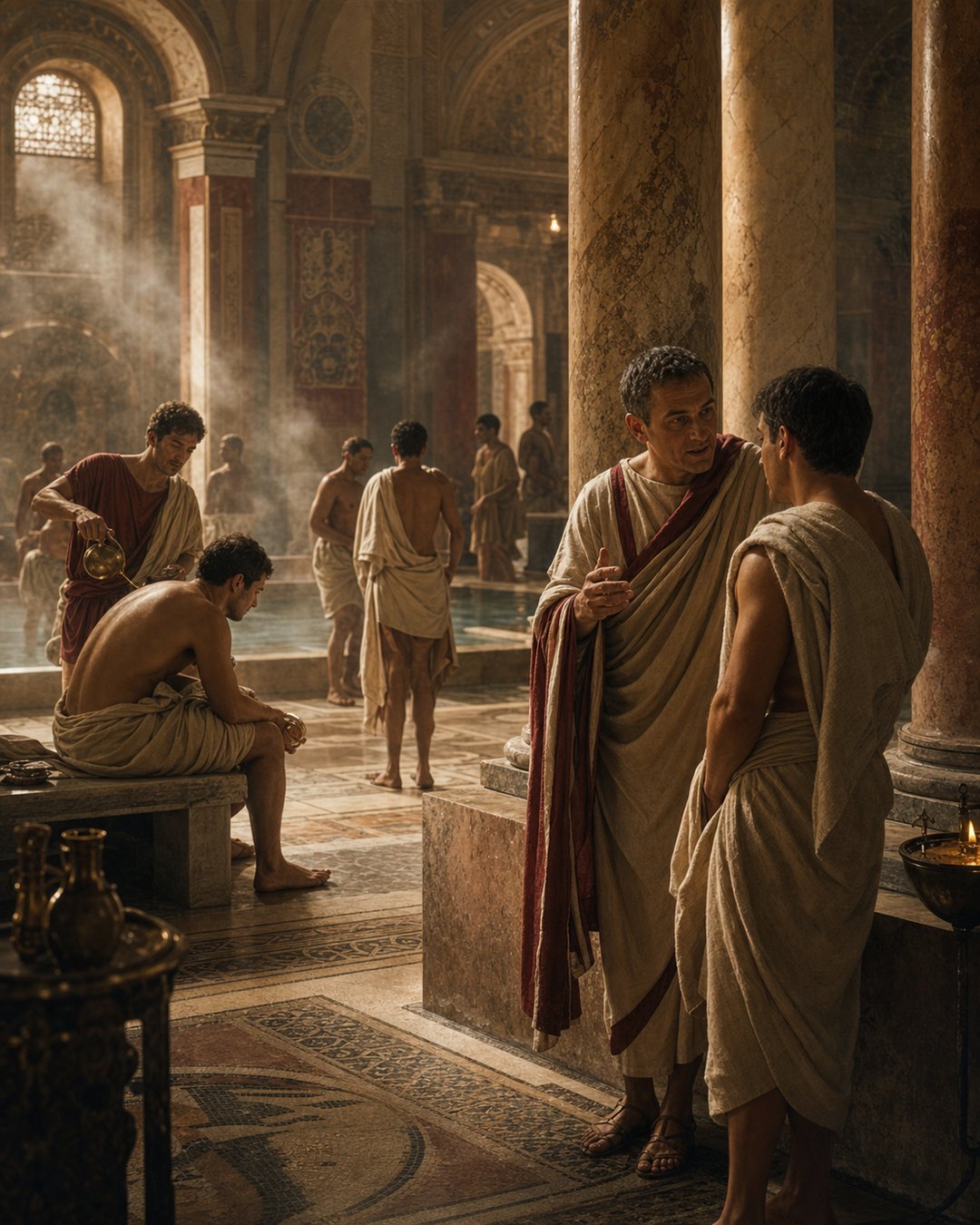
A Roman bath was not just where the day softened. It was a place where bodies, greetings, favors, rumors, clients, attendants, and ambitions moved through steam together. Privacy entered the bath and came out social.
Baths mattered because they made private ambition public. A man could wash, exercise, gossip, look generous, pursue a patron, display leisure, or watch who greeted whom. The rooms were warm, but the social temperature could be sharper than it looked.
The bath gathered people who needed one another
The bathhouse worked because it brought different kinds of people into the same routine. Patrons, clients, friends, freedmen, slaves, travelers, idlers, and office-seekers could cross paths in a setting that felt ordinary rather than formal.
That ordinariness was useful. A favor asked in a bath might sound less like a petition than the continuation of a greeting. A reputation could be tended while oil was rubbed into skin.
Rooms turned bodies into social signals
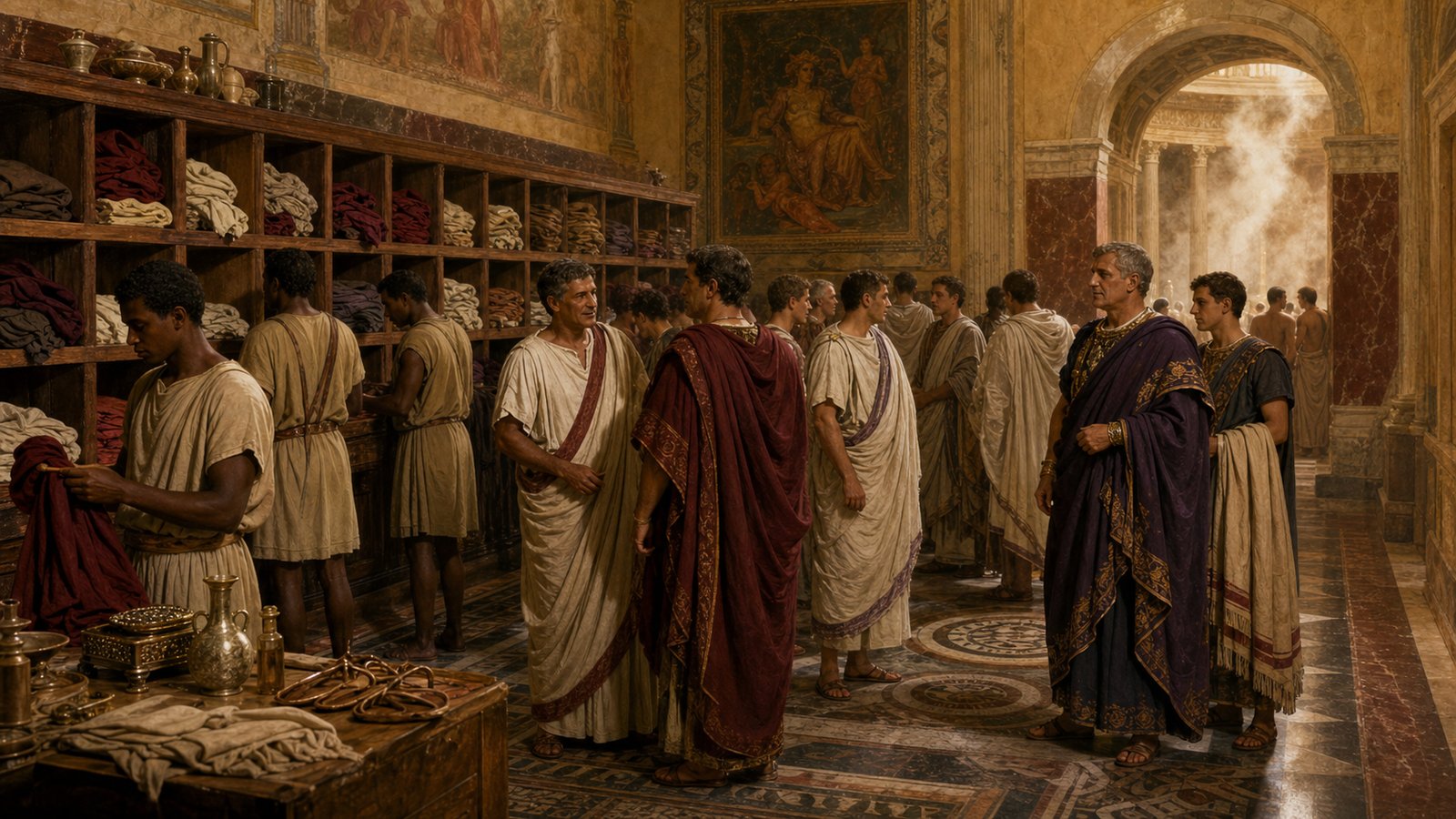
The sequence of rooms mattered: changing, warming, sweating, washing, cooling, dressing. Each stage created pauses where people could see and be seen. Clothing changed, attendants appeared, and possessions had to be guarded.
The apodyterium was more than a changing room. It was a place where status became visible through slaves, towels, oil flasks, confidence, and the ability to move comfortably through a public ritual.
Noise made the bath impossible to ignore
Seneca’s famous complaint about bathhouse noise is valuable because it makes the scene physical. Voices, splashes, grunts, slaps, vendors, attendants, and exercise all crowd the ear. The bath was not a quiet spa detached from urban life.
That noise tells us why baths mattered socially. Conversation and observation were built into the experience. A person who entered the bath entered a civic soundscape.
Engineering made leisure look natural
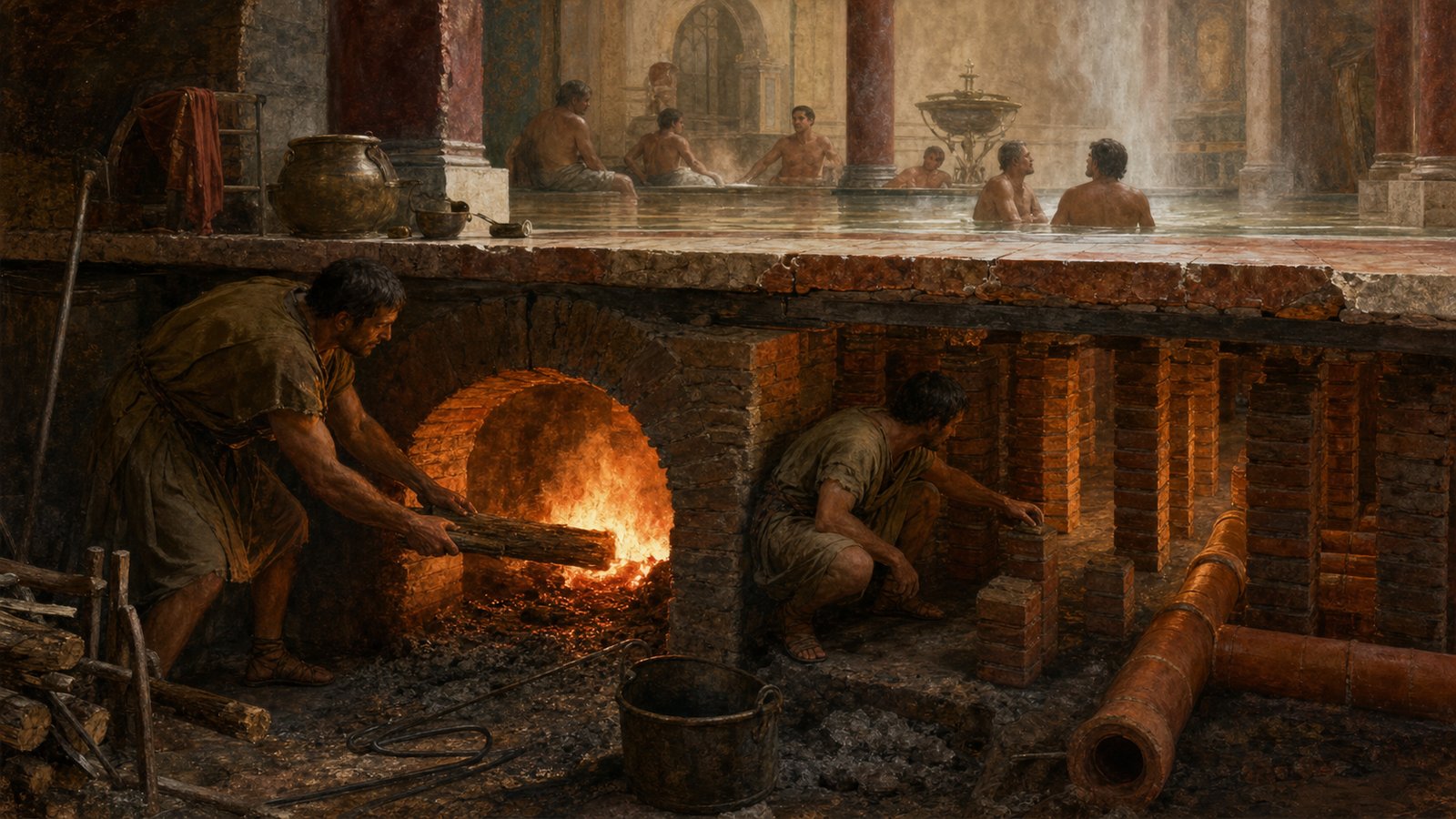
The warm rooms depended on labor below and behind the walls. Hypocausts, furnaces, water channels, fuel, cleaners, and attendants made comfort appear effortless to bathers above. Leisure rested on an infrastructure of heat and work.
This makes the bath a useful Roman symbol. Public ease often depended on hidden exertion. A graceful pool could require stokers feeding a furnace where no elegant bather wanted to look.
Generosity could buy memory
Elites who built, repaired, or endowed baths could convert money into public gratitude. A bath was not only a service. It was a monument people used with their bodies. Every visit could remind the community who had paid for comfort.
That kind of benefaction was powerful because it touched routine. A statue is admired occasionally; a bath could become part of the week. Ambition entered daily life disguised as generosity.
The bath made reputation washable but not private
Bathing cleaned bodies, but it did not remove rank. It exposed rank to negotiation. Who arrived with attendants? Who was greeted? Who waited? Who seemed generous? Who was mocked? Who looked out of place?
This is why Roman baths made private ambition public. They gave personal care a civic stage. Steam blurred the room, but it did not blur the social world that Romans brought with them.
The bath’s appeal came partly from its mixture of comfort and exposure. A person could relax without disappearing from society. For Romans who lived through patronage, competition, and reputation, that balance was valuable. You could be at ease and still be visible.
Martial’s urban world helps explain the mood. Dinners, greetings, gifts, insults, and favors circulate constantly. The bath belongs to that same network because it provides a plausible place to meet without formally summoning anyone.
The objects sharpen the picture. Strigils scraped oil and sweat; slaves watched clothing; sandals slapped wet floors; steam softened voices; a rich man’s attendants made his ease look organized. None of this was neutral. Material detail carried social meaning.
The bath also created small vulnerabilities. Clothing was removed, belongings stored, bodies exposed, and personal habits observed. In a status-conscious city, vulnerability could become another form of performance. Confidence itself was a signal.
For poorer visitors, the bath offered access to comfort that private houses could not provide. That made it socially generous and socially risky at once. Shared luxury can produce fellowship, envy, comparison, and dependence.
For ambitious men, the setting allowed careful informality. A greeting near the pool, a remark in the changing room, or a promise after exercise could seem casual while still doing political work. Rome often made power move through ordinary rituals.
The engineering below the floor is therefore not separate from the social story. Heat, water, and maintenance made the social stage possible. Without fuel and labor, there would be no warm room in which reputations could be warmed as well.
A bathhouse could also announce civic identity. The community that possessed baths possessed a certain Roman way of ordering time, cleanliness, sociability, and public generosity. Bathing made Roman life feel shared even when status remained unequal.
The next time a Roman bath looks merely luxurious, it is worth imagining the whole chain: aqueduct water, furnace heat, attendants, oil, greetings, bodies, favors, gossip, and memory. The bath cleaned the skin, but it also polished ambition in public.
Even silence in the baths could be meaningful. A man ignored by someone powerful learned something; a client greeted warmly learned something else. The ritual offered countless small tests of belonging that never needed to be written down.
The bath also softened hierarchy without abolishing it. Shared water and common rooms could make Roman society look more open, yet attendants, leisure time, entry habits, and networks of greeting kept distinctions alive. Equality of steam was not equality of power.
This tension explains why baths were so useful as social stages. They felt ordinary enough to disguise ambition and public enough to reward it. A successful greeting could look accidental, a favor could look friendly, and reputation could be refreshed along with the body.
Public bathing also made time itself social. To arrive when others arrived, linger where others lingered, or leave with the right companion could matter. The schedule of bathing became part of the schedule of being seen.
The furnaces below sharpen the contrast. Above, the elite could appear polished and effortless; below, stokers fed heat into brick spaces no guest praised during a polite conversation. Roman sociability often depended on labor deliberately kept out of sight.
The bath therefore joined two Roman habits: the love of public generosity and the hunger for social advantage. It made comfort collective, but it also made every collective comfort available for comparison, gratitude, rivalry, and memory.
For that reason, a bath visit could never be completely private. The water touched the body, but the room touched reputation. In Rome, even relaxation could become a way of entering public life.
This is the useful correction to the postcard image of Roman baths. They were beautiful, social, noisy, engineered, and political at once. The same pool could wash dust from the skin and place a name more firmly inside the city’s memory.
Sources & Further Reading
- Smith Dictionary, Balneae
- World History Encyclopedia, Roman Baths
- Seneca, Letters, 56
- Martial, Epigrams
- Smith Dictionary, Hypocaustum
- Frontinus, Aqueducts of Rome
- Cambridge Companion to Ancient Rome
- British Museum, Strigil
- Metropolitan Museum of Art, Roman Baths
- Oxford Classical Dictionary, Roman social life