
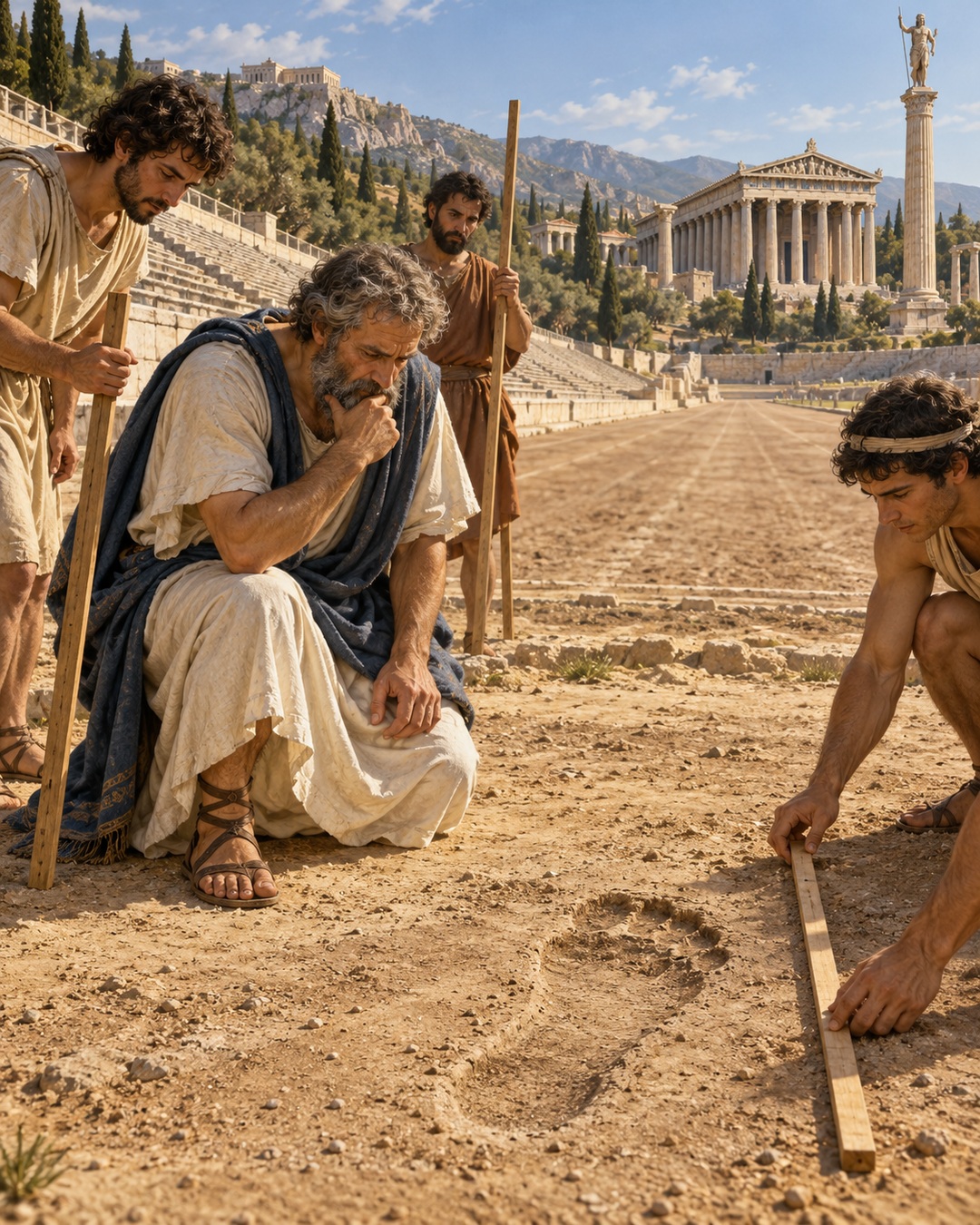
Six hundred feet ought to settle the length of a race-course. In the calculation preserved by Aulus Gellius, it opened a puzzle instead. The stadium at Olympia and later Greek stadia carried the same count, yet Olympia’s course was longer. The number matched while the ground did not.
Plutarch’s account, as Gellius reports it, made that discrepancy evidence about Hercules. Tradition said the hero himself had paced the course near the temple of Olympian Zeus. Pythagoras therefore reasoned backward: if Hercules laid out six hundred of his feet across a longer distance, his foot must have exceeded the feet behind later measurements.
The argument then made a second move. A longer foot implied a proportionately taller body. No surviving sandal, skeleton, or direct encounter was required. Track, unit, and anatomy became parts of one chain of inference.
The same number concealed two different lengths
The account begins at Pisae, by the sanctuary of Olympian Zeus. Hercules was generally said to have paced out the stadium there and to have made it six hundred feet long. Later builders elsewhere in Greece also produced courses of six hundred feet.
Those descriptions appear equivalent until the courses are compared. Gellius says the later stadia were somewhat shorter than Olympia’s. Six hundred, then, named the same number of units without guaranteeing the same accumulated distance.
This is the hinge of the whole story. A number does not measure by itself. It needs a unit, and the unit called a foot carries a bodily origin inside its name. If two people supply unequal feet, six hundred repetitions will not finish at the same point.
The anecdote does not provide modern survey data or a numerical ratio. It asks the reader to accept the reported difference and follow its implications. The exact excess matters less than the structure: same count, unequal total, therefore unequal unit.
That structure distinguishes the problem from the quarter-digit that changed a Roman water measure. Frontinus’s dispute turns on the dimensions assigned to an opening. Here the discrepancy is used to reconstruct the person imagined behind the standard.
The course also fixes the reasoning in a physical place. It is not a free-floating puzzle about giants. The ground at Olympia supplies one side of the comparison, and other Greek tracks supply the other. Legend becomes measurable because it has been attached to built space.
Yet the evidence remains literary. Gellius preserves Plutarch’s report of a calculation attributed to Pythagoras. Each layer matters. The passage shows what an ancient writer considered an acute inference, not a modern scientific measurement of a mythical body.
Pythagoras worked backward from track to foot
The first proportional step is direct. Olympia’s stadium exceeds the later courses; Hercules’ foot must therefore exceed the ordinary feet represented by those courses in the same proportion.
Suppose only for illustration that one course were a small fraction longer. Six hundred repeated units would magnify that difference across the track. The passage gives no figures, so attaching a modern percentage would invent precision. Its logic needs only a consistent relation between unit and total.
Pythagoras is described as reasoning by comparison. He does not search the sanctuary for a footprint. Instead, he treats the completed race-course as a residue of repeated bodily action. The unit has disappeared, but the total is still visible.
This reversal gives the anecdote its appeal. Measurement usually moves from a known unit toward an unknown distance. Here a known—or at least asserted—distance difference is used to recover the unknown unit. The object measured becomes evidence about the measurer.
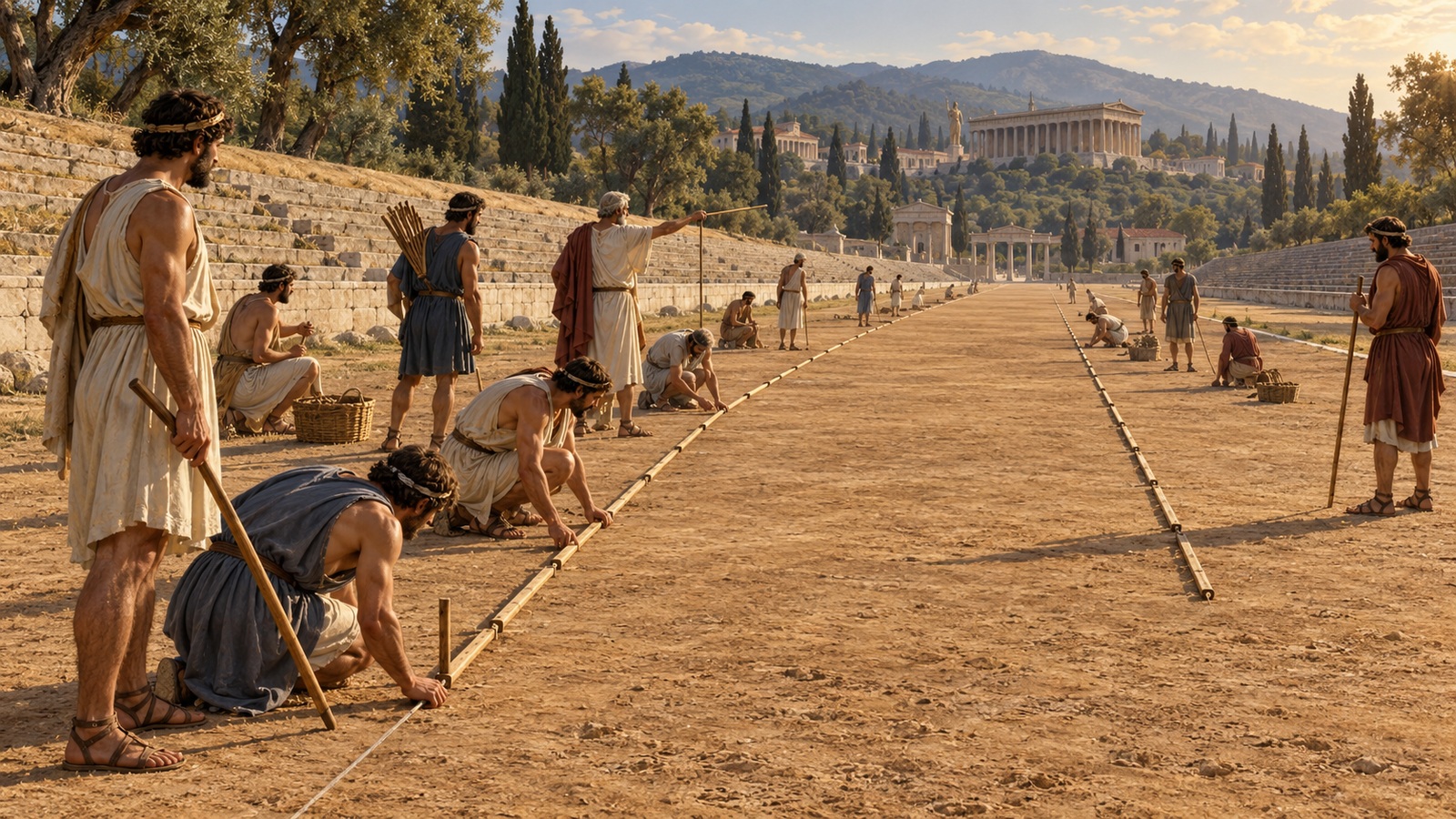
The inference also relies on sequence. Hercules’ course comes first; other men build later courses. Their equal label does not force the original to shrink into their standard. Instead, the later tracks become the comparison set against which the heroic unit stands out.
There is no claim that every ancient foot varied freely. The story is narrower. It exploits the bodily language of a unit to make a legendary act of pacing carry information about the legendary body that performed it.
Ancient measurement often sought repeatability through rods, vessels, marks, or conventions. two fixed points could preserve a workshop length without relying on anyone’s stride. Pythagoras’s attributed calculation travels in the opposite direction, deliberately reopening the body inside the standard.
A foot became a model for the whole body
Recovering the size of Hercules’ foot was only the intermediate result. Plutarch’s Pythagoras then appealed to the natural proportion of bodily parts. A foot suited to a certain body implied a corresponding full height.
The passage does not list a canon of anatomy. It does not say how many feet tall Hercules was, nor does it state a fixed foot-to-height multiplier. It says that Pythagoras calculated the bodily height appropriate to the inferred measure.
This preserves the argument without pretending to offer the missing arithmetic. First compare stadium to stadium. Then infer foot from stadium. Finally infer body from foot. Each step carries the same proportional excess forward.
Hercules consequently becomes taller than other men by the same proportion that Olympia’s course is longer than other six-hundred-foot courses. The conclusion mirrors the original observation. Architecture and anatomy occupy opposite ends of one ratio.
The move assumes that Hercules’ body maintained ordinary relations among its parts even while exceeding ordinary scale. He is not imagined with an exceptionally large foot attached to an otherwise average frame. Heroic size enlarges a coherent body.
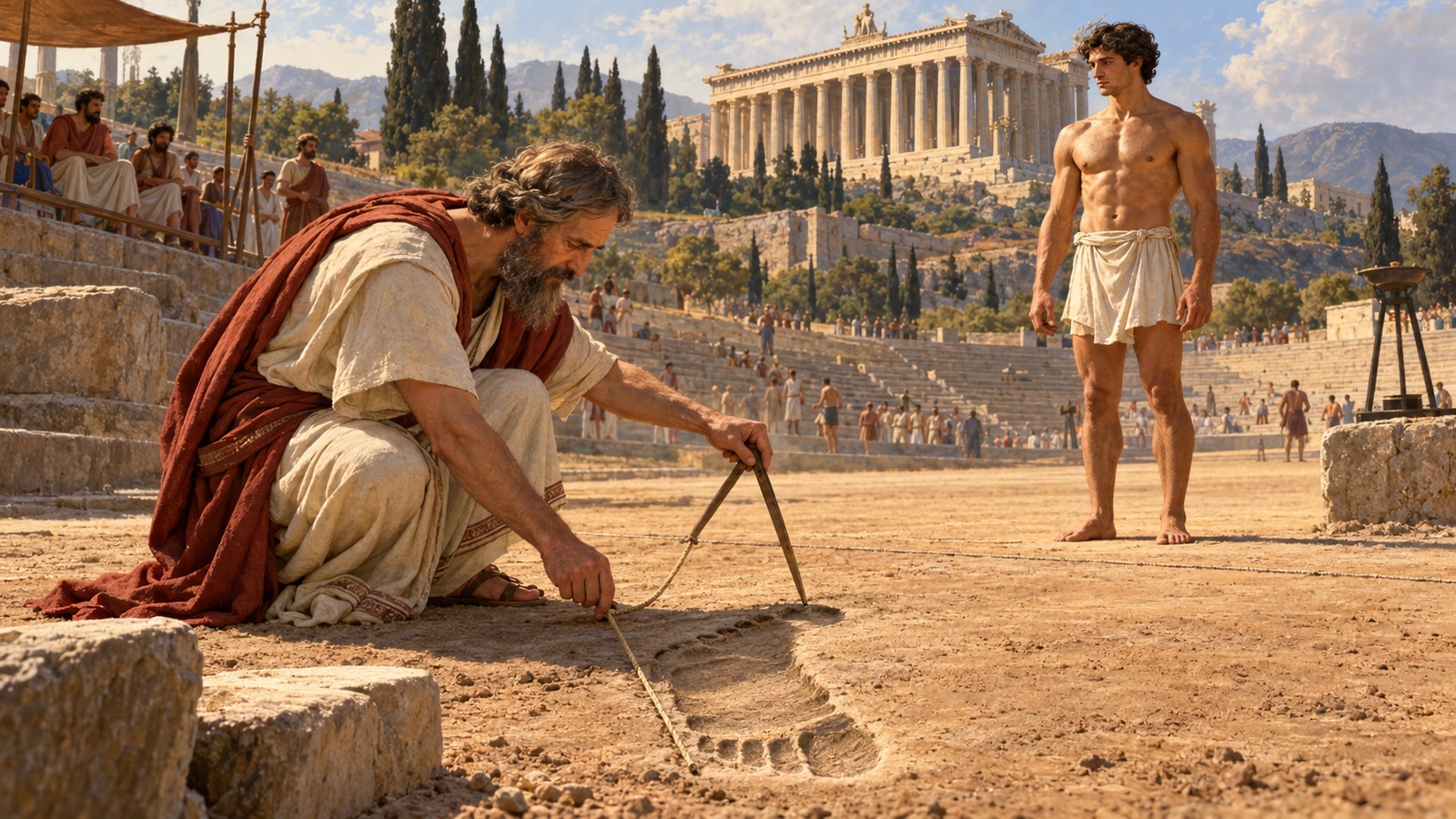
That assumption is what allows the calculation to leave the ground. Without proportional anatomy, the longer unit would reveal only a larger foot. With it, the stadium becomes an indirect portrait of stature.
The story therefore joins two kinds of proportion. Repeated units explain the length of a course, while related body parts explain the height of a man. Pythagoras links them at the word “foot.”
The cleverness lay in exposing the unit’s hidden body
Gellius calls attention to the sagacity and acuteness of the reasoning. The pleasure is not in a final number—none is supplied—but in seeing an apparently stable label become unstable and then useful.
“Six hundred feet” first sounds like certainty. The unequal stadia reveal that certainty to be incomplete. Instead of treating the mismatch as a nuisance, the argument turns it into information. Difference becomes the data.
The story also shows how monuments invite reverse engineering. A track can be read for the choices that produced it. In this case those choices are condensed into a legendary pace, and the pace is expanded into a legendary body.
Its limitations are equally instructive. The tradition that Hercules paced the course must be accepted. The reported comparison with other stadia must be accepted. The proportional body model must be accepted. The chain is elegant, but every link is an assumption preserved in literature.
That does not make the passage empty. It reveals an ancient habit of explanation: compare visible outcomes, identify the variable hidden behind a shared name, and carry a proportion from one domain into another.
The result is a measurement story in which no one measures Hercules directly. Six hundred repetitions across sacred ground do the work. The hero’s body survives not as remains but as a proposed unit, and the stadium becomes the long shadow cast by one oversized foot. The reasoning remains comparative from beginning to end; it never requires a surviving standard rod to supply an absolute length.
Sources
Aulus Gellius, Attic Nights 1.1, preserving Plutarch’s account.