

Solon’s law appears to punish the person most determined not to fight. If civil discord divided Athens into two armed parties, the citizen who joined neither could lose home, country, and property and be driven out as an outlaw.
Aulus Gellius says the rule astonished him. Why should someone who stood apart from factional violence deserve punishment? The explanation he records reverses the first impression: neutrality could leave both camps to the people least interested in peace.
The law’s proposed remedy was dangerous and deliberate. Reputable citizens were to enter the opposing parties, gain influence over their own allies, and use that position to restrain rather than destroy. It treated participation as a path back to reconciliation.
Wooden tablets turned distance into an offence
Gellius places the rule among Solon’s early laws at Athens. They were inscribed on wooden tablets and ratified by the Athenians with penalties and oaths meant to secure their endurance.
Those details frame the measure as public law rather than a philosopher’s casual recommendation. A rule fixed on tablets, reinforced by penalties, and protected by communal oaths claimed authority before any particular citizen had to decide where to stand.
The particular law, reported through Aristotle, begins only after severe conditions arise. Strife and disagreement have produced civil dissension. The people have split into two parties. Anger has led both sides to take up arms.
This is not a demand that every citizen choose a position in an ordinary policy dispute. The trigger is an armed division that has become a common calamity of the state.
At that point, remaining alone and apart brought sweeping consequences. The neutral person was to be deprived of home, country, and property and made an exile and outlaw. The language removes both material security and political belonging.
The severity creates Gellius’s question. Avoiding the fight looks prudent, perhaps even virtuous, when both factions are enraged. The law seems to confuse refusal to harm with betrayal.
That first reaction matters because the chapter is structured as reconsideration. Gellius does not present the law as self-evidently wise. He allows its apparent injustice to stand before giving the purpose supplied by people who had studied it deeply.
The rule also differs from the technical boundary between a tribune’s arrest and summons. That dispute distinguishes named powers within office. Solon’s law uses punishment to change where private influence will be positioned during collapse.
The law wanted moderates inside, not above, the factions
The explanation begins with failure. Good men may have been unable to check dissension at the outset. Once the crowd is aroused and frenzied, standing outside may no longer give those citizens enough leverage to stop it.
The proposed response is to divide. Some join one faction, others the opposing faction. Their moral purpose remains reconciliation, but their practical location changes.
Inside each party, influential participants can begin guiding and directing allies. They speak as members rather than detached lecturers. Their commitment makes them harder to dismiss as people who will bear none of the faction’s danger.
The law’s logic therefore separates side from aim. A person may enter one camp without accepting destruction of the other as the goal. Affiliation supplies access; reconciliation supplies direction.
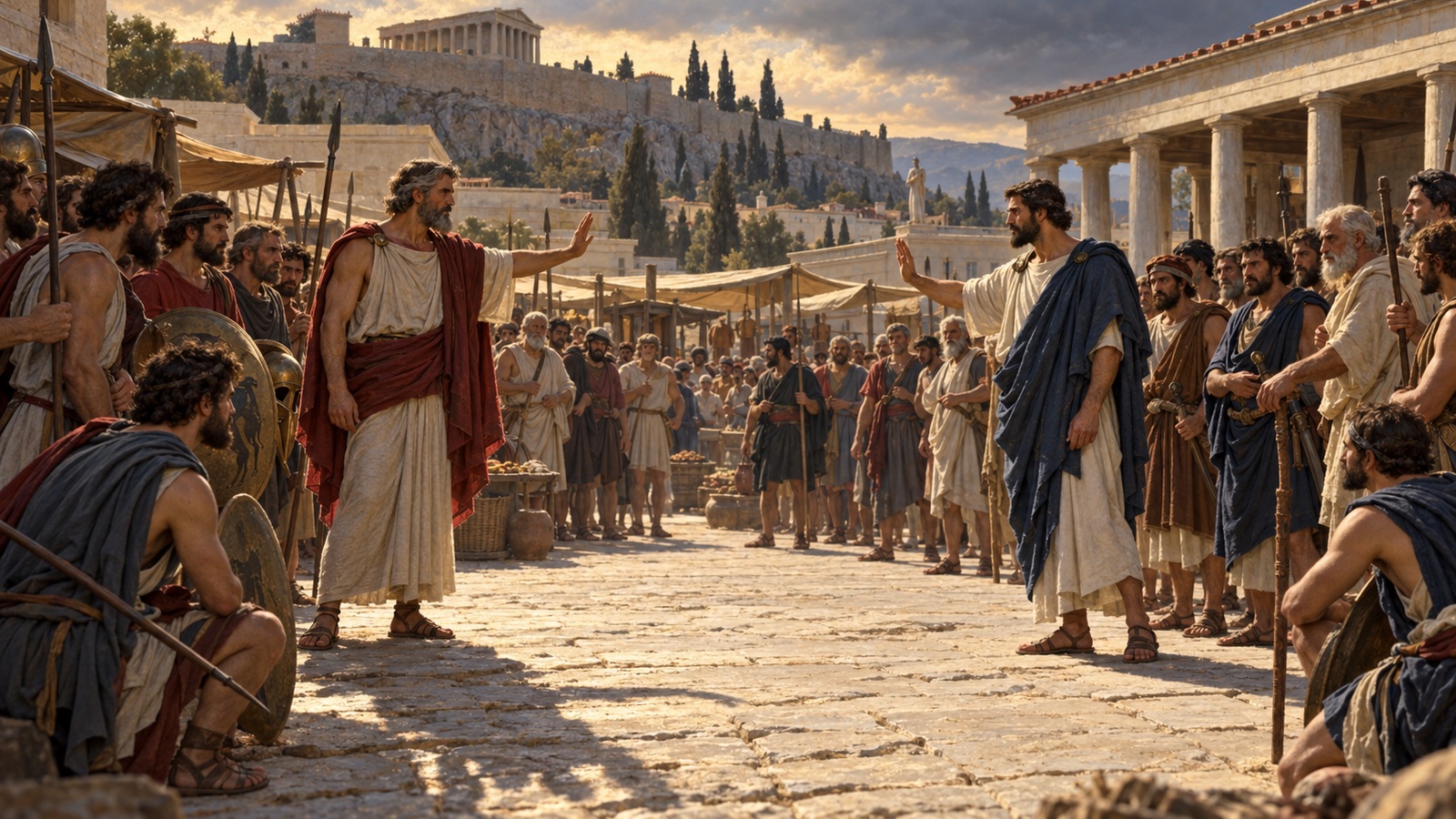
This is a risky design. Joining a faction can strengthen it, compromise the joiner, or let anger absorb the intended mediator. Gellius does not catalogue those objections. He records the law’s rationale: influence works differently after affiliation.
The good citizens are imagined as wanting to reconcile opponents rather than destroy them. That motive is the condition that keeps the mechanism from becoming simple conscription into partisan hatred.
The rule also assumes that factions are not sealed blocks. Leadership and advice can redirect them. If respected people enter early enough, each side may contain someone able to translate restraint into language its own members will hear.
Favorinus moved the same mechanism into a private quarrel
The philosopher Favorinus extended the idea from civil conflict to brothers or friends at odds. His smaller example clarifies the mechanism because the parties and advisers can be imagined within a single social circle.
People friendly to both disputants may initially remain neutral and try to reconcile them from outside. If that position carries too little influence because affection has not been made visible, Favorinus suggests another arrangement.
Some mutual friends should take one side and some the other. By displaying devotion, they can gain the confidence needed to prepare a return to harmony.
Again, taking a side is not the final purpose. It is a way to enter the flow of counsel around each angry person. The friend becomes credible enough to discourage escalation from within.

Favorinus contrasts this with the common boast of abandoning both disputants. Neutral friends may congratulate themselves on purity while leaving the field to people animated by hatred or greed.
Those remaining advisers do not merely fail to calm the dispute. They add fuel and inflame passion. Withdrawal changes the composition of counsel, making escalation more likely even if the people who withdrew never raise a weapon.
The private analogy exposes the theory beneath the law. Neutrality is not condemned as an inner attitude. It is criticized as a location from which goodwill may be ineffective while hostile influence becomes concentrated around both parties.
This does not make every quarrel demand theatrical side-taking. Gellius records Favorinus’s extension as an argument tied to failed outside influence. The sequence matters: an attempt at neutral reconciliation has lacked force, so affiliation is proposed as another route.
The counterintuitive rule judged influence by where it stood
Gellius concludes that Solon’s law was intended to terminate dissension, not enlarge it. Its harshness aimed to prevent capable citizens from treating public collapse as someone else’s contamination.
The rule is still unsettling. It threatens exile and confiscation in a situation where choosing either armed party could expose a person to moral and physical danger. The chapter does not erase that cost; it explains why ancient interpreters considered the coercion salutary.
Their answer rests on a map of influence. Outside both camps, a good citizen may preserve personal distance but lose practical reach. Inside one camp, the same person may restrain allies, recognize a counterpart across the divide, and make negotiation possible.
This offers a different political scene from the Senate isolating Catiline in plain view. There physical separation exposes a man already treated as dangerous. Solon’s attributed law tries to stop separation from leaving dangerous groups internally unchallenged.
No success story follows in the passage. Gellius does not name a civil war ended by the statute or citizens who performed the role perfectly. The chapter preserves a rationale, not proof that the mechanism always worked.
Its value lies in the problem it identifies. Conflict changes not only what people believe but who remains close enough to advise them. When moderates withdraw together, extremists can become the only voices distributed across both sides.
Solon’s law answered that problem with compulsion. Favorinus answered it with a strategy among friends. Both versions insist that reconciliation may require contact that looks, from a distance, like compromised neutrality.
The chapter therefore distinguishes peace as a wish from peacemaking as a position. Good intentions outside the camps did not satisfy a mechanism that depended on counsel delivered from within.
The citizen who stayed apart kept clean hands only in the narrowest sense imagined by the law. His absence also helped determine who filled the space beside armed neighbours. That is why the wooden tablet made distance itself punishable.
Sources
Aulus Gellius, Attic Nights 2.12, citing Aristotle on Solon.