

“Elegant” did not always flatter a Roman. In the linguistic history preserved by Aulus Gellius, the word once pointed toward a man who selected too carefully, dressed too expensively, and arranged his life with suspect fastidiousness. Refinement looked less like taste than like excess.
Gellius follows the term across a moral change. Under Marcus Cato, elegans normally carried reproach. Later it lost that automatic sting, yet still needed a limiting virtue before it could become praise. Cicero’s ideal pairings make the adjustment visible: one man was the most frugal of the elegant, another the most elegant of the frugal.
The history of the word therefore records more than a dictionary shift. It shows Romans negotiating how polish, expenditure, discipline, and public reputation could coexist.
Cato heard excess inside the compliment
Gellius begins with a warning to his own readers. They may know elegance as refinement, but earlier Romans did not necessarily hear the word that way. Up to Cato’s time, he says, calling a man elegant was usually blame.
His evidence comes from Cato’s Carmen de Moribus, a work concerned with conduct. In the quoted passage, Cato lists the extravagant, ambitious, elegant, vicious, and good-for-nothing man in one bitter sequence. The point is not that every term meant the same thing. Their proximity places elegance among recognizable failures of character.
Gellius then explains the older charge. The elegant man was excessively particular and extravagant in attire and mode of life. Selection had gone beyond care. A person’s clothes, household habits, and cultivated preferences could suggest that too much money and attention were being spent on surfaces.
This older force gives the word a social setting. Clothing was seen in public. Meals required servants, ingredients, and equipment. A highly managed style announced resources and priorities even when no one stated their price.
The criticism resembles the status compressed into Cicero’s costly citrus-wood table, but Gellius is not evaluating one possession. He is recovering a label broad enough to judge a whole manner of living.
The chapter also warns against reading later approval backward. If an early author calls someone elegans, a modern-sounding compliment may reverse the intended meaning. Gellius treats historical vocabulary as evidence whose moral temperature has to be recovered.
Dress and dinner made character visible
Cato’s scattered remarks fill out the world in which that reproach made sense. He remembered a custom of dressing becomingly in the forum while keeping domestic clothing to the minimum required for decency. Public appearance demanded order, but private life did not have to become a theatre of consumption.
He also contrasted spending on horses with spending on cooks. The line does not provide an account book, yet its hierarchy is clear. A horse could serve transport, agriculture, or war; an expensive cook signalled elaboration at table. What a household paid to perfect appetite became moral evidence.
Cato’s criticism of poets and banquet-goers is similarly severe. Gellius quotes him saying that poetic activity or frequent attendance at dinners could earn the label “ruffian.” The judgment belongs to the austere voice Gellius is documenting, not to a neutral catalogue of Roman occupations.
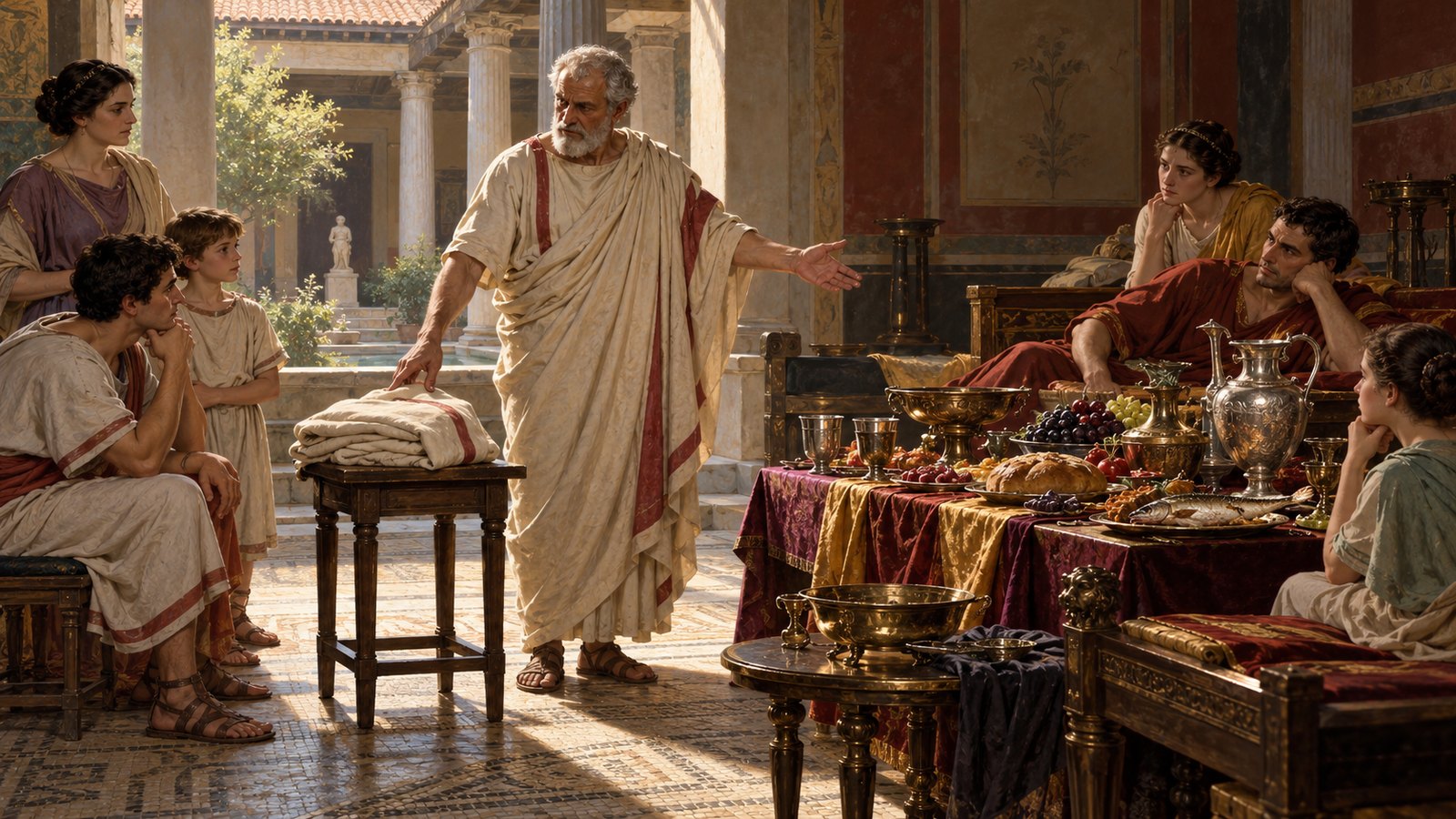
These examples make elegance concrete. It was not an abstract appreciation of proportion. It could be inferred from fabric, grooming, servants, menus, and the time devoted to display.
That logic helps explain why moderation later became necessary. Refinement could not simply erase its old association with expense. To become admirable it had to prove that choice remained governed by restraint.
The same tension appears in Lollia Paulina’s fortune displayed at dinner. There jewels made cost impossible to ignore. Gellius’s word history catches a quieter version of the same scrutiny in ordinary judgments about a person’s way of life.
Moderation changed the word without erasing its risk
Gellius says the elegant man later ceased to be reproached. That is a genuine semantic move, but not a complete reversal. Elegance still deserved no commendation unless it was very moderate.
The qualification matters. If refinement alone had become a virtue, there would be no need to protect it with frugality. Instead, later praise preserves the old anxiety by requiring visible control.
Cicero’s balanced descriptions of Lucius Crassus and Quintus Scaevola supply the solution. Crassus was the most frugal of elegant men. Scaevola was the most elegant of the frugal. Each phrase starts from a different side but meets in the same middle.
The pairings work because neither virtue stands alone. Frugality without any polish might appear rough. Elegance without frugality might slide back into extravagance. The admired Roman occupies the narrow space where cultivated choice does not become costly obsession.
The sentences also show language actively managing reputation. Cicero does not merely call either man elegant. He builds a verbal counterweight into the praise. Readers are told how to prevent the dangerous interpretation.

This is why Gellius’s chapter is more than a note about changing definitions. The old and new senses coexist in the explanation. Elegance can be admired, but only after the speaker demonstrates that it has not become the excess Cato condemned.
One word carried a contest over Roman values
Words that describe taste often pretend to be light. Gellius makes this one heavy with social judgment. To call a man elegant was to place his clothing, spending, meals, and discipline before an imagined audience.
The shift did not happen because Romans suddenly stopped noticing luxury. It happened because writers developed a conditional form of approval. Refinement could count as virtue when bounded by economy and self-command.
Cato’s image of human life as iron closes the chapter’s moral atmosphere. Iron wears away when used, but rust consumes it when left idle. Toil may exhaust a person; sluggishness and torpor can do worse. The comparison values purposeful use over decorative preservation.
That image helps explain the suspicion behind the older sense of elegance. A life devoted to arranging appearances might look polished while failing the test of use. Cato’s moral vocabulary asks what conduct produces, not merely how smoothly it presents itself.
Gellius does not claim a precise date when insult became praise. He gives a sequence: early reproach, later neutrality, then guarded commendation. The evidence is literary and comparative rather than statistical.
That restraint makes the chapter valuable. It shows how to read a moral word historically without pretending every speaker used it identically. Cato’s elegance is excess. Cicero’s elegance can be admirable, but only when frugality stands beside it.
A compliment was therefore built from an old insult rather than replacing it completely. The polished Roman still had to answer the censor hidden inside the word.
The chapter also preserves an asymmetry between public and private display. Cato’s remark about dressing becomingly in the forum does not demand deliberate ugliness. It recognizes a civic standard for appearing among others. His contrast lies at home, where elaborate presentation offered less public purpose and could look like appetite turned inward.
That distinction keeps austerity from becoming neglect. Becoming dress still has a place. Horses still attract expense. Work still wears the body. What Cato attacks is not every crafted choice but a hierarchy in which cooks, banquets, and painstaking appearance absorb attention that should serve more durable uses.
Gellius’s later examples do not cancel that hierarchy. They domesticate refinement by making it answerable to another virtue. Crassus and Scaevola can be elegant because the phrasing immediately certifies economy. The praise is almost an audit: polish is admitted only after restraint balances the account.
Readers therefore watch one Latin adjective carry several periods at once. Its old sting explains the later qualification, and the later qualification keeps the old sting intelligible. Semantic change did not erase Roman moral memory; it folded that memory into a more careful compliment.
Sources
Aulus Gellius, Attic Nights 11.2, quoting Marcus Cato and Cicero.