
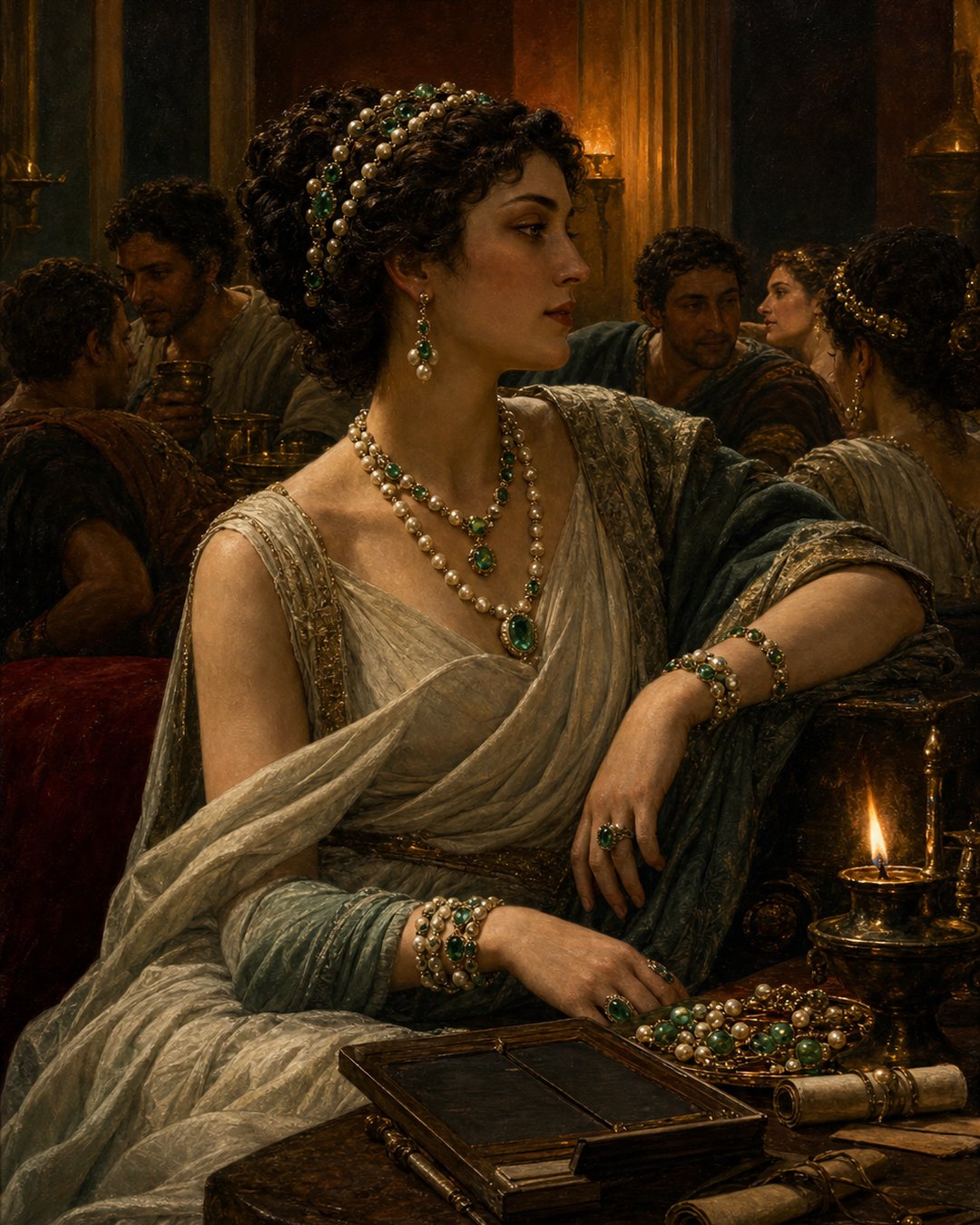
Pliny the Elder chose an ordinary dinner to make wealth look extraordinary. He remembered seeing Lollia Paulina, once the wife of Emperor Caius, arrive covered in alternating layers of pearls and emeralds. They appeared on her head and in her hair, among her wreaths, at her ears and neck, around her wrists, and on her fingers. His valuation was forty million sesterces.
The setting is essential. Pliny insists this was not a public festival or solemn state ceremony. It was a wedding entertainment, a social meal under lamps. Lollia also stood ready to prove the valuation with receipts and acquittances. The outfit was therefore more than sparkle. It came with paperwork, inheritance, and a financial history that Pliny traced back to provincial extraction by her grandfather, M. Lollius.
His account is hostile, vivid, and personal. We should preserve all three qualities. Pliny’s moral anger shapes the portrait, but he also supplies an eyewitness inventory, a number, a room, a documentary claim, and a family line. The jewels become a portable archive of Roman power.
An Ordinary Dinner Removed the Official Excuse
Triumphs, temples, and imperial ceremonies could surround costly materials with public purpose. Lollia’s dinner offered no such defence. Pliny labours over its ordinariness because the absence of ceremony makes the scale of the display harder to justify. Forty million sesterces did not appear on a triumphal platform. It moved through a dining room on one person’s body.
The lamps sharpened the effect. Pearls do not flash like cut modern diamonds; they gather and return light across curved surfaces. Emeralds offered a different colour and depth. Pliny’s phrase about alternating layers suggests deliberate arrangement rather than a heap of ornaments. Hair, wreath, ears, neck, bracelets, and fingers became successive zones in a controlled composition.
Roman elite dining already turned bodies, vessels, textiles, and food into rank. Lollia’s ensemble pushed that grammar to an extreme. No herald had to announce the price. The visual field established distance between wearer and viewer before the receipts entered the conversation.
The Receipts Made Display Auditable
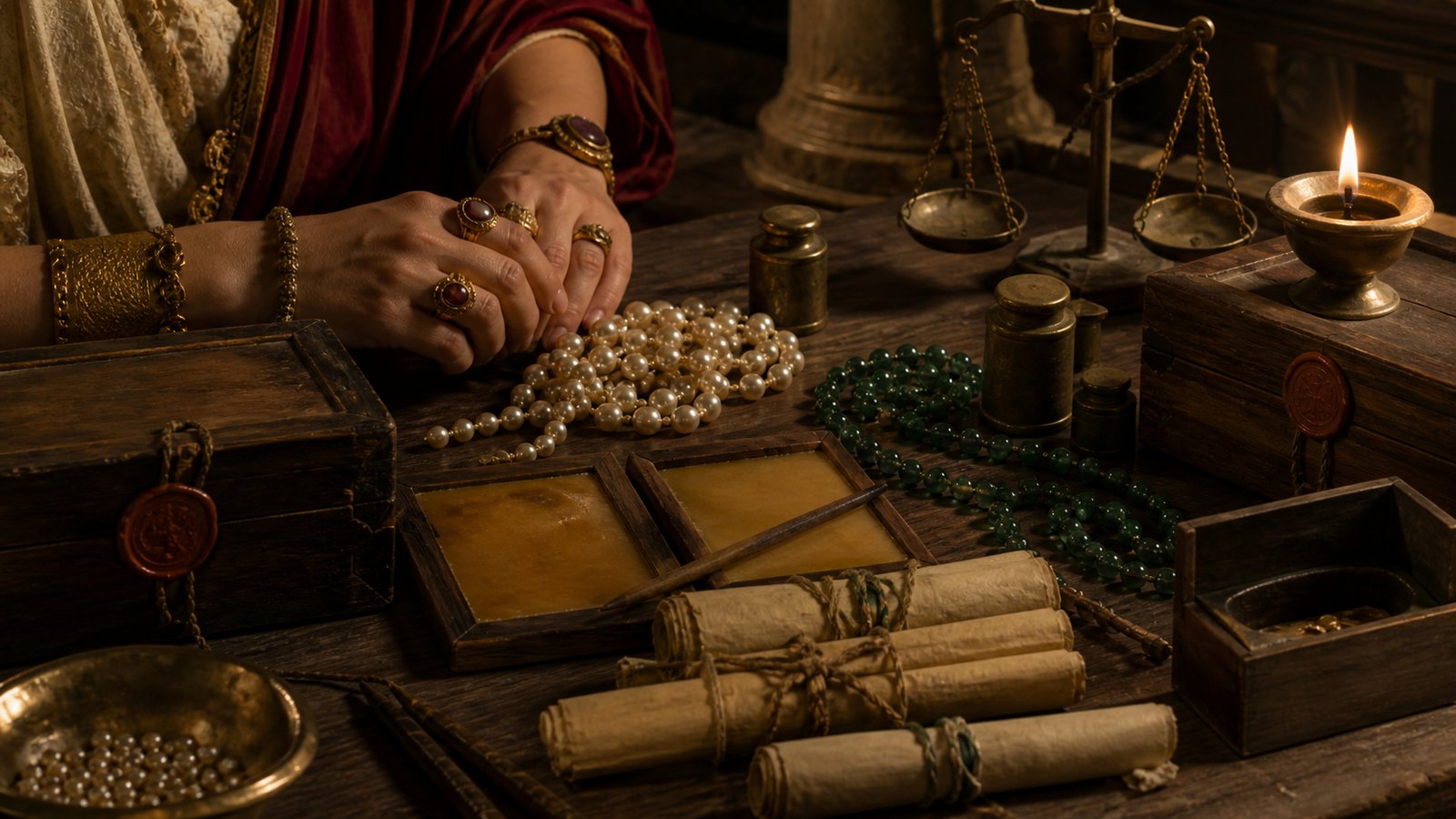
Pliny says Lollia was prepared to prove the forty-million valuation by showing receipts and acquittances. That detail changes the scene. Boasting about priceless jewels is easy; attaching documentary evidence makes the boast testable within the accounting habits of elite property. The outfit could be admired aesthetically and defended numerically.
Receipts also imply transactions stretching beyond the dinner. Each object had passed through purchase, transfer, inheritance, appraisal, or settlement. Pearls harvested far from Rome and emeralds brought through long-distance exchange arrived in a domestic archive as entries with values. Lollia could wear them, but paperwork stabilized what the audience was expected to believe about their worth.
Luxury objects often hide the chain that produced them. A polished surface suppresses the mine, coast, workshop, dealer, tax, and negotiation. Here, Pliny briefly restores one part of that chain through documents. The receipts did not expose every worker or location, but they tied beauty to enforceable ownership and quantified price.
M. Lollius Sat Behind the Pearls
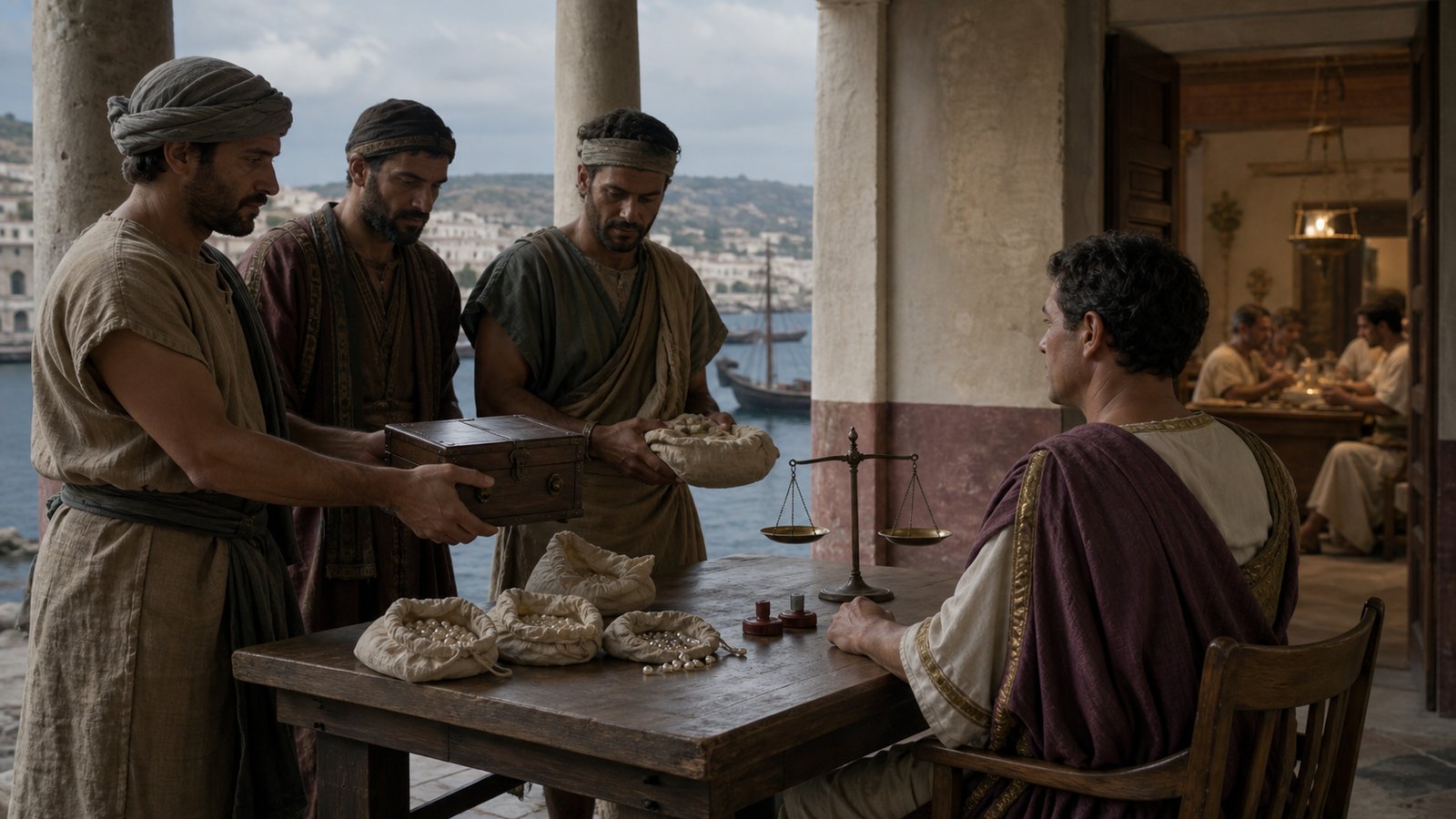
Pliny refuses to let the jewels begin with Lollia. He says they were inherited from her grandfather, M. Lollius, rather than received from a prodigal potentate. He then supplies his explanation for the family fortune: gifts extorted from kings and wealth taken through the spoliation of provinces. In his telling, the dinner’s light came from an older geography of command.
M. Lollius had been prominent in the Roman East. Pliny says his reputation there was infamous, that he lost the friendship of Caius Caesar, and that he took poison. The passage compresses a political career into the moral provenance of an outfit. Whatever individual routes the pearls followed, Pliny wanted readers to see provincial extraction when they imagined them on Lollia’s fingers.
This is not simply an attack on a wealthy woman. Lollia is the visible endpoint, but the charge points backward toward male officeholding, imperial friendship, pressure on kings, and inherited family capital. The outfit concentrates consequences that had been dispersed across administration and distance.
Pearls Turned Geography into a Private Surface
Pearls entered Roman luxury through waters and trade routes far from the capital. Their small size made enormous value portable. Unlike a marble column or a bronze quadriga, a fortune in pearls could move inside boxes, cross a threshold, and then be distributed across hair and skin. Lollia’s body temporarily became the display case.
The same empire that moved pigments, metals, spices, and animals could redirect marine objects into social competition. Our account of the salt-heavy start of purple dye follows a costly colour through physical processing. Lollia’s pearls reveal a different mechanism: value condensed through rarity, provenance, possession, and the ability to assemble many pieces at once.
Pliny’s itemization also resists the vague word “jewellery.” Head, hair, wreaths, ears, neck, bracelets, fingers: each location increases the sense of coverage. The expense did not rest in one pendant. It multiplied across the body until no single ornament could contain the statement.
Pliny Compared Dinner with Conquest
After describing Lollia, Pliny asks readers to imagine the clothing of older victors such as Curius and Fabricius and the objects displayed on triumphal litters. His comparison is deliberately severe. Conquest had once presented spoils as public proof of victory; now, in his polemic, the proceeds of empire returned as private decoration at table.
That contrast belongs to Pliny’s moral voice, not to a neutral inventory. Yet it preserves a Roman argument about what wealth was for. Was conquest justified by public security, collective monuments, and civic memory, or did it culminate in private consumption by connected families? Lollia’s receipts proved legal possession. They did not answer Pliny’s question about legitimate use.
The polished ensemble could therefore be read two ways at once. To participants at dinner, it demonstrated rank, taste, inheritance, and command of scarce materials. To Pliny, it demonstrated that extraction survived political scandal and death by entering family property. The jewels outlived M. Lollius’s fall and reappeared under lamps on his granddaughter.
Pliny’s emphasis on polished appearance also belongs beside Rome’s other surface crafts. A mirror, for example, depended on stages of abrasion before it could return a face; the stages of a Roman polish show how labour disappeared into finish. Lollia’s jewels performed a similar concealment at a larger scale. Viewers received colour and lustre first. The writer then forced administration, receipts, and extraction back into the frame.
Forty Million Was a Family History
The force of the number comes from its attachment to details. Forty million sesterces is not left floating as a cliché. It has an eyewitness, an ordinary occasion, a sequence of body parts, alternating materials, receipts ready for inspection, a named ancestor, and an accusation about the provinces. Each element turns price into narrative.
That narrative also clarifies why Pliny remembered Lollia rather than only the pearls. Her outfit joined private display to public power without needing a speech. A viewer could see an emperor’s former wife, the granddaughter of an eastern commander, wearing inherited value that had crossed generations and regions. Biography made the supply chain socially legible.
Roman luxury was often condemned for excess, but condemnation can preserve mechanics. In this case, Pliny’s anger records how jewels were layered, valued, documented, inherited, and politically interpreted. Lollia’s dinner survives because it made a fortune visible for an evening—and because one observer insisted on asking where that fortune had begun.
The result is less a catalogue of ornaments than a balance sheet worn in public. Light made the pearls visible; Pliny’s narrative made their political ancestry difficult to ignore.
Sources
Pliny the Elder, Natural History, Book 9, chapter 58.