
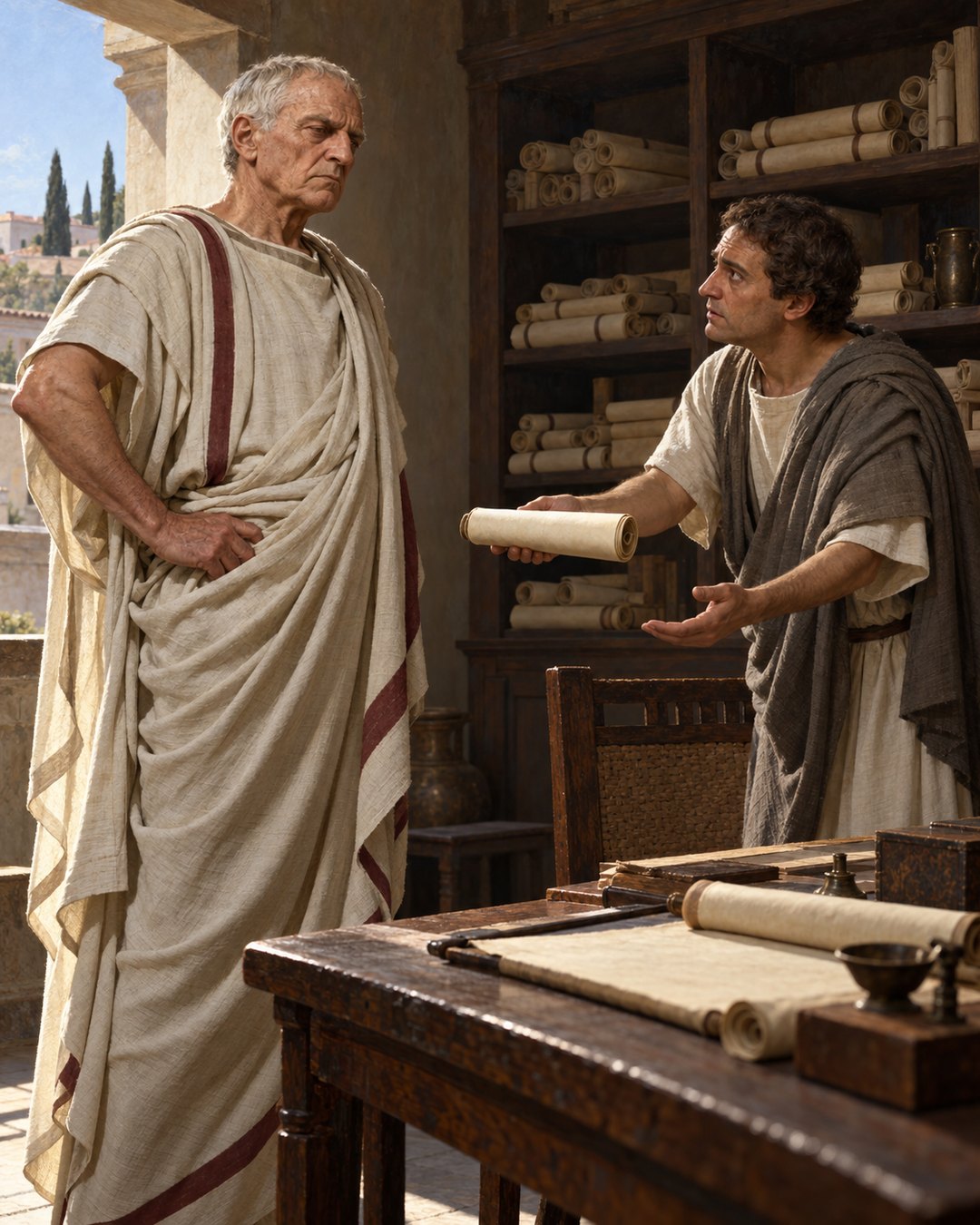
Aulus Albinus wrote Roman history in Greek and tried to protect himself in the first pages. He was Roman, born in Latium, he reminded readers. Greek was foreign to him. If his books contained anything incorrect or inelegant, critics should forgive the errors.
Marcus Cato refused the bargain. No one had compelled Albinus to choose Greek. Why ask pardon in advance for a fault that could be avoided by not undertaking the project in those terms?
Aulus Gellius preserves the exchange as a compact lesson in responsibility. A disclaimer may reveal honest limits, but it can also seek credit for ambition while transferring the cost of foreseeable weakness to the audience.
Albinus chose a foreign language for Roman history
Gellius identifies Albinus as a Roman of high standing who had been consul with Lucius Lucullus. The project was not a casual exercise by an unknown beginner. A former consul had decided to compose the history of Rome in Greek.
That choice placed Roman subject matter inside the language of a wider Mediterranean literary culture. The chapter does not explain all of Albinus’s motives, and it would be unsafe to invent them. What matters for Cato’s reply is that the choice was voluntary.
Albinus’s introduction acknowledges the obvious problem. He was born in Latium, not in a Greek-speaking household as he presents himself. Greek remained foreign enough that mistakes and inelegance could enter his prose.
The admission could sound modest. By naming his limitation, the author appears candid. He does not pretend native mastery. He tells readers what sort of imperfection they may encounter.
Yet the preface goes beyond description. Albinus asks that no one blame him. He wants the disclosure to change the standard by which the completed history will be judged.
This makes the introduction part of the work’s machinery. Before the first historical argument, it assigns roles: Albinus becomes the brave outsider to Greek expression, while the reader is asked to become an indulgent judge.
The situation differs from Gellius collecting difficult old ship names during a journey. There linguistic difficulty becomes the subject of inquiry. Albinus uses difficulty as a shield around a project he selected.
The preface tried to move blame before criticism began
An advance apology can perform several tasks at once. It can warn, lower expectations, display humility, and frame later criticism as ungenerous. Cato isolates the last effect.
His rebuke begins by calling Albinus a trifler. The fault is not simply imperfect Greek. It is the preference for apologizing over avoiding the conditions that made apology necessary.
Cato distinguishes two familiar grounds for pardon. A person may err through inadvertence, failing to foresee what happened. Or a person may act under compulsion, lacking a free alternative. In either case, the distance between intention and result matters.
Albinus’s own preface removes the first defence. He foresees the danger clearly enough to describe it. The request is printed before the errors, not improvised after an unexpected failure.
The project also lacks the second defence. No order forced a Roman historian to choose Greek. Cato’s question—who compelled you?—returns control to the author.
The logic is sharp because it uses the disclaimer against itself. Every sentence Albinus offers in mitigation demonstrates knowledge and agency. He knew the risk, chose the form, and asked readers to absorb the consequence.
That does not prove the history was bad. Gellius gives no sample of its Greek here. Cato’s target is the structure of the excuse, not a measured catalogue of errors.
Cato separated difficulty from necessity
Writing in a learned second language can be difficult without being compulsory. Cato refuses to let those categories collapse.
A demanding choice may deserve admiration, but difficulty alone does not create immunity. If the author asks to be judged as a Greek historian, readers may judge the Greek history. If he asks to be judged only as a Roman attempting Greek, the project’s ambition and its standard begin to pull apart.
The anecdote therefore turns on a boundary between explanation and exoneration. “Greek is foreign to me” explains why errors might occur. It does not by itself establish why blame should disappear.
Cato’s response also preserves the reader’s position. A preface cannot simply order an audience not to notice incorrect or inelegant language. The writer may supply context, but the critic retains judgment.
That concern fits Cato’s larger reputation in the chapter as a defender of Roman seriousness. Gellius does not need a long speech. One question restores proportion between voluntary authorship and requested pardon.
The exchange also recalls Herodes Atticus testing a philosopher’s claimed identity against conduct. In both stories, a respectable outer form meets a demand for substance. A preface and a cloak can announce seriousness; neither settles the judgment.
A short joke fixed responsibility on the author
Gellius praises the rebuke as both just and neat. Its neatness comes from compression. Cato does not dispute every sentence in the introduction. He asks one question that reorganizes all of them.
Who compelled you to do the thing for which you request pardon before doing it? The timing is essential. Albinus is not confessing after discovering an accidental flaw. He is designing the excuse alongside the work.
The question also avoids an absolute rule against writing beyond one’s native language. Cato does not say Romans must never write Greek. He says a voluntary choice cannot automatically claim the pardon attached to compulsion.
Nor does the anecdote deny the value of candour. Acknowledging limits can help readers. The target is a stronger demand: because the limit has been acknowledged, adverse criticism should be suspended.
Gellius attributes the story to the thirteenth book of Cornelius Nepos’s On Famous Men. The chain of preservation matters. We receive Cato’s line through a miscellanist citing a biographical work about notable figures.
That literary afterlife shows why the reply endured. It is portable. The specific contest concerns a Roman history in Greek, but the mechanism belongs to any work that converts a foreseeable limitation into a request for exemption.
Albinus wanted two benefits: the reach or prestige of a Greek history and the leniency owed to someone outside Greek mastery. Cato made him choose which standard his voluntary ambition invited.
The preface tried to place the apology before the error. Cato placed responsibility before both.
The difference between a warning and a waiver is central. A warning helps an audience interpret what follows: this author is working outside his first language. A waiver tries to determine the verdict in advance: because the difficulty has been disclosed, defects should no longer count against the work. Cato permits the first fact but rejects the second conclusion.
His reply also protects the meaning of pardon. If every foreseeable weakness in a voluntary undertaking automatically deserved forgiveness, apology would become a routine design feature rather than a response to accident or force. The author could choose any disadvantage, announce it, and ask readers to carry it.
Nothing in Gellius’s account tells us how Albinus received the rebuke or whether he revised the introduction. The anecdote ends where its logic becomes complete. That limit should be respected: the surviving point is Cato’s question, not an invented reconciliation between the men.
The exchange remains generous in one unexpected way. Cato treats Albinus as capable of choosing otherwise. He does not reduce him to a helpless foreign speaker. By refusing the excuse, he credits the historian with agency over language, project, and standard.
Sources
Aulus Gellius, Attic Nights 11.8, citing Cornelius Nepos.