
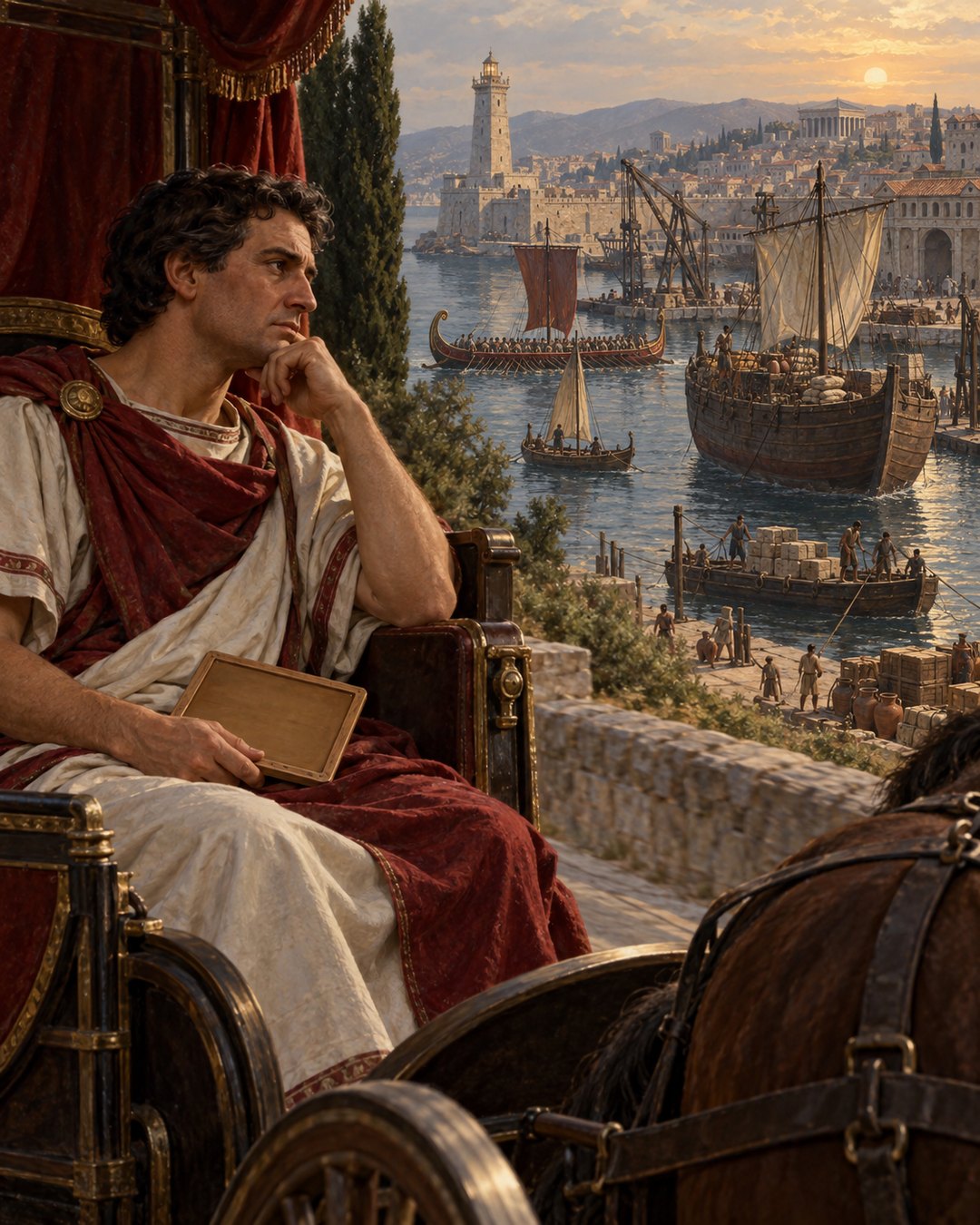
The carriage kept moving. Aulus Gellius refused to let his attention drift with it.
He began retrieving old words: first weapons, then boats. Merchant carriers, cavalry transports, cutters, tenders, flat craft and spy boats passed through his memory like vessels entering a harbor one by one.
The result is not a shipwright’s drawing. It is evidence of how much difference a maritime vocabulary could hold—and how easily that difference could disappear.
A Moving Carriage Became a Memory Room
Gellius explains the circumstances before giving the catalogue. He was riding in a carriage and wanted to prevent his mind from becoming dull, idle and available to what he called worthless trifles.
His solution was recall. He challenged himself to summon terms encountered in early histories and other old books. The exercise was private, portable and suited to a journey: no library shelves needed to be opened while the road jolted beneath him.
That setting matters because it reveals what the list was for. Gellius was not ordering a fleet or preparing a cargo contract. He was testing whether reading had left durable distinctions in memory.
He paired maritime terms with names for spears, darts and swords. Both fields accumulated precise labels because small differences could matter in use. A weapon’s form, origin or method of delivery separated it from another weapon. A vessel’s burden, speed or service could do the same.
Gellius admits the collection is what came to mind at the time. That protects the passage from being treated as a complete register of every craft afloat in Roman waters. It is a remembered sample from older literature.
Yet even a sample is crowded. The abundance itself is the first result of the exercise. The ordinary word “ship” flattened a world that earlier writers had divided much more finely.
The order of recall is useful too. Gellius does not begin by defining an abstract category and then filling its branches. One remembered word pulls another behind it. Merchant hulls lead toward military carriers; fast craft lead toward small service boats. The catalogue preserves the pathways of a reader’s memory as well as the contents of old books.
Cargo and Combat Required Different Hulls
The maritime catalogue opens with merchant ships, cargo carriers and skiffs. Gellius then names warships and cavalry transports before moving through cutters and fast cruisers.
The English labels cannot supply a naval blueprint for every Latin original. They do preserve a practical contrast. A carrier existed to bear a load. A transport could be identified by the living cargo it moved. A fast cruiser was remembered for movement rather than capacity.
Cavalry transport is especially revealing. Horses are not amphorae. They occupy space, shift weight, require handling and must arrive capable of further work. The name keeps the military passenger visible in the identity of the vessel.
Warships appear separately from such transports. The distinction prevents “military ship” from becoming another flattening category. One craft fought; another delivered mounted capacity to the place where fighting would occur.
Roman readers could see such specialization expressed in timber and rigging. Shipwrights who joined a hull before raising its frames made a structure whose proportions answered an intended burden. The vocabulary Gellius preserves begins after those choices have already produced different working forms.
His list does not pause to explain each construction. It assumes that names once carried enough recognition to distinguish one class from another. The need to retrieve them from early books suggests that confidence was no longer universal.
Small Craft Made Large Ships Useful
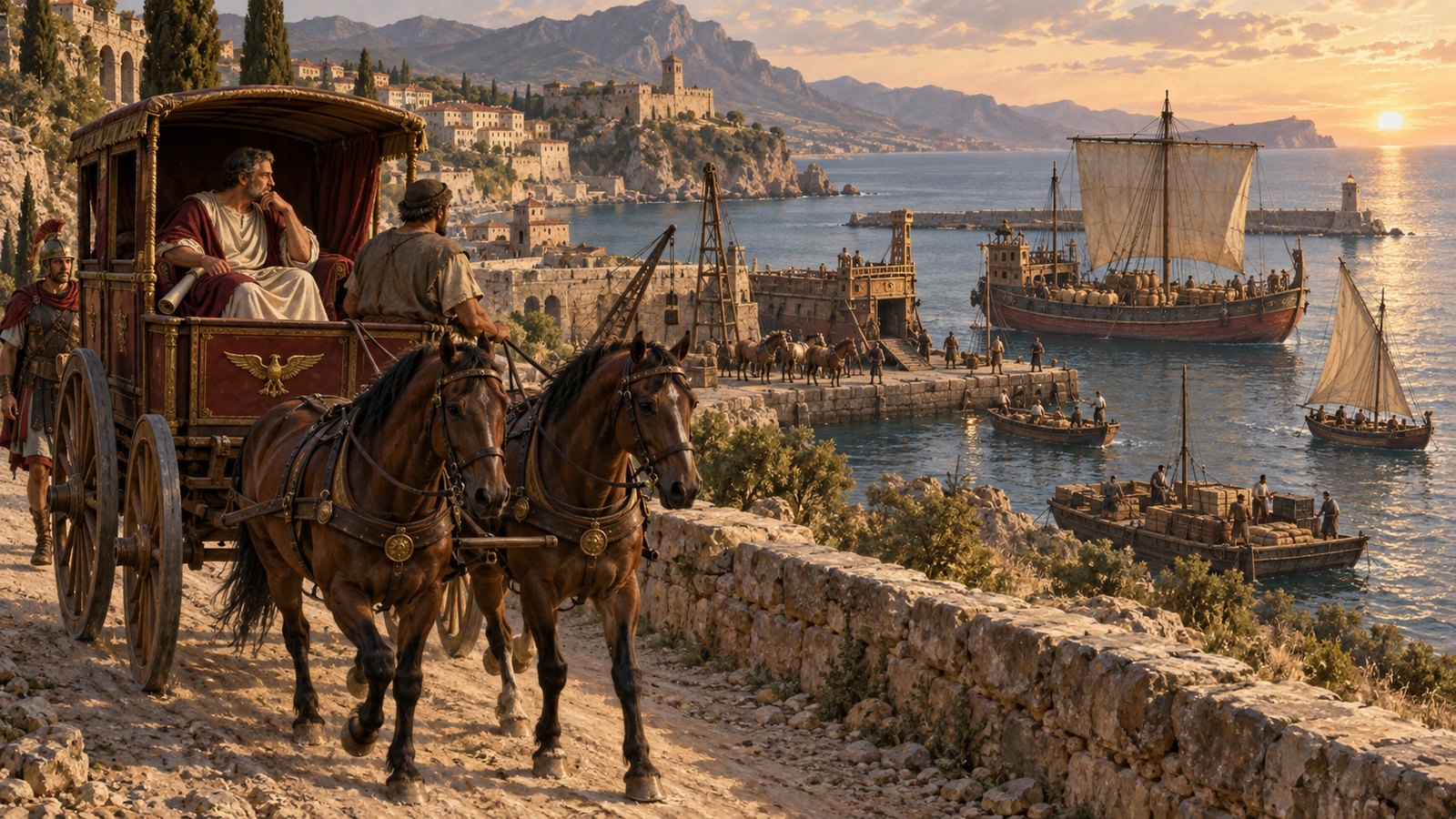
Not every remembered vessel crossed open water with a hold full of goods. Gellius includes scouting boats, tenders, flat boats, yachts, pinnaces and craft associated with scullers.
A tender gains meaning through relation. It serves another vessel or connects ship and shore. A lighter similarly belongs to the difficult final movement of people or cargo where a large hull cannot conveniently go.
That changes the mental picture of a harbor. The great merchant carrier may dominate the horizon, but its arrival does not complete the journey. Smaller hulls transfer, inspect, guide, communicate and bridge shallow water.
Flat craft add another environmental distinction. Depth and shore conditions could make a broad, shallow form more useful than an ocean-going silhouette. The waterway helped decide which shape counted as competent.
Scouting and spy boats turn size into information. Their value lay not in filling a hold but in seeing, moving and returning. A fleet that lacked such craft could possess force while remaining poorly informed.
Gellius offers names rather than an operational manual, so the passage should not be forced to provide routines it does not describe. What it securely preserves is classification: these craft were different enough in remembered literature to deserve separate words.
Greek Terms Sat Inside a Roman Catalogue
Twice in the maritime section Gellius pauses to mention Greek terminology. He gives a Greek name for fast cruisers and Greek alternatives for light galleys.
The gesture suits a Mediterranean vocabulary. Vessels crossed political and linguistic boundaries, and technical words could travel with the forms, crews or texts that used them.
Gellius does not purify the list into a single language. He displays the overlap. A Roman reader’s knowledge of ships could include a Latin label, a Greek equivalent and an old literary occurrence held together in memory.
This is one reason the catalogue cannot be reduced to a row of modern one-to-one translations. Words collect histories. Two labels that look interchangeable in English may have carried different associations of region, period or literary usage.
The problem can be seen at Puteoli, where raised topsails announced the Alexandrian fleet. There, one visible feature identified a particular arriving service. Gellius’s words performed a related act on the page: they sorted vessels before a later reader could see their sails or hulls.
Translation gives us access, but uncertainty remains productive. It reminds us that the list is not only about ships. It is about the survival of technical recognition after the material object and its habitual name have drifted apart.
The Final Names Preserved Conditions of Use
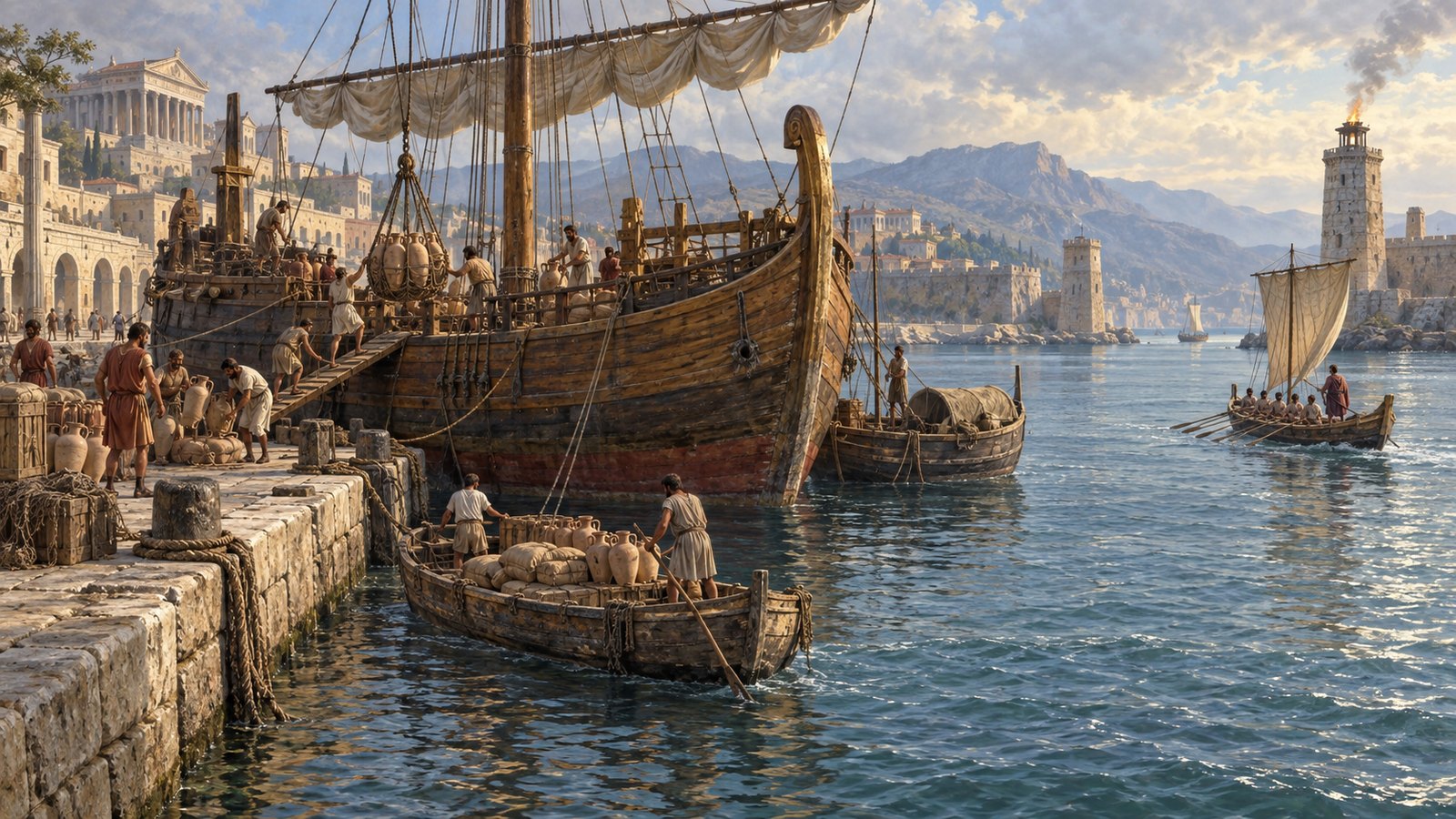
Near the end Gellius remembers arks, fair-weather craft, pinks, lighters and spy boats. The sequence ranges from broad forms to terms defined by circumstance or task.
“Fair-weather craft” is a compact admission of limits. A vessel could be useful without being suitable for every sea state. Its identity included the conditions under which prudent people chose to operate it.
“Lighter” makes location part of the name. Such a craft matters because cargo must pass between a larger carrier and a quay, riverbank or shallower reach. Movement by sea was a chain of transfers rather than one uninterrupted voyage.
“Spy boat” makes purpose decisive. Its cargo might be little more than observers and what they learned. Speed, discretion and position outweighed volume.
The catalogue therefore preserves more than a museum of odd words. It records a habit of noticing. Readers were expected to recognize that hulls belonged to different systems of work: commerce, cavalry movement, battle, reconnaissance, ship service and local transfer.
Gellius feared mental dullness during a carriage ride. His remedy rescued distinctions from books that were already old to him. He did not rebuild the vessels, and he did not define every line. He kept their names in circulation long enough for us to see the vanished harbor as a place of specialized labor rather than a backdrop filled with interchangeable ships.
The carriage scene closes the argument quietly. Travel on land prompted a catalogue of travel by water. As the wheels turned, Gellius measured the strength of memory by how many kinds of movement language could still keep separate.
Sources
Aulus Gellius, Attic Nights, book ten, chapter twenty-five.