
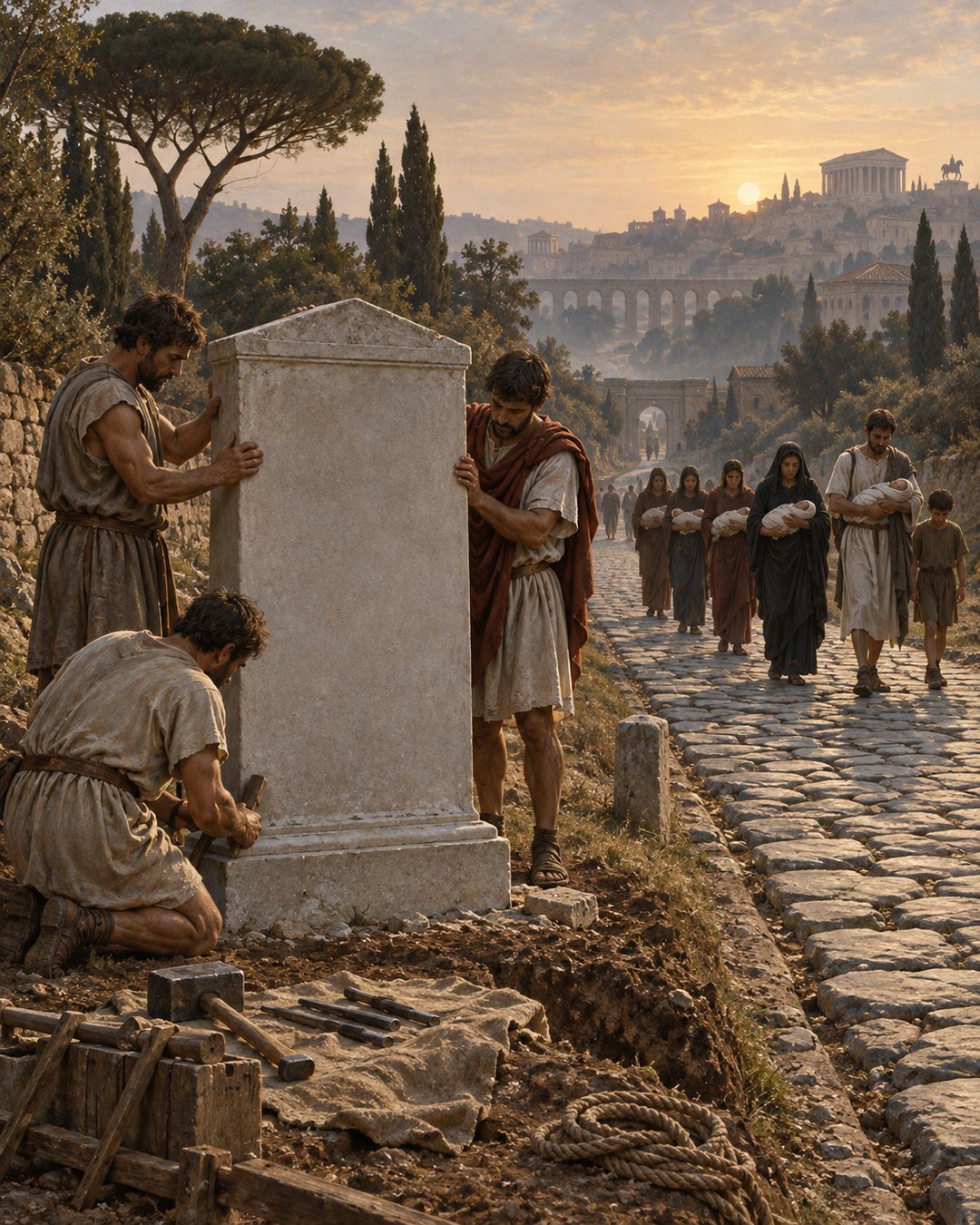
Five children arrived in one delivery near Laurentum. They lived for only a few days. Their mother died soon afterward.
Aulus Gellius preserves no name for her and none for them. He does preserve an order from Augustus: erect a monument beside the Via Laurentina and inscribe the number of children.
The count entered public memory. The family did not.
Gellius Began with a Claimed Human Limit
The short chapter opens with Aristotle rather than Rome. Gellius says the philosopher recorded an Egyptian woman who bore five children at one birth.
In the report as Gellius gives it, five marked the limit of human multiple birth. More than that had never been known, while even five was described as very rare.
This is ancient testimony, not a modern medical survey. Gellius does not provide Aristotle’s observations, a case series or a method for deciding what nature could permit. The claim matters here as the intellectual frame through which the Roman event was understood.
A boundary makes an example memorable. If five represented the outer edge of possibility, then another birth of five was not merely a difficult household event. It became evidence that appeared to touch a stated limit.
Gellius’s wording also separates rarity from impossibility. Five had happened, but seldom. The Egyptian report established precedent; the case near Laurentum supplied a Roman parallel tied to a place, a ruler and a monument.
The chapter is therefore built from two forms of authority. A philosopher defines the edge. Historians of Augustus’s period report an event that reached it.
The Roman Case Entered Through an Imperial Household
Gellius identifies the mother as a maidservant of Caesar Augustus in the region of Laurentum. That description locates her through service and ownership rather than through a personal name.
The imbalance is stark. The emperor is identifiable. The district is identifiable. The extraordinary number is identifiable. The woman at the center of the event remains grammatically attached to a powerful household.
Gellius says historians of the time supplied the report. He does not claim to have seen the delivery or interviewed a witness. His account already passed through written memory before entering the Attic Nights.
Laurentum was not an empty label to Roman readers. The coastal district held elite properties and roads leading south from the capital. A later view of retreat there appears in Pliny’s carefully separated Laurentine house. Gellius instead lets the place hold a brief, devastating event inside an imperial domestic network.
The household connection may help explain why the case was recorded, but the text does not tell us who attended the birth, how care was organized or what decisions followed. Those absences must remain absences.
What survives is a chain of notice: the event reached contemporary historians, imperial authority responded, and Gellius later repeated the report.
Each link selected the same feature. The historians made the birth reportable; Augustus made it monument-worthy; Gellius placed it beside a philosophical limit. The woman’s household status explains how she enters the sentence, while the exceptional count explains why the sentence was copied. That repetition did not preserve the event whole. It carried forward the facts most useful to an argument about rarity: one delivery, five infants and a memorial that made the number visible.
Chronology survived in a similarly compressed form. Gellius anchors the case in Augustus’s reign, says the infants lived for a few days and places the mother’s death not long after delivery. Those markers establish an order without pretending to give a clinical record. Birth, brief survival, maternal death and commemoration follow one another, but the text supplies no exact dates between them.
The distinction protects the article from turning silence into scenery. We can see why the case attracted attention and how it was transmitted. We cannot fill the room with named attendants, medical procedures or imagined imperial emotion. The surviving chain is powerful precisely because its boundaries remain visible.
A Few Days Contained the Whole Family
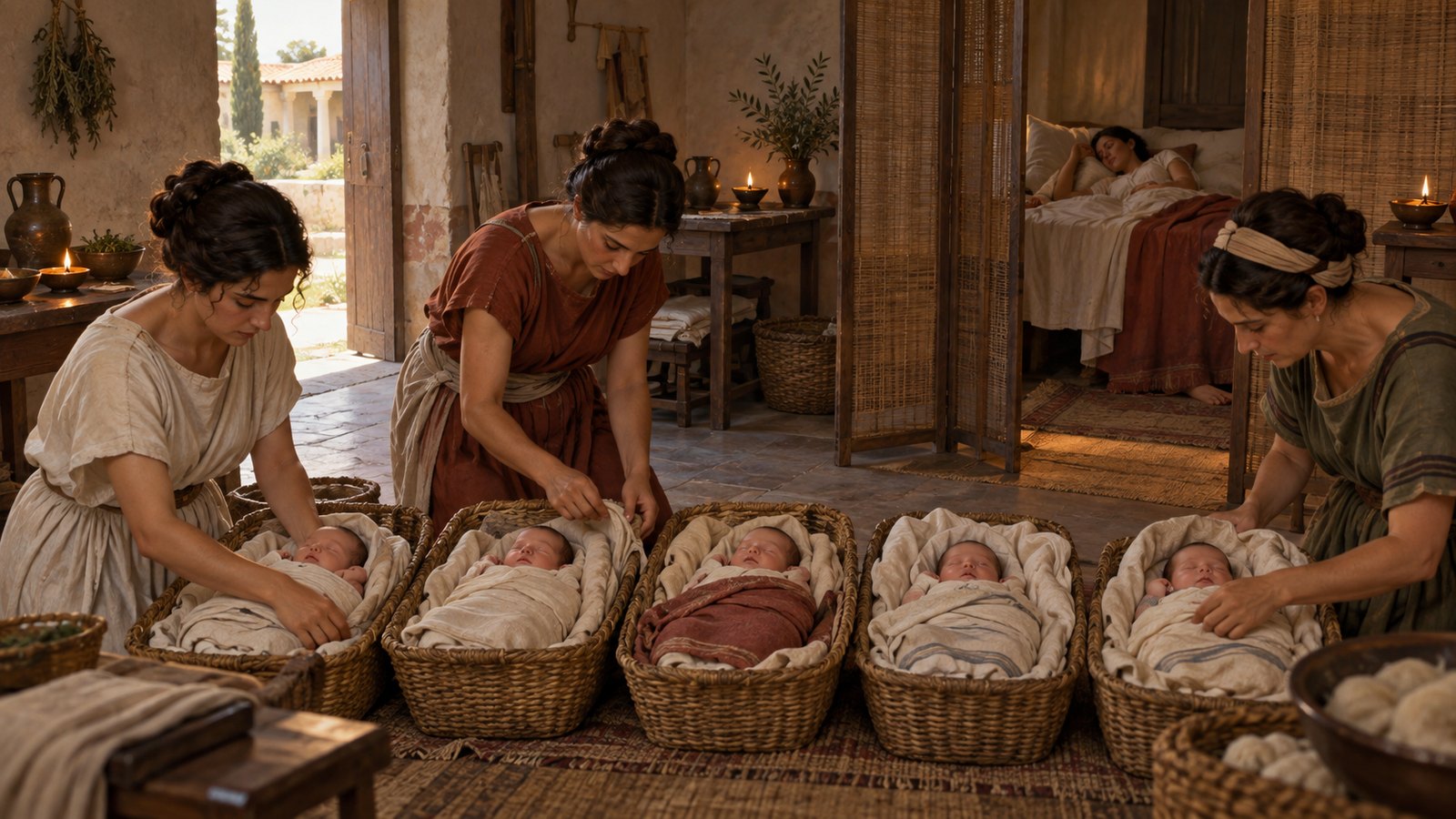
The five infants, Gellius says, lived for a few days. Their mother died not long after giving birth.
His sequence is compressed into two clauses. No infant is distinguished from another. No interval is measured more precisely. No cause of death is offered for mother or children.
That restraint is important. A vivid reconstruction might feel humane, but details not in the source would replace these people with invention. The historical force lies partly in how little the record allows us to know.
The number five can make the episode sound like a marvel. The reported survival for only days changes its center. This was not simply a curiosity about the capacity of the human body. It was a household losing every person named by the count.
Ancient authors often gathered exceptional births among wonders or natural limits. Gellius’s Roman example refuses to remain an abstraction because death follows immediately. The same fact that proved rarity also multiplied grief.
Yet even grief is visible only indirectly. Gellius gives no lament, burial speech or relative’s voice. He moves from deaths to monument, from lived time to public record.
Augustus Converted Loss into Roadside Evidence
The memorial was erected by order of Augustus. That act changed the scale of remembrance.
A household could preserve a story among people who knew the mother. A monument on the Via Laurentina exposed the event to travelers who did not. The road carried the count beyond the circle of witnesses.
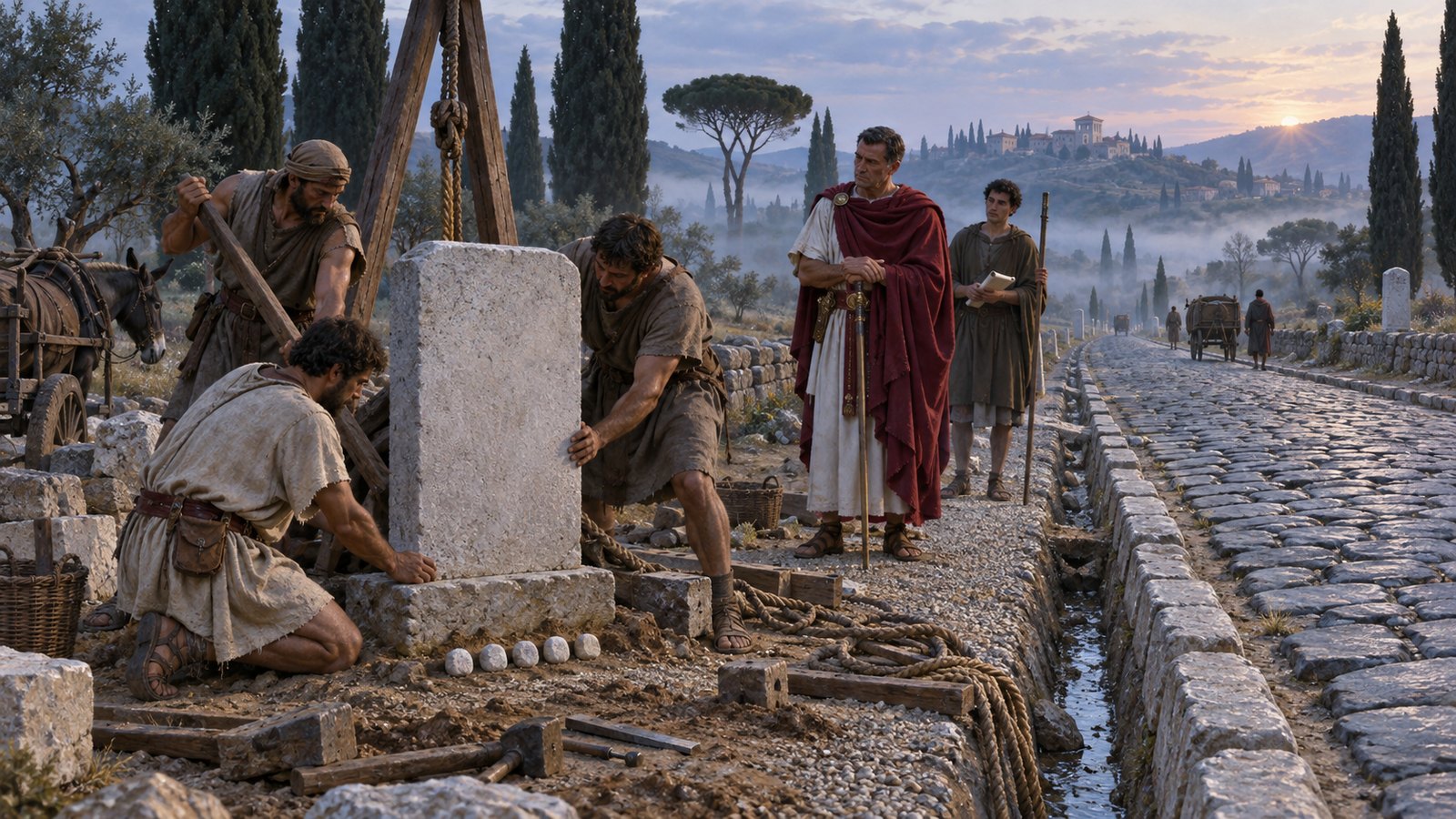
Gellius specifies what was inscribed: the number of her children. He does not quote a name or a long epitaph. Quantity was the essential claim the monument had to communicate.
Roman funerary display often turned ancestry, office and family ambition toward an audience. Elite funerals used procession and memory to make status visible. This memorial worked differently in Gellius’s telling. Its public fact was biological rarity, authorized by the emperor and fixed beside a road.
The order can be read neither as pure private tenderness nor as a cold scientific label with certainty. The source gives the action, not Augustus’s motive. It is safest to say that imperial authority selected the event for durable notice.
The monument also joined two kinds of proof. The chapter’s opening appealed to Aristotle and a report from Egypt. The roadside stone supplied a Roman object that travelers could encounter, even if the original delivery remained inaccessible to them.
The Inscription Preserved a Number and Produced a Silence
Gellius says the monument bore the number of children, “as I have given it.” His own prose and the inscription reinforce one another.
The count crosses media: birth becomes report, report becomes stone, and stone becomes a sentence in a literary collection. At every stage, five remains stable enough to be the organizing fact.
Other information falls away. The mother’s personal identity is not transmitted. The children are not named. We do not learn whether names had been given during their few days of life. We do not know the monument’s design, exact wording beyond the numerical fact or eventual fate.
This is why the episode belongs to social history as much as to a collection of marvels. Records do not preserve all people equally. Proximity to Augustus helped make the event visible, yet that same framing left the unnamed woman defined by her place in his household.
The Via Laurentina monument was material memory, but material memory could be selective. Stone resisted forgetting while deciding what later viewers were asked to remember.
Gellius kept the selection intact. Aristotle’s alleged limit explains why the number deserved attention. The deaths explain why it demanded a memorial. Augustus’s order explains how it moved into public space.
What remains is both precise and incomplete: one delivery, five children, a few days, a mother’s death, a road and an inscription. The monument counted the lives without giving them back their names. Its endurance makes that silence more visible, not less.
Sources
Aulus Gellius, Attic Nights, book ten, chapter two.