
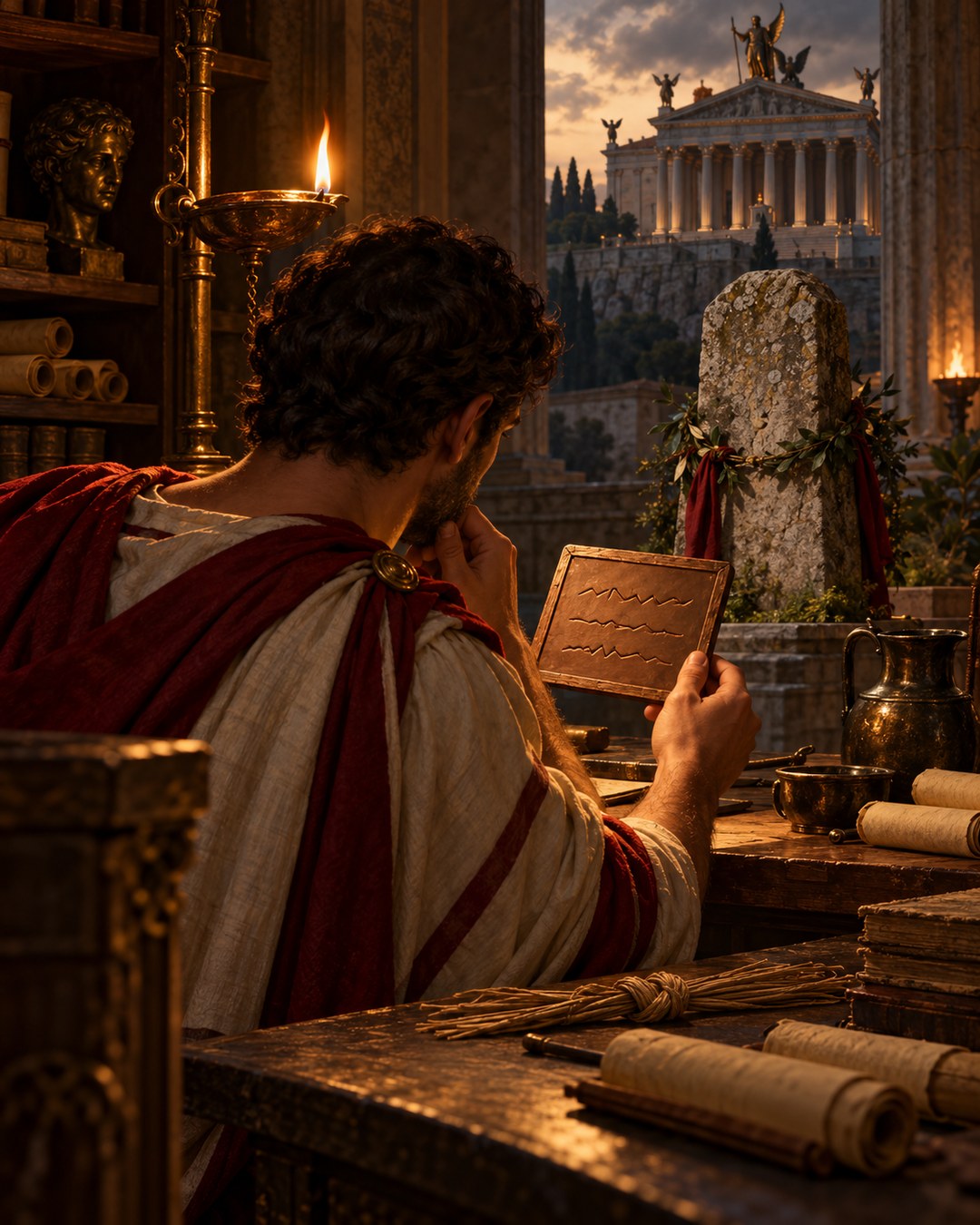
Aulus Gellius found an old riddle and refused to solve it for his readers. It occupied only three iambic lines. Its speaker seemed to be missing something once, twice, or both ways at once, yet claimed that no one would willingly exchange places with Jupiter. The language looked compact enough to copy in a notebook and strange enough to keep a dinner table busy.
Gellius called the little composition ancient and neat. Then he did something revealing: he stopped. The answer existed, and he even named the book where an impatient reader could find it, but he wanted the puzzle to work before scholarship closed it. Behind the three lines stood the Roman god Terminus, a joke built from subtraction, sound, and a sacred stone that tradition said would not move even for Jupiter.
Romans Could Call a Riddle a Plaited Rush
The Greek name for this kind of composition was “enigma.” Gellius says some early Latin writers used scirpi, “rushes.” The term evokes strands bent across one another until a pattern becomes difficult to follow. His example does the same thing with language. A reader has to separate and recombine pieces rather than move straight through a statement.
The physical metaphor suits a culture in which rushes could be plaited into useful forms. A riddle is not mere obscurity. Its crossing lines have been arranged. If the reader pulls at the right strand, the design begins to show. Gellius praises his specimen as old, but he does not place it behind glass. He presents it as a live test of ingenuity.
Its form sharpened that test. The enigma consisted of three iambic trimeters, a measured line associated with spoken dramatic verse. Brevity meant there was nowhere for an unnecessary word to hide. The speaker says he does not know whether he is “minus” once, twice, or both, and then invokes a remembered saying about refusing to trade places with Jupiter. The lines promise that grammar and mythology will meet, but they do not say where.
Gellius Made the Reader Do the Last Piece of Work
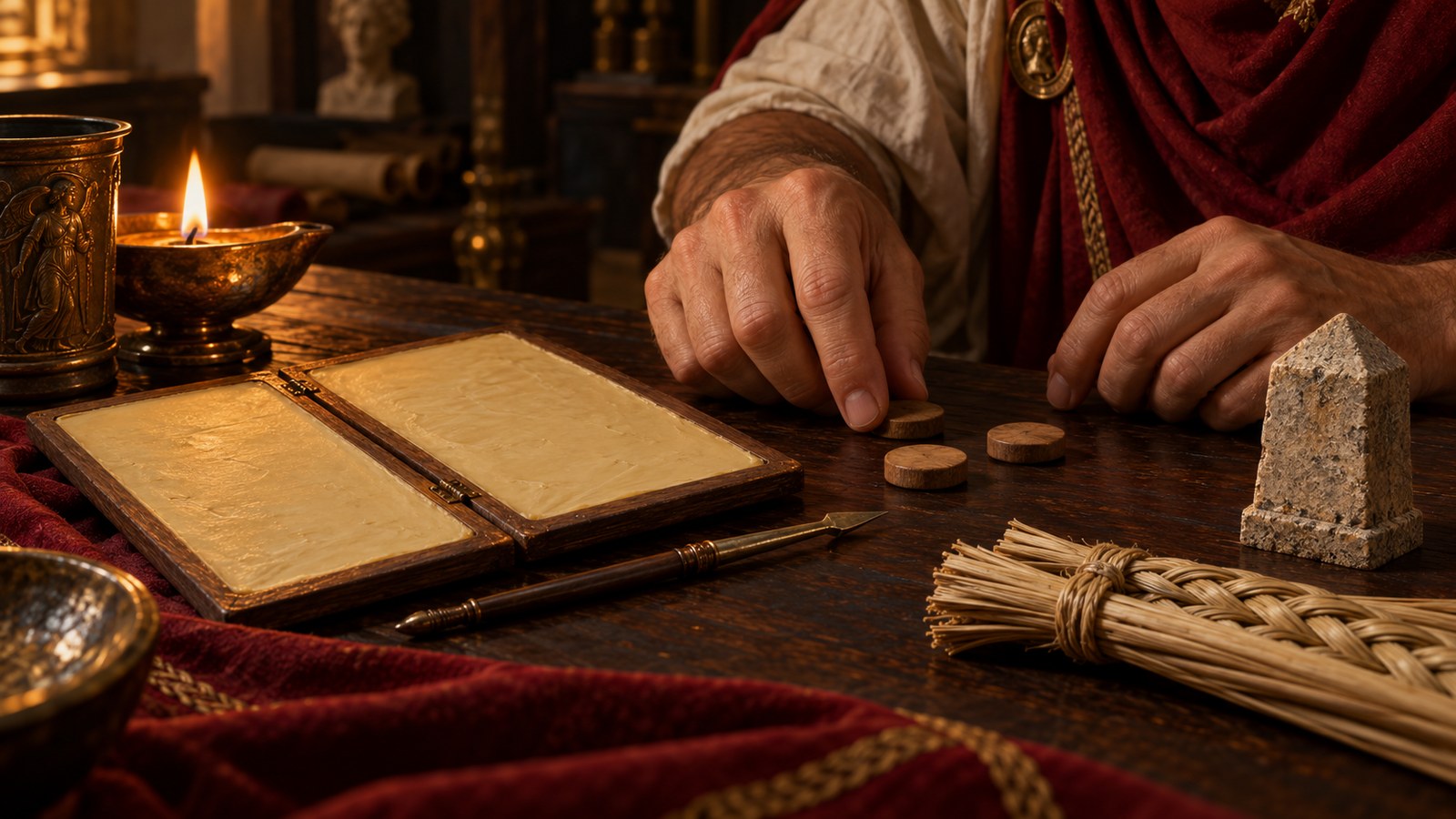
The author could easily have supplied the solution. Instead, he says he left the riddle unanswered to excite his readers’ ingenuity. That choice turns reading into participation. A note collector normally gathers answers; here Gellius preserves the gap that makes inquiry possible.
He did not leave his audience without a route. Anyone unwilling to puzzle for long could consult the second book of Varro’s Latin Language, addressed to Marcellus. The reference creates two speeds of reading. One reader can sit with the three lines, test divisions, speak them aloud, and wait for recognition. Another can reach for an authority. Both activities belong in the same learned world.
This small arrangement also tells us something about Gellius’s library. Varro was not cited as decoration. His book could function as the key to a verbal lock. The enigma travelled as verse, while the explanation survived in linguistic scholarship. Gellius joined the two without flattening one into the other.
The refusal to answer immediately is more than playfulness. It respects the difference between knowing a solution and experiencing a solution arrive. Once the word has been disclosed, the riddle can be admired, but it cannot be encountered in quite the same way again.
Once Minus and Twice Minus Pointed to Terminus
The preserved explanation identifies the answer as Terminus. The route depends on Latin sound and division. “Once minus” and “twice minus” together suggest “thrice minus”: ter minus. Spoken and compressed, the pieces point toward Terminus. The god’s name emerges from an instruction about subtraction.
This is why a translation can reproduce the surface oddity without carrying every mechanism. The English words “once,” “twice,” and “minus” preserve the arithmetic tease, but the decisive joining happens in Latin. The puzzle asks the ear to find a divine name inside a phrase.
Terminus was an especially apt answer because he embodied fixed limits. Roman boundary markers were not merely convenient survey points when consecrated to him. They marked where one holding ended and another began, and their stability acquired sacred force. A word assembled by shifting verbal boundaries names a god who guarded physical ones.
The riddle therefore works at several scales. Letters and syllables cross. A phrase becomes a proper name. The answer then points from a notebook toward land, property, worship, and the old conviction that some limits should resist human pressure.
The God Who Would Not Give Place to Jupiter
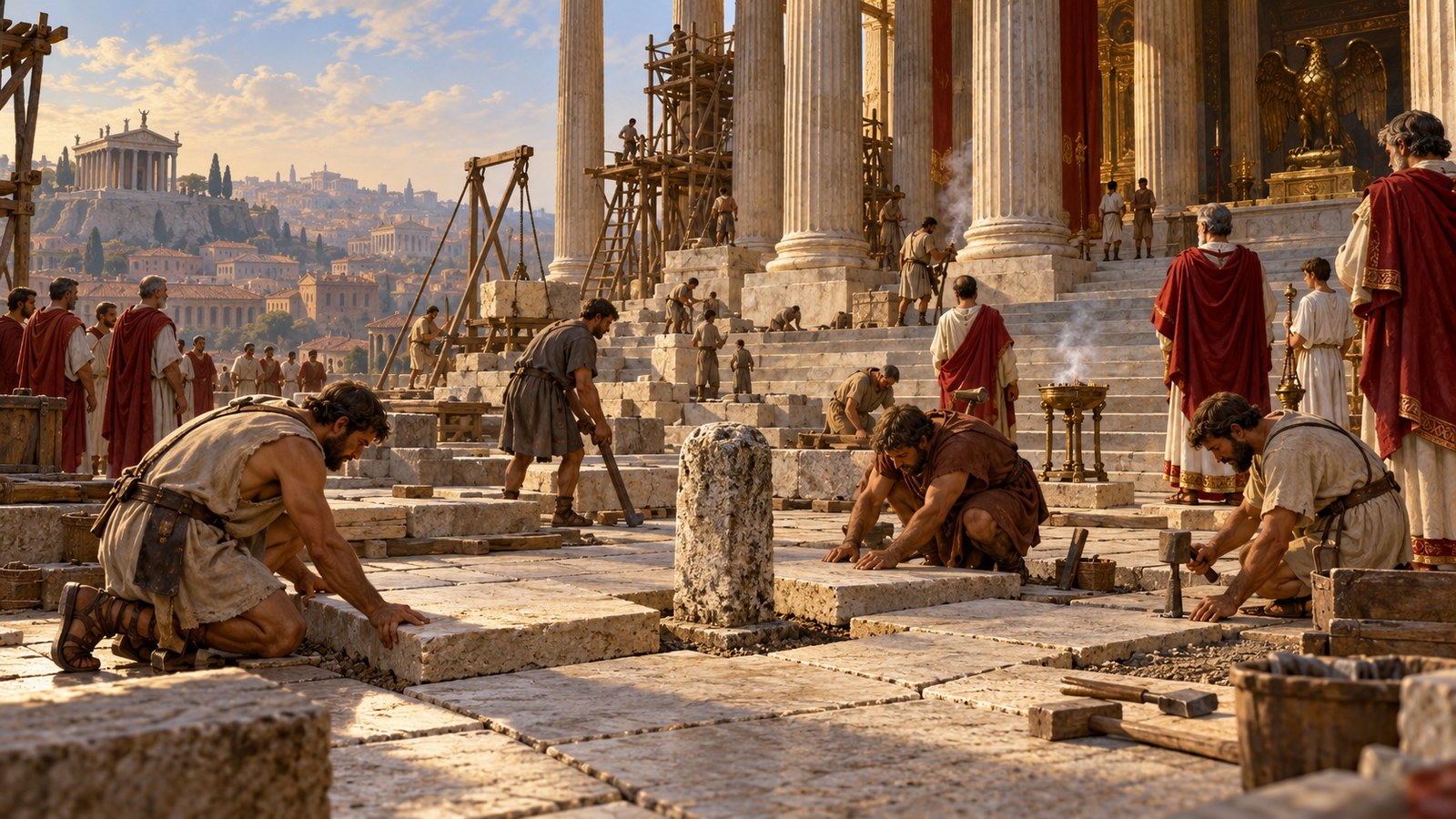
The final line’s boast depends on a Roman story about the Capitoline temple. When the great sanctuary of Jupiter was established, existing sacred sites had to be moved or ritually cleared. Terminus refused removal. His marker remained within the new sacred complex, a sign that even the arrival of Jupiter did not erase every prior boundary.
That tradition explains why the riddle’s speaker would not exchange places with Jupiter. Terminus already possessed a place Jupiter could not make him surrender. The joke reverses the expected hierarchy. The greatest god has the greater temple, but the smaller god has the better claim to one immovable spot.
The answer also makes the boast precise rather than merely proud. Terminus does not say he is more powerful in every respect. His advantage concerns place. A boundary god wins by remaining where he is. The mythology completes the verbal mechanism because the name alone is not enough; the solver must understand why that name satisfies the final line.
A Tiny Puzzle Joined Page, Voice, and Monument
Gellius’s chapter is short, but its object is densely made. It preserves an early Latin term for riddles, identifies a metrical form, quotes three lines, withholds an answer, directs the hurried reader to Varro, and opens onto a story about the religious landscape of Rome. The enigma can be spoken, written, researched, and imagined as stone.
That movement helps explain why such pieces belonged in the Attic Nights. Gellius did not organize knowledge into a single continuous argument. He kept encounters that could awaken a reader: an odd word, a remembered verse, a legal difficulty, a teacher’s reply. The riddle is almost a model of his book. It is compact on the page and expansive once opened.
The answer does not destroy the play. It reveals how carefully the play was built. Arithmetic language hides sound; sound reveals a god; the god recalls a marker; the marker remains beside Jupiter. Three lines carry the reader from a verbal knot to the Capitol.
Roman boundaries could be political as well as sacred, as the story of Remus, the Aventine, and Rome’s sacred line makes clear. They could also become practical instruments, which is why boundary stones made land claims visible. Gellius’s enigma catches the same seriousness in miniature and lets a reader discover it by playing with a phrase.
The preservation of the metre adds another layer. Three iambic trimeters are not a random cluster of clues. They give the solver a rhythm against which the odd phrasing can be heard. An ancient reader might encounter the verses aloud, where the closeness of ter minus and Terminus becomes more available than it is to an eye scanning a modern translation. The answer depends on performance as much as spelling.
There is also a productive tension between permanence and rearrangement. Terminus refuses to move, but the solver must move pieces of language. The boundary stone stays fixed while syllables change partners around it. That inversion gives the riddle its finish: the most immovable figure in the story is reached through mental flexibility.
Gellius’s direction to Varro ensures that the game has an endpoint without forcing every reader to take the same path. Authority waits in the library, but curiosity gets the first chance. A tiny chapter thus stages a balance his larger work repeatedly seeks—respect for learned books without allowing them to replace alertness, memory, speech, and the pleasure of noticing.
Sources
- Aulus Gellius, Attic Nights, 12.6
- Varro, On the Latin Language, book 2, fragment cited by Gellius