
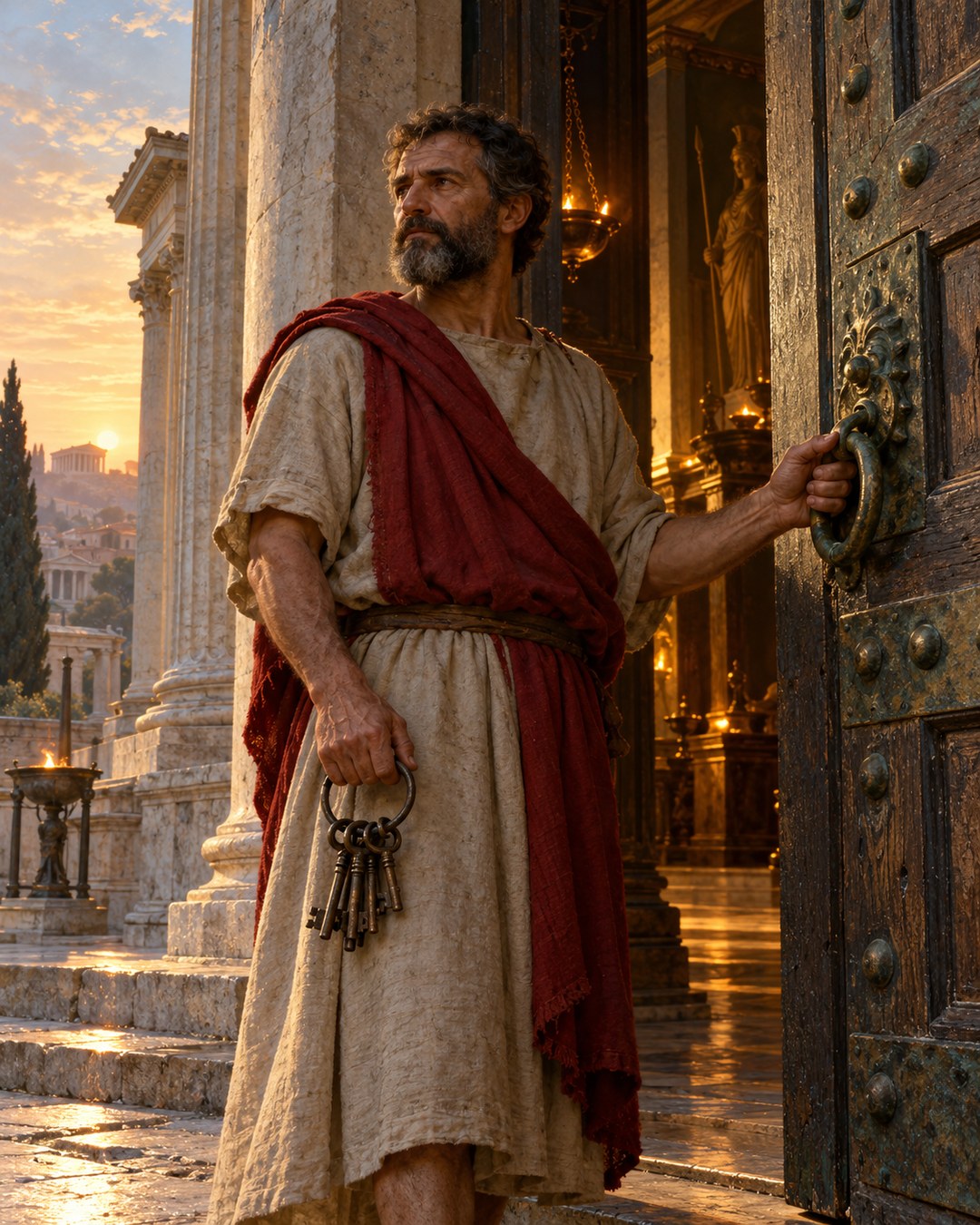
A temple keeper could disappear while the temple still stood. Not physically, but in the word used to name the office. Aulus Gellius noticed that Romans around him preferred aedituus, a form that seemed naturally connected with guarding a sacred building. He defended an older alternative, aeditumus, and assembled witnesses from scholarship, courtroom oratory, comedy, poetry, and the manuscripts on his desk.
The result is a small history of how language survives. Gellius did not rely on one attractive derivation. He compared formations, cited Varro, recalled Laevius, checked reliable copies of Cicero, quoted an Atellan farce by Pomponius, and added Lucretius. The keeper of a temple became the subject of another kind of custody: preserving a word against easy correction.
A Familiar Explanation Could Still Be Too New
Gellius begins with a correction. Aeditumus, or in another spelling aeditimus, was an old Latin word. Many people in his own day instead said aedituus. The newer form felt persuasive because it could be explained as a compound involving a temple and guarding. A word that seemed to describe the job transparently had an obvious advantage in ordinary speech.
For Gellius, that obviousness was precisely the danger. Speakers can remodel an inherited word until its parts make better sense to them. The result may be perfectly usable Latin, but it can hide an older formation. He compares aeditumus with words such as finitimus and legitimus. The resemblance places the disputed office inside a recognizable family rather than treating it as an isolated curiosity.
His target was not change itself. The chapter records both forms and therefore proves that Latin had changed. What irritated him was the confident claim that the transparent form must be the original one. Language keeps traces that common sense can polish away.
Varro Supplied an Argument, Not the Only Verdict
Marcus Varro, in the second book of On the Latin Language addressed to Marcellus, preferred aeditumus. Gellius reports his reason: aedituus was a later invention, while aeditumus was pure and ancient. Varro’s authority mattered because he studied Latin systematically, but Gellius did not stop after naming him.
The chapter even contains a broken place in the transmitted text before the appeal to authorities. That gap is an accidental reminder of the problem under discussion. Ancient words reached later readers through copies that could omit, replace, or normalize what scribes found difficult. To establish usage, Gellius had to collect evidence across texts rather than trust a single line.
He cites Laevius, who used claustritumus for a person responsible for door fastenings. The parallel is concrete. A keeper associated with a temple and a keeper associated with locks share a formation. The rare word supports the rare word because both preserve the same piece of linguistic machinery.
This method turns etymology into comparison. Gellius asks not merely what a word appears to mean now, but what shapes Latin writers actually used and what other formations travelled beside it.
Reliable Copies of Cicero Preserved the Older Form
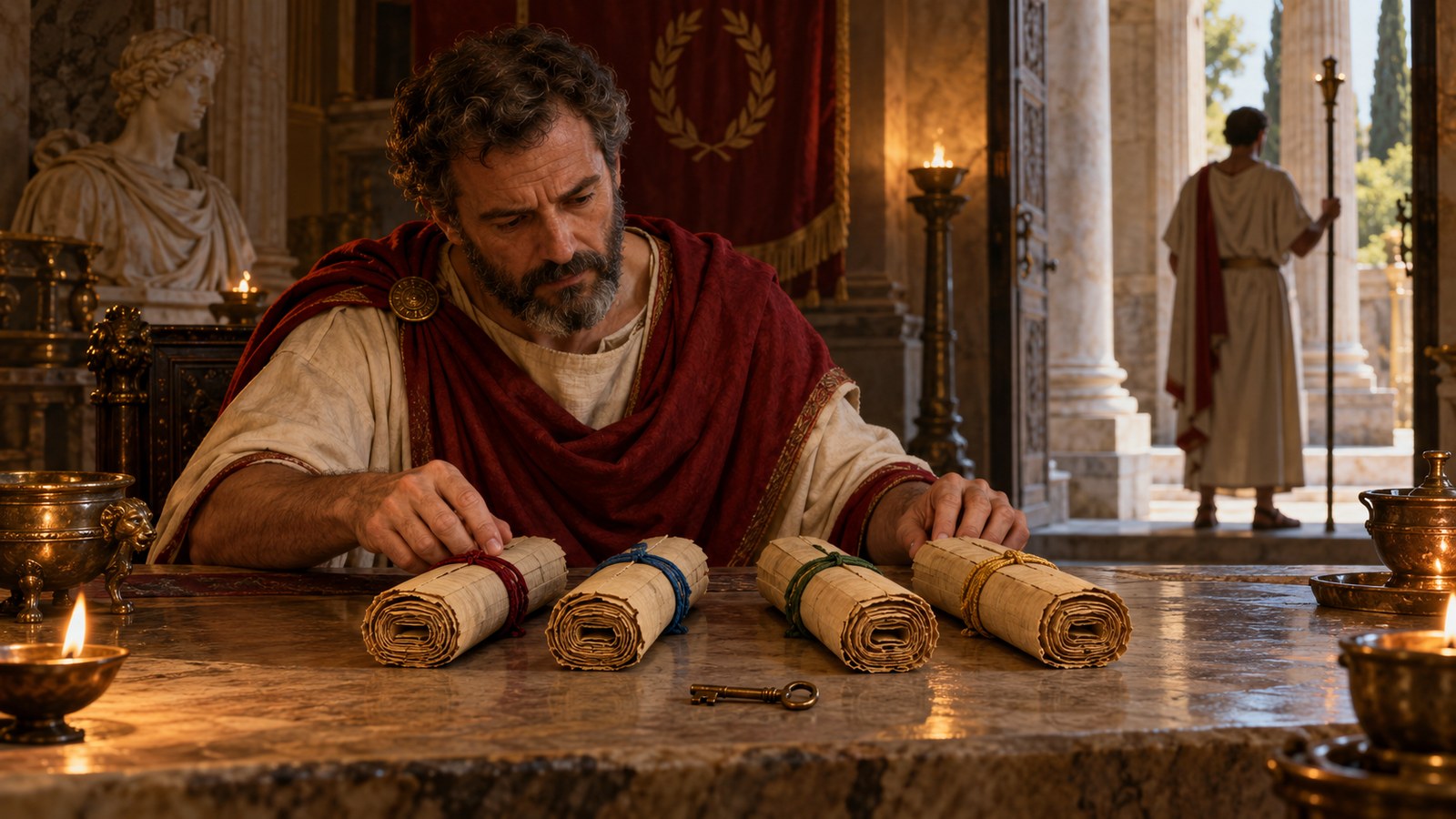
The strongest scene in the chapter may be silent: Gellius comparing manuscripts of Cicero’s fourth speech against Verres. In the copies he considered most trustworthy, the line referred to temple custodians as aeditumi. Ordinary copies offered aeditui. The difference is small enough for a scribe to “fix” without thinking that anything important had changed.
That observation gives the chapter stakes beyond pronunciation. A common form can enter a famous author’s text because it feels safer than an unfamiliar one. Once enough copies agree, later readers may mistake the result for Cicero’s own choice. Gellius’s preference depended on the quality of witnesses, not a simple count of manuscripts.
The disputed line also came from a speech about Verres, whose conduct in Sicily made temples, sacred property, custodians, and guards part of a political prosecution. The office was not an imaginary label built for a grammar exercise. Someone had to watch sacred spaces, notice intrusions, control access, and answer for objects placed under divine and civic protection.
By restoring the older form, Gellius believed he was restoring a voice in its setting. Philology became a kind of maintenance work, close in spirit to checking hinges before a door failed.
Comedy and Poetry Kept the Word Moving
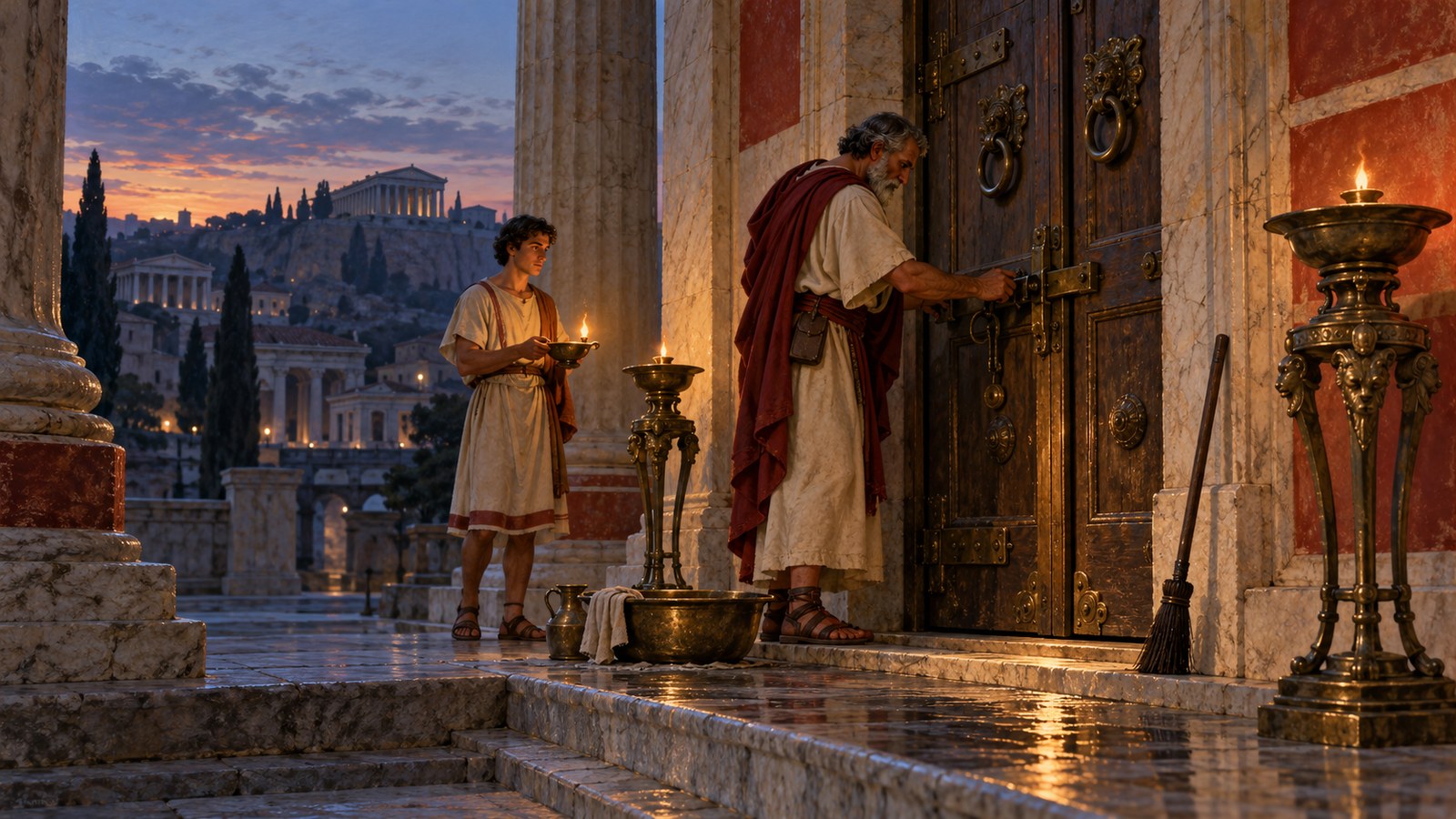
Gellius next leaves oratory for performance. Pomponius wrote an Atellan farce titled Aeditumus. One quoted line turns the noun into a verb: the speaker will attend someone and keep the temple door. The office could therefore anchor a comic character and generate playful language on stage.
That evidence matters because it shows the term outside a scholar’s definition. Audiences had to recognize enough of the role for a title and joke to work. The keeper stood at a threshold, an ideal position for comedy: close to sacred authority, responsible for access, and available to anyone who wanted to enter.
Lucretius provides another poetic form, aedituentes, used instead of the common plural for temple keepers. With Laevius, Cicero, Pomponius, and Lucretius beside Varro, Gellius could display a web of usage. No single author carried the entire case.
The Keeper’s Job Continued inside the Manuscripts
Modern linguistic notes complicate Gellius’s certainty. Both aeditumus and aedituus were valid Latin forms. The older word may originally have meant belonging to a temple and then acquired the occupational meaning under the influence of the form connected with guarding. The history is less like a duel between truth and error than Gellius’s polemic suggests.
That complication makes his evidence more valuable, not less. He captured a moment when speakers were negotiating which form sounded correct and why. His irritation preserves the pressure of living usage. Without it, we might have the forms but not the argument around them.
A temple keeper managed a boundary between outside and inside. Gellius’s chapter performs an analogous task for texts. It decides which readings enter the trusted copy, which innovations must identify themselves, and which old forms deserve another hearing. The building, office, word, and manuscript all depend on acts of custody.
The physical world behind that vocabulary appears in the story of how eighty-two temple repairs became an Augustan program. Sacred architecture also directed the body, as shown by the west-facing statue that made worshippers face dawn. Gellius adds the person at the door and the fragile word by which Romans knew him.
The range of his examples matters because each genre tests the word differently. Varro explains; Cicero persuades a court; Laevius experiments in poetry; Pomponius expects laughter from a crowd; Lucretius fits temple service into hexameter. A form confined to a grammar book could be dismissed as antiquarian collecting. A form moving among these settings had a social life.
Even the verb in Pomponius’s farce shows that Romans could treat the office as an action. The keeper did not merely possess a title. He attended, watched, and held a threshold. Doors had to be opened at proper times, closed against intrusion, and connected to people responsible for what happened around them. That practical rhythm helps explain why speakers might reshape the occupational name into a form that sounded more clearly like guarding.
Gellius’s preference for “the most reliable copies” also reveals judgment at work. Manuscripts did not arrive with modern critical apparatus. Readers compared hands, reputations, age, consistency, and the likelihood that a difficult reading had been simplified. The rarer form could deserve preference precisely because a copyist was more likely to replace it with the familiar one than to invent it independently.
The chapter therefore preserves more than a lexical verdict. It shows a scholar moving between morphology, material books, remembered performance, and institutional life. His argument may be too severe toward the newer form, but his procedure remains exacting: before declaring a word wrong, assemble the witnesses and ask how the easier reading might have won.
Sources
- Aulus Gellius, Attic Nights, 12.10
- Varro, On the Latin Language, book 2, fragment cited by Gellius
- Cicero, Against Verres, 2.4.96
- Lucretius, On the Nature of Things, 6.1273