
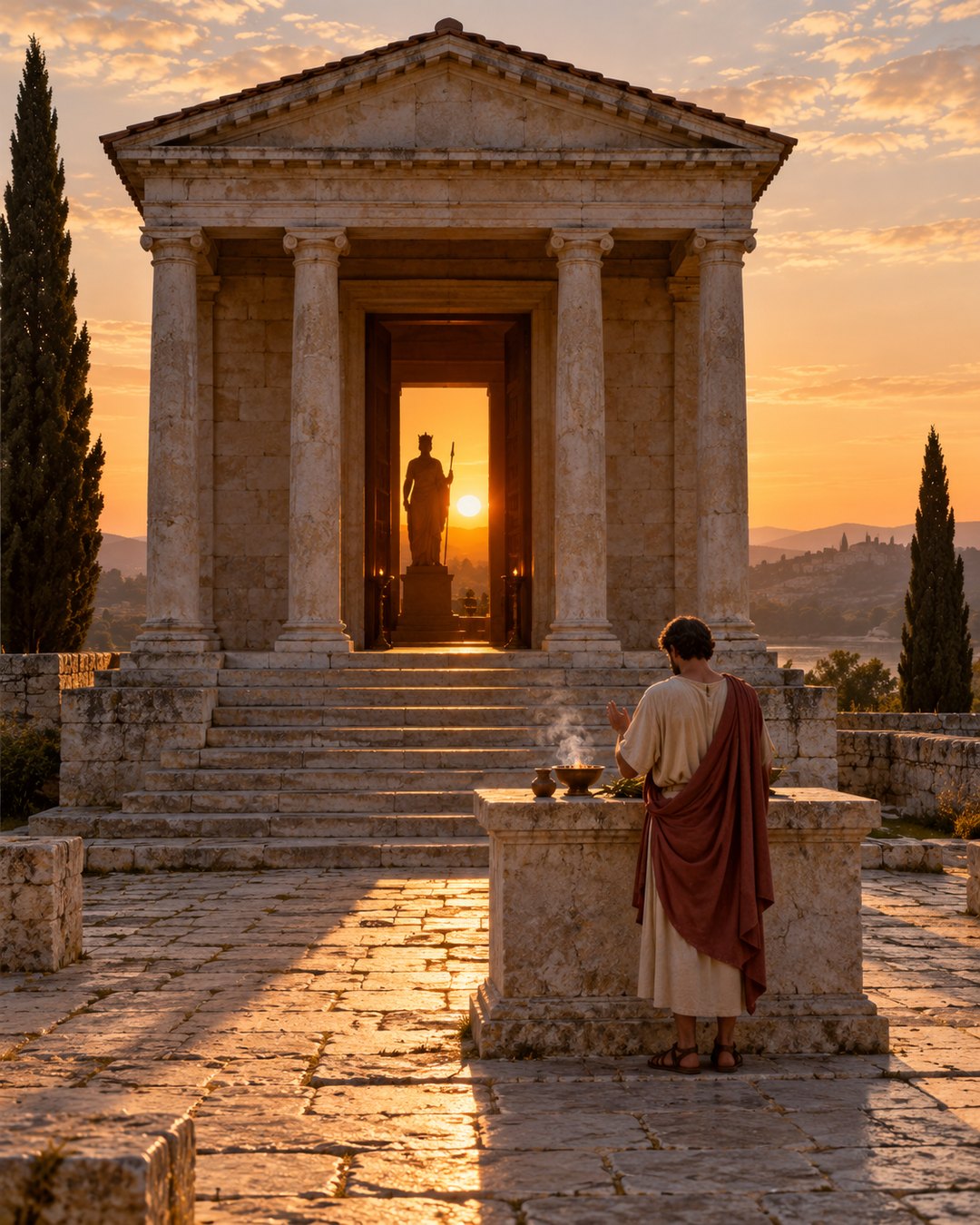
The image inside the sanctuary looked west. A person entering with an offering therefore looked east while also looking toward the deity. Vitruvius describes the result as a single encounter: temple, dawnward sky, divine image, and worshipper aligned along one axis.
That sentence can sound like a universal Roman compass rule. It is not. Vitruvius opens with conditions—nothing must obstruct the arrangement, and the use of the building must allow it—then gives alternatives for difficult ground, city views, riverbanks, and roads.
The chapter is brief because it does not explain a theology of sunrise. Its subject is architectural orientation: where a body stands, what it sees, and how a sanctuary announces itself to people approaching from outside.
A west-facing image turned the entrant toward the east
Vitruvius begins from the statue in the cella, the enclosed room at the temple’s centre. In his preferred arrangement, its face is directed west. That decision controls the experience of someone coming through the entrance from the opposite side.
The entrant faces the image and, in doing so, faces east. Sacrifice and offerings are the actions Vitruvius names, so this is not merely a picturesque sunrise viewed from a portico. Orientation belongs to the performance of a vow.
He makes the geometry vivid by giving each element a gaze. Suppliants seem to have the temple, the east, and the deity looking upon them together. Stone and compass direction become participants in an arranged moment.
The building is not simply “east-facing” or “west-facing.” The image faces one way; the worshipper faces the other. Description depends on which object supplies the viewpoint. Reducing the passage to a label loses the reciprocal line.
That line also separates this mechanism from the public visibility of vows at Roman altars. An altar makes an undertaking material and observable. Vitruvius’s rule determines how the person making it stands in relation to image and horizon.
The chapter does not say that every sanctuary followed the prescription. It tells an architect what should happen if obstruction and function permit. Archaeological plans must still be read as individual buildings, not forced into a sentence from a handbook.
The altar extended the same ritual axis outside the cella
After describing the entrant, Vitruvius states that the altars of the gods should be placed toward the east. The altar is therefore not an unrelated furnishing dropped wherever a forecourt remains empty.
Image, doorway, entrant, and altar belong to one composed route. A person approaches, reaches the place of offering, and looks along an axis whose religious object and compass direction have already been coordinated.
Height, sacrifice, smoke, and crowd movement would introduce further practical demands, but this chapter does not specify them. Its claim is narrower: the altar should agree with the orientation established for the encounter.
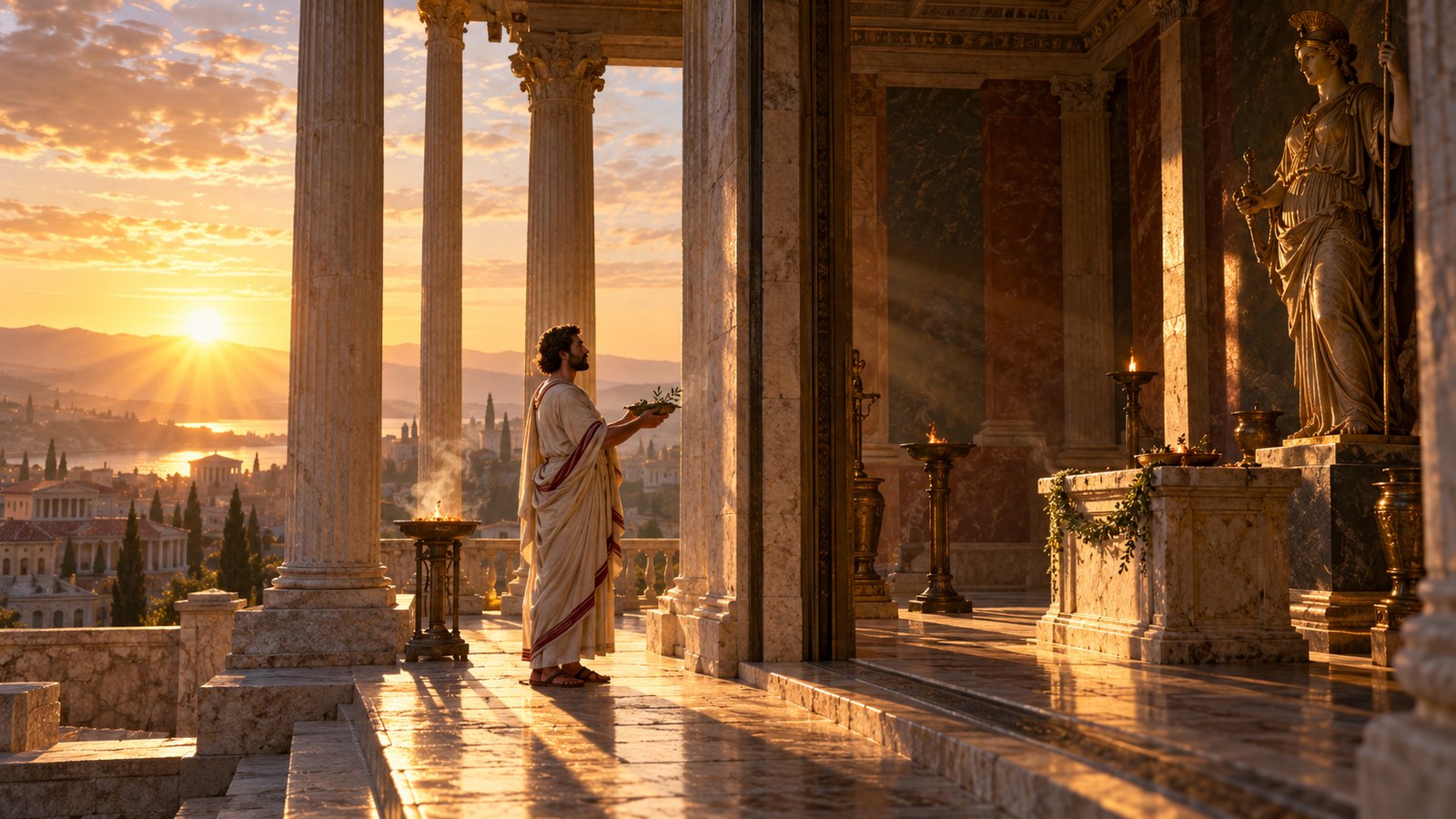
Vitruvius’s language of seeing matters. The worshipper does not merely occupy coordinates on a ground plan. The person sees the image, while temple, east, and deity seem to look back.
This makes orientation a problem of bodies as much as walls. A plan can show the axis, yet the passage asks the reader to imagine a person standing inside it with a gift or sacrifice.
It also cautions against reading the rule as sun worship. Vitruvius names the east, but he does not say the deity is identical with the sun or that dawn supplies the sacrifice’s power. The text explains the arrangement, not a hidden creed.
A city, a river, or a road could overrule the ideal
The next sentence changes the architect’s task. If the nature of the place does not permit the preferred alignment, the temple should be turned so that the greater part of the city can be seen from it.
Topography now competes with the compass. A sanctuary on a constrained hill, crowded precinct, or irregular urban edge cannot be treated like a clean diagram. The city becomes the object toward which the building is opened.
Vitruvius then gives a more specific environmental relation. A temple on a riverbank should face the river; temples beside the Nile supply his example. The waterway is too important to become an accidental back wall.
Rivers carry movement, labour, goods, and public visibility. Facing one allows a sanctuary to address an approach used by boats and settlements strung along the bank. Vitruvius does not spell out that social history, but his exception makes the water’s spatial authority explicit.
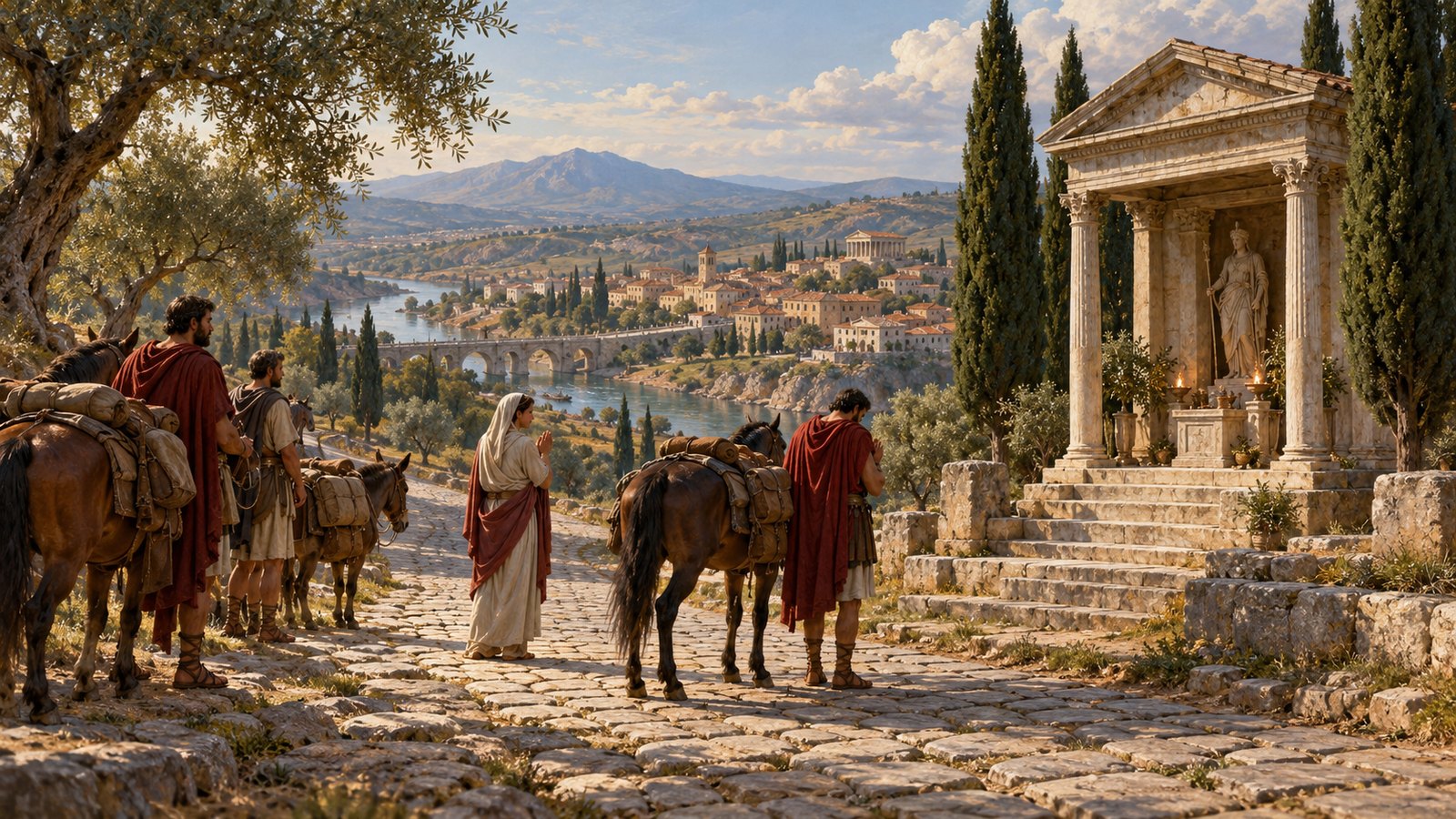
Roadside sanctuaries receive a similar adjustment. They should stand so passing people can look toward them and make obeisance. Here the decisive worshipper is not already inside. It is the traveller whose route crosses the temple’s field of view.
The rule recalls how Rome’s sacred boundary depended on place and ritual action. In both cases, religion is not floating above the landscape. It is made legible through a line, direction, and movement on real ground.
Orientation was a negotiated relationship, not a stamp
The chapter’s sequence is its argument. Begin with an ideal relation among image, east, and worshipper. Continue the axis through the altar. Then adapt when place, city, river, or road imposes a stronger public relation.
None of the exceptions abolishes ritual visibility. They preserve it by changing the object addressed. A river-facing temple answers the river approach. A roadside temple catches the passing gaze. A constrained urban temple opens toward the city it serves.
This is why a compass bearing alone cannot explain a sanctuary. The archaeologist must ask where the entrance lay, where an image could stand, how the terrain rose, what route brought visitors, and which public space the facade addressed.
Vitruvius gives no catalogue of actual temples in this chapter beyond the Nile reference. He does not prove compliance rates or tell us how patrons settled disputes between priestly wishes and difficult parcels. Those questions require evidence from each site.
What he does preserve is a designer’s hierarchy of considerations. The first plan is cosmically neat, but the world is allowed to interrupt it. Architecture succeeds by restoring a meaningful encounter under local conditions.
A worshipper approaching from the road, a boat moving along a river, and a citizen climbing through a city do not arrive in the same way. Vitruvius’s temple can turn toward each of them.
The west-facing statue is therefore only the beginning. The lasting principle is relational: sacred architecture had to decide who was looking, what they faced, and how the deity entered that view.
Doorway and facade also frame the sequence. The entrant does not confront the image from every point in the precinct. The encounter tightens while the body approaches the threshold, where the opening selects what can be seen inside and the sky beyond remains behind the viewer.
That framing helps explain why Vitruvius moves directly from orientation to temple doorways. The next chapter changes subject to proportions, but the doorway is also the aperture through which the preferred alignment becomes experience. Width and height govern access; direction governs the relation revealed through it.
A crowded festival could complicate the ideal sightline as people, smoke, offerings, and attendants filled the forecourt. The text does not resolve that congestion. Its diagram is clearest at the scale of one suppliant, which is precisely why the imagined gaze remains useful: it tells the architect what the arrangement should make possible even when ritual life becomes busy.
For a roadside traveller, the equivalent aperture is the landscape itself. A bend, slope, or stand of buildings can either disclose or hide the sanctuary. Turning the facade toward movement allows recognition before formal entry, making a passing act of respect architecturally available.
Sources
Vitruvius, On Architecture, Book 4, chapter 5.