
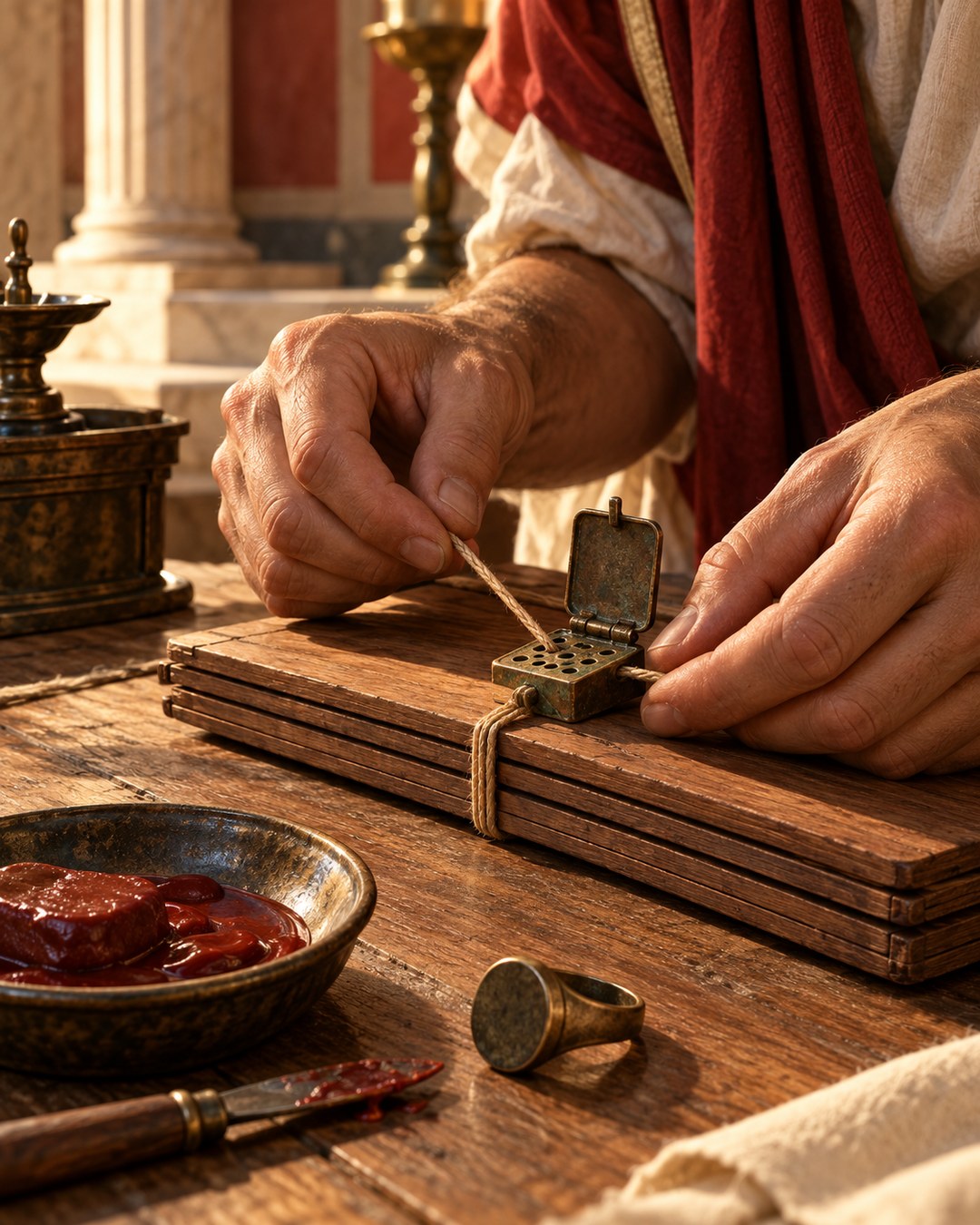
A Roman seal box from London is only 22 millimetres wide and 19 millimetres deep. Open, it stands 24 millimetres high. Its base has three perforations and an opening on each side. Those holes are not damage. They are the working parts of a security system built from copper alloy, cord and wax. The security claim depended on the whole sequence remaining intact: cord through the base, wax above it, a personal impression, and a closed lid. A recipient did not need to prove who touched the box in transit; an opened or broken seal made interference visible before the document was trusted.
The cord of a document or package passed through the box. Wax was placed inside and stamped by a sender or by witnesses to an agreement. The hinged lid sheltered the impression. Anyone determined to reach the contents could still do so, but not invisibly: the cord or wax had to be disturbed, and the recipient could see that the chain of trust had failed.
This was security by evidence rather than resistance. The little box could not defeat a knife or a thief. It made interference legible. Roman administration depended not only on writing words, but on transporting them between people who needed a reason to believe that the closed message arriving in their hands was the one that had left its sender.
Five Openings Turned a Box into Part of the Knot
The London Museum example has three perforations in its base and one aperture on each side. A cord could enter, cross the protected cavity and leave again. Once tied around a folded tablet or packet, the box became part of the binding rather than a loose ornament placed on top.
Other Roman examples clarify the common construction. Their bases usually carry three to five circular holes, while opposed notches or slots interrupt the low side walls. These channels allowed fibre to pass without lifting the box away from the object beneath it. Cord, base and package formed one assembly.
The geometry mattered. A seal attached only to the surface might be prised away and replaced. Threading the binding through the metal forced anyone opening the packet to deal with the sealed cavity itself. The recipient did not need to understand every twist of the original knot. An intact cord path and undamaged impression provided a quick first test.
The object therefore solved a problem familiar from Roman credit recorded on tablets: writing could preserve an obligation, but the physical carrier still had to survive movement and handling. A message’s authority depended on wood, wax, fibre and metal remaining in a recognizable relationship.
Soft Wax Stored an Identity That Metal Could Protect
Inside the box, wax received an impression from a personal seal. The London Museum describes senders and witnesses using recognizable devices that functioned like signatures. The pattern mattered because correspondents knew whose mark they expected to see.
Wax offered an advantage precisely because it was soft. Pressing a matrix into it produced a detailed impression quickly. The same softness made the result vulnerable to rubbing, pressure and heat. A metal lid protected the surface from ordinary contact while leaving the cord fixed beneath it.
The seal did not prove that every statement inside was true. It connected a closed object to a person or witnessed act. The recipient could ask two narrower questions before reading: Does this impression match the expected authority? Does it appear to have remained unbroken since the packet was closed?
That distinction gave the system practical strength. A courier did not have to know the contents. The messenger carried an object whose integrity could be judged later. Trust travelled through a visible mark protected from casual damage, while confidentiality depended on the fact that access would normally destroy or disturb that mark.
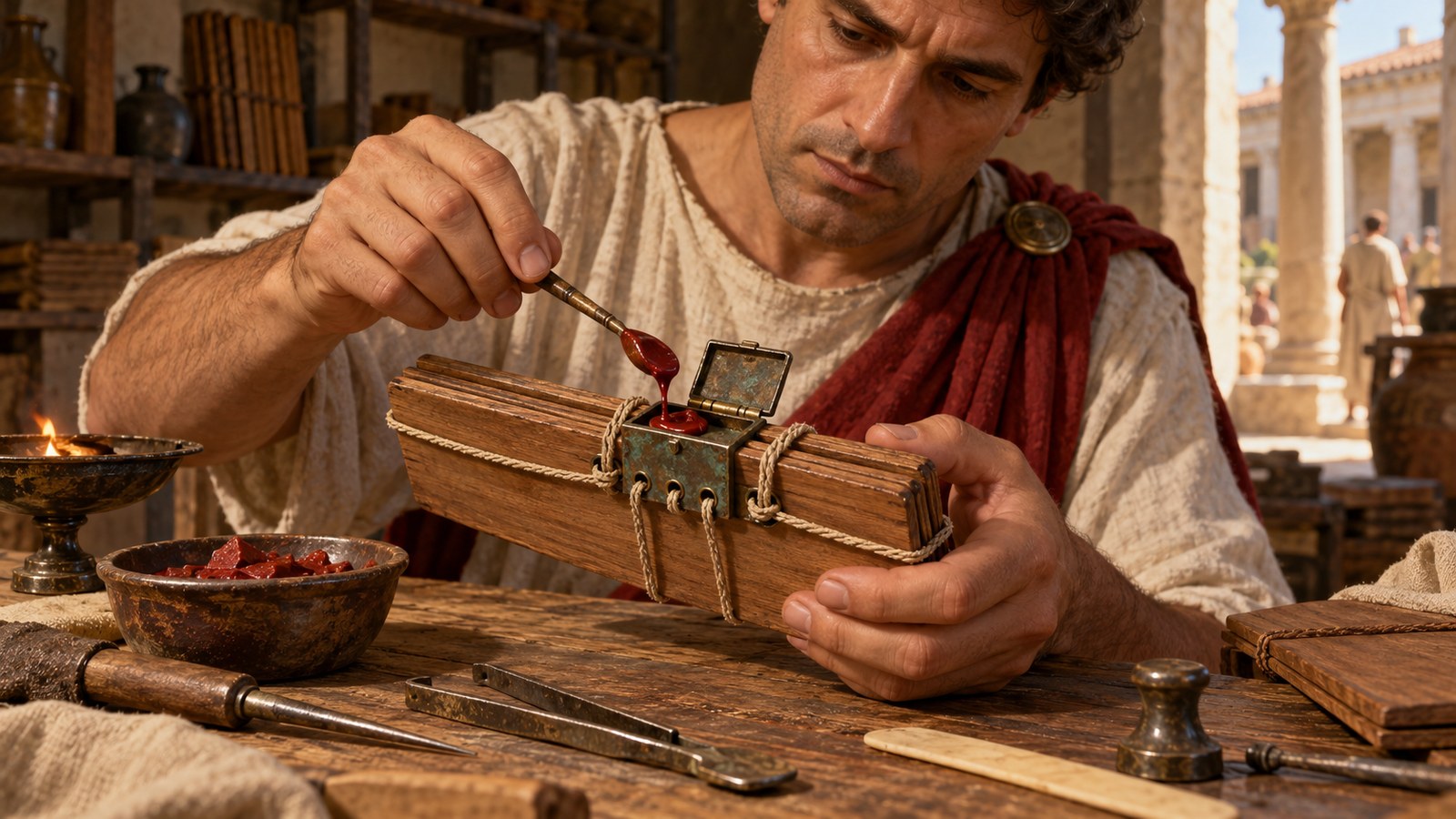
A Three-Loop Hinge Kept Inspection Separate from Opening
A common seal-box hinge used two loops cast with the base and one loop attached to the lid. The lid’s loop fitted between the pair, and an iron or copper-alloy pin passed through all three. This simple arrangement let the cover swing repeatedly without detaching from the box.
Some lids also carried a small locating pin opposite the hinge. It entered a matching socket in the base and reduced sideways movement. The feature was modest, but it helped the lid settle correctly over a fragile impression instead of grinding across it.
The recipient could inspect the exterior before deciding to break the seal. A displaced lid, damaged hinge, cut cord or cracked wax all carried information. The box separated protective covering from authorized access: lifting the metal was one action, breaking the binding another.
This sequence resembles the tiny physical details that could decide a Roman legal dispute. Procedure often turned on whether a required act had happened in the recognized way. A seal box made that concern material. Correct closure left a particular arrangement; unauthorized entry altered it.
Different Shapes Let Security Become Display
Roman seal boxes survive in leaf-shaped, circular, rectangular and lozenge-shaped families. Many lids were decorated, and some carried enamel or a bright metal coating. The security mechanism did not require such variety. A plain cover could protect wax. Shape and colour made the object more personal and more visible.
That visibility could help recognition. A correspondent might know not only the impression inside but the form of the box expected on a particular kind of packet. It also allowed status to enter administration. Even a device serving contracts or correspondence could be cast and finished as an attractive possession.
The leaf-shaped group shows how typology follows construction. A long tapering lid still needed room for hinge loops, cord slots and the sealed cavity. Decoration occupied the upper surface while the lower structure performed the repetitive work of threading, filling and closing.
No shape made forgery impossible. A determined attacker could imitate a box or attempt to copy an impression. The object raised the cost and complexity of undetected substitution. It multiplied the details that had to look right: material, form, hinge, cord, wax and mark.
The Box Secured a Relationship, Not Just a Document
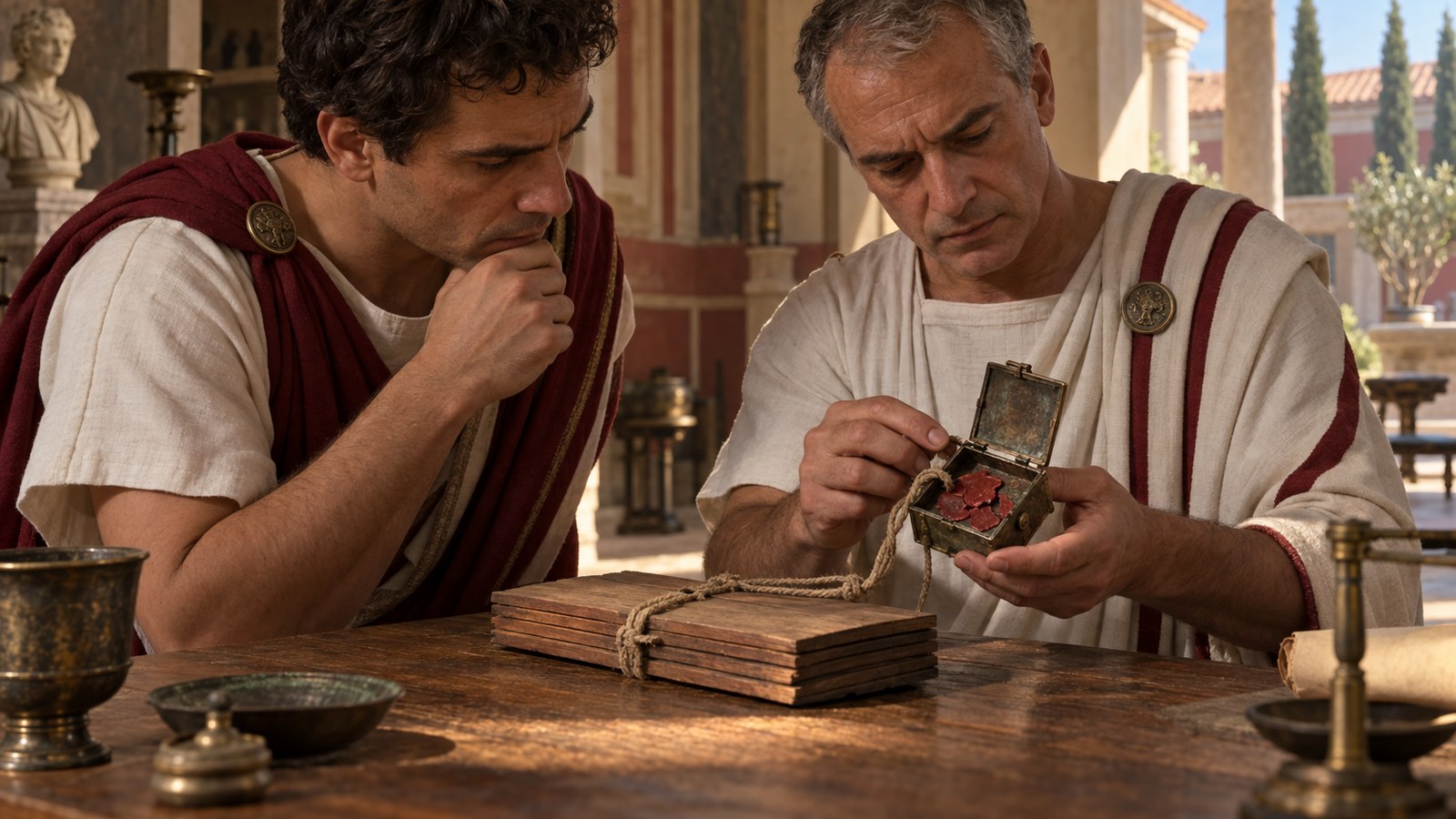
A sealed packet joined several people who might never stand together. A sender closed it. Witnesses might add authority. A courier transported it. A recipient inspected and opened it. The copper-alloy box sat at the point where their separate actions had to remain connected.
Its mechanism depended on shared expectations. The sender had to use a recognizable impression; the recipient had to know what counted as intact; witnesses had to understand that breaking the wax ended the sealed state. Technology worked because procedure taught people how to read it.
The small dimensions sharpen the lesson. Roman information security did not always look like a guarded archive or a heavy chest. It could fit beneath a thumb. Three holes in a base, two side openings and a hinged lid made ordinary fibre and wax carry a claim about custody.
That claim remained limited but valuable. The box did not guarantee honest authorship, safe delivery or secrecy against force. It offered tamper evidence. If the message arrived unchanged, the mark remained available for comparison. If someone opened it, the damage became part of the message.
A surviving seal box often lacks its cord, wax, document and impression, leaving only the durable shell. Reconstructing the missing parts returns movement to the object: thread, tie, fill, press, close, carry, inspect and break. The metal mattered because it protected the soft evidence long enough for trust to cross distance.
Sources
London Museum, “Seal Box,” object 1882; Colin J. Andrews, “Roman Seal Boxes.”
London Museum Roman seal box catalogue; Portable Antiquities Scheme seal-box records.