
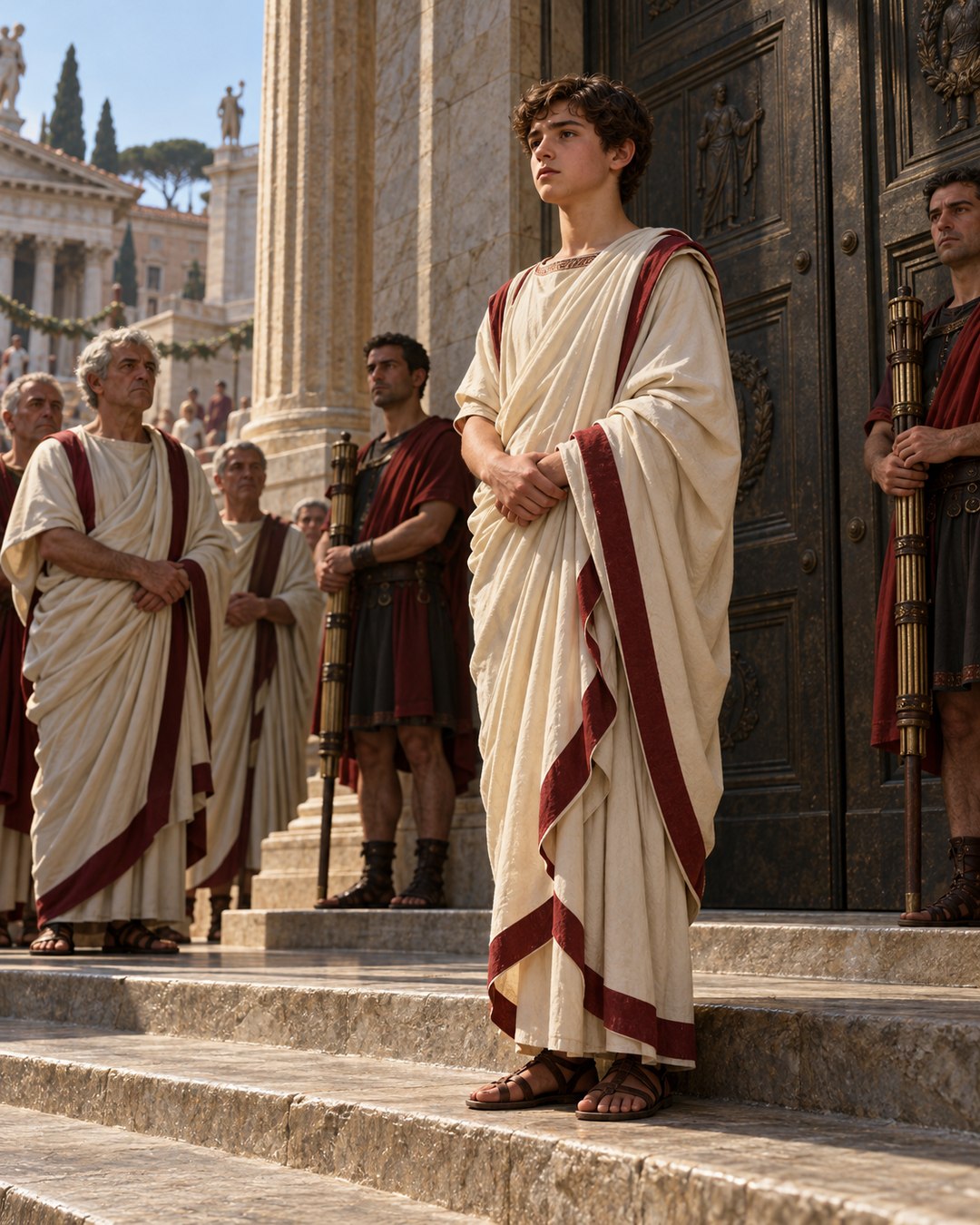
Rome’s consuls left the city for the Latin Festival, and a temporary prefect remained behind. Then a constitutional question appeared: could this substitute official summon the senate?
Aulus Gellius preserves no tidy answer. Junius said no. The appointee could be so young that he was not eligible to sit in the senate or give an opinion there. Marcus Varro and Ateius Capito said yes, and Capito reported that Tubero agreed. Their comparison was the tribunes of the plebs, who could convene senators before they were senators themselves.
The argument exposes a fault line inside delegated power. Did authority follow the personal standing of the officeholder, or the duties of the office he temporarily occupied?
The festival emptied Rome’s highest ordinary chairs
The Latin Festival drew the consuls away from Rome. Public religion created an administrative absence: the same magistrates whose presence sustained government had to leave the city for a shared rite.
A prefect was appointed to remain in charge. The arrangement prevented geography from suspending every function of the capital. Someone stood in for officials who were absent because duty required their absence.
Temporary substitution sounds straightforward until the substitute needs to exercise a power with its own status rules. Convening the senate was not simply keeping watch over streets or receiving a message. It brought Rome’s governing council into formal session.
Gellius phrases the problem as both convening and consulting the senate. Calling members together opened a process in which qualified participants could state opinions, divide, and advise.
The distinction matters beside the silent senators who voted by moving their feet. That procedure asks how members expressed a decision once a meeting existed. The prefect dispute asks who could create the meeting in the first place.
A replacement official could possess enough authority to guard continuity but not necessarily every power of the absent consuls. Roman constitutional practice often grew from overlapping precedents rather than one exhaustive written chart.
The festival therefore acted like a stress test. Routine government could leave ambiguous boundaries untouched. A scheduled absence forced experts to decide how far substitution reached.
Junius made youth a limit on institutional reach
Junius denied that the prefect could hold a senate meeting. His argument began with the man rather than the vacancy.
The prefect was not a senator. He lacked the right to express an opinion among senators. Junius connected those facts to the age at which the office could be assigned: the appointee might still be too young for senatorial eligibility.
The objection has intuitive force. A person excluded from participating in deliberation seems an unlikely official to command deliberators to assemble.
Youth sharpened the mismatch. Rank by appointment could place someone in charge of the city before age admitted him to the council whose meeting he might summon.
Junius’s position protected the senate’s threshold through membership qualifications. Convening was not a neutral act performed outside the institution; it was close enough to deliberation that a non-member without speaking rights could not do it.
Gellius does not say that the young prefect lacked every civic power. The disability is specific. A temporary official could be genuine without being equivalent to a consul in all respects.
This line of reasoning ties competence to personal legal capacity. Delegation cannot create what age and membership rules withhold.
Varro and Capito let the office survive its holder’s status
Marcus Varro reached the opposite conclusion in his Investigations in Epistolary Form. Ateius Capito agreed that the prefect could convene the senate, and he said Varro shared the view of Tubero.
The cluster of names matters because Gellius presents a debate among authorities, not one eccentric opinion answered by obvious law. Learned Romans could organise the same offices differently.
The affirmative view begins from substitution. The prefect remained in charge because the consuls were absent. If continuity was the purpose of appointment, withholding the power to summon advice during that absence might defeat the arrangement at the moment it was most needed.
Capito offered a precedent rather than relying only on functional logic. Tribunes of the plebs had the right to convene the senate even before the Atinian law made them senators.
That comparison separated two capacities. Speaking as a member belonged to membership. Calling members together could belong to an office outside the senate.
The precedent answers Junius directly. If non-senators had already possessed convening authority, then the young prefect’s exclusion from debate did not settle his ability to summon a debate.
Capito did not need to claim that prefect and tribune were identical. The analogy targeted the exact proposition at issue: personal non-membership did not universally block the convening power.
This is constitutional reasoning by controlled comparison. One office illuminates another where no single rule quoted by Gellius closes the case.
The disagreement preserved two different maps of Roman power
Junius mapped authority inward from the person. Is he a senator? Can he offer an opinion? Is he old enough to qualify? If not, the door to convening remains closed.
Varro, Capito, and Tubero mapped authority outward from office and precedent. Is he filling the place of absent magistrates? Have other non-senators summoned the council? If yes, membership is not decisive.
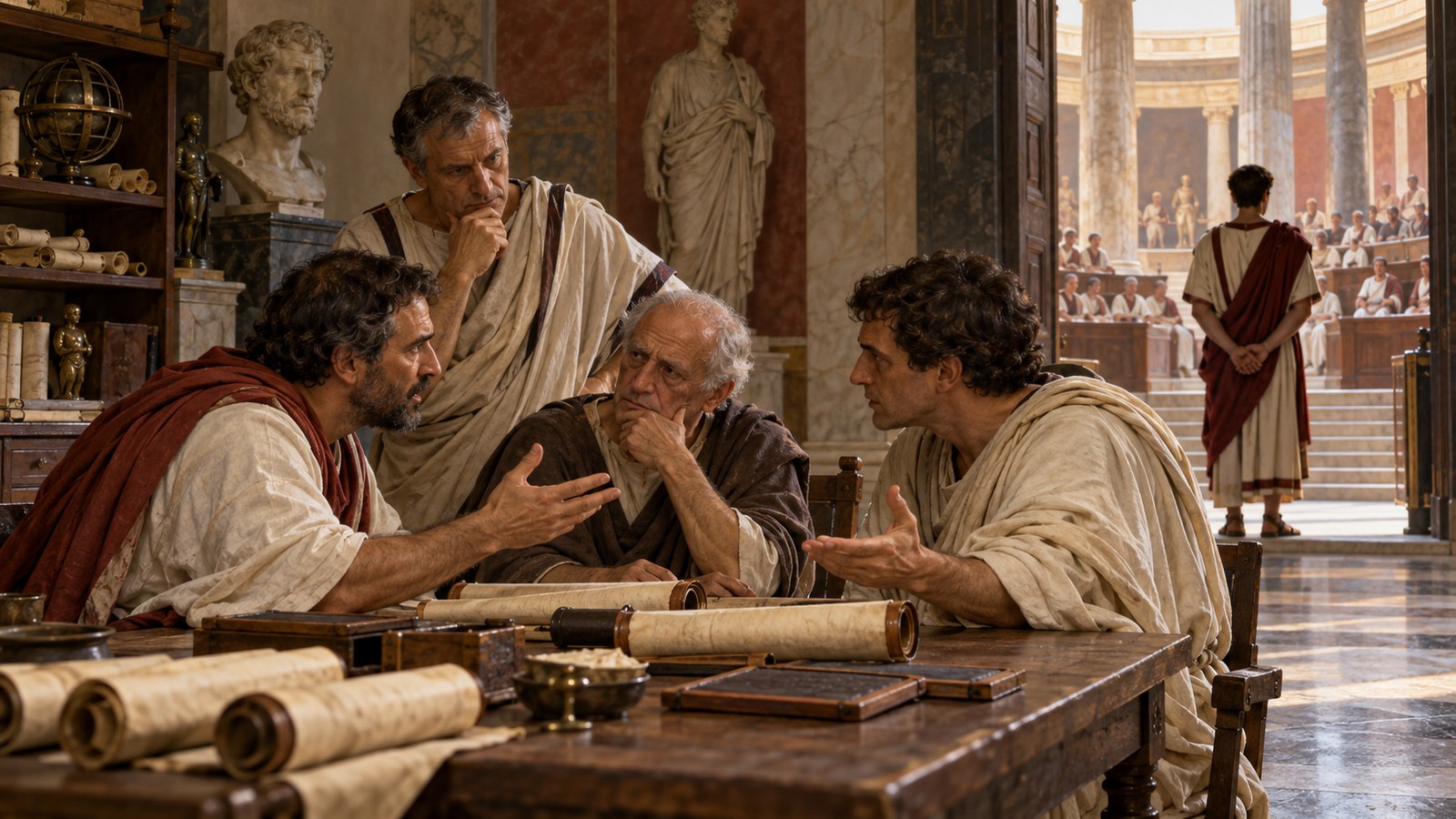
Neither map makes the temporary prefect a senator. The dispute is narrower and more revealing: institutions require actions by people who may stand outside the body affected by those actions.
The same precision helps distinguish this case from the language separating a general law from a private decree. That controversy classified the scope of a measure. Here, the uncertainty concerns the actor who may begin deliberation.
Gellius’s short chapter also warns against flattening “Roman law” into one stable answer. His value lies partly in preserving disagreement, sources, and analogies. Junius, Varro, Capito, and Tubero occupy the page because authority itself was contested.
The question was practical, not academic decoration. A crisis or urgent message during the festival could make the ability to assemble senators consequential. Waiting for the consuls to return might preserve hierarchy while sacrificing response.
Conversely, allowing every substitute the full convening power of the absent office could expand authority beyond its intended boundary. Continuity and restraint pointed in opposite directions.
The young prefect stood at their intersection. His appointment was real enough to keep Rome governed but unusual enough to reveal assumptions usually hidden by senior officeholders.
Gellius leaves the split visible. That is the stronger ending. Rome’s machinery did not always produce certainty; sometimes it produced rival explanations of why the machinery could move at all.
The form of preservation is revealing too. Gellius identifies books and authors as he lays out positions. The reader receives a chain of attributed judgement rather than an anonymous rule. Junius supplies the objection; Varro supplies an affirmative view; Capito both agrees and reports Tubero.
That chain limits what can safely be claimed. The chapter establishes disagreement among learned authorities. It does not record a particular young prefect successfully convening a named emergency session, nor does it describe senators refusing his summons. A vivid institutional problem must not be converted into an invented incident.
What survives is still concrete: consular absence, a temporary urban prefect, senatorial eligibility, the right to voice an opinion, and the earlier power of tribunes. Each detail tests a different link between person and office.
The Latin Festival created only a temporary vacancy, but temporary vacancies often expose permanent design. By asking who could open the senate’s doors while the consuls were away, Roman scholars revealed where they believed public power resided.
Sources
Aulus Gellius, Attic Nights, Book 14, chapter 8.