
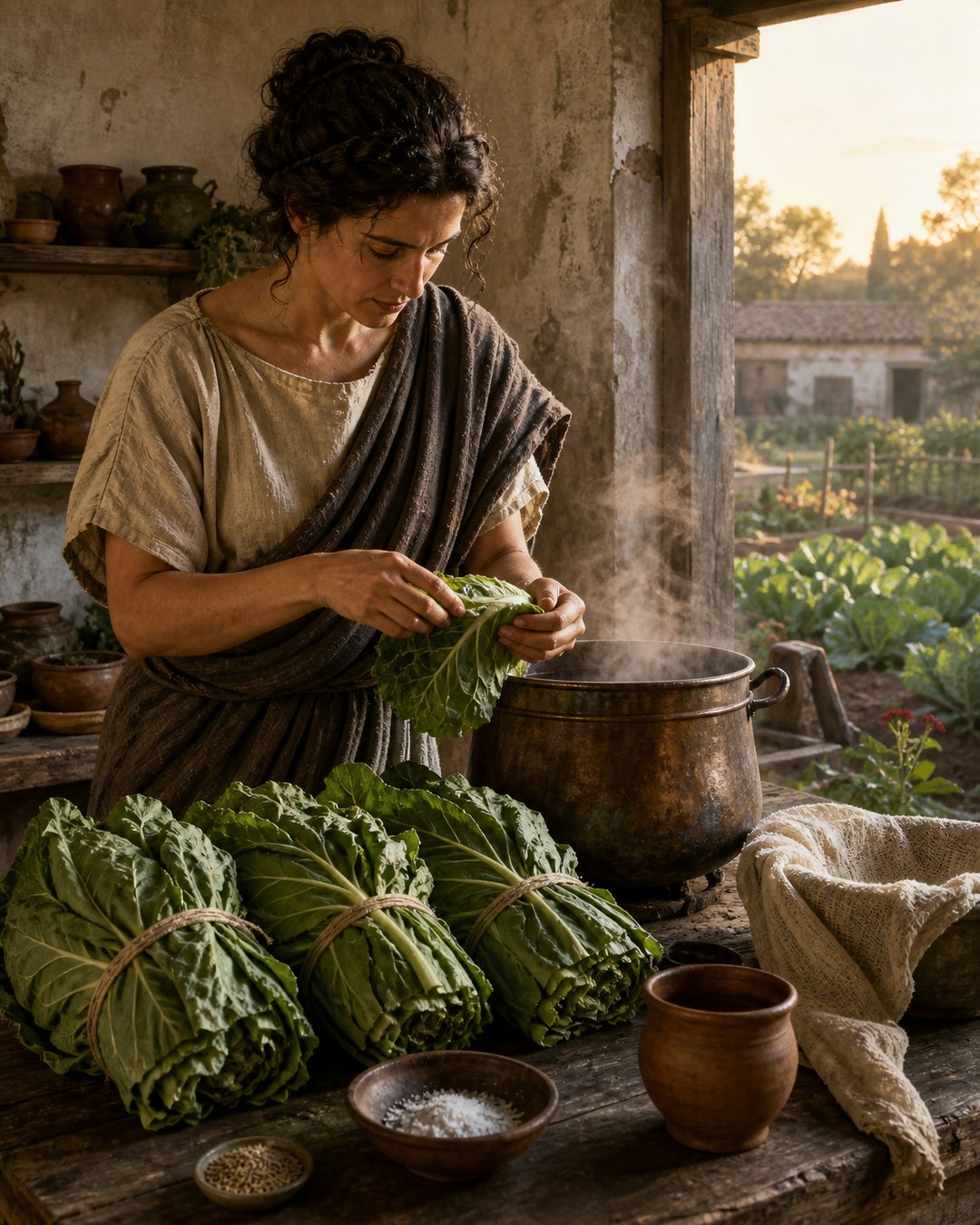
Cato’s patient was not simply told to eat a vegetable. Four pounds of smooth cabbage leaves had to be divided into three bundles. Each bundle met boiling water in a timed sequence. The leaves were pounded, squeezed through cloth, seasoned in an earthen cup and left outside through a calm night.
Preparation continued with a hot bath, honey-water and fasting. At dawn came the cabbage juice. Then the patient was expected to walk around and conduct business for four hours before the purge took effect.
This elaborate routine appears in two chapters of On Agriculture devoted to cabbage. Cato credits the plant with a range of powers that no modern reader should accept as clinical evidence. Yet the chapters remain revealing. They show household medicine becoming concrete through weights, vessels, counts, textures, heat, movement and repeated applications.
Cabbage could be food, drink, poultice or purge. It could be raw with vinegar, boiled with barley flour, crushed onto a washed surface or dried and powdered. The plant stayed familiar while technique changed its role. Cato’s medicine chest was partly a sequence of kitchen operations.
A banquet remedy began with vinegar and six leaves
Cato opens with an absolute claim: cabbage surpasses every other vegetable. It may be cooked or raw, he says, although the raw leaves should be dipped in vinegar. He praises its effects on digestion and assigns usefulness even to the urine of someone who consumes it.
The first regimen belongs to a banquet rather than a sickbed. A person who wishes to drink deeply and enjoy dinner should eat as much raw cabbage with vinegar as desired before the meal. Afterward, Cato prescribes about half a dozen leaves. He promises that the diner will feel as if he has not eaten and can continue drinking.
The claim is sweeping, but the format is practical. There is a before and an after, a seasoning and a rough count. Cabbage becomes a way of preparing the body for elite consumption with an ingredient available far from an exotic drug trade.
That ordinariness helps explain the confidence of the passage. The remedy does not require a rare mineral or an unknown ritual expert. It begins with recognizable leaves and vinegar. A household could repeat it, observe an effect and preserve the instruction even when Cato’s explanation reached beyond what the evidence could support.
Roman banquets were also legal and social stages. dinner laws counted different ceilings for festivals, ordinary days and weddings. Cato approaches appetite from another direction: not how much the host may spend, but how a diner might use a garden plant to keep eating and drinking.
The comparison should not turn his instruction into successful medicine. It shows how the same meal could attract regulation, moral judgment and bodily technique. Cabbage sat at their intersection because it was simultaneously food and, in Cato’s telling, an instrument for controlling food’s consequences.
Three bundles made treatment repeatable
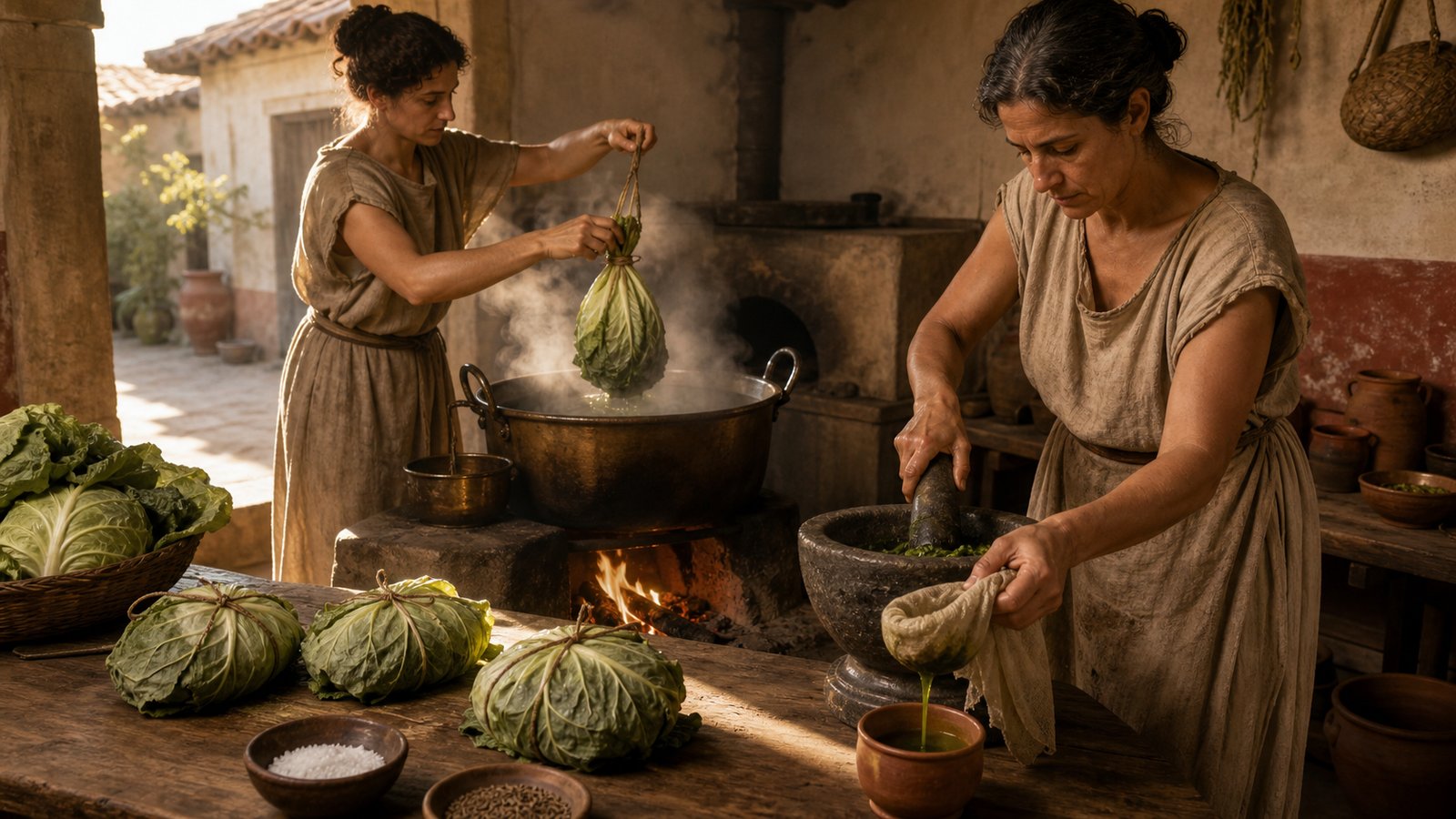
The long cleansing recipe is far more exact. Cato calls for four pounds of very smooth cabbage leaves. They are made into three equal bunches and tied. A pot of water goes on the fire. When boiling begins, the first bunch is dipped briefly, interrupting the boil; when the water rises again, the bundle returns while the preparer counts to five.
The second and third bundles receive the same treatment. All three are then combined and macerated. The crushed material is squeezed through cloth until about a hemina of juice reaches an earthen cup. A lump of salt the size of a pea and enough crushed cumin to create an odor complete the mixture.
The cup stands in open air through a calm night. Before taking it, the patient bathes hot, drinks honey-water and goes to bed without food. Early in the morning comes the dose. Cato then orders four hours of walking and ordinary business while the patient waits for nausea and evacuation.
Every stage makes the instruction transferable. Weight controls the leaves. Three bundles organize blanching. A five-count limits one immersion. Cloth separates juice from pulp. The hemina measures liquid; the pea gives salt a visual scale; smell determines the cumin. Weather, bathing and fasting regulate the patient before the final four-hour interval.
This procedural density is the chapter’s strongest historical evidence. It does not prove the promised purge was safe, predictable or beneficial. It does show how an author could make household treatment feel disciplined. Exact actions lend authority to a remedy even when its larger medical claims are not established.
Cato even supplies an emergency response if the purge acts too strongly: fine flour sprinkled into water. The sequence anticipates variation, then answers it with another kitchen mixture. Treatment remains inside the same world of pots, cups, cloth, grain and measured ingestion.
Food and poultice used different properties of one plant
Other instructions transform cabbage by cooking. For colic, Cato has it macerated in water and boiled until very soft. The water is poured off; salt, cumin, barley flour and oil are added; the mixture is boiled again and cooled in a dish. He prefers the patient to eat the cabbage by itself, though other food may be broken into it.
He varies drink according to fever and tells the reader to repeat small morning doses so the food does not become repellent. Men, women and children receive the same basic preparation. Here palatability matters alongside the recipe. A remedy that must be repeated has to remain edible.
In the next chapter, Cato distinguishes varieties. The smooth cabbage is large, broad-leaved, thick-stemmed and hardy. Curly “parsley cabbage” has stronger medicinal properties in his ranking. A mild, small-stalked and pungent variety produces less juice but is credited with the greatest force.
Plant recognition therefore enters treatment before preparation begins. “Cabbage” is not one interchangeable material. Leaf shape, stalk and juice affect Cato’s choice, even though his claims about their relative power remain ancient assertions rather than tested comparisons.
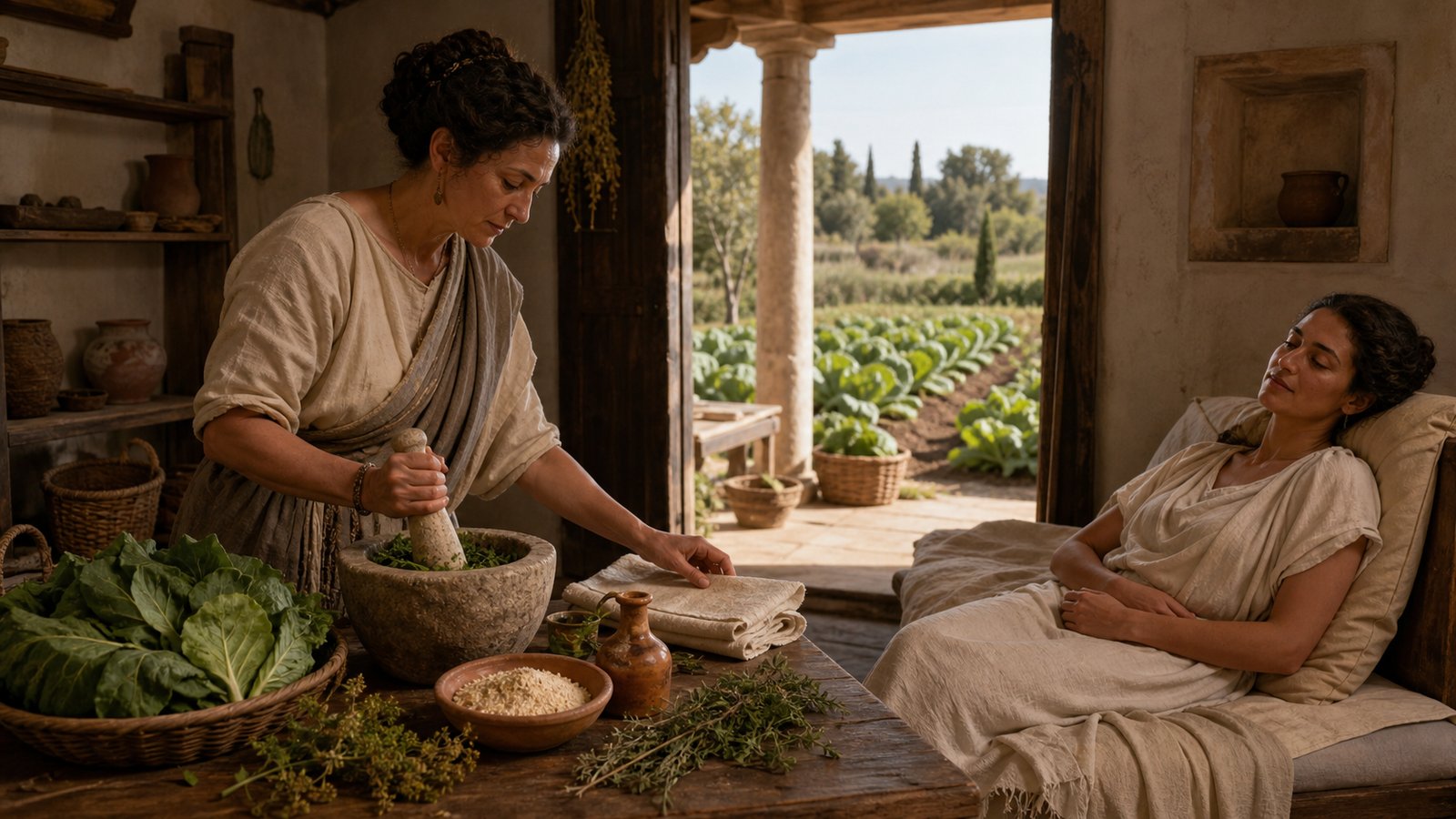
For external use, the leaves become a poultice. Cato tells the caregiver to wash the affected surface with plenty of warm water, crush cabbage and renew the application twice a day. For a place too tender to endure its astringency, barley flour softens the mixture.
The shift from food to poultice changes both texture and schedule. The plant is no longer swallowed; it is macerated and held against a washed surface. Twice-daily renewal turns one preparation into ongoing care. Those actions are historically concrete even where Cato’s promise to heal wounds, swellings and more is far too broad.
Roman healing did not belong to one profession or room. Roman dental treatment could demand specialized forceps and a steady hand. Cato’s cabbage chapters instead keep much of treatment within the farm household, using ingredients and equipment that overlap with cooking.
Wild cabbage pushed household technique to its limit
Cato seasons chopped cabbage with vinegar, rue, coriander and salt for eating. Elsewhere he adds silphium or asafoetida in the transmitted recipe, honey, oil or barley meal. The changing combinations create a small technology of taste, texture and delivery. Bitter or pungent material becomes tolerable; wet pulp becomes an adherent application; juice becomes a measured dose.
Wild cabbage receives the strongest claims. Cato orders it dried and ground very fine. A patient fasts overnight and takes the material the next morning with four cyathi of water. He calls it safer and more effective than powerful purgatives, then extends the regimen across seven days with directions for meat, boiled cabbage, bread, diluted wine, limited bathing and oil rubbing.
The detail should not hide the danger of the claim. “Harmless” is Cato’s judgment, not a guarantee. A historical recipe can tell us what an author recommended without making the recommendation fit for modern use. The more conditions the text promises to cure, the more important that distinction becomes.
Some delivery methods are remarkably physical. For a fistula, Cato proposes inserting a pellet. If that is impossible, he describes liquid placed in a bladder attached to a reed and injected by squeezing. For a nasal growth, powder is inhaled. For deafness, cabbage is macerated with wine and its pressed preparation applied warm at the ear.
These are not casual references to a healthy vegetable. They are transformations designed for particular routes into or onto the body. Drying, pounding, straining and warming decide how the material moves. Containers—the earthen cup, cloth, bladder and reed—are part of the remedy as surely as the leaves.
Cato also preserves ideas that can feel alien or disturbing, including medicinal use of urine from a cabbage eater. Such passages belong to the evidence, but they do not need to be romanticized. They show a household medical system willing to recycle bodily products and to infer broad virtue from one favored plant.
The chapters’ importance lies in that mixture of the familiar and the extreme. A cabbage could be grown, cut and boiled by ordinary hands. Once surrounded by numbers, timings and confident promises, it could also become a near-universal answer. Cato’s instructions let us watch practical craft create medical authority—three bundles, one earthen cup and four hours of walking at a time.
Sources
Cato the Elder, On Agriculture 156–157