
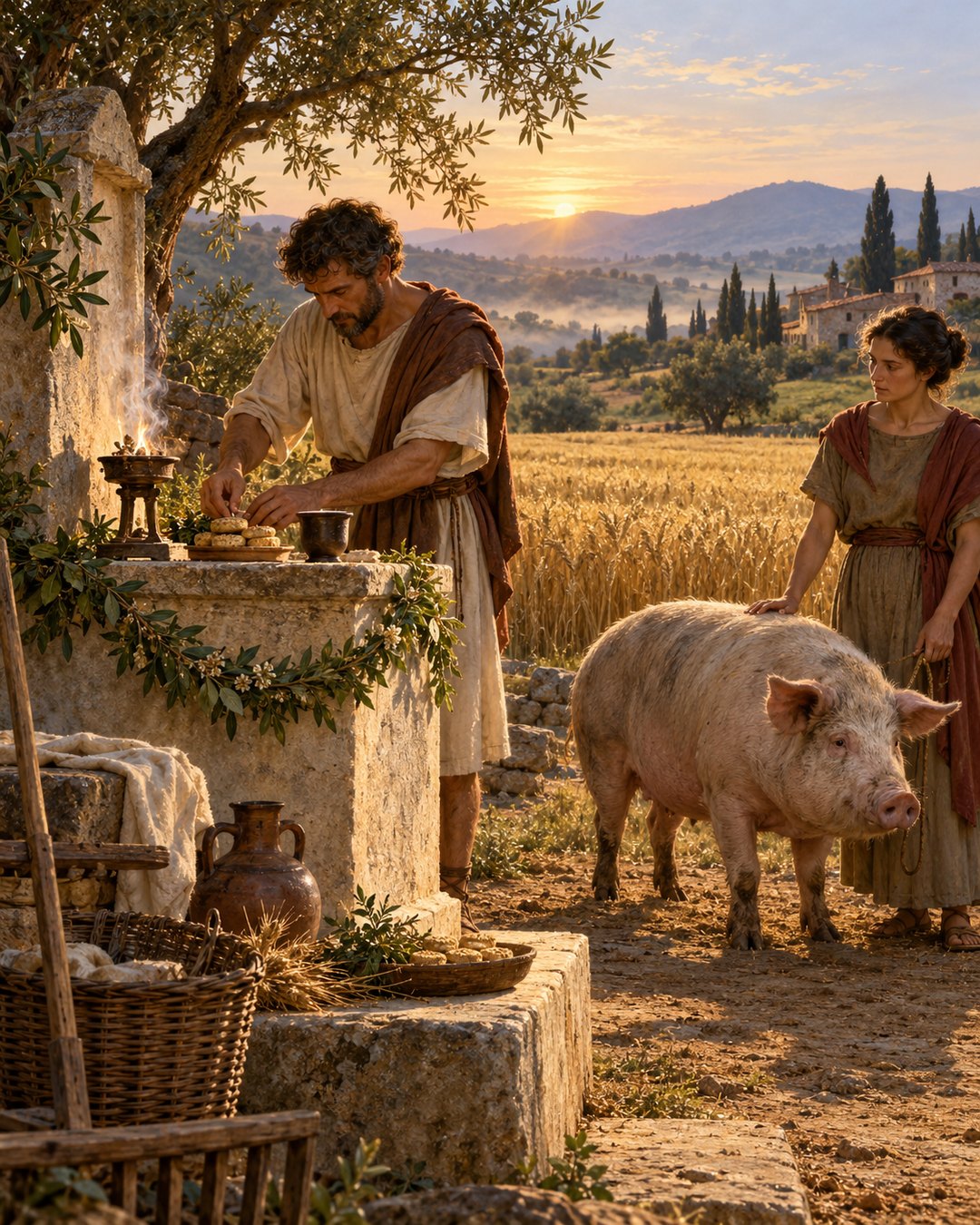
Before anyone cut spelt, wheat, barley, beans, or rape seed, Cato required a sow for Ceres. Yet the animal did not stand alone at the center of a single gesture. Incense and wine came first. Cakes went to Janus and Jupiter. Wine followed those cakes. After the sow had been offered, cakes and wine returned, and only then did entrails and wine complete the sequence for Ceres.
The repetition is the key to the rite. Cato’s instructions treat harvest as a threshold that had to be approached in order, with gods addressed by name and offerings placed before and after the principal sacrifice. The prayer also reaches beyond the field. It asks protection for the speaker, children, house, and household.
A crop was about to leave the standing plant and enter human possession. Cato made that change begin with a ritual whose sequence was as carefully managed as any farm operation in his handbook.
Five crops shared one threshold before the sickle
Cato names the rite as the sacrifice of the porca praecidanea, a sow offered before harvest. He assigns it to Ceres and lists the crops it preceded: spelt, wheat, barley, beans, and rape seed.
The list prevents the ceremony from being reduced to one emblematic grain. Cereals appear beside a pulse and an oil-bearing crop. The common feature is timing. Each was agricultural produce ready to cross from growth into harvest, and Cato placed the sow before that crossing.
Nothing in the chapter separates those crops into five different ceremonies. Cato gathers them under one pre-harvest instruction. A farm with more than one crop could therefore meet the same ritual threshold as different plants reached the point of cutting or gathering, while the named list kept the rule concrete rather than saying merely “produce.”
His instruction does not describe a public festival calendar or a vast civic procession. It appears in a farm manual and speaks to the person responsible for a household and its work. The scale is domestic and agricultural even though the gods addressed were central Roman divinities.
The sow belonged to Ceres, but the first prayer named Janus, Jupiter, and Juno and accompanied incense and wine. The rite therefore widened before it narrowed. Several divine powers were acknowledged before the specific victim was given to the goddess connected with crop growth.
The use of spelt recalls the parched grain that entered another Roman sacrificial preparation. Here, however, spelt is not yet an ingredient. It stands in the field beside four other named crops, waiting for the act that authorizes harvest to begin.
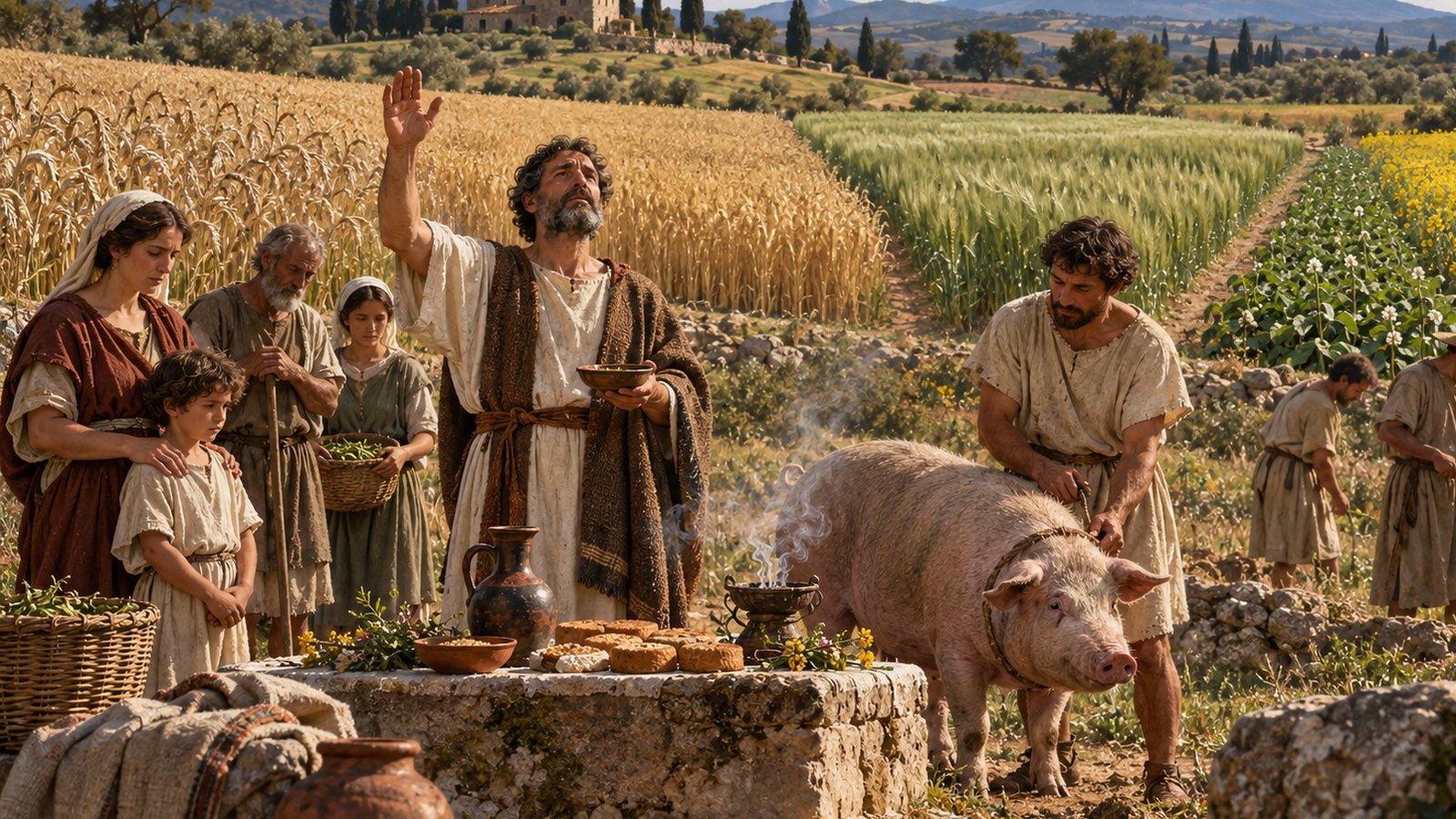
Janus received the first cakes and the household entered the prayer
After the opening prayer with incense and wine, Cato directs cakes to Janus. The spoken request asks Father Janus to be gracious and merciful to the officiant, his children, his house, and his household.
The wording maps responsibility outward. The speaker does not petition only for personal safety or for the abstract success of a crop. Children and the physical house appear alongside the wider household, which could encompass the people whose labour and subsistence were tied to the farm.
Janus’s position comes through order rather than an explanation supplied by Cato. His cakes come before Jupiter’s and before the sow. It is tempting to expand this into a universal theory of beginnings, but the passage itself gives firmer evidence: in this rite, Janus was approached first with a formula that gathered the household into the request.
Jupiter then received a cake and a parallel appeal for favour toward the same circle. The sequence preserves distinction without changing the human beneficiaries. Two gods were addressed separately; the children, house, and household remained the repeated object of concern.
These were not casual morsels placed beside an altar. Cato supplies words to accompany them. Correct material and correct speech worked together, making the farmer’s handbook a script as well as an inventory.
Wine doubled the approach before the sow
Once the cakes had been presented, the officiant returned to Janus with wine. The new prayer explicitly referred back to the earlier cake offering and asked that the wine honour him toward the same end.
Jupiter was then asked to accept both cake and wine. Cato’s compact formula makes the pairing audible. The liquid did not replace the solid offering, and the second address did not blur the first god into the next.
Only after these acts did Cato say to offer the porca praecidanea. That placement gives the preliminary sequence real weight. Someone following the text could not jump straight from naming Ceres to presenting the sow without omitting the cakes, wine, and addresses that prepared the rite.
The animal’s presence also tied the ritual to the working landscape. This was a sow at a farm threshold before crops were cut, not a detached symbol floating outside food production. The offering joined animal husbandry, grain, beans, oil crop, household, and divine address in one scheduled act.
Unlike the public gestures remembered in accounts of the Lupercalia, Cato’s instructions build tension through repetition rather than movement through a city. The meaningful path runs across an altar sequence: cake, wine, sow, then cake and wine again.
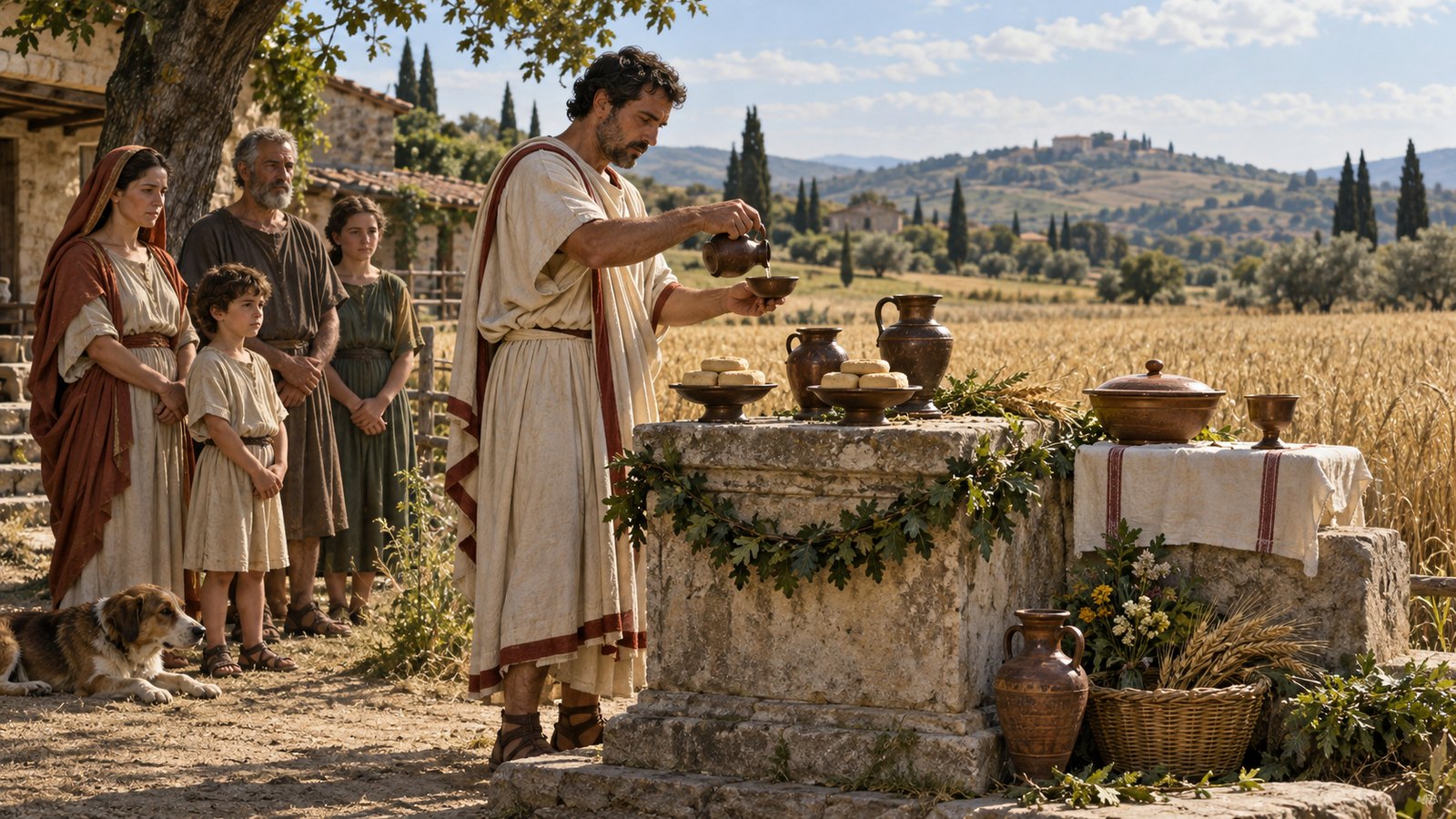
The repeated offerings closed around Ceres
After the entrails had been removed, Cato sends the officiant back to Janus. Cakes were offered again with the prayer used before. Jupiter likewise received a cake and the earlier prayer.
Wine also returned for both gods in the manner already prescribed. The repetition was not an editorial accident or a vague instruction to continue appropriately. Cato deliberately tells the reader to repeat the earlier forms after the central offering.
This creates two matching frames. Cakes and wine to Janus and Jupiter precede the sow; cakes and wine to Janus and Jupiter follow it. The sequence opens, encloses, and closes rather than moving in a straight line from small gifts to a larger one.
Ceres receives the final named act: entrails and wine. The end clarifies the agricultural direction of the whole rite. Janus and Jupiter structure the approach on both sides, while the sow and final offering belong to the goddess for whom the pre-harvest sacrifice was undertaken.
Juno appears in the opening address but is not assigned the repeated cakes and wine in Cato’s later directions. Preserving that asymmetry matters: the text names three gods at the beginning, then gives distinct recurring actions to two before returning the close to Ceres.
Cato gives no permission to compress the rite into “Romans sacrificed a pig for good crops.” That summary loses the five crops, the incense, the two cake offerings, the two rounds of wine, and the household named in prayer. It also loses timing, which is the practical hinge of the passage: all of this happened before harvesting began.
The instruction belongs in an agricultural book because ritual order was one kind of farm order. Crops, tools, workers, weather, and storage all demanded sequences. Here, divine relations did too. The person who managed the harvest had to know not just what to offer, but when to pause, whom to address, which words to repeat, and what act finally belonged to Ceres.
At the edge of the field, the sow marked more than expectation of abundance. The rite brought the people and house behind the crop into speech. Harvest would alter stores, labour, and meals for everyone named by that household formula. Cato’s repeated cakes and wine made the first cut wait until that dependency had been formally acknowledged.
Sources
Marcus Porcius Cato, On Agriculture, 134.