
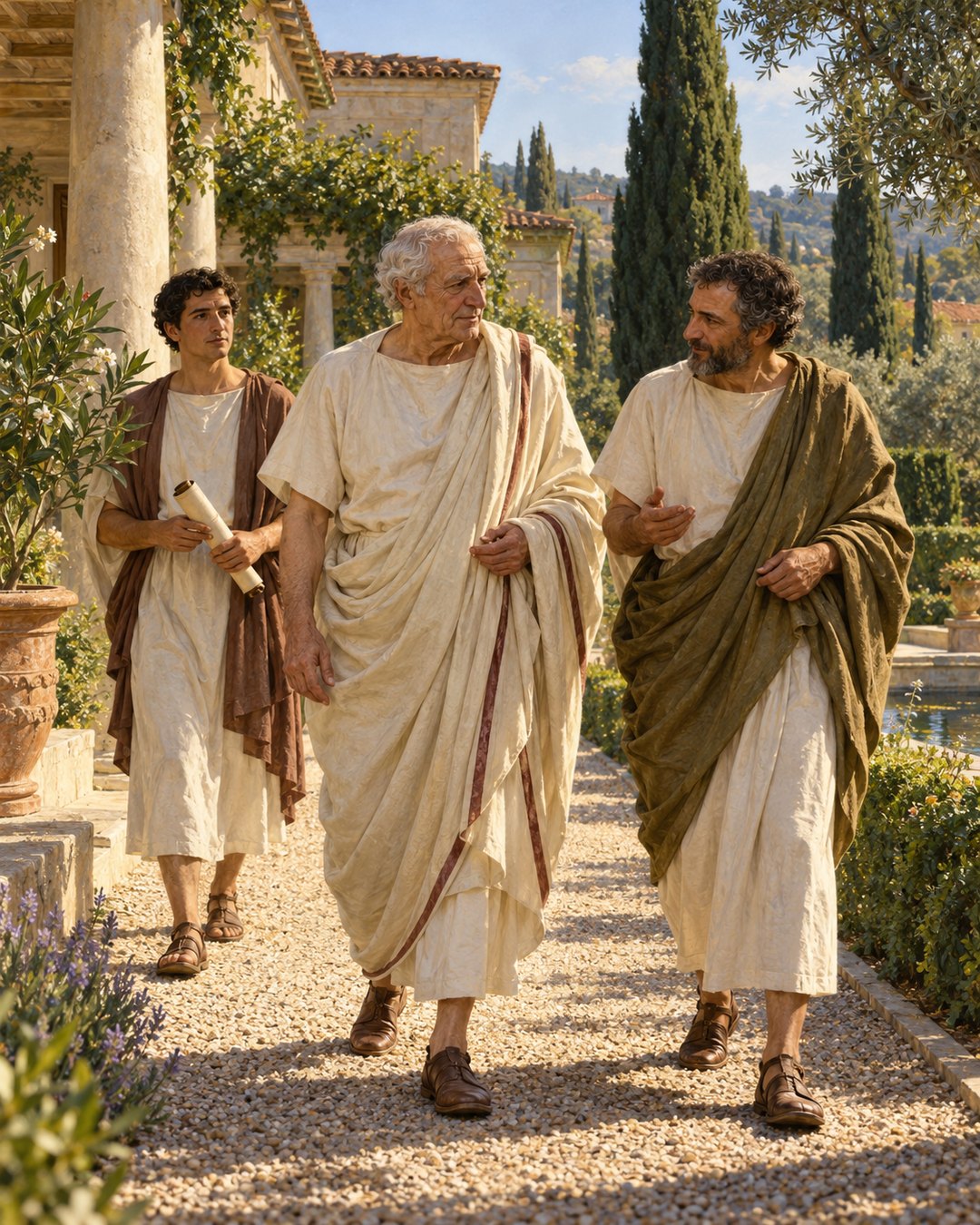
At the second hour, Spurinna asked for his shoes. The request started a circuit that Pliny the Younger could measure: three miles walking, seven miles in a carriage, then another mile on foot. Reading and conversation accompanied the movement. Writing followed it. Sun, a ball game, bathing, another book, and a modest dinner carried the routine into evening.
Pliny encountered this order while staying at Spurinna’s house and decided that he had found a model for his own old age. The attraction was not idleness. Spurinna had been a magistrate and provincial governor, and Pliny says that abundant work had earned his leisure. What impressed the visitor was the deliberate replacement of public pressure with a daily pattern that still exercised body, memory, friendship, and pen.
Spurinna was past seventy-seven. Pliny’s portrait makes every part of the day answer the same question: how could retirement remain structured without becoming another office?
Three miles made conversation part of exercise
Spurinna did not leap from bed at first light. Pliny says he kept his couch in the morning, then called for his shoes at the second hour. Only then did he begin a three-mile walk.
The distance was physical, but Pliny presents the walk as exercise for the mind as well. Friends discussed what he calls the noblest themes. When companions were absent, someone read a book aloud. Reading could continue even when friends were present, but Pliny carefully adds that it never happened in a way that bored them.
That qualification reveals the social skill inside the timetable. A fixed activity did not require every guest to become silent furniture. Conversation could replace reading; reading could enter company without dominating it. Spurinna kept the shape of the morning while allowing the people inside it some freedom.
After the walk he sat, and the same alternatives continued: more reading aloud or, preferably, more talk. Rest did not break the intellectual sequence. It changed posture and pace.
The pattern offers a quieter counterpart to Pliny’s plan for financing a school at Comum. There he worried about how learning would be funded and supervised in a town. At Spurinna’s house, learning survived through household time: a reader, a guest, a remembered example, and a host who knew when not to sound like a teacher.
Seven miles in a carriage opened a chamber of memory
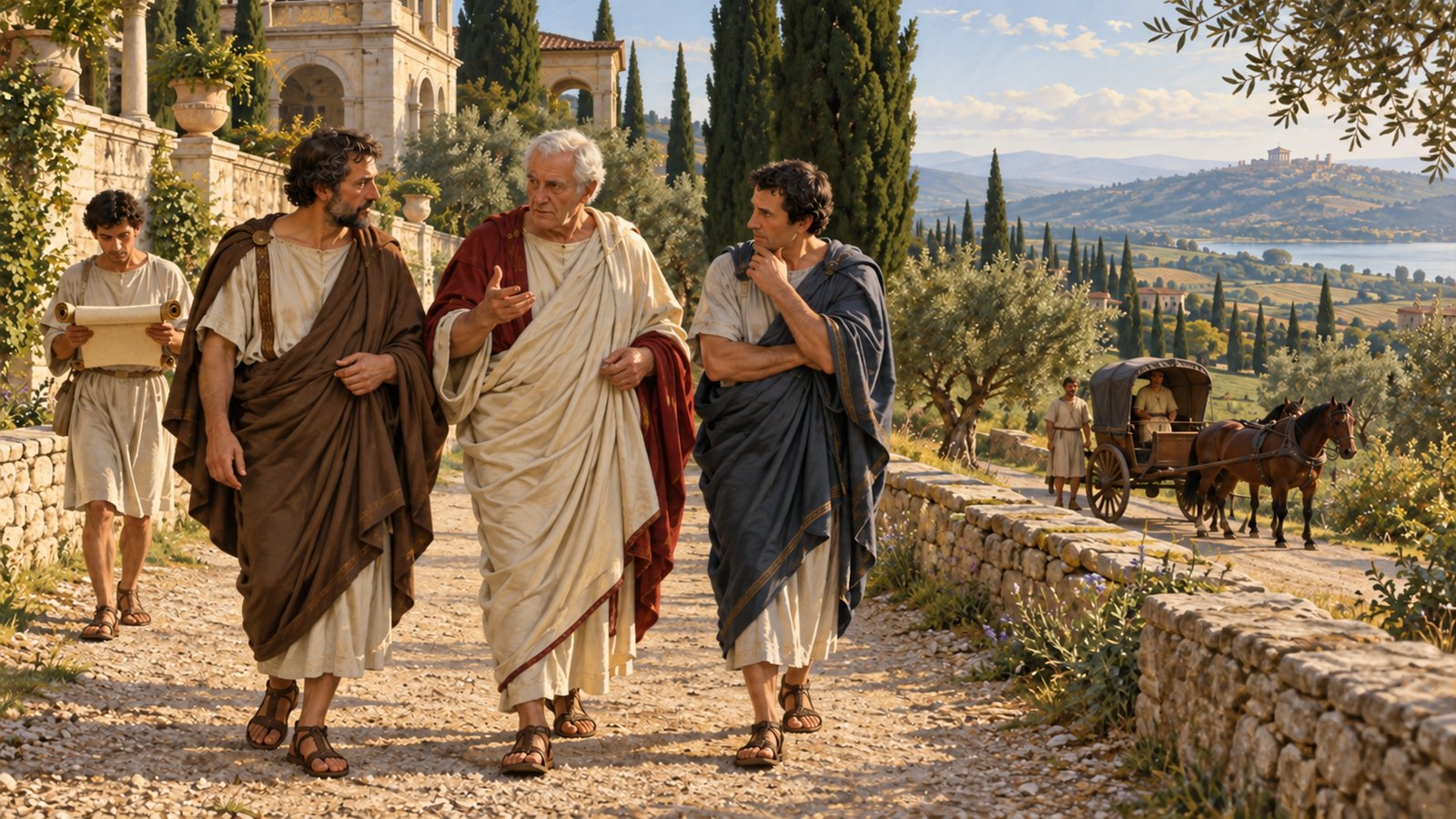
Spurinna next entered his carriage with either his wife or one of his friends. Pliny had received that invitation and remembered the privacy as a special distinction. The vehicle moved for seven miles, but the letter dwells less on the road than on what the enclosed company allowed.
Spurinna spoke of earlier times, noble deeds, and notable men. For Pliny, the journey offered glimpses into a past held by someone who had participated in public life. Yet the older man blended learning with modesty so successfully that he never seemed to be playing the schoolmaster.
The carriage made recollection mobile and bounded. It gave host and companion a defined interval together, away from a larger room, while the measured route prevented reminiscence from becoming endless. The miles supplied an outer frame for memory.
After seven miles riding, Spurinna walked another mile. Pliny’s count brings the day to four miles on foot without pretending that all eight miles required the same exertion. Carriage travel separated two walking periods and carried a different kind of activity between them.
On returning, Spurinna either sat again or withdrew to his room and his pen. He wrote polished lyric poems in both Latin and Greek. Pliny praises their grace, sweetness, humour, and moral restraint. The former official was not merely telling old stories; he was still making new work in two literary languages.
Retirement in this house therefore moved between oral and written memory. The carriage conversation transmitted people and deeds to one companion. The private room turned a quieter part of the day into composition. Neither required a formal audience.
The bathing hour divided composition from bodily play
The schedule changed with the season. Spurinna’s bath came at the ninth hour in winter and the eighth in summer. Pliny does not translate those hours into a modern clock, but the seasonal difference itself shows that the routine was fixed without being blind to changing daylight.
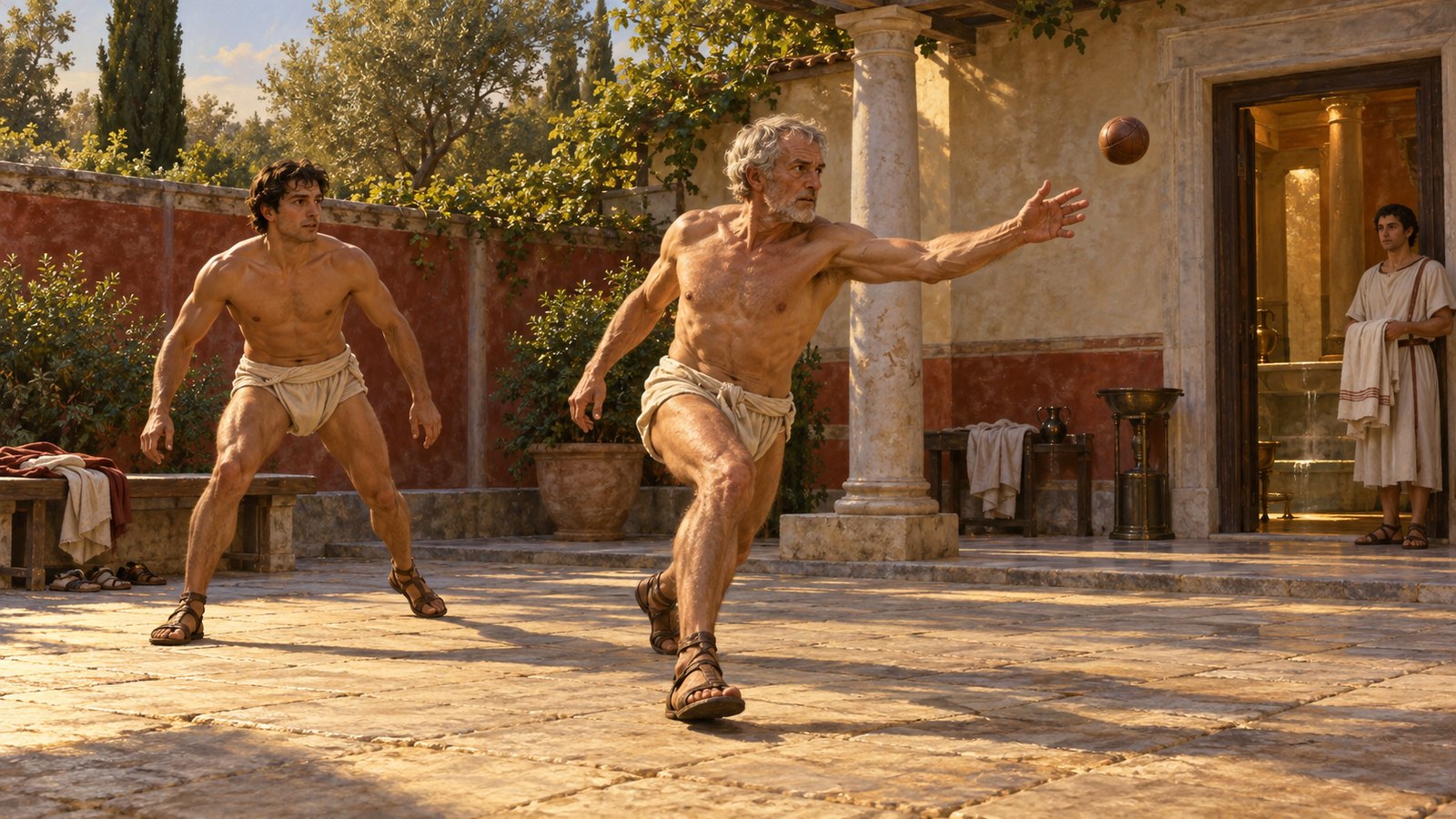
Before the bath, if there was no wind, Spurinna walked unclothed in the sun. He then played ball for a long period and did so vigorously. Pliny interprets the game as a way of fighting old age through active exercise.
The portrait matters because the ball game follows writing rather than replacing it. Spurinna could spend part of the day composing learned verse and then commit himself wholeheartedly to play. Pliny did not see dignity in preserving one solemn posture from morning to night.
The wind condition also sets a limit. Sun exposure belonged in the routine only when weather allowed it. Pliny’s admiration rests on regularity, not on forcing every activity through unsuitable conditions.
After bathing, Spurinna lay down and waited before eating. During that interval he listened to a light and pleasant book. The reading differed in mood from the serious themes of the morning. Texts were chosen for their place in the day: substantial conversation during the walk, easier pleasure while the body rested after the bath.
The bath setting recalls the bathhouse complaint preserved in a prosecution speech, but Spurinna’s household scene runs on another scale. There is no civic dispute here. A bathing hour is simply one hinge in a private day, joining exercise to food and public memory to domestic comfort.
A modest dinner kept guests inside the orbit
Dinner was bright but restrained. Pliny notes plain, old-fashioned silver and a few Corinthian vessels enjoyed without obsession. Comic actors or readers sometimes seasoned the meal with literature.
In summer the gathering could continue well into the night, yet Pliny says no one found it long because good humour and charm sustained it. The statement balances the morning rule about not boring guests. Spurinna’s method did not turn hospitality into a list of compulsory improvements.
Friends remained free throughout the day to follow his example or do something else. This freedom kept the routine personal rather than authoritarian. The household revolved around Spurinna’s sequence, but a guest did not have to copy every walk, rest, reading, or game.
Pliny links the result to Spurinna’s condition after seventy-seven: hearing and sight still sound, body active and alert, wisdom the only sign of age. That is a literary tribute, not a medical case history. The letter shows what Pliny admired, not a controlled proof that a particular number of miles guaranteed longevity.
Its final turn is political. Spurinna’s leisure had been earned through magistracies, provincial government, and long effort. Pliny was still distracted by countless obligations, so he treated the older man’s day as a future goal rather than an excuse for immediate retreat.
He even asked the recipient, Calvisius, to use the letter against him later if he exceeded the proper limit and refused to rest when no one could fairly accuse him of laziness. The schedule thus became a promise placed in another person’s hands.
Spurinna’s achievement was not escape from time but control over its texture. Four miles walking did not collapse into the seven miles by carriage. Serious reading did not erase light reading. Poetry did not exclude ball play, and dinner did not have to choose between simplicity and delight. Pliny saw a life with the regularity of an orbit because each part returned without swallowing the others.
Sources
Pliny the Younger, Letters, 3.1.