
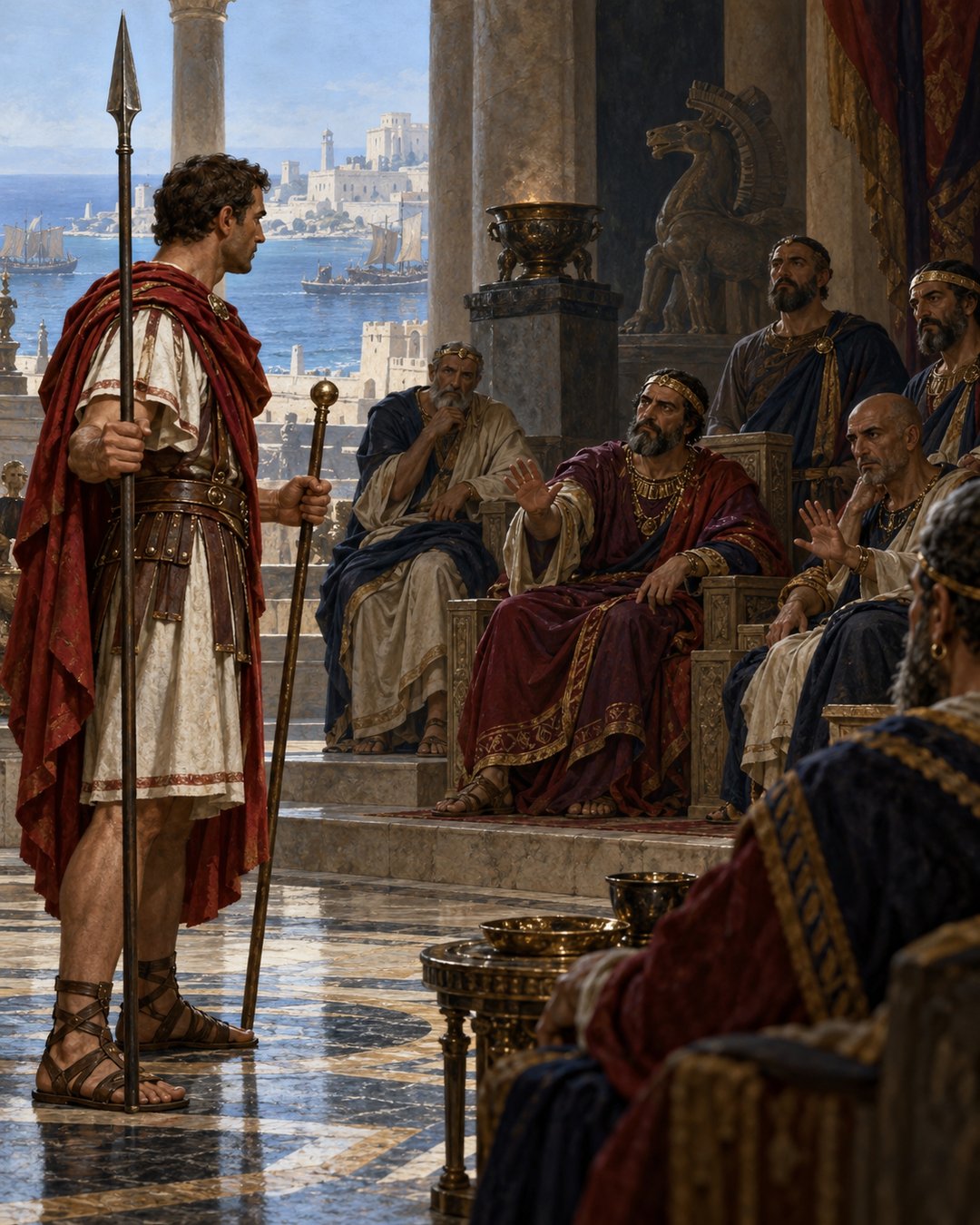
Rome’s embassy brought Carthage a choice that was meant to look clean. One object stood for war. Another stood for peace. Select one, the Romans said, and treat it as the decision delivered by Rome.
Carthage refused the arrangement. In Aulus Gellius’s compact story, the Carthaginians chose neither the spear nor the herald’s staff. They told Quintus Fabius and his companions to leave whichever object they pleased. Whatever Rome left would then be accepted as Carthage’s choice.
The reply did not avoid a decision. It fought over who would own it. In a rivalry Gellius describes as nearly equal in strength, spirit, and numbers, neither side was willing to let the other control both the alternatives and the blame.
Two Objects Compressed the Whole Dispute
Gellius introduces the exchange as evidence of parity. With other peoples, he says, Rome’s contest concerned the independence of one state or the other. With Carthage, the contest concerned rule of the world. His scale is deliberately enormous, but the scene through which he expresses it is small enough to fit in two hands.
The spear signified war. The herald’s staff signified peace. The Roman message offered the objects as mutually exclusive answers and told the Carthaginians to choose. Material symbols made the demand immediate. There was no long list of clauses in Gellius’s telling, only a pair of visible outcomes.
That compression gave the embassy theatrical force. Rome appeared to offer agency while defining the available field. Carthage could point, but Rome had named the meanings in advance. The offer turned a political crisis into a controlled ritual whose simplicity favoured the party presenting it.
The objects also removed the shelter of vague language. A spoken formula can be rephrased, translated, or disputed after the meeting. A spear set beside a staff made the alternatives visible to every participant. Yet that apparent clarity hid an asymmetry: Rome had arrived holding both the question and its authorized answers. Carthage’s task was to decide whether pointing at one would also concede Rome’s right to stage the decision.
The larger rivalry had already tested Roman confidence in ways explored in Why Hannibal’s Elephants Were Not the Real Miracle. Gellius’s anecdote catches the same contest at a different scale: before armies and endurance, there is a struggle over the form of the choice.
Carthage Refused the Script, Not the Consequence
The Carthaginian answer was carefully matched to the Roman challenge. They did not seize the peace symbol. They did not seize the spear. They instructed the bearers to leave whichever they wished, then promised to count the object left behind as the one Carthage had chosen.
That response returned the burden to the embassy. Rome could still produce war or peace, but it could not make Carthage perform the decisive gesture on Roman terms. The reply exposed the difference between being offered alternatives and controlling the decision.
There is also an edge in the promise to accept Rome’s deposit as their own choice. Carthage did not plead for another set of options. It declared itself prepared for whichever outcome Rome physically selected. The answer therefore combined refusal with readiness. It denied the ritual while refusing to look frightened by either object.
The reply depended on exact verbal symmetry. Rome said that the object Carthage chose should count as sent by Rome. Carthage answered that the object Rome left should count as chosen by Carthage. Each side tried to assign the other the decisive motion while retaining its own claim to resolve. The same two symbols remained on the table, but the direction of responsibility had been reversed.
Gellius uses the exchange to support his claim that the two peoples possessed comparable spirit. Equality here is not a table of resources. It appears as verbal nerve. One side devised a compact challenge; the other found a compact way to reverse it.
Varro Remembered Tokens Instead of Objects
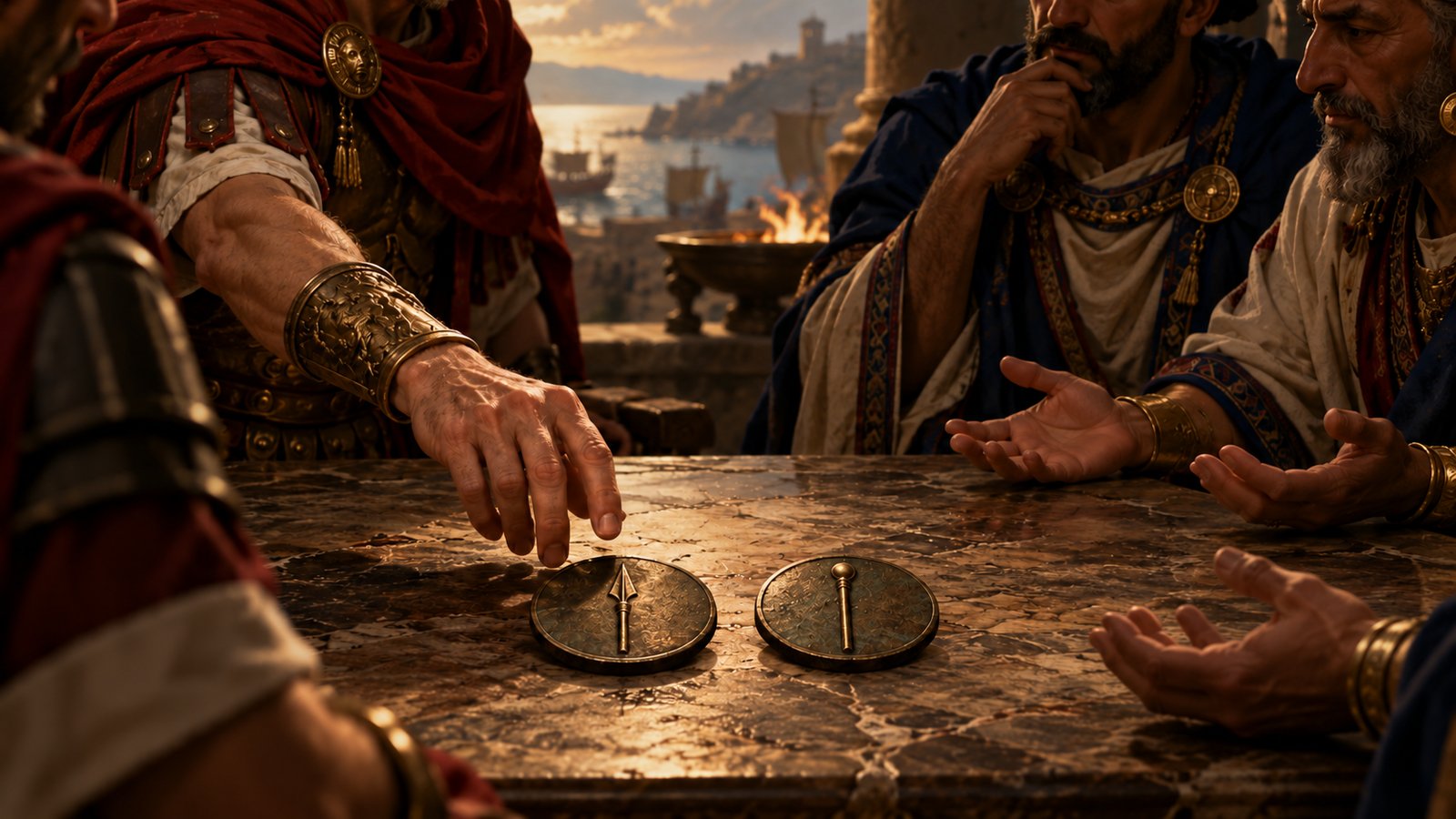
The story survives with an important variation. Gellius says Marcus Varro reported that the embassy did not carry the spear and staff themselves. Instead, it carried two tokens: one engraved with a staff, the other with a spear.
The difference changes the scene’s texture without changing its mechanism. Full-sized objects would have made the embassy almost ceremonial, with war and peace present as tools. Engraved tokens would have made it closer to a formal selection, portable signs whose authority came from agreed meaning.
Gellius preserves both versions rather than smoothing them into one. That choice is useful. The point of the episode does not depend on whether Fabius held wood and iron or two marked pieces. In each form, Rome reduced policy to symbols and Carthage disputed the ownership of the final selection.
The engraved version may even make the logic easier to see. A token is already a representation, so everyone must agree that an image can stand for an outcome. The diplomatic contest then concerns a second act of representation: whose gesture will stand for consent? Varro’s variant strips away the practical use of either object and leaves only their political meaning.
The variant also warns against turning an ancient anecdote into a photograph. Its exact props were already debated in antiquity. What remains stable is the contest over agency: who named the options, who touched the sign, and who could be said to have chosen what followed.
A Rivalry Fought over Responsibility
Gellius frames Rome and Carthage as rivals for more than survival. His phrase about rule of the world makes the embassy a miniature of the greater conflict. Each state sought not only advantage, but a position from which its own action looked compelled by the other.
That is why the Carthaginian response matters. Accepting Rome’s invitation would have made the selected object legible as a Carthaginian decision. Refusing both forced the Roman representatives to become visibly responsible for the thing left behind.
The contest over responsibility continued in later Roman memory, where Carthage could become a permanent reference point, as in Why Cato’s Rome Could Not Stop Talking About Carthage. Gellius gives that memory a scene of balanced defiance rather than an easy picture of Roman command.
His emphasis on comparable numbers, strength, and spirit prepares the reader for that balance. The anecdote would work differently if one party were merely submitting to an ultimatum it could not answer. Gellius instead presents two communities capable of matching pressure with pressure. The Carthaginian response is his proof in miniature: it neither begs for peace nor theatrically selects war, but contests the premise that Rome may dictate the gesture.
The Strongest Answer Changed Who Had to Point
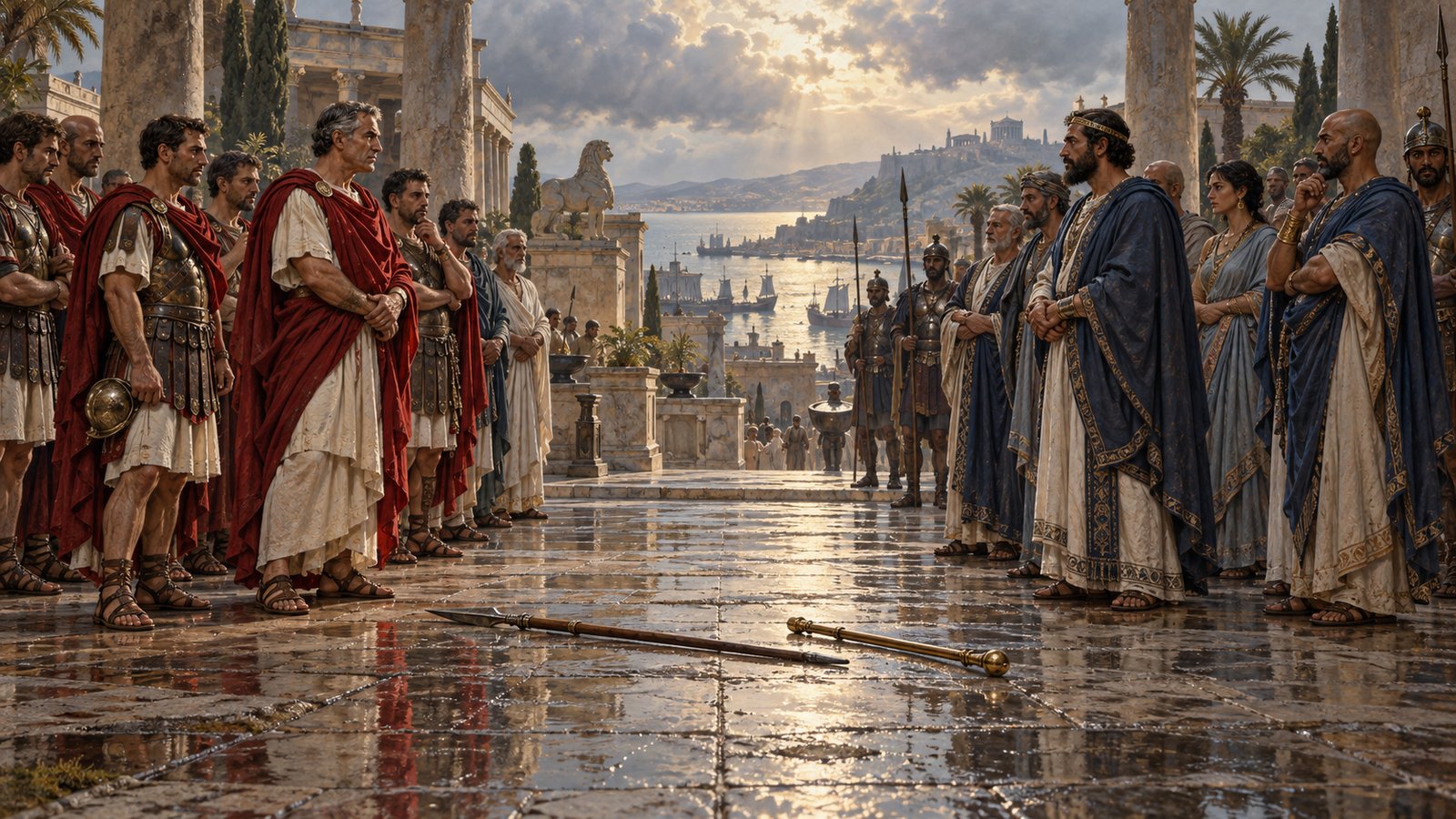
The embassy’s two objects promised clarity. The Carthaginian reply showed that a clear symbol can still conceal a disputed allocation of responsibility. Peace and war were not difficult to distinguish. The difficult question was whose hand would make one of them official.
Rome brought the spear and staff. Carthage made Rome choose where to leave them. In five brief exchanges preserved by Gellius, the rival powers fought a complete diplomatic contest before either symbol could do its work.
The story’s durability comes from that economy. Gellius does not need to settle the date, reconstruct the room, or choose between Varro’s tokens and the larger objects to preserve the encounter’s central problem. The Roman offer tried to control the visible choice. The Carthaginian answer made the chooser visible instead. What looked like a question about two symbols became a question about who would accept authorship of the next act.
Sources
Aulus Gellius, Attic Nights, Book 10.27.
Marcus Varro, variant account quoted by Aulus Gellius in Attic Nights 10.27.