
Pliny the Elder begins his account of coral with a reversal. People in his part of the world prized pearls from India; people in India prized Mediterranean coral. Value did not travel automatically with rarity or beauty. Taste on opposite sides of long trade routes made one sea’s familiar material another region’s treasure.
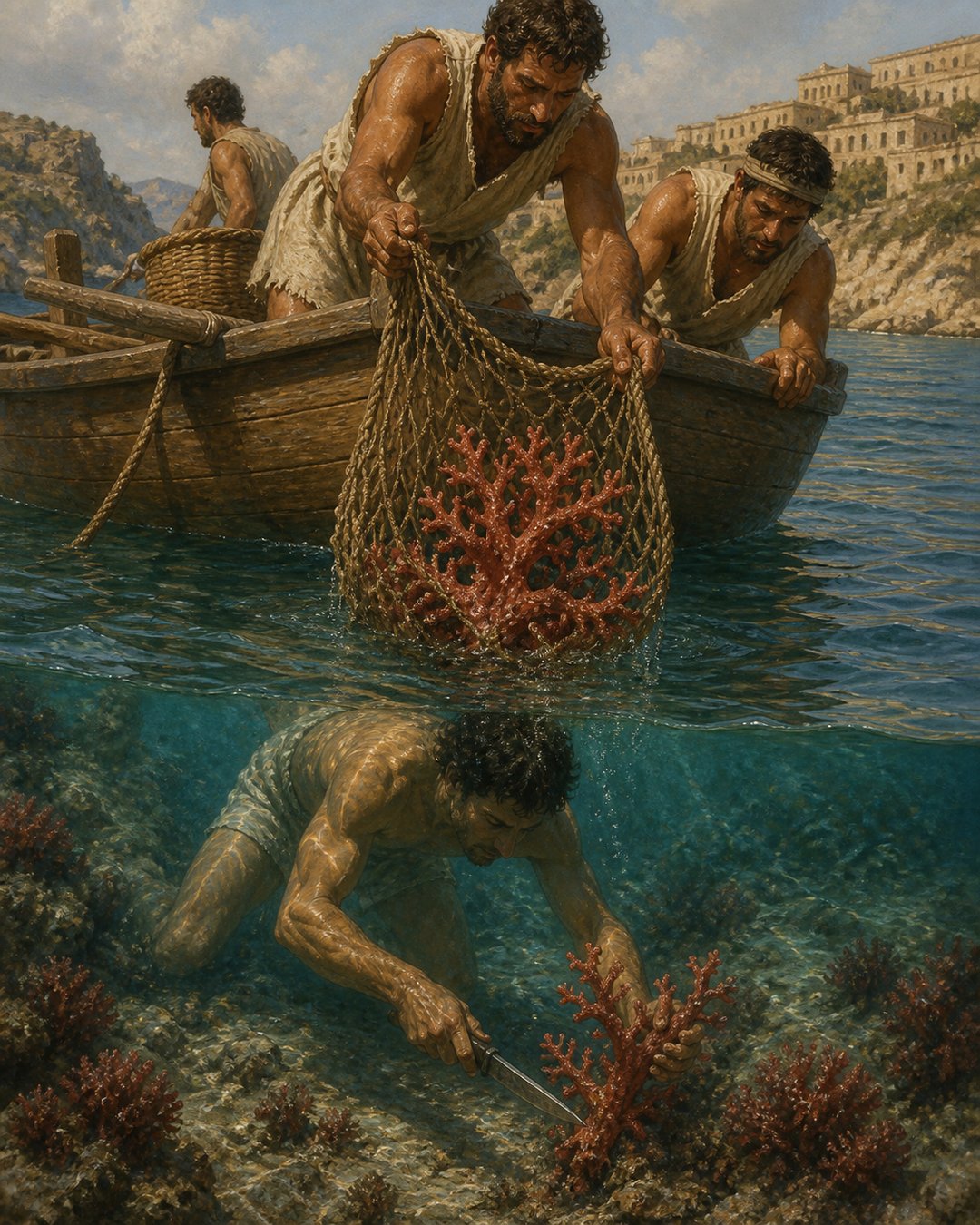
Before coral could enter that exchange, it had to cross a more immediate boundary. Pliny describes it as shrub-like, green, and soft beneath the water, with pale berry-like parts. Once removed, he says, it became hard and red. Harvesters therefore tried to detach it with nets or a sharp iron edge rather than touch it directly.
His natural history is not modern marine biology, and its soft-to-stone transformation should be read as an ancient account. Yet the sequence preserves a sharp commercial logic. Harvest method protected the object people believed they were changing. Color, branching, density, and surface determined grade. Export then redirected the best pieces so strongly that coral grew scarce near the very coasts that produced it.
Two Luxury Markets Looked Past Each Other
Pliny compares coral with pearls to explain value through regional desire. Mediterranean consumers looked east for pearls. Indian consumers looked west for coral. Each market elevated a material obtained from water far beyond its own familiar shore.
The comparison turns luxury into a relationship rather than a property sealed inside an object. Coral had physical characteristics that could be judged, but Pliny says prevailing taste constituted value. A branch that seemed locally available near a Mediterranean coast could become precious once merchants connected it to buyers who treated it as ornament and sacred protection.
This is not the same story as amber carried six hundred miles for Nero’s arena. Amber entered a single spectacular display after a named journey. Coral moved through a broader exchange in which repeated export altered local availability and displaced an earlier use.
Pliny’s geography widens the field. He mentions darker coral in the Red Sea and a Persian Gulf material called iace. His most highly esteemed examples came from Mediterranean waters near the Stoechades, the Aeolian Islands, and Drepana in Sicily. Other beds lay near Graviscae, Neapolis, and Erythrae.
The Harvest Tried to Preserve a Moment of Change
Coral’s form puzzled ancient classification. Pliny compares it to a shrub. Underwater, he describes green branches and white, soft berries. The moment the material left the sea, it hardened and reddened like the fruit of a cultivated cornel tree.
Modern readers should preserve his attribution instead of converting it into a laboratory statement. What matters for the historical mechanism is that harvesters were believed to face a rapid transformation. Touch could harden living coral prematurely, so workers supposedly took pains not to handle it before detachment.
Nets offered one solution. A sharp-edged iron instrument offered another. One method tore the branching growth from below; the other cut it short. Both placed an intermediary between hand and coral. The harvest technique followed the material theory: if contact altered the product, distance during removal protected quality.
That concern resembles the practical chain behind cork floats marking the route of underwater treasure near Cyprus. In each case, the sea hid valuable material beneath a surface where ordinary land habits failed. Tools and markers converted an underwater location into something workers above could act upon.
Pliny even reports an etymological guess linking coral’s name to the act of cutting it in the sea. The explanation may be strained, but it shows how closely his source tradition joined the material’s identity to the moment of harvest.

Branches, Color and Solidity Became a Grading System
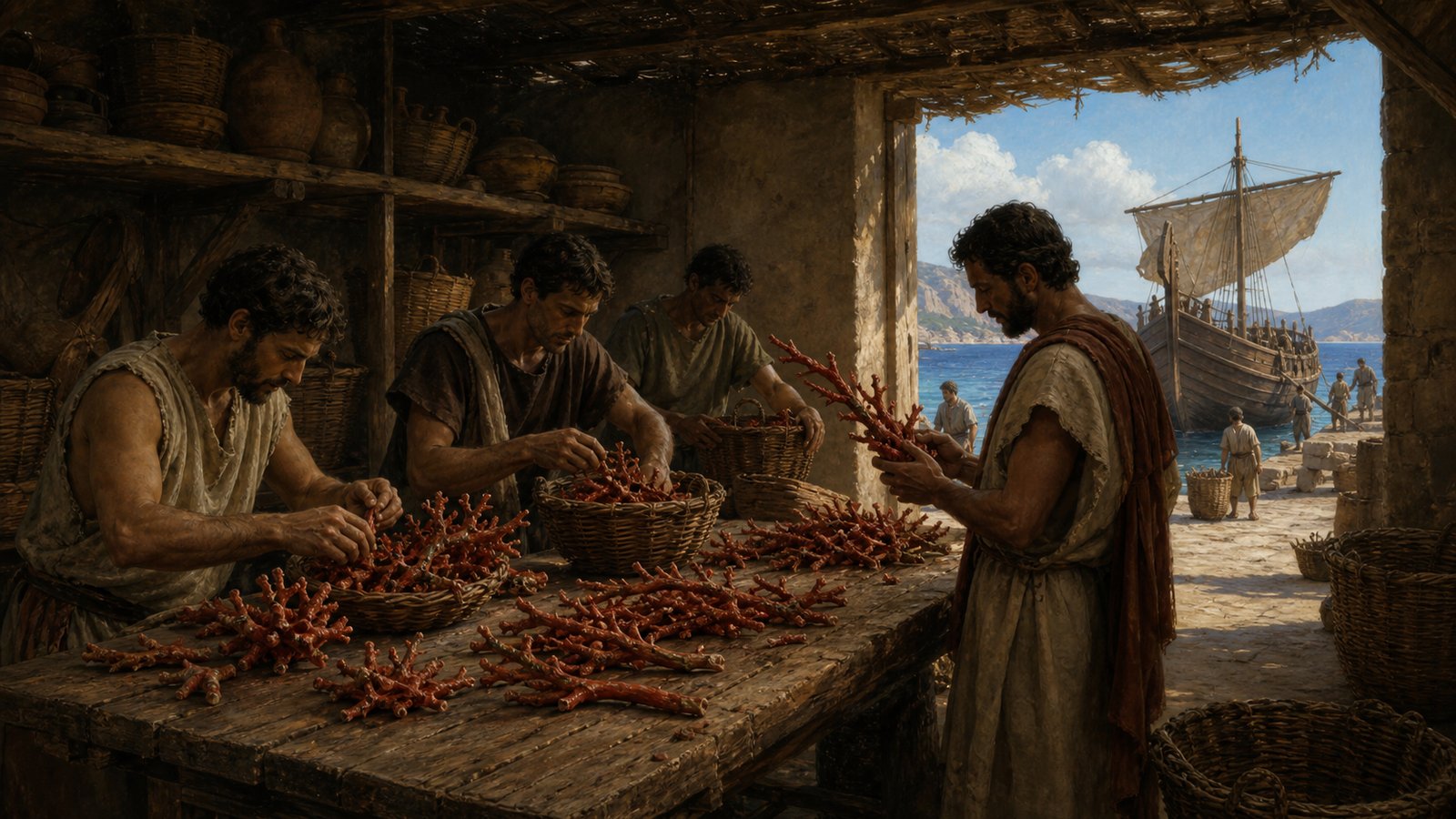
Removal did not make every piece equal. The reddest and most branchy coral received the highest esteem. A good specimen displayed complexity without losing integrity: it should not be rough and excessively stone-like, but neither should it be pierced with holes or hollow.
Those criteria can be imagined at a sorting table. Color could be compared. Branches could be counted and inspected for breakage. A surface could be judged for roughness, and a piece tested for obvious cavities. The final grade condensed the hidden conditions of growth and harvest into visible and tactile signs.
Pliny’s note on Erythrae proves that redness alone was insufficient. Coral there was intensely red, yet its softness made it little valued. The desired commodity balanced traits. Buyers wanted strong color and branching together with a solid body of the correct texture.
This was a different value-making process from the salted shellfish sequence behind Roman purple dye. Purple production destroyed and transformed marine bodies into color carried by cloth. Coral retained its branching form. Its commercial identity depended on looking as though a strange underwater shrub had become durable without ceasing to resemble itself.
Export Replaced the Coral on Gallic Arms
Before distant demand became dominant, Pliny says, Gauls decorated swords, shields, and helmets with coral. The material joined personal display to weapons and defensive equipment. Red branches or cut pieces could mark an object already meant to be seen in danger and ceremony.
Indian demand changed that distribution. Pliny says soothsayers and diviners there regarded coral as an amulet preserving people from danger. It was valued both as ornament and as an object of devotion. A material attached to Gallic arms could therefore enter another visual and protective language far to the east.
The route did not merely add a new customer. Export value made coral so rare, Pliny claims, that it was seldom seen even in producing regions. The best branches were pulled outward by the price buyers elsewhere would pay. Local abundance at the seabed did not guarantee local possession after merchants entered the chain.
This is the article’s decisive movement. Harvest changed coral’s physical state in Pliny’s account. Trade changed its social place. The branch passed from growth below water to sorting on shore, then from Mediterranean equipment toward Indian ornaments and amulets.
A Small Branch Carried Several Kinds of Protection
Pliny closes the commercial story by noting coral hung around infants’ necks as a protection against danger. He also lists medicinal preparations, including calcined or powdered coral. These claims belong to ancient remedy traditions, not modern medical advice, but they broaden the roles assigned to the object.
Coral could protect by placement on a weapon, by devotion in an amulet, by suspension at a child’s neck, or by preparation as a drug. Those uses did not require everyone to explain its power identically. They required the material to remain recognizable, obtainable, and credible within a practice.
The branch-like form helped. Unlike a uniform ingot, coral carried an obvious history of growth. Its forks made it appear organic; its hardness after removal made it seem mineral. Pliny’s uncertainty between categories was commercially productive because the material could look alive in shape and enduring in substance.
His chapter therefore contains more than a curiosity about color. It records a complete material biography: underwater growth, careful detachment, sudden hardening, grading by form and solidity, attachment to local equipment, export to distant devotion, and eventual scarcity near the source.
The coral that reached India was valuable because many boundaries had already been crossed. Sea became shore, softness became stone, branch became commodity, and a Mediterranean object became a distant defense against danger. Trade did not erase the material’s marine origin. It made that origin travel.
Sources
Pliny the Elder, Natural History, Book 32, chapter 11.