
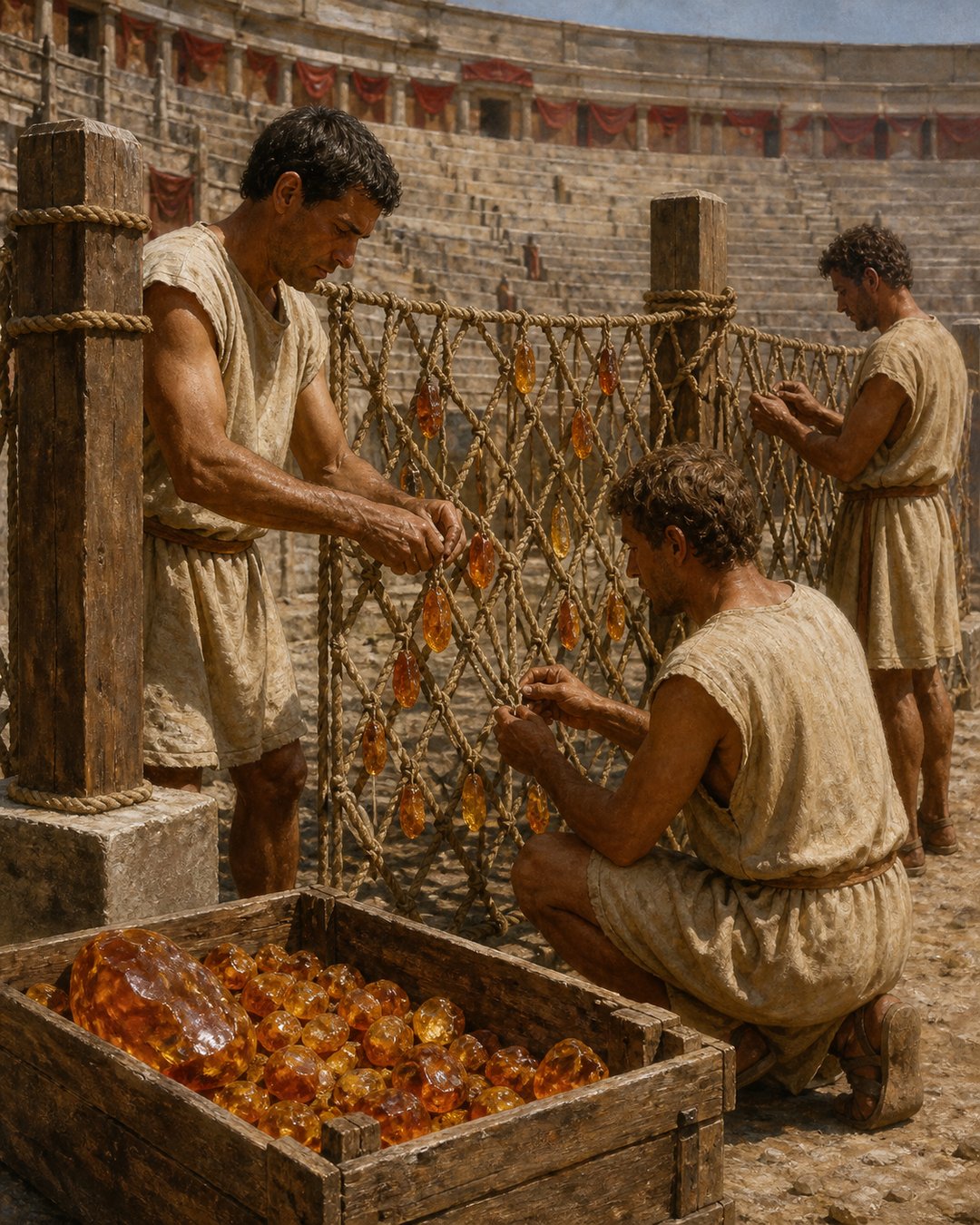
The scene Pliny records begins far from the arena. A Roman of equestrian rank travelled north from the Pannonian frontier, crossed markets along the coast, and returned with enough amber to alter the look of a day at Nero’s gladiatorial games. The distance Pliny gives between Carnuntum and the supplying coast is about six hundred miles. At the end of that road stood not a jeweller’s counter but the apparatus of mass spectacle: barriers, weapons, litters, and nets glittering above the sand.
This is luxury seen as a supply problem. Amber did not simply “reach Rome.” Somebody commissioned it, somebody followed a route, merchants assembled quantities at several stops, and workers turned the cargo into temporary theatre. Pliny even gives the weight of the largest piece: thirteen pounds. The number makes the display tangible, but the more revealing fact is the mismatch between the journey and its use. A long chain of travel and exchange was consumed in a single day’s visual programme.
Carnuntum Was the Last Roman Measure
Pliny locates the route through Pannonia and names Carnuntum, the important Danube settlement from which he measures the remaining distance to the German coast. His six hundred miles should be read as an ancient report, not a modern route survey. Yet its precision matters. It converts northern amber from a vaguely exotic material into a commodity with an itinerary that Roman administrators and merchants could discuss in miles.
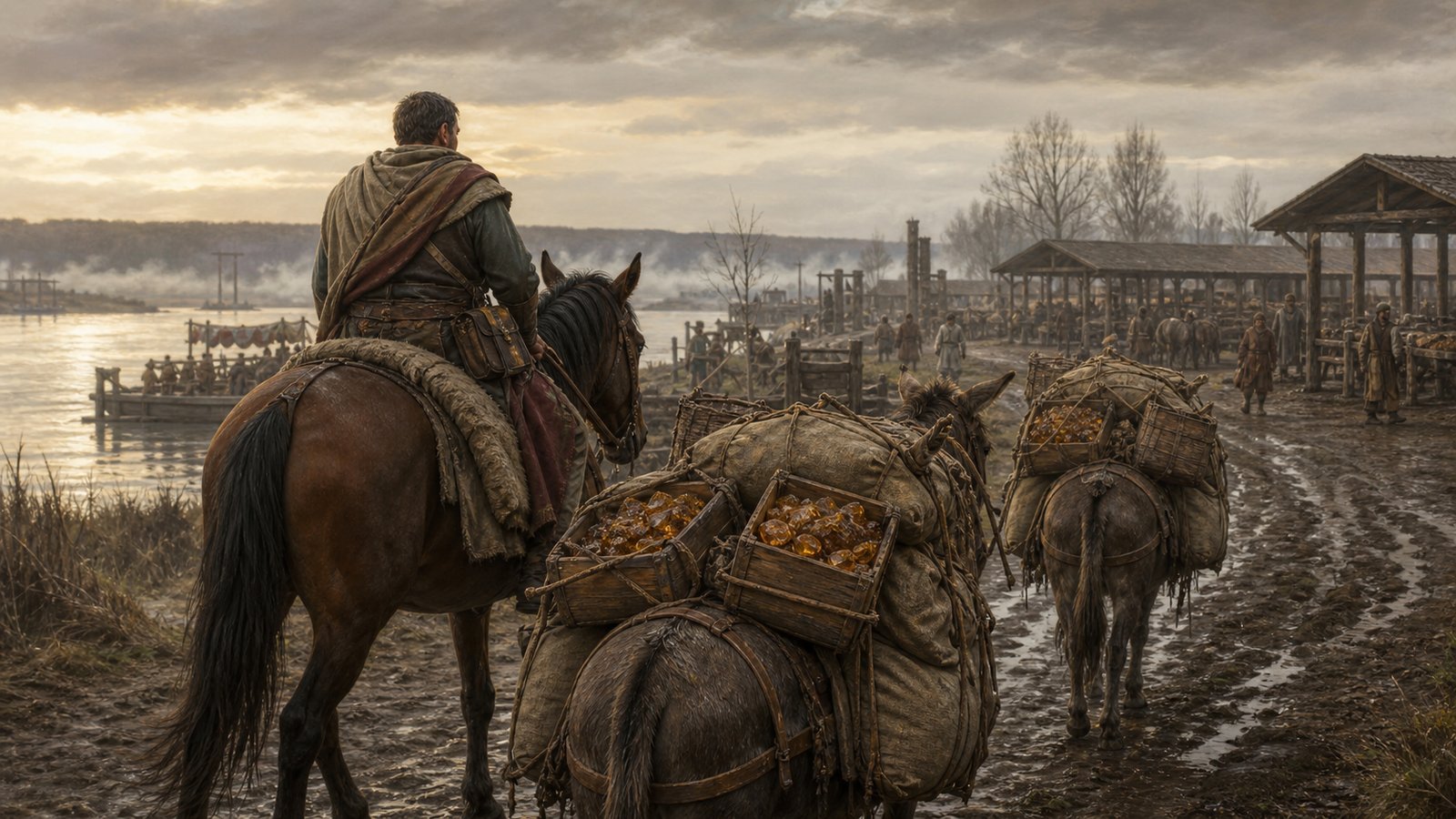
Carnuntum was therefore more than a dot on the map in this story. It was the Roman-facing edge of a supply line. Beyond it, the buyer had to traverse the coast and visit markets. Pliny’s phrasing implies accumulation rather than discovery: the equestrian did not stumble upon one miraculous deposit. He moved through places where amber had already been gathered, sorted, and offered for exchange.
Every market on that path represented prior work that Pliny leaves unnamed. Resin had to be noticed on a shore or in disturbed ground, separated from debris, carried to a place of exchange, and judged by colour, clarity, size, and flaws. The Roman agent entered near the end of that northern process. His status did not create the amber; it gave him the purchasing power to draw many local parcels into one exceptional consignment. This distinction matters because an imperial order could enlarge demand without controlling the earliest stages of supply.
The route also crossed political boundaries that the word “Roman” can conceal. Carnuntum offered a familiar administrative and military environment, while the coast lay beyond it. Money, interpreters, guides, carriers, and local knowledge had to bridge that gap. Pliny records only the successful return, so we cannot reconstruct the contract. We can still see that the celebrated cargo depended on cooperation outside Rome’s direct urban institutions.
The route gives us a useful counterpoint to Mediterranean freight. Amphorae made oil and wine legible through repeated container forms, as our look at Roman amphora traffic explains. Amber moved differently. Small valuable pieces could pass hand to hand, cross ecological zones, and travel without a standard ceramic shell. Nero’s commission made that dispersed stream visible only when an unusually large purchase converged on Rome.
Julianus Turned a Show into a Buying Mission
The man who ordered the procurement was Julianus, whom Pliny identifies as manager of Nero’s gladiatorial exhibitions. The buyer himself belonged to the equestrian order. Those details place the expedition between imperial entertainment and Roman status. This was not described as an anonymous merchant’s private gamble. A manager responsible for spectacles sent a socially substantial agent to secure a distinctive material for the programme.
That choice also hints at the difficulty of the job. Buying a few ornaments in Rome would not have required a coastal journey. The assignment demanded enough confidence, contacts, and money to collect bulk amber through multiple markets and bring it back safely. Pliny says the equestrian was still alive when he wrote, making the report unusually immediate: a contemporary could be pointed to as the traveller who had tested the route.
No surviving invoice tells us the price, and Pliny does not describe the caravan’s exact composition. The safe conclusion is narrower. The games created demand powerful enough to send a named agent over a measured long-distance chain. Imperial spectacle reached backwards into procurement. Before an audience saw one polished surface, the display had already mobilized travel, bargaining, packing, guarding, and transport.
The Podium Net Became Part of the Scenery
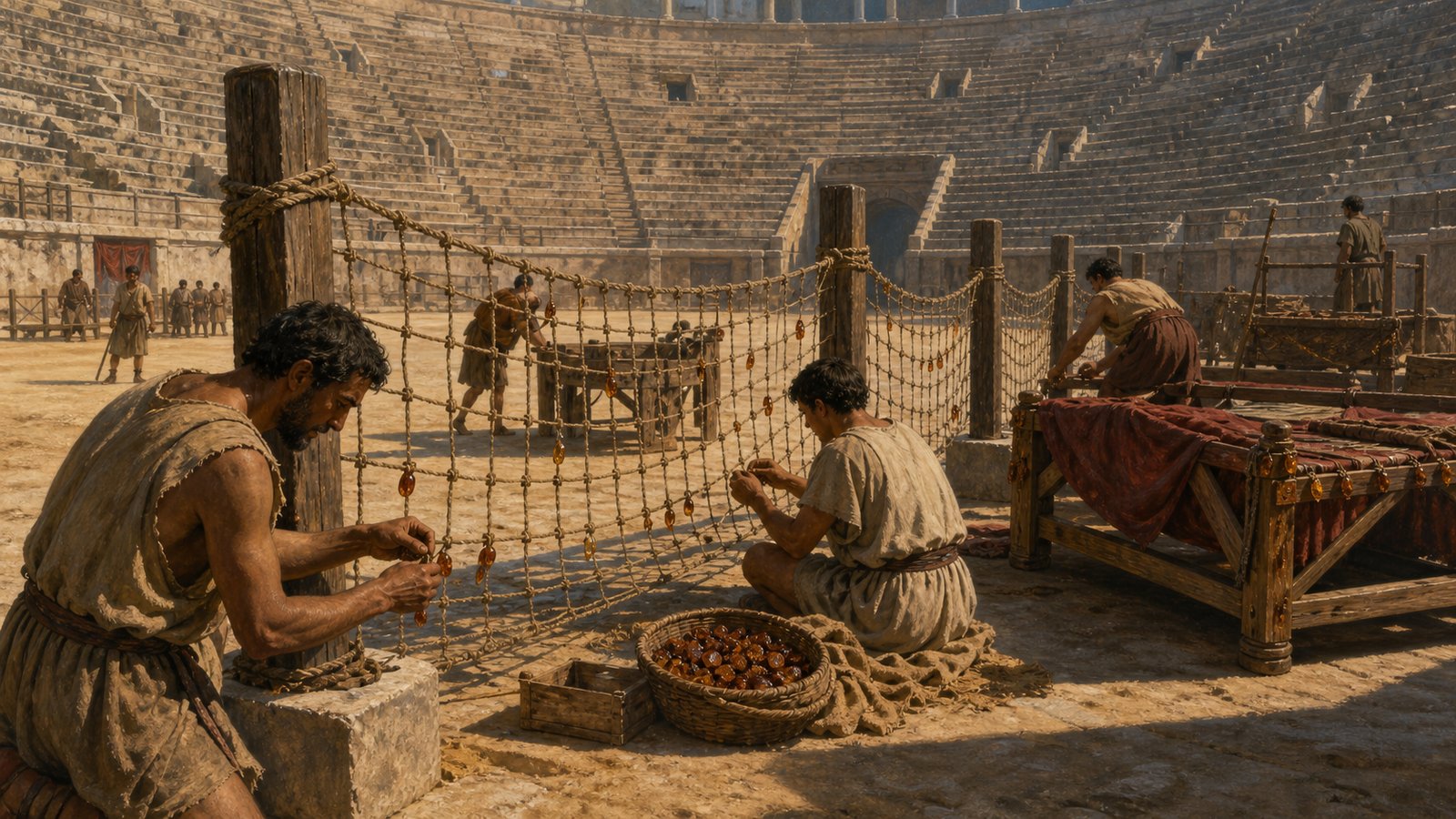
The returned quantity was vast enough, Pliny says, for amber to stud the nets protecting the podium from wild animals. That net had a practical job: it helped separate danger on the arena floor from elite spectators at its edge. Decoration did not replace the barrier’s function. It overlaid safety equipment with costly shine, turning the machinery of separation into part of the spectacle.
The visual effect would have changed as lamps or daylight struck the translucent pieces. Pliny understood amber as tree resin and noted that rubbing or burning it produced a pine-like character. He also pointed to insects and small creatures trapped inside transparent pieces as evidence that the substance had once been liquid. The same material could therefore invite close inspection in a cabinet and flash collectively across a public barrier.
Rome’s arena engineering often made practical devices theatrical. The velarium turned shade into performance; Nero’s amber turned a protective net into luxury scenery. The mechanisms were different, but both show that spectators were meant to notice infrastructure. The arena displayed its command over materials as much as the bodies moving below.
Thirteen Pounds Made Distance Visible
Pliny singles out the largest piece at thirteen pounds. He does not say it was made into a particular object. Its importance in the passage is evidentiary: the weight demonstrates the scale and quality of the cargo. A lump that large could stand as proof that the northern trip had reached sources unavailable through ordinary retail circulation.
The rest of the material spread across arms, litters, nets, and other equipment. Pliny says the amber scheme belonged to one day, while other days received different displays. That schedule sharpens the economics of attention. Durable stone monuments justified expense by surviving. This amber programme justified expense by vanishing into a sequence. Its value lay partly in being seen once and then displaced by another novelty.
For the audience, the north was condensed into shine. They did not watch the equestrian cross Pannonia or negotiate at coastal markets. They saw the result already detached from mud, weather, language, and risk. The thirteen-pound piece briefly reconnects the object to those logistics. Its mass says that the glitter had travelled as matter before it became an imperial effect.
Nero’s Luxury Was Also a Map
Pliny writes critically about luxury, but his account preserves something broader than moral complaint. It shows a Roman frontier settlement used as a distance marker, a manager turning visual ambition into an order, an equestrian acting as buyer, northern markets feeding a bulk shipment, and arena workers distributing the result across functional equipment.
That chain is the article’s real subject. Amber already carried stories about the sun, tears, distant islands, and unusual creatures frozen within it. Nero’s games added another story: the empire could gather a northern resin in quantities large enough to decorate danger itself. The claim was temporary, but the procurement behind it was concrete.
Pliny’s natural explanation and Nero’s theatrical use pull in opposite directions. One asks what amber is, how it formed, and what inclusions reveal. The other strips pieces from their geological and botanical history and makes them a coordinated surface. The arena did not need spectators to understand resin. It needed them to recognize abundance. Natural history restored the material’s past after spectacle had converted it into an instant impression.
A six-hundred-mile route ended in a one-day surface. That imbalance explains the spectacle better than the word “extravagance” alone. The amber net was impressive because a huge invisible system had been compressed into a visible border around the arena.
Sources
Pliny the Elder, Natural History, Book 37, chapter 11.