
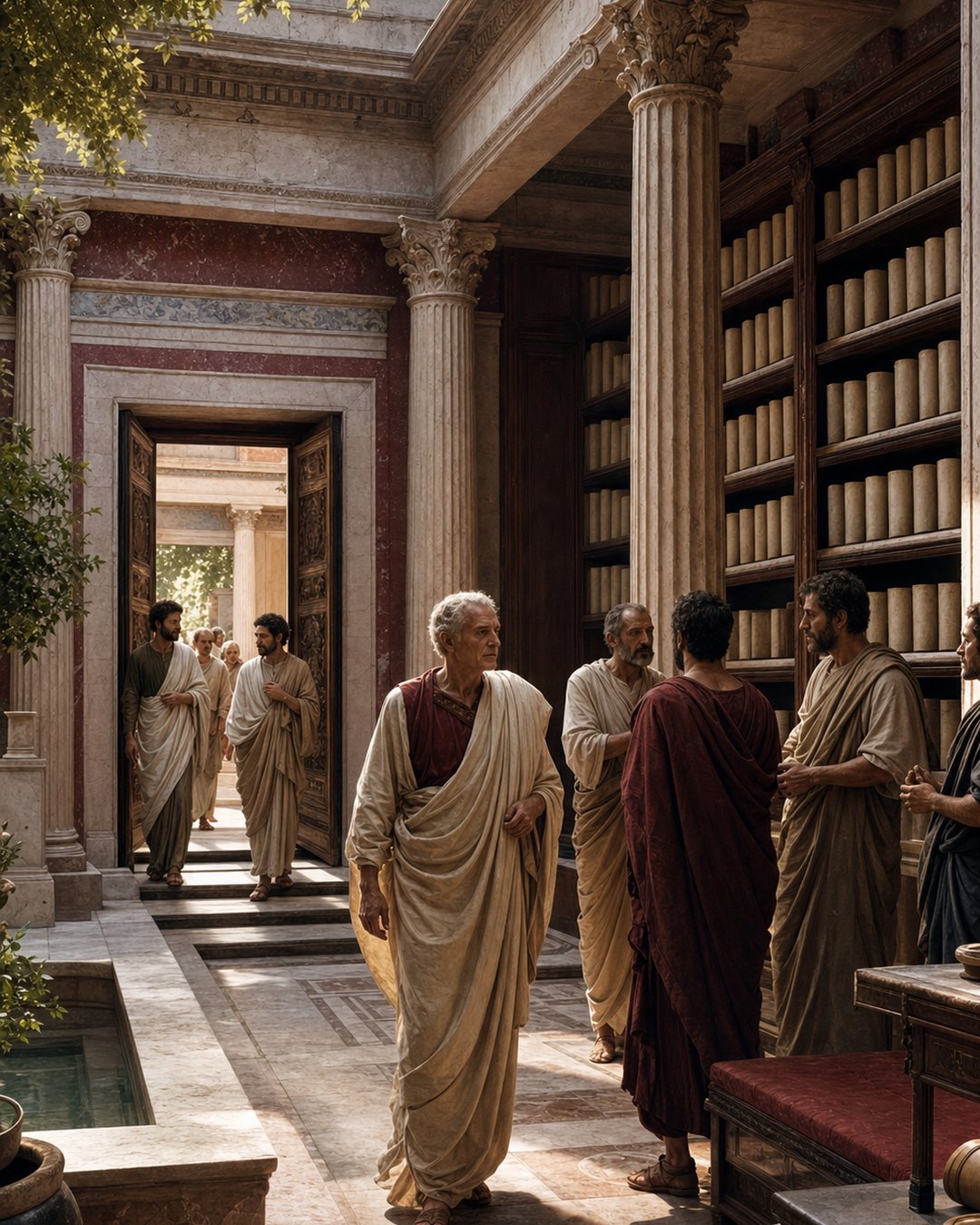
Lucullus could have kept his books as another form of captured wealth. Plutarch says he collected many fine volumes, but the biographer praises their use more than their acquisition. The libraries were open. Greek visitors in Rome could enter the surrounding cloisters and study rooms without restriction, spend the day together, and encounter the owner walking among scholars.
The distinction is small enough to miss: a collection is not yet a community. Lucullus’s doors, rooms and habits made the difference. His house became what Plutarch calls a hostelry of the Muses and a kind of Greek civic hearth. Books anchored the place, but access turned possession into infrastructure.
This was also a Roman house receiving people whose intellectual lives were conducted in Greek. Plutarch does not describe a neutral municipal service. He describes elite hospitality crossing language, origin and political status. The arrangement depended on Lucullus, yet it gave visitors room to meet one another rather than requiring every encounter to pass directly through him.
A Conqueror’s Books Entered Civilian Time
Plutarch introduces the library after a display of astonishing private consumption. A dinner in the room called Apollo carried a standard allowance of fifty thousand drachmas. Servants knew the budget and equipment from the room name alone, and Pompey was amazed at how quickly the feast appeared. The biographer treats this luxury as wealth handled like a captive from war.
Then his judgement changes. Lucullus’s establishment of a library “deserves warm praise.” He had gathered many books, Plutarch says, and they were well written, yet the honorable part was how he used them. The contrast is deliberate. The dining room consumed a fixed sum for a small company. The library created recurring use for visitors who were not members of the household.
The placement after the banquet keeps wealth in view. Plutarch is not praising simplicity or pretending that libraries were cheap. He is comparing forms of expenditure available to the same man. The books, rooms and colonnades were luxuries too, but their value did not disappear when one evening ended. Repeated access allowed the original outlay to support many unplanned conversations.
Roman books were material objects assembled from labor, fiber, ink and copying. The archive’s look at papyrus made from crossed strips follows that production before a text ever reached a shelf. Lucullus’s episode begins at the next threshold: once costly books had been gathered, would they remain signs of ownership or become things other people could consult?
Open Doors Extended the Collection
Plutarch says the libraries were thrown open to all. He then names the spaces around them. Cloisters and study rooms were accessible without restriction to Greeks, who went there repeatedly and spent the day with one another. The wording shifts attention from shelves to circulation.
Access changed the unit of value. A closed library could magnify one owner’s education and prestige. An open complex multiplied encounters: reader with manuscript, visitor with visitor, scholar with patron, Greek statesman with a Roman who might help. The architecture supplied duration as well as entry. A person could remain for the day instead of receiving a brief view of a treasure room.
“Without restriction” should not be stretched into a claim about every resident of Rome, because Plutarch specifically emphasizes Greek users. Even so, his language presents openness as the remarkable feature. The library’s social boundary was broader than the household. People could arrive repeatedly, use peripheral rooms, and organize their own time together within the space.
Plutarch compares the place to a hostelry of the Muses. The metaphor combines shelter, travel and intellectual life. Greek visitors in Rome were away from their own cities. Lucullus’s house offered a place where their language, debates and relationships could continue. Hospitality was not an ornament attached to the books; it was the system that let the books gather people.
Cloisters Made Reading Social
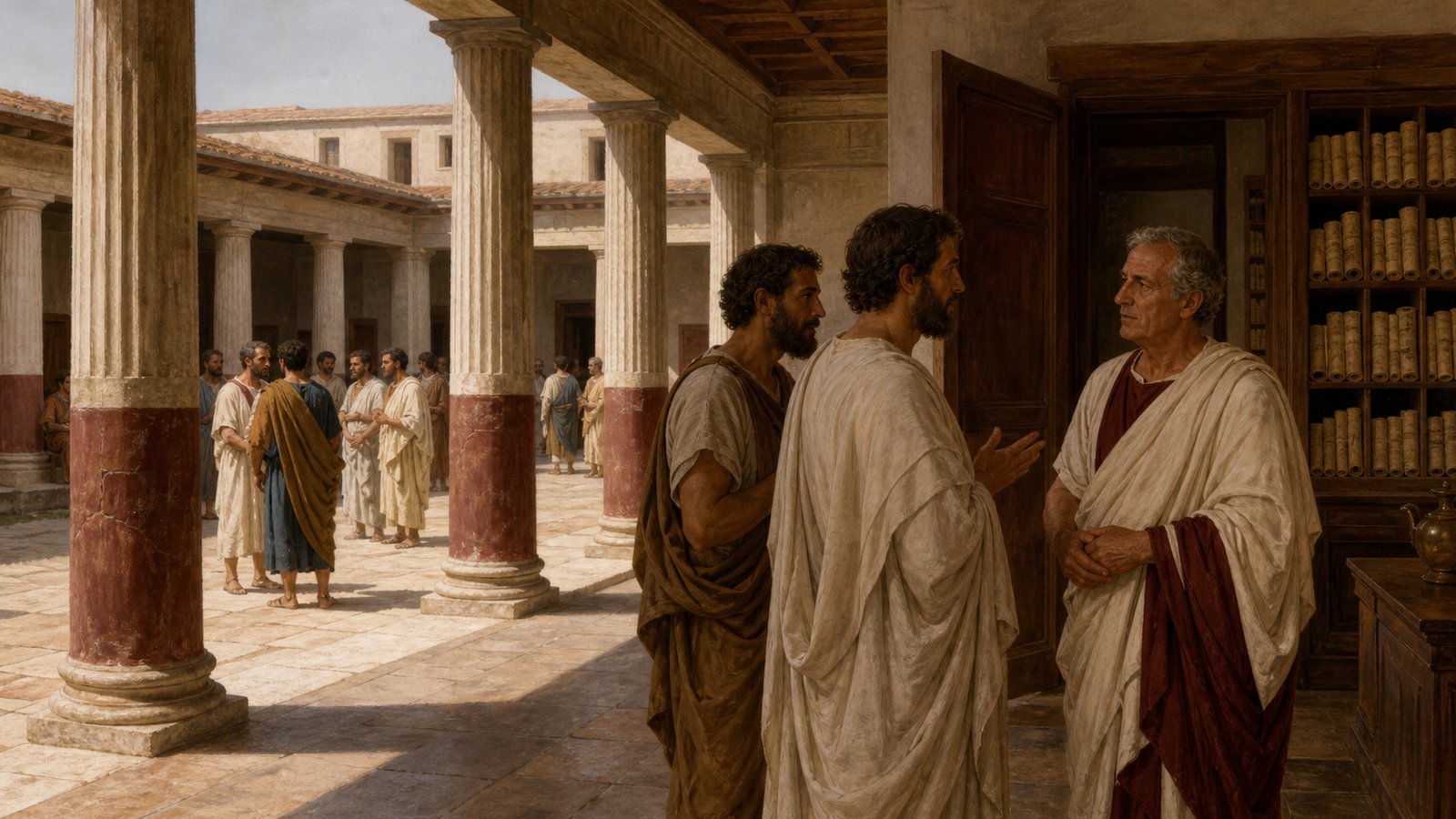
The surrounding walks matter because Plutarch does not describe silent readers isolated at desks. Greeks spent time together. Lucullus walked with scholars in the cloisters. Movement, conversation and study occupied the same complex. A library was functioning through rooms and routes, not only through storage.
This is different from the broader public institution explored in the history of Roman libraries and public memory. Lucullus’s library remained attached to an elite house and depended on its owner’s invitation. Its interest lies precisely in that hybrid form. Private wealth produced a semi-public intellectual environment before access could be taken for granted as a civic service.
The cloister also made the owner visible without forcing him to dominate every exchange. Lucullus could walk, listen, debate and introduce people. His presence joined patronage to routine. Instead of appearing once for a ceremonial opening, he repeatedly inhabited the same paths as his guests.
Walking is important evidence for the character of study Plutarch wants us to see. Thought was not confined to reading a roll in silence. Arguments could unfold while bodies moved through shade and light, pause at a room, then resume among another group. The library complex hosted an intellectual rhythm that shelves alone could not provide.
Philosophy Gave Hospitality a Political Edge
Plutarch says Lucullus welcomed philosophy broadly but had a particular loyalty to the Old Academy. Antiochus of Ascalon, a persuasive speaker, led that school in the biographer’s account. Lucullus made Antiochus his friend and companion, placing the library’s hospitality inside real philosophical disagreements rather than a vague love of culture.
Cicero belongs to this network too. Plutarch notes that Cicero later wrote a treatise in which Lucullus voices the argument for apprehension while Cicero carries the opposing case. The title was Lucullus. A Roman commander’s name thus travelled from campaigns and banquets into a philosophical dialogue.
The house also served practical politics. Lucullus assisted Greek statesmen who sought help. Plutarch calls the residence a home and prytaneium for Greeks arriving at Rome—a comparison to a civic hearth, not merely a book room. Visitors could move between learning, sociability and requests addressed to someone with Roman influence.
That political assistance keeps the portrait from becoming a sentimental scene of detached scholars. Greek visitors at Rome could have business as well as philosophical interests. Lucullus’s value lay partly in his ability to connect conversation with action. The same colonnade might support textual discussion, introductions and counsel about affairs that reached the forum.
The Library Was the Opposite of the Dining Room
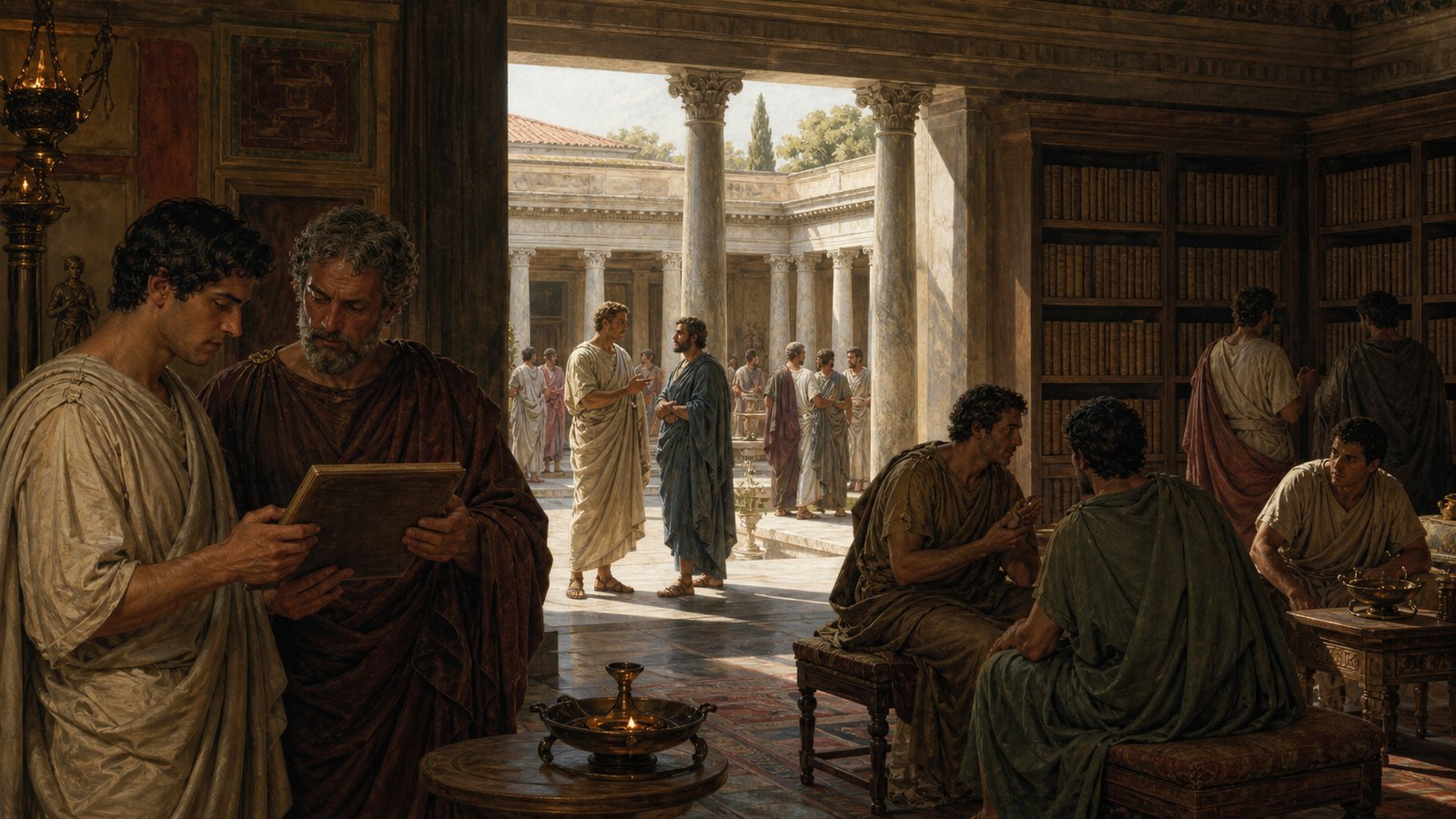
Plutarch’s sequence asks readers to judge two uses of abundance. The Apollo dining room translated a spoken room name into an immense, rapid expenditure. The library translated ownership into time shared by others. Both depended on servants, architecture and wealth, but they sent resources in opposite directions.
A feast demonstrated that the household could mobilize luxury on command. Open study rooms demonstrated that it could sustain repeated access without knowing exactly who would enter each day. One performance astonished Pompey. The other allowed Greek visitors to escape their occupations, meet and return.
This does not make Lucullus a modern public librarian, and Plutarch does not erase the hierarchy of patron and guest. The house remained his. He could offer advice because he possessed influence that visitors needed. Yet the biographer’s praise identifies a durable principle: acquiring cultural objects earns less honor than arranging conditions in which other people can use them.
The books gave the complex a purpose; the open doors gave it a public life. In Plutarch’s portrait, Lucullus’s most admirable luxury was not the number of rolls he owned. It was the social space he permitted to form around them.
Sources
Plutarch, Life of Lucullus, sections 41–42; Plutarch’s Lives, Clough translation, “Lucullus.”