
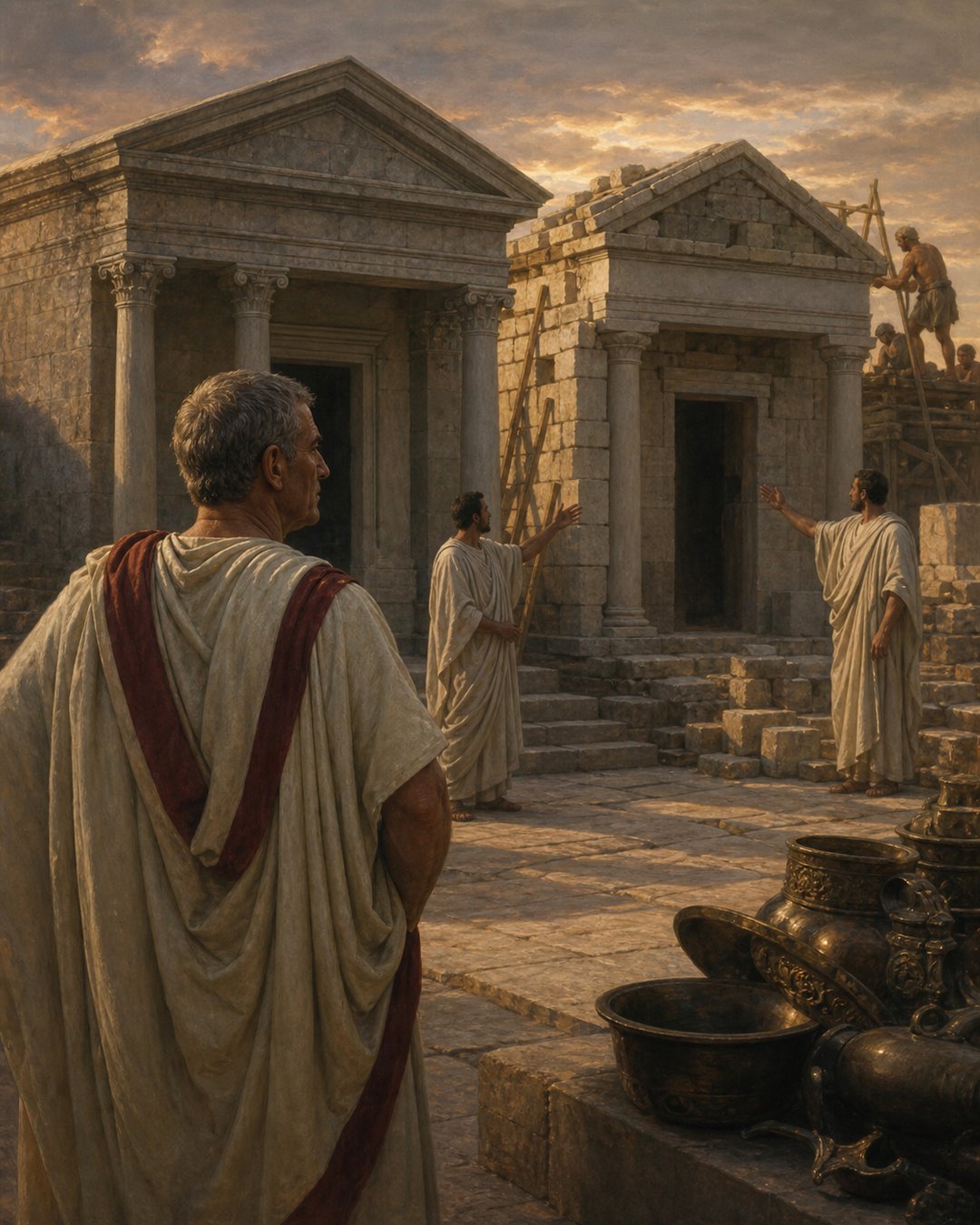
Marcellus had the money, the victory spoils and the office. He still did not control the dedication. In Plutarch’s account, the Roman commander wanted one temple built from his Sicilian spoils to honour two divine recipients: Honour and Virtue. The priests refused. They would not agree that two deities should occupy one temple.
The solution was architectural. Marcellus began another temple adjoining the first. What looked at first like one victor’s monument became two sacred addresses because ritual specialists insisted on a distinction the patron had not planned. The paired buildings preserved more than success abroad. They recorded a limit placed on a powerful Roman at home.
Sicilian Spoils Asked for a Permanent Address
Plutarch places the episode at the opening of Marcellus’s fifth consulship. The general had just survived a political accusation and emerged not merely acquitted but elected again. He then settled agitation in Etruria and pacified its cities. Only after that civic work does the biographer bring him to the temple he intended to dedicate.
The building was tied to Sicily. Marcellus’s campaigns there had already furnished Roman memory with spectacular machinery and contested glory. A separate piece on the ten-talent stone that smashed a floating siege tower shows the destructive scale associated with his siege of Syracuse. A temple funded from Sicilian spoils transformed that world of engines, captured wealth and command into a permanent Roman religious claim.
Spoils did not explain the monument by themselves. Money and objects taken in war had to be assigned a civic form, and the chosen recipients framed what the victory was supposed to mean. Marcellus selected abstractions that sounded inseparable from a successful commander. By naming Honour and Virtue together, he could present the Sicilian achievement as proof of character rather than mere possession of wealth.
Honour and Virtue made an attractive pair for such a patron. Their names could turn a military biography into a moral statement. Yet Plutarch’s emphasis falls not on the elegance of the pairing but on the interruption. The temple existed; the dedication Marcellus desired did not automatically follow. Building and consecrating were related acts, not interchangeable ones.
One Building Could Not Hold Both Recipients
The priests’ objection was precise. They would not consent to two deities occupying one temple. Plutarch does not give us a long theological explanation, and it would be unsafe to invent one. His brief sentence is revealing enough. The identity of the recipient mattered to the arrangement of sacred space, and the people authorized to judge that arrangement could stop a consul and celebrated general.
Roman religion often appears in modern retellings as a flexible collection of names, vows and public ceremonies. This scene exposes its procedural edge. A patron could choose what he hoped to express. Priests could determine whether the proposed form was acceptable. Their refusal was not an abstract disagreement hidden in a book. It blocked the use of a completed monument.
The distinction also prevented the paired dedication from collapsing Honour and Virtue into one convenient slogan. Whatever association Marcellus wished viewers to make, each deity required a separate cult place. Stone had to respect the boundary that language might glide across.
The priests’ power operated negatively but produced a positive result. They did not supply Plutarch with a new design or seize the spoils. They withheld consent from the proposed occupancy. Marcellus then had to decide whether to abandon one recipient, abandon the whole dedication, or alter the architecture. His choice to add a building shows that a veto could redirect elite expenditure without ending the elite project.
The Adjoining Temple Made the Veto Visible
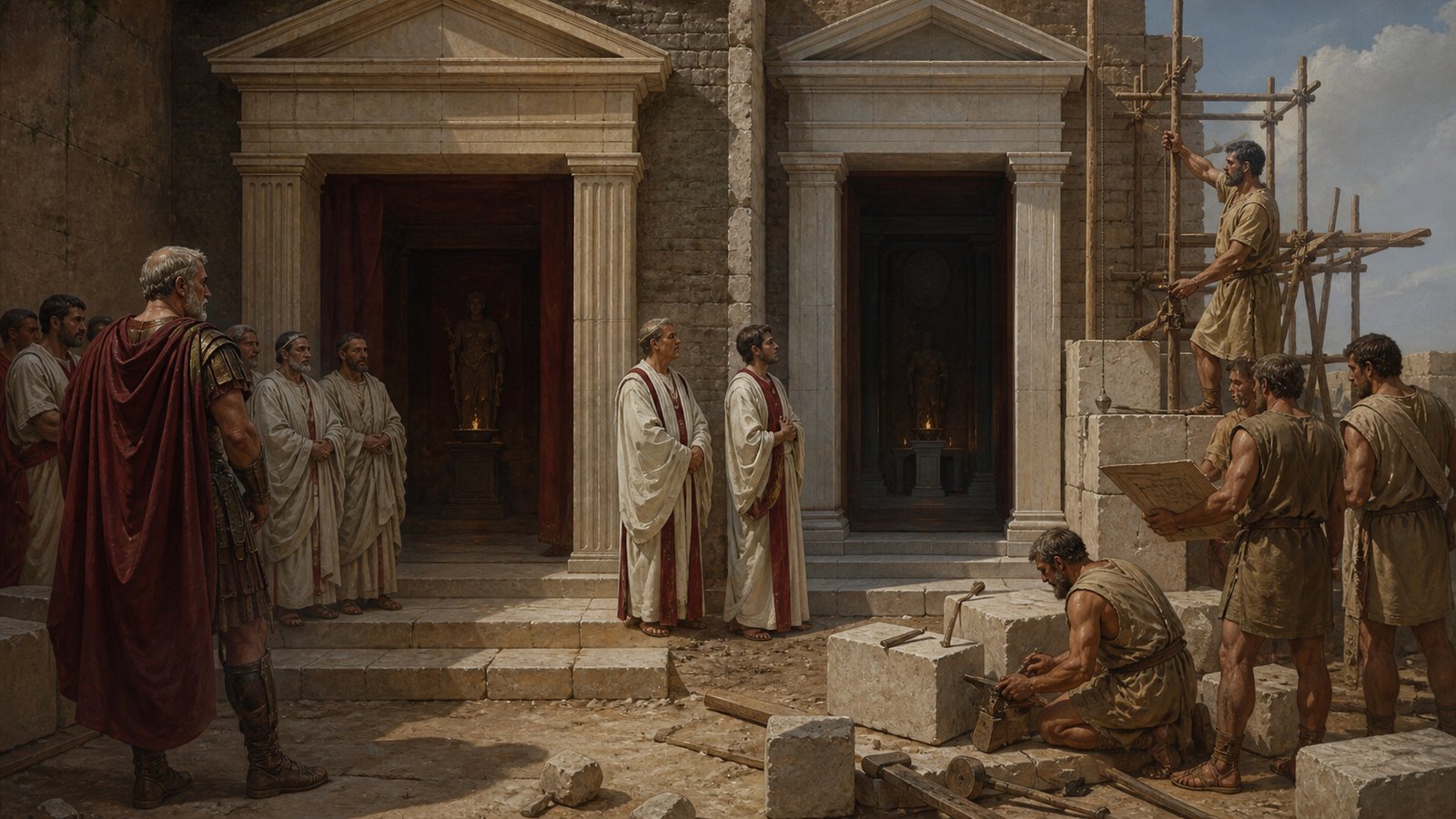
Marcellus did not abandon the project. He began a second temple beside the first. The word “adjoining” captures the compromise. The divine recipients remained close enough for the original pairing to be seen, but no longer shared one interior. Unity became adjacency.
That physical answer is the article’s central mechanism. A ritual ruling changed the plan, the changed plan required more labour and material, and the completed arrangement made the ruling durable. Visitors did not need access to the original dispute. Two neighboring sanctuaries could display both the intended relationship and the demanded separation.
Adjacency also preserved sequence. One temple had already been built when the refusal came; the next began as a correction. Even if later viewers experienced the pair as a coherent ensemble, Plutarch asks readers to remember the interruption inside it. The second footprint was evidence that consecration had its own authorities and could reach backward into a patron’s completed construction.
Roman public religion repeatedly moved through objects, routes and places. Processions made religion travel through streets; this pair of temples made a priestly decision remain still. One is a choreography of bodies, the other a choreography of walls. Both show institutions becoming legible through designed space.
Marcellus Read Resistance as an Omen
Plutarch says Marcellus resented the opposition and regarded it as ominous. The biographer then crowds the narrative with disturbing signs. Temples were said to have been struck by lightning. Mice reportedly gnawed gold in Jupiter’s temple. An ox was said to have spoken with a human voice, and a child was reportedly born with an elephant’s head. During rites meant to address such signs, seers received unfavorable indications and kept Marcellus in Rome.
These reports belong to Plutarch’s literary and religious world; they are not observations we can verify independently. Their narrative position is still concrete. The blocked dedication becomes the first disturbance in a sequence that delays an impatient commander. Marcellus wanted above all to face Hannibal in a decisive battle. Priests, seers and ominous reports held him inside a civic timetable he did not set.
Plutarch adds age to the pressure. Marcellus had passed sixty when he entered this fifth consulship, yet his desire for battle is described as consuming. The dedication problem therefore stands between an old commander and the decisive encounter he imagines. Building another temple required patience at exactly the moment his biography stresses impatience.
The contrast sharpens his character. A man accustomed to forcing military decisions encountered procedures that interpreted delay as necessary. His reaction to the temple ruling—resentment mixed with fear of its meaning—shows that he could neither dismiss priestly authority nor welcome its limits.
Architecture Recorded a Negotiation, Not a Slogan
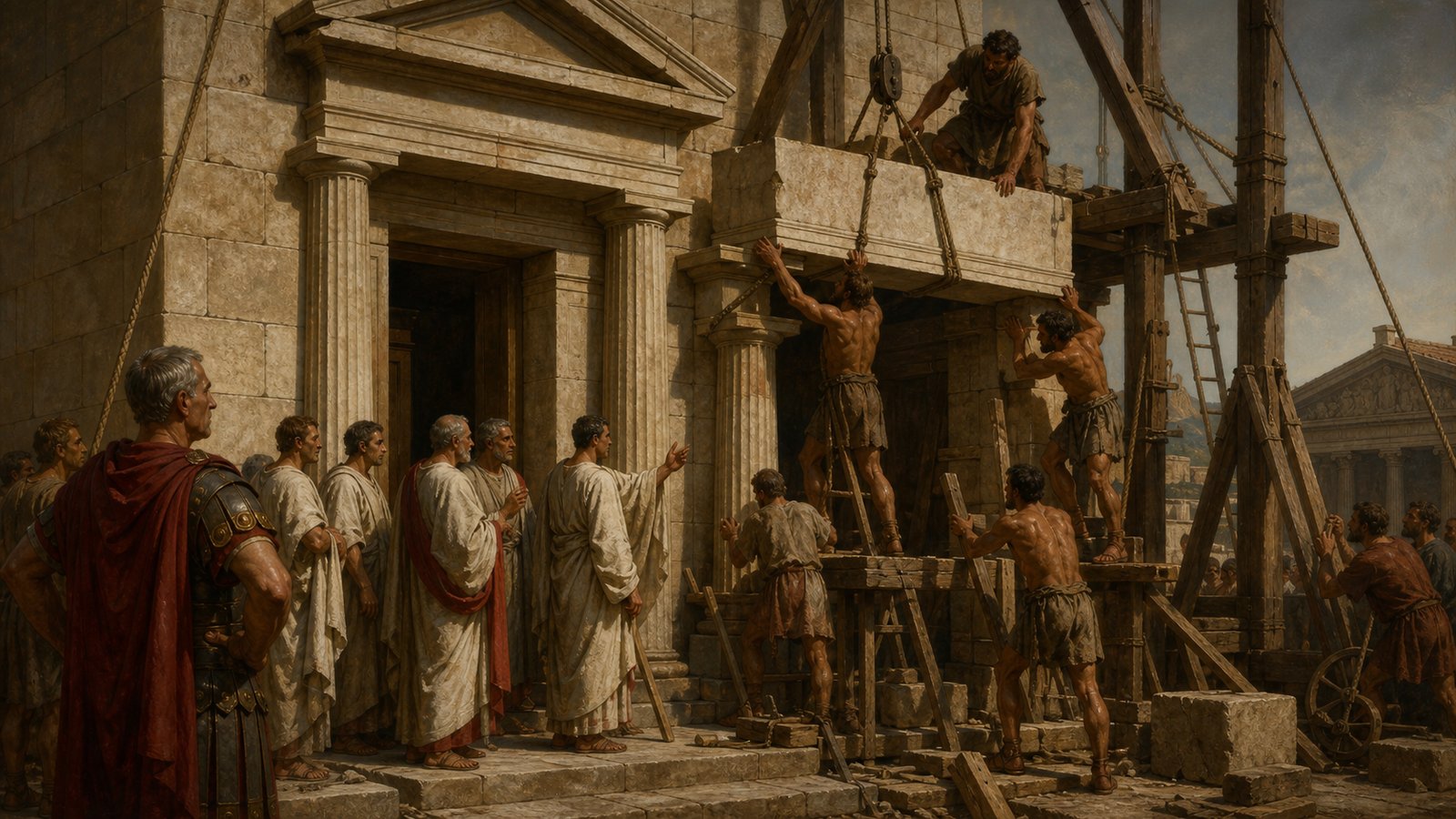
It is tempting to read a victory temple only as propaganda: spoils become stone, a general claims virtue, and Rome sees a controlled message. Plutarch gives a messier construction history. The patron’s first formula failed. Specialists intervened. A second structure repaired the problem while preserving the desired association in altered form.
The result therefore embodied negotiation among military wealth, elected office and priestly jurisdiction. Marcellus remained powerful enough to build again. The priests remained authoritative enough to make rebuilding necessary. Honour and Virtue stayed together in the urban composition but apart in cult occupancy.
There is no need to turn the episode into a universal rule for every Roman sanctuary. Plutarch gives a specific refusal in a specific biography. Its value comes from the narrowness of the evidence. At least in this remembered case, a fifth-time consul could not assume that naming two divine occupants made one sacred interior acceptable. The repair was expensive, visible and adjacent.
Plutarch’s few lines let us watch Roman institutions leave a physical seam. The most informative feature is not decorative carving or scale. It is the join between two temples. There, an ambitious dedication met a rule, and Rome answered by adding another doorway.
Sources
Plutarch, Life of Marcellus, sections 27–29; Plutarch’s Lives, Clough translation, “Marcellus.”