
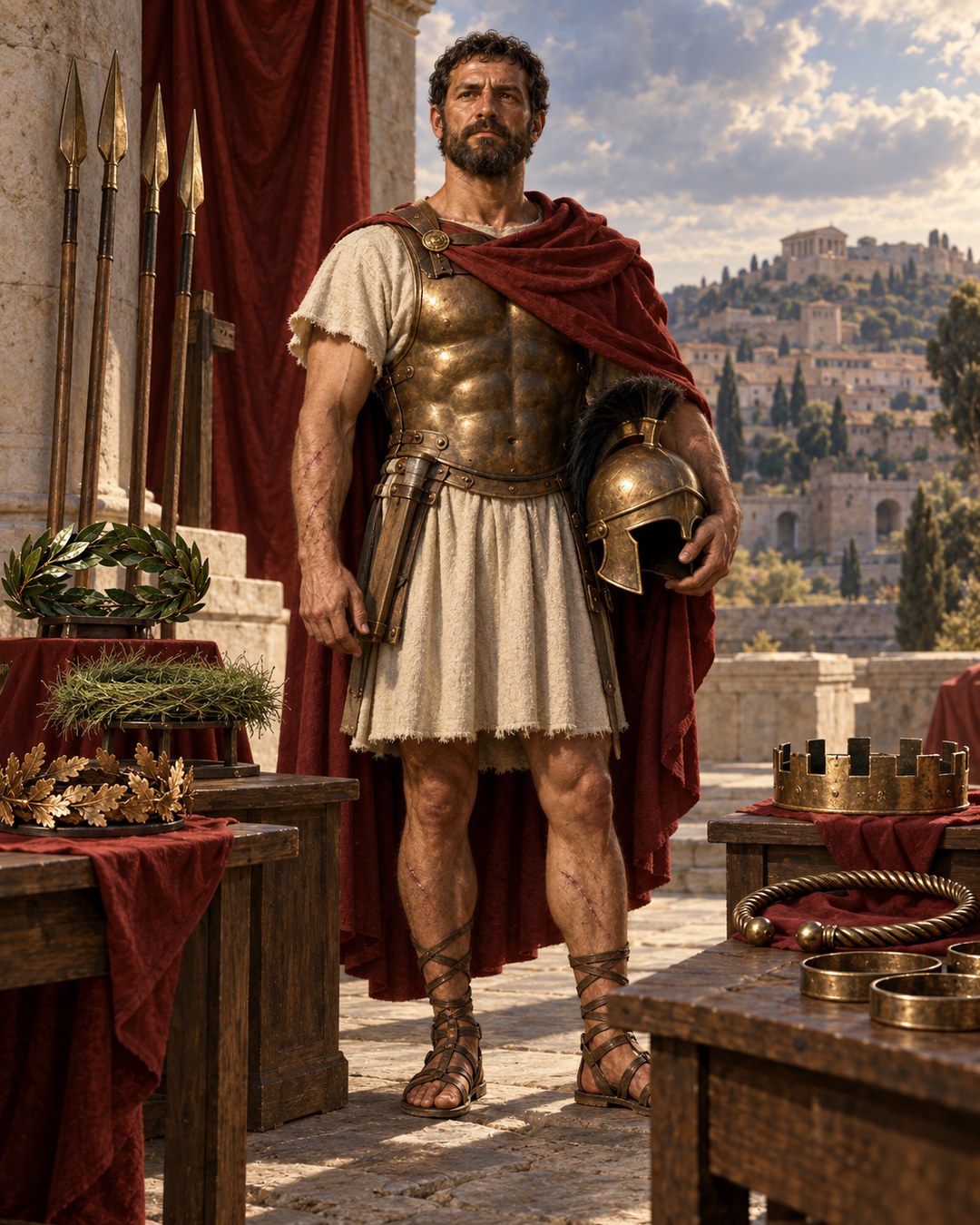
Forty-five scars marked the front of Lucius Sicinius Dentatus’s body. The annals, according to Aulus Gellius, counted none on his back.
That contrast supplies the moral before the catalogue begins. Battles, crowns, neck chains, armlets and spears follow in quantities so large that the man was called the Roman Achilles. Yet the direction of the wounds does the sharpest work: Dentatus had met danger while facing it.
Attic Nights 2.11 is only a short chapter. Its compression is the point. It presents military reputation as a record whose entries can be checked by type and number.
The Annals Built a Soldier from Totals
Gellius introduces Dentatus through written annals. He identifies him as a former tribune of the commons in the consulship of Spurius Tarpeius and Aulus Aternius, then shifts rapidly from office to service.
The total is 120 battles. Gellius does not narrate them one by one, name every enemy or supply a chronology. The count treats endurance across campaigns as an achievement in itself. A single celebrated day can make a hero; 120 engagements make survival and repeated return part of the claim.
“Roman Achilles” translates the accumulation into a familiar heroic comparison. The title does not mean that Dentatus reproduced Homer’s life scene for scene. It supplies a scale for exceptional martial energy.
The body then becomes another document. Forty-five scars lie in front and none behind. Ancient praise often uses wounds as proof because they seem harder to counterfeit than a speech. Their placement interprets conduct: the front belongs to advance and resistance, the back to flight.
That logic is rhetorical as well as physical. The list does not tell us how each injury occurred, whether all scars remained visible at the same time or who inspected them. Gellius reports what the annals said. Responsible reading preserves both the specificity and the distance.
Compare the Cannae prisoners who returned to Hannibal. Their story tests honour through a promise after defeat. Dentatus’s dossier tests it through repeated exposure before capture could occur.
Four Kinds of Crown Prevented Honour from Becoming a Blur
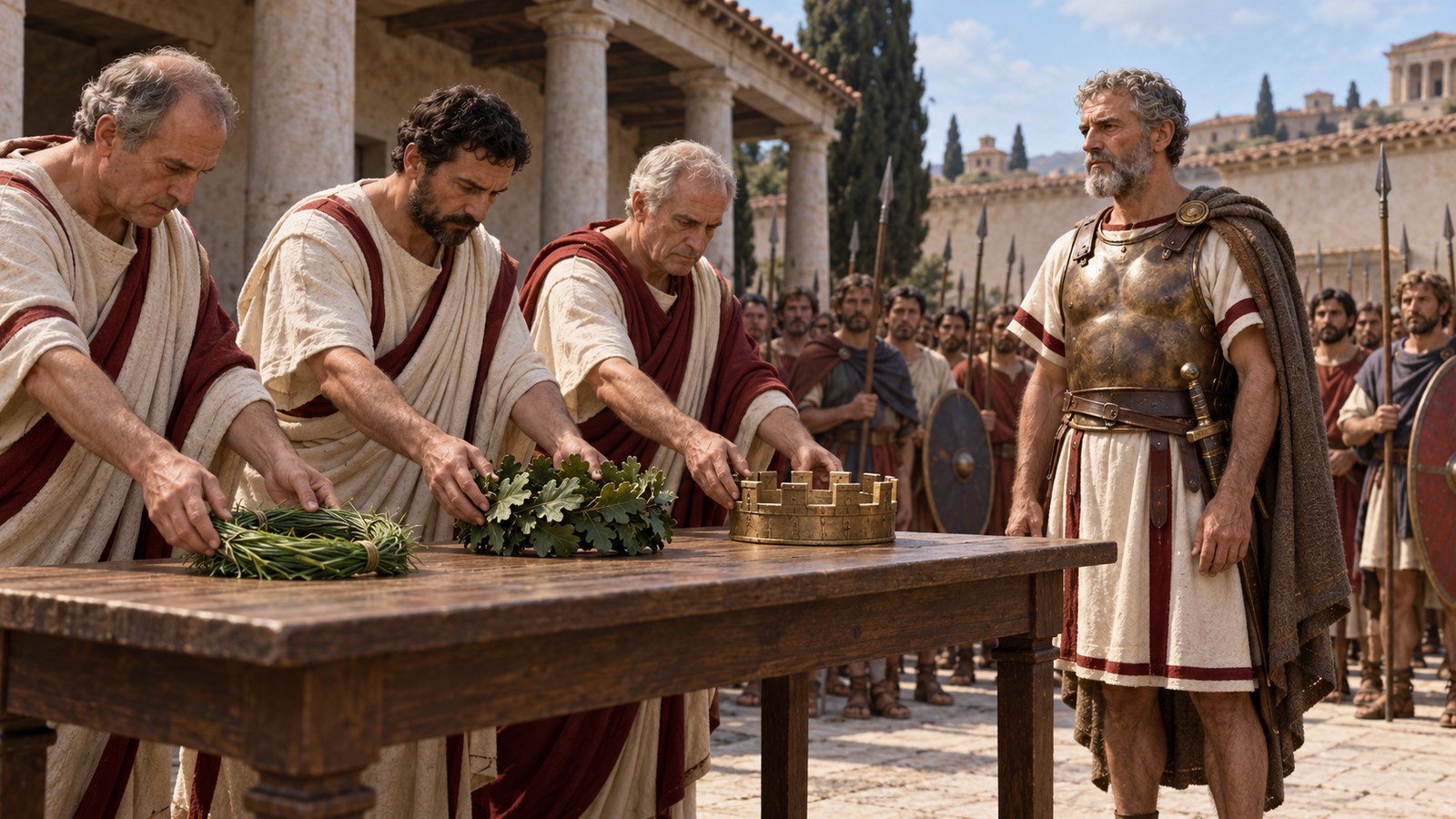
Dentatus received eight golden crowns, one siege crown, three mural crowns and fourteen civic crowns.
To a hurried reader, the sequence can dissolve into “many awards.” Gellius’s categories resist that flattening. Roman crowns were not interchangeable ornaments. Naming each class says that recognition came through different forms of action and institutional memory.
The siege crown sits alone in the list. The mural crowns appear three times. Civic crowns reach fourteen. Even without reconstructing a lost citation for every award, the distribution creates texture: one rare distinction, repeated assaults associated with walls, and many acts understood as saving fellow citizens.
Gellius does not describe the ceremony for any one crown. He offers an inventory, not a parade script. We should not invent a general’s speech or a cheering legion. The safe inference is narrower: the annalistic tradition wanted readers to recognize both abundance and classification.
The crowns also convert bodily risk into portable symbols. A scar remains with the soldier. A crown can be bestowed in public, displayed, remembered by descendants and copied into a written record. The two kinds of evidence reinforce one another.
Rome’s military culture repeatedly tied reward to visible acts. The story of Fabricius supporting a commander he later expelled shows how service and political judgment could occupy the same career. Dentatus, too, was not only a fighting body; Gellius identifies a tribune of the commons before opening the armoury of honours.
Torques, Armlets and Spears Extended the Ledger
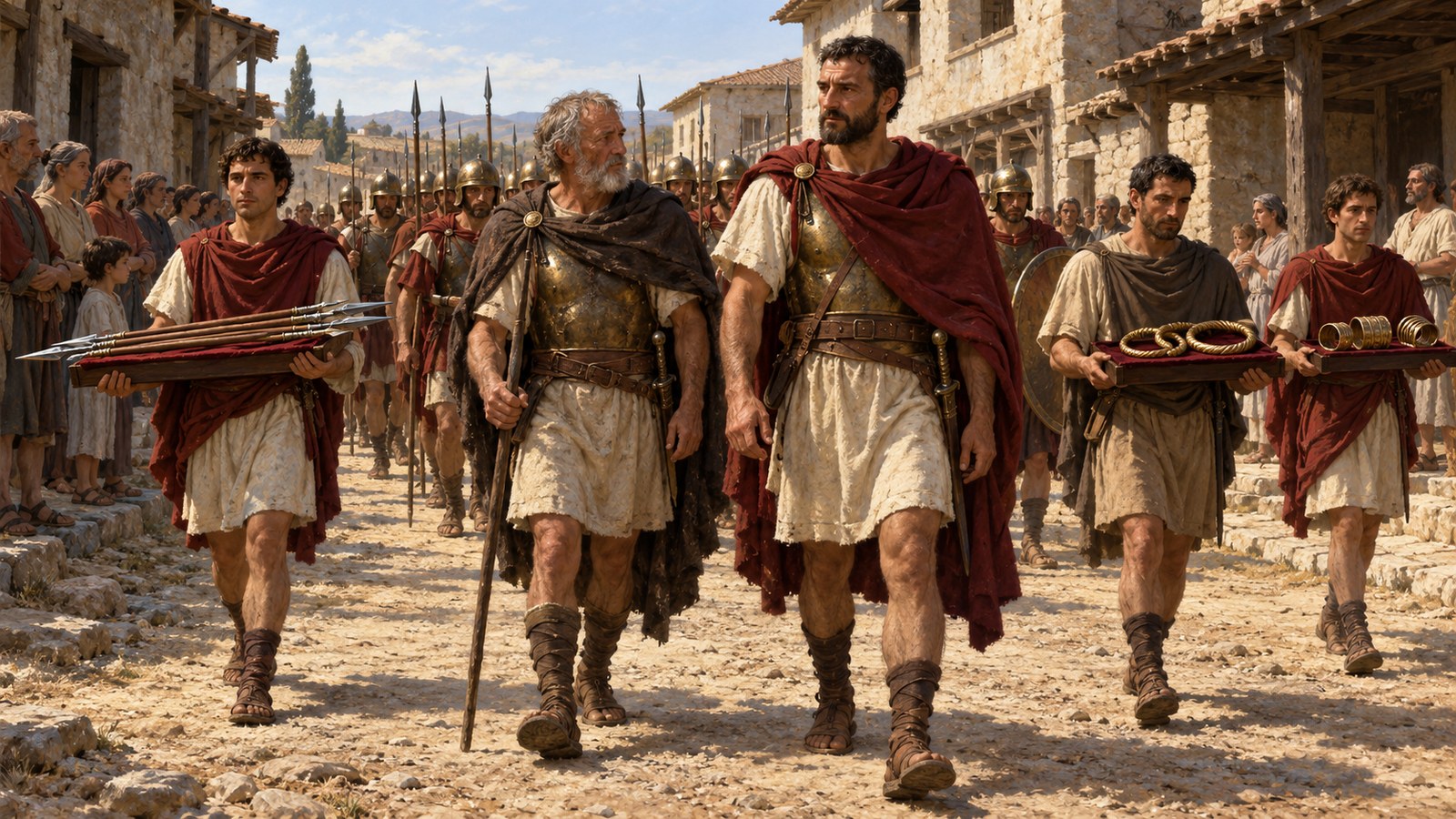
After the crowns come 83 neck chains, more than 160 armlets and eighteen spears. Then Gellius adds twenty-five decorations.
The numbers are deliberately overwhelming, but the objects remain distinct. A torque occupies the neck, an armlet the arm, and an award spear carries a different shape and use. The list imagines a reputation distributed across a whole vocabulary of recognition.
“More than 160” is especially interesting. It sounds less like a polished symbolic number than a total whose exact upper edge had become difficult to fix. The annalistic voice wants magnitude even where precision loosens.
Many spoils were said to have been won in single combat. That phrase changes the scale from army to opponent. The 120 battles measure recurrence; individual spoils isolate moments when Dentatus’s own encounter could be distinguished within collective war.
None of this lets us reconstruct his equipment as a single impossible costume bearing every award at once. The objects accumulated over time. A responsible image of the dossier should arrange them as evidence, not hang 160 armlets on two arms.
The catalogue works because Roman honour had material forms. Courage could become metal, wreath and object, then survive again as words after the material dispersed.
Nine Triumphs Kept the General in the Picture
Gellius closes by saying Dentatus took part with his generals in nine triumphal processions.
The wording matters. A triumph belonged to a commander and to the victory recognized by the state. Dentatus participated with the generals under whom he had served. His personal record therefore remained nested inside command, army and civic ritual.
Nine processions also add another kind of repetition. Battles expose the soldier to danger. Awards select acts from those battles. Triumphs bring victories back through Rome in public form. Dentatus appears at all three levels.
The sequence prevents the “Roman Achilles” label from floating into myth alone. His comparison is heroic, but the dossier is bureaucratic in appetite. It names an office, a consulship, totals, award classes and processions.
Such precision can tempt modern readers either to accept every number without question or reject the whole list as exaggeration. Gellius gives us a report of annalistic memory. The sound approach asks what that memory chose to count.
It counted duration, orientation and recognition. The 120 battles say he returned. The front wounds say how he was imagined to have faced risk. The crowns and ornaments say institutions repeatedly acknowledged him. The nine triumphs reconnect the individual to collective victory.
Dentatus’s fame was therefore not stored in one anecdote. It was assembled like a veteran’s ledger, line after line, until the arithmetic itself became a portrait.
The political identifier at the beginning deserves one further pause. A tribune of the commons could be remembered for conflict inside the city, while this chapter preserves Dentatus almost entirely through war. Office and battlefield were not separate biographies pasted together; military standing could shape the authority with which a Roman later appeared in civic struggle.
Gellius gives no speech by Dentatus and no verdict on his tribunician programme. That absence makes the martial list unusually stark. Readers meet a public man through what annalists believed his body had endured and what commanders or communities had awarded.
The quantities also produce a problem of scale. Eighty-three torques and more than 160 armlets exceed what one ceremony or one visible display could comfortably communicate. Their force depends on accumulation across time. The imagined audience has to keep adding, just as the soldier had to keep returning to service.
Counting can exaggerate, but it can also classify. “Very brave” would flatten the record into an adjective. The ledger distinguishes battles from wounds, front from back, siege crown from mural crown, and individual spoil from a commander’s triumph. Even a skeptical reader can see the model of excellence the tradition built.
That model valued courage that could be externally witnessed and repeatedly certified. Dentatus’s inner fear or confidence remains unavailable. The annals substitute public traces: position of scars, material rewards and presence in processions. His “energy” becomes legible because institutions kept finding new ways to mark it.
Sources
Aulus Gellius, Attic Nights, 2.11, reporting the annalistic record of Lucius Sicinius Dentatus.