
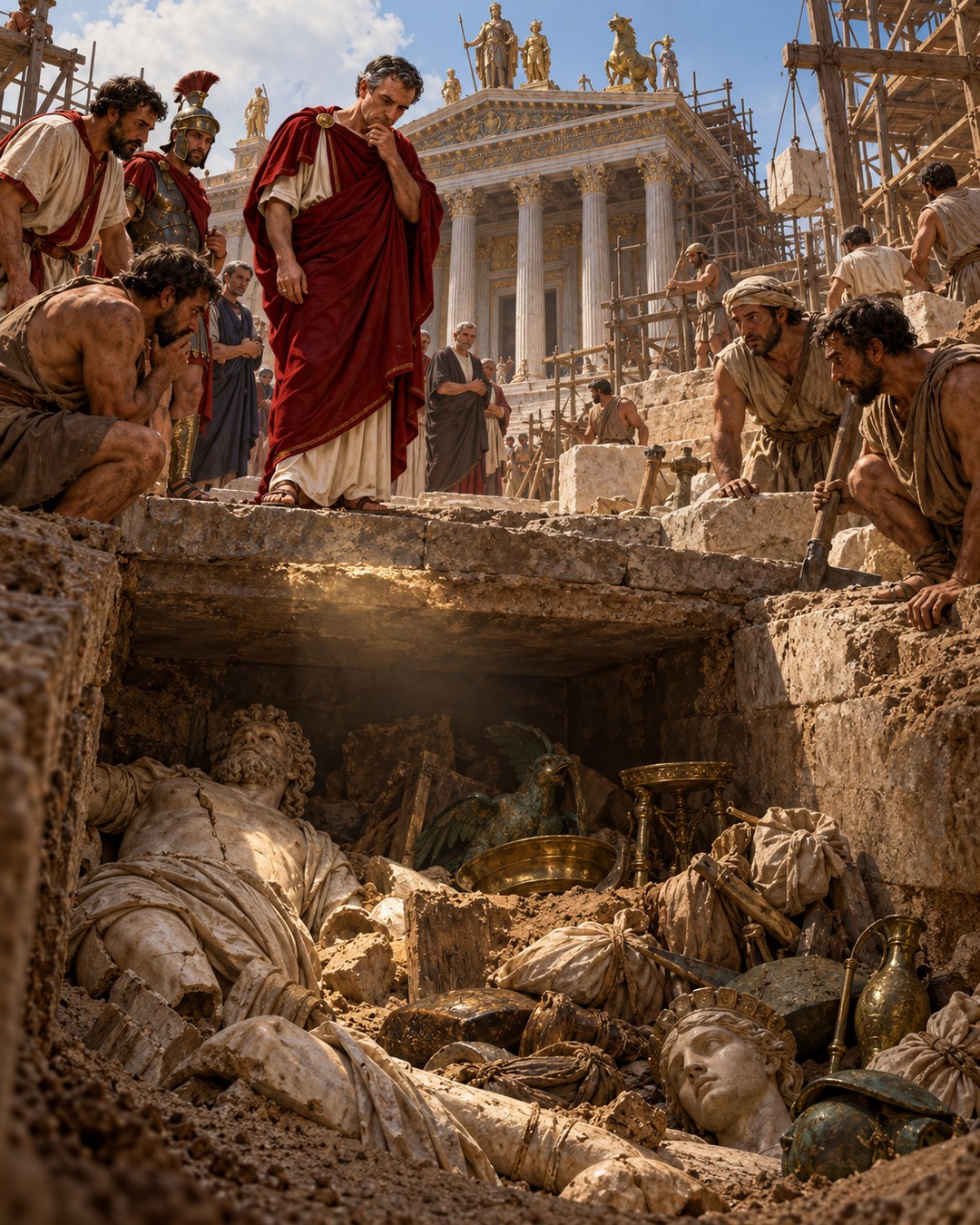
Quintus Catulus wanted the restored Capitol to rise more sharply above its approach. Lower the forecourt, add more steps, and the podium would answer the scale of the pediment above it.
The plan stopped below ground. Chambers under the Capitoline area already held statues that had fallen from the temple and other consecrated offerings. They were called favissae, and Catulus told Varro they prevented the change.
Aulus Gellius preserves the episode not as a building manual but as an inquiry into one old word. That narrow question opens a larger view of reconstruction: Rome’s most visible sacred architecture rested on material that could be hidden but not casually erased.
A Censorial Word Sent Sulpicius to Varro
Servius Sulpicius encountered favissae Capitolinae in the records of the censors. He was not an antiquarian without another profession. Gellius identifies him as an authority on civil law and a man deeply read in literature. Even so, the term demanded help.
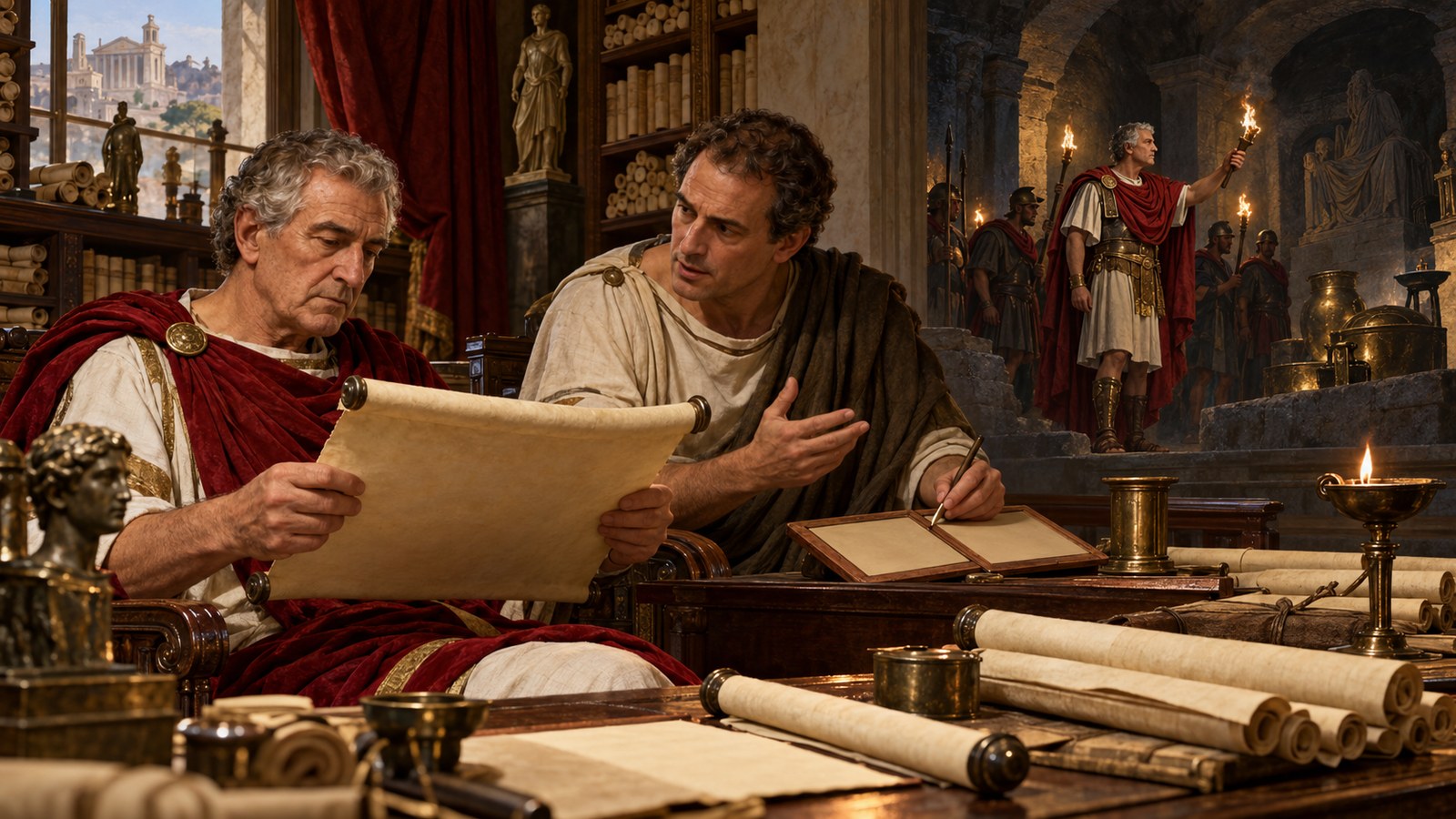
He wrote to Marcus Varro. The exchange is revealing because neither man treats an unfamiliar institutional word as self-explanatory. A form copied in an official record still needed a physical referent and a history.
Varro’s answer began with testimony he remembered from Catulus, who had charge of restoring the Capitol. Catulus had considered changing the level of the area before the temple. His aim was visual and architectural: a lower approach would create room for additional steps and make the podium appear higher, bringing the lower mass into proportion with the elevation and size of the pediment.
The proposal was not cosmetic in the modern sense. Stairs govern procession, effort and sightline. A higher podium changes the moment at which the visitor meets the façade. Anyone who has followed the story of a river forcing Ceres’s portico across the road has seen how Roman sacred building answered a stubborn site. Here the obstruction lay inside the site’s own religious history.
Catulus could imagine the desired profile and still decline to force it through. The surviving explanation gives no engineering calculation, cost estimate or senatorial debate. It gives one decisive noun: the favissae prevented him.
The Chambers Stored What the Temple No Longer Displayed
Varro described the favissae as underground chambers and cisterns in the Capitoline area. Their contents explain why they were not ordinary voids beneath a terrace.
Old statues that had fallen from the temple were customarily placed there. Other consecrated objects from votive offerings joined them. Each had ceased to occupy its former visible place without becoming common refuse.
That distinction matters. A damaged statue may no longer stand upright in a sanctuary, yet dedication has changed its status. The chamber solved a practical problem without pretending the sacred history had vanished. Objects could leave circulation and public view while remaining within protected space.
The Capitol therefore accumulated vertically. Worship, rebuilding and display continued above; displaced sacred material remained below. Catulus’s proposed excavation would not merely cut natural soil. It would meet a curated deposit created by earlier religious decisions.
Gellius does not say that every object was catalogued, arranged by date or accessible for study. Calling the favissae a museum would import a purpose the passage does not provide. Storage is enough. The rooms preserved what attendants were responsible for keeping.
The contrast with the geese that warned Manlius on the Capitol is useful. That story turns the hill into a defended height. The favissae turn it into an archive of things: a place whose security included objects buried within its fabric.
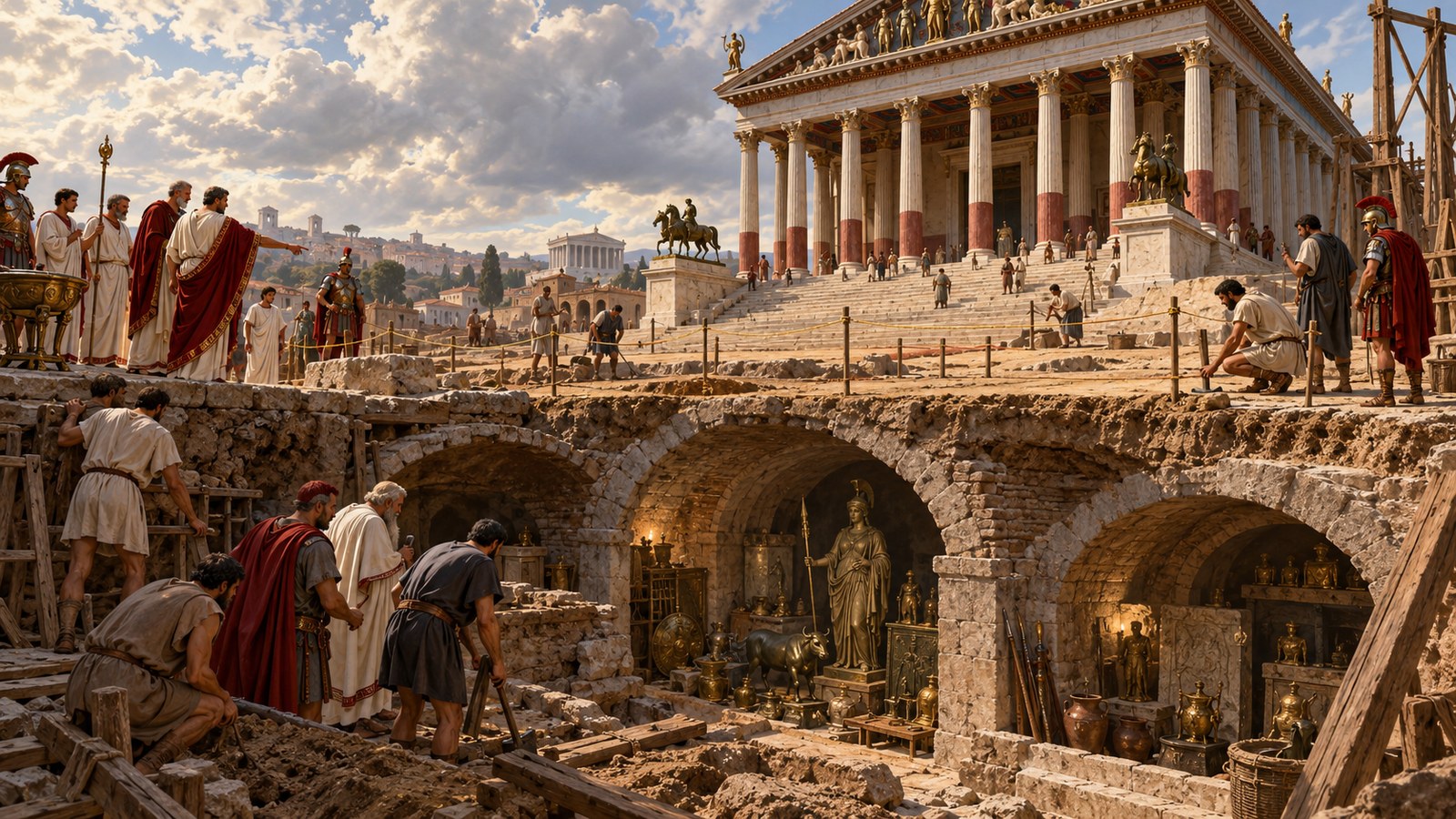
A Higher Podium Had to Yield to an Older Layer
Catulus’s idea joined three linked alterations. Lower the area. Increase the number of steps. Raise the apparent or actual relation of podium to pediment. The intervention would improve the temple’s vertical composition from the approach.
But lowering a surface is excavation. Once the chambers occupied that depth, the clean geometry of the redesign became a collision between visible proportion and inherited custody.
The episode is especially valuable because it records a project not completed. Monumental history often privileges what builders finished. Gellius instead gives us a design intention preserved through its failure. The absence of extra steps becomes evidence.
We should resist filling the silence with invented drama. The passage does not describe workmen breaking through a roof, priests rushing to the trench or Catulus receiving an oracle. Varro says Catulus wanted the alteration and could not execute it because of the favissae. That is secure.
Even within those limits, the mechanism is clear. Existing sacred storage constrained later architecture. Reverence was not only an idea spoken over sacrifice; it occupied cubic space. A chamber wall and its contents imposed a boundary on a prestigious restoration.
The result also complicates the language of renewal. Restoring the Capitol did not mean returning to an empty beginning. Every rebuilding inherited previous repairs, discarded fittings and obligations. New grandeur had to negotiate with matter that had already acquired claims.
Varro Knew the Place Better Than the Name
After explaining the chambers, Varro admitted a lexical limit. He had never found an account of the term favissae in literature.
He nevertheless reported an etymology offered by Quintus Valerius Soranus. On that theory, early Latins called certain treasuries flavisae. The defining content was stamped and minted money, not uncoined copper or silver. Lose the second letter and flavisae could become favisae, then attach to the Capitoline pits and chambers used for old sacred objects.
Gellius does not convert that proposal into certainty. The structure of the report separates levels of confidence. Varro remembers Catulus’s physical explanation. He can say what attendants placed in the chambers. For the word’s origin, he has no literary confirmation and transmits another scholar’s assertion.
That honesty is part of the chapter’s method. A place may be real, consequential and institutionally named even when learned men cannot recover a secure etymology. Language can outlast its explanation just as consecrated objects outlast their first display.
The correspondence began with a word in a record and ended with a stopped building plan. Between them lie censorial administration, architectural ambition, temple custody and a conjecture about money. The chain is not accidental. Old vocabulary carried traces of old practices, but recovering those traces required witnesses as well as verbal ingenuity.
Catulus never gained the extra descent and rise he imagined. The Capitol’s buried rooms had already designed that part of the monument for him.
The account also cautions against treating archaeological depth as a simple calendar. The chambers were old relative to Catulus’s restoration, and their contents came from earlier service in the temple, but Gellius supplies no layer-by-layer chronology. “Below” tells us where the custody occurred, not the exact date of every deposit.
That limit makes the surviving design decision more important. Catulus did not need to know the biography of every broken statue before recognizing the collective status of the store. The obstruction worked at the level of an institution: attendants had placed sacred things there under an inherited custom, so a later project encountered an established protected use.
There is a practical economy in that solution. Temples receive gifts over generations. Statues fall, fittings age and new dedications compete for visible room. If consecration prevents ordinary disposal, some form of retirement space becomes necessary. The favissae allowed cult practice to continue without forcing every damaged object to remain on display.
Yet storage creates future costs. What solved an earlier problem narrowed the choices of Catulus’s builders. The chapter captures that exchange without complaint: preservation gives continuity, and continuity occupies space.
For historians, the episode joins text and negative architecture. Varro’s remembered testimony explains why a desired profile was not made. A missing stair can carry evidence when a source records the reason for its absence. The Capitol that visitors saw was partly shaped by rooms most of them never saw at all.
Sources
Aulus Gellius, Attic Nights, 2.10, reporting Varro’s reply to Servius Sulpicius.