
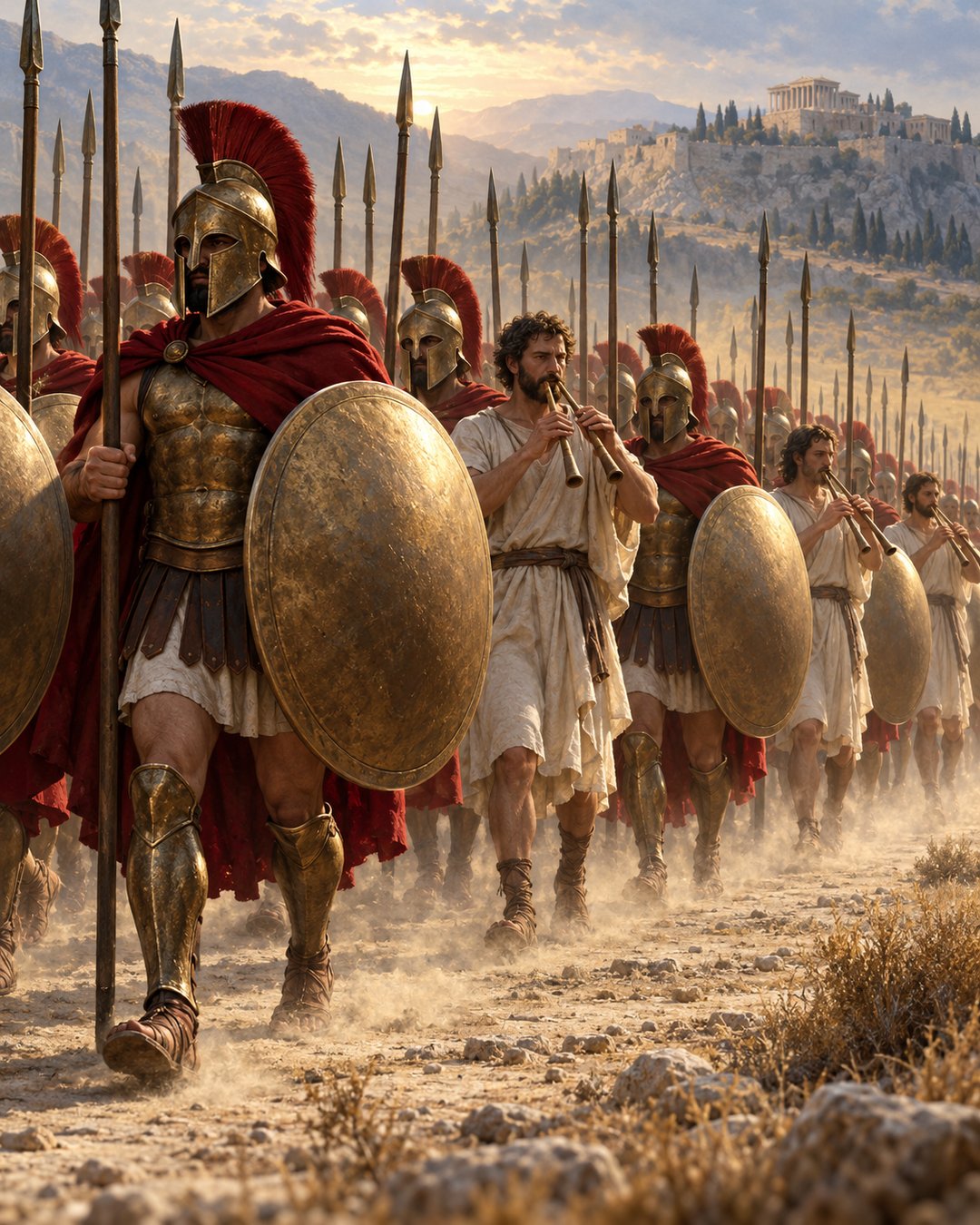
Imagine a battle line waiting for the signal to move. The obvious sound is a trumpet: bright, urgent and hard to ignore. Aulus Gellius asks his reader to imagine something less obvious. The Lacedaemonians, he says through Thucydides, began their advance to pipes. The sound was not supposed to inflame them. It was meant to stop their own courage from tearing the formation apart.
That inversion is the heart of Attic Nights 1.11. Gellius gathers battlefield music, silent marching, a Roman attack shout and an orator’s pitch cue into one inquiry about controlled intensity. His examples are not interchangeable curiosities. Each assigns a different sound to a different danger.
The pipe restrained the first rush
Gellius begins by excluding two tempting explanations. The Spartan pipes were not a religious ceremony, and they were not the equivalent of horns or trumpets used to excite courage. Their gentler notes worked in the opposite direction. They restrained impetuosity and kept feeling under control at the point when an eager formation might surge unevenly.
The physical arrangement matters. Once the army was drawn up and began to advance, pipers played from positions in the ranks. Music was therefore distributed through the body of the formation rather than projected only from a distant command post. Soldiers could attach their steps to a regular pulse shared with the men beside them.
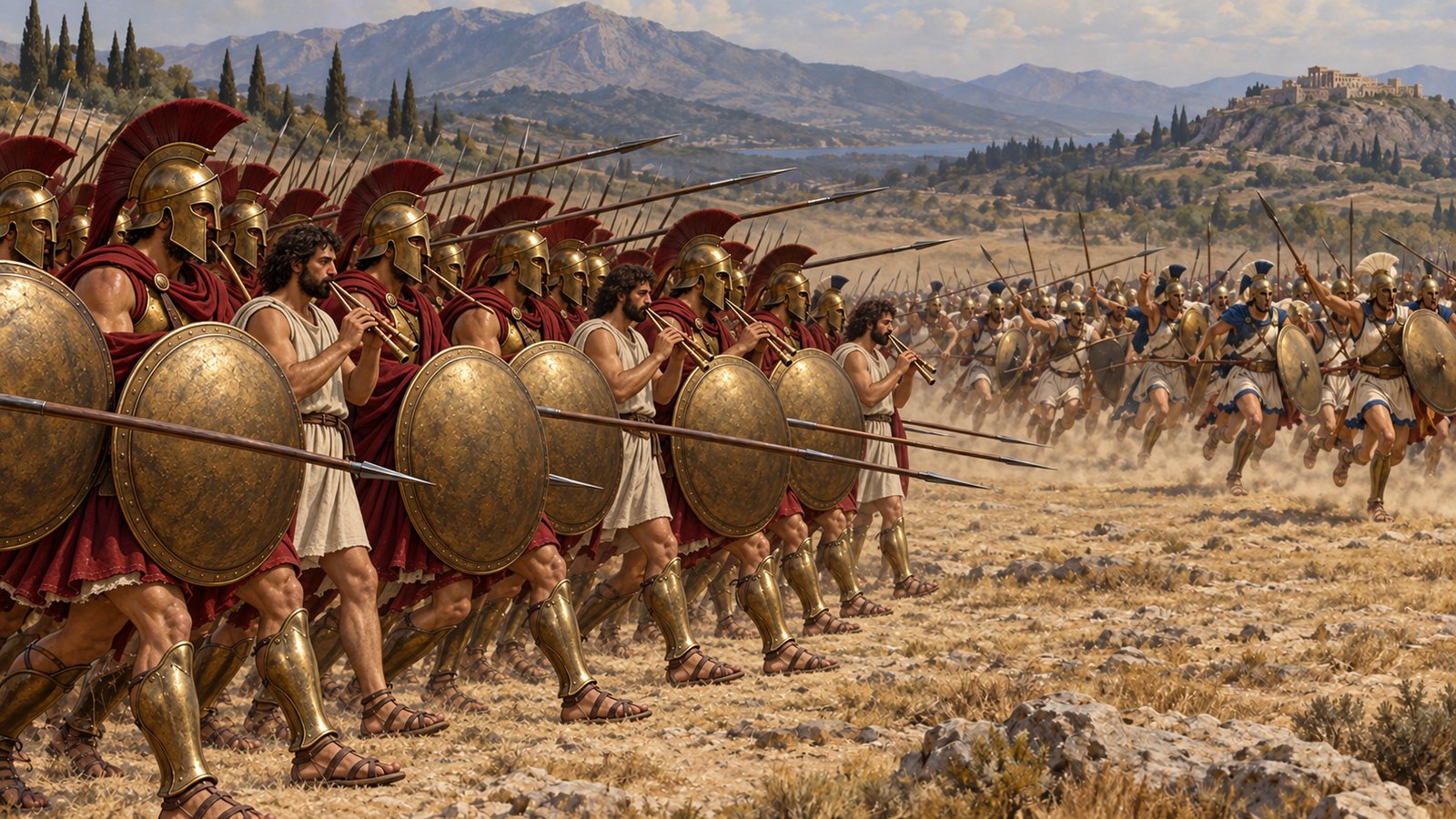
Thucydides’s quoted contrast makes the purpose concrete. The Argives and their allies rushed forward in eagerness and anger. The Lacedaemonians moved slowly to many flute players placed at intervals. The point was to attack while marching rhythmically so that the ranks did not break, a failure that Gellius says often happened when great armies advanced.
The instrument did not win the battle by magic. It managed the transition from standing order to forward motion. A line can look perfect while stationary and still fragment as thousands of feet cross rough ground at different speeds. The pipe supplied a tempo against that ordinary mechanical risk.
Gellius’s wording keeps the claim narrow. He does not say every maneuver was played through or that officers surrendered command to musicians. The cited scene begins after deployment, when the line starts toward the enemy. “Regular intervals” describes where the players stood, while “rhythmically” describes the result expected from the soldiers. Placement and tempo answer the same problem from two sides: men across a broad front needed a cue close enough to hear and regular enough to share.
That reading also explains why calm could count as courage. Gellius says the gentler notes soothed men whose confidence was already present. A soldier who wanted to prove himself by running ahead could create the gap an opponent needed. Restraint was therefore not the opposite of aggression. It preserved the collective shape that made aggression effective when the distance finally closed.
Other armies made different sounds do different work
Gellius then broadens the comparison. Cretans, tradition said, entered battle with a lyre regulating their step. Alyattes of Lydia carried a much richer musical company against Miletus: pipe players, lyre players and female flute players of a kind associated with luxurious banquets. Those examples put disciplined tempo beside royal display without pretending that every musician served the same function.
Homer’s Achaeans offer a sharper contrast. They advance without pipes or lyres, in silence, united in spirit and resolved to support one another. Silence can therefore carry order too. The controlling principle is coordinated action, not devotion to one instrument.
That distinction helps prevent a modern caricature of ancient armies marching like bands. Gellius is comparing accounts from different writers and cultures. His chapter asks what sound does at a particular phase, not what soundtrack all ancient warfare possessed.
His method is deliberately cumulative. Thucydides supplies the detailed Spartan explanation. A remembered Cretan custom adds another step-regulating instrument. Herodotus contributes the extravagant Lydian company, and Homer supplies disciplined silence. Gellius does not flatten these authorities into one report. He places them side by side so the reader notices that musical presence alone tells little. The useful question is whether sound regulates movement, advertises royal luxury, sustains morale or does something else entirely.
A nearby Lost Eagles story on a crowd drowning an attack order shows the inverse problem: noise can destroy a signal instead of coordinating men. Another on Caesar’s burning spear signal shows how a visible cue could serve when a voice could not.
Rome saved its shout for closing distance
Gellius knows that Roman soldiers were famous for a very different sound: the collective shout of a charge. He does not treat that as proof that the Spartan explanation was wrong. Instead he separates phases of combat. Quiet order is useful while approaching an enemy still visible at a distance. Near the moment of collision, a violent assault and terrifying shout can have another purpose.
This temporal distinction is easy to miss. “Music versus shouting” is not the chapter’s real argument. The relevant question is when a sound enters the sequence. A steady pulse protects alignment during movement. A shout at close range turns organized motion into impact and attempts to unsettle the opponent.
The chapter therefore sketches a compact acoustics of battle. Distance, visibility and formation determine what the army needs. The best signal is not always the loudest. Before contact, too much excitement may damage the force producing it.
The Roman shout fits because it begins after the long approach has done its work. Gellius imagines an enemy first seen at range and then met almost hand to hand. At the first distance, the army must arrive together. At the second, sudden noise can reinforce the assault and frighten those receiving it. The apparent contradiction dissolves once sound is attached to sequence. Pipe and shout are not rival national styles; they are tools suited to different moments.
Gracchus carried the same problem into public speech
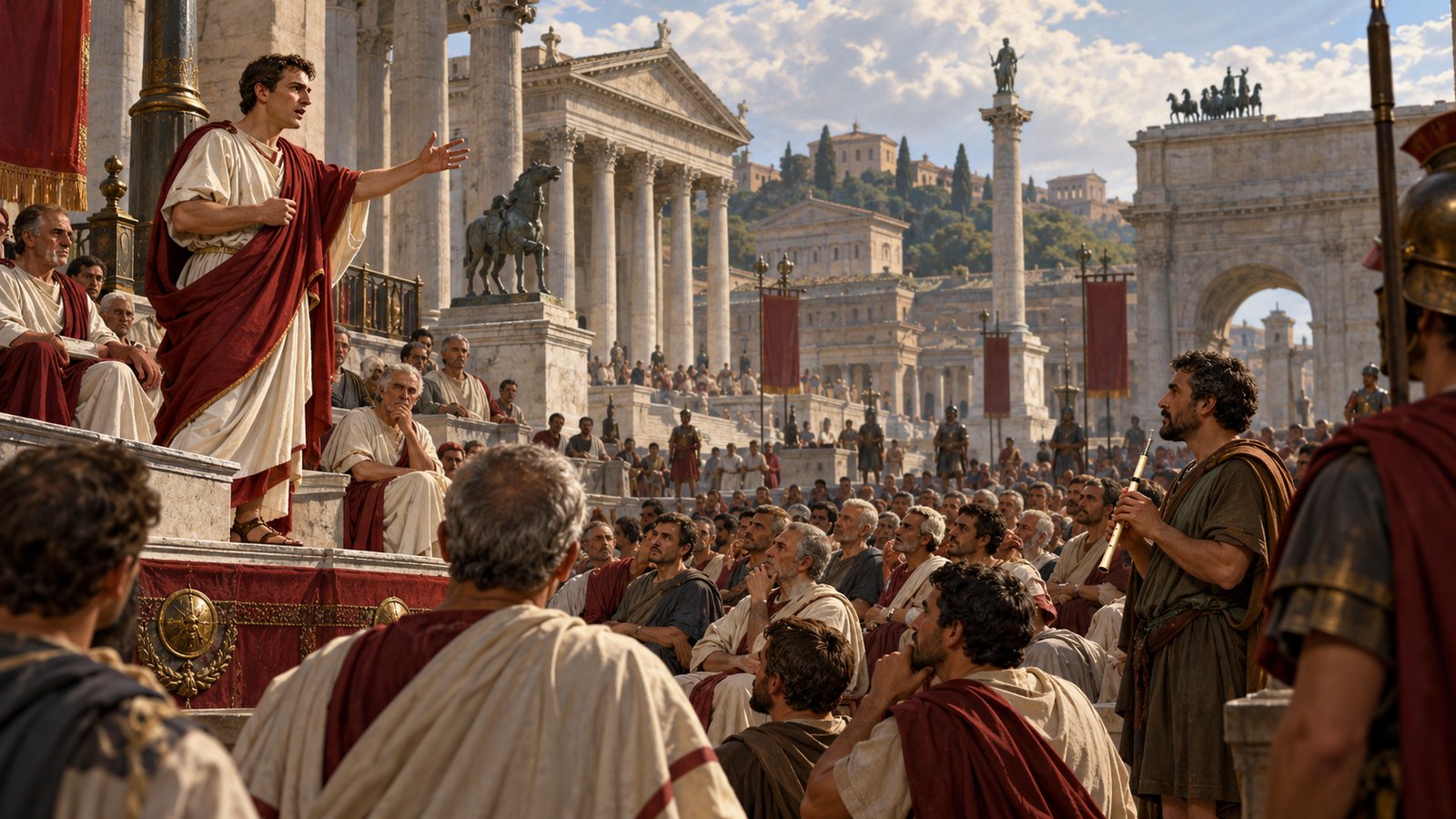
The Spartan pipe reminds Gellius of a second story about Gaius Gracchus. A popular version imagined a musician standing behind the orator and playing changing melodies as though accompanying a performer. Gellius rejects that picture as absurd. More reliable authorities, he says, put the musician unnoticed among the listeners with a short pipe.
At intervals the musician sounded a deeper note. Its purpose was to restrain the natural exuberance of Gracchus’s delivery. Cicero’s version allows the cue to work in both directions: a note might rouse the speaker when his force weakened or call him back when passion became too violent.
The connection with the battlefield is precise. Neither music system replaces judgment. Each provides an external reference when a collective body or a powerful speaker may outrun control. The pipe is valuable because emotion is already present. It makes intensity usable.
Gellius is also careful about what he will not believe. He dismisses the theatrical image of a musician continuously accompanying Gracchus with changing melodies. The credible core is shorter and less visible: an occasional note sounded from within the audience. Cicero’s recollection preserves the two thresholds that mattered. Delivery could sink below the force required to hold a crowd, or rise beyond the control required to persuade it. One practiced listener and one brief cue marked the usable middle.
Gellius closes with another explanation attributed to Aristotle. A fearless, rhythmical advance also exposed anyone unable to keep time. That gives coordination a diagnostic edge: the same cadence that holds the line can reveal the man whose fear disrupts it.
Read together, the examples turn ancient music away from decoration. Pipe, silence and shout are technologies of timing. The memorable Spartan detail is not that battle had a melody. It is that courage had to arrive in formation.
Sources
Aulus Gellius, Attic Nights, 1.11, citing Thucydides, Herodotus, Homer, Cicero and Aristotle.