
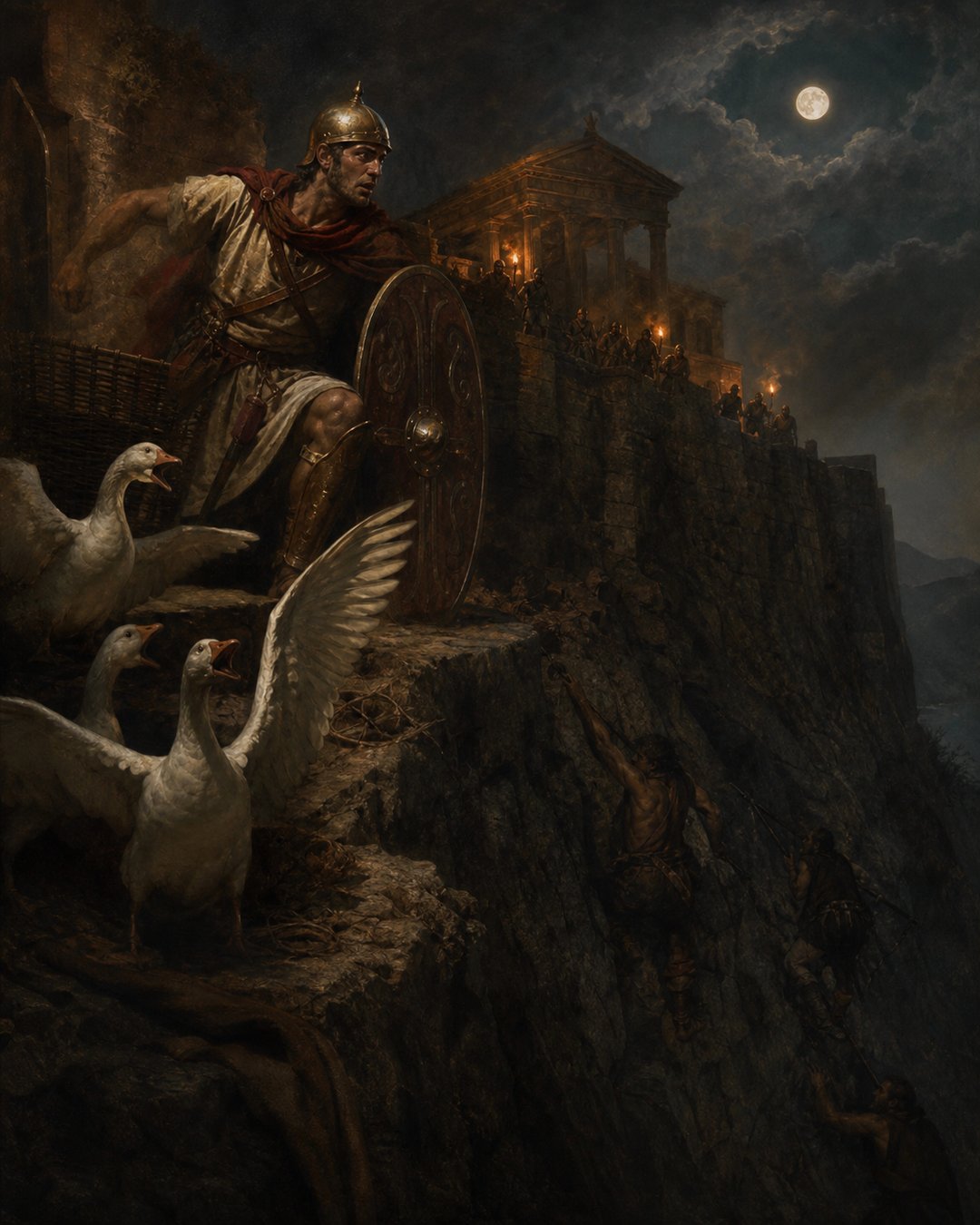
The Gauls climbed toward Rome’s Capitoline in darkness. They found a route so steep that the defenders had left it unguarded. Livy says the first man reached the summit without waking a sentry or even disturbing the dogs.
Then Juno’s geese began to call and beat their wings. Hunger had not persuaded the besieged Romans to kill the birds sacred to the goddess. Their noise woke Marcus Manlius, who seized his weapons, knocked the leading climber backward, and turned a silent infiltration into a fight the garrison could win.
The famous birds did not defeat an army by themselves. They broke a chain of concealment at its most fragile instant. One alarm gave one alert defender enough time to block the narrow approach before the attackers could establish themselves on the height.
A Hidden Route Replaced a Direct Assault
Rome had already suffered catastrophe. After the defeat at the Allia, Gallic forces entered the city while a Roman remnant held the Capitoline. Livy’s narrative surrounds the hill with abandoned streets, burned buildings, hunger, and the psychological strain of siege.
A conventional attack on the defended ascent had failed. The Gauls therefore watched the ground and discovered a different possibility. Livy says either a messenger’s earlier journey revealed the line or the enemy noticed for itself that a crag near the shrine of Carmentis could be climbed.
The uncertainty matters. The historian offers alternatives instead of pretending to know exactly how reconnaissance worked. Both versions lead to the same tactical discovery: terrain that looked impossible had become less protected precisely because it looked impossible.
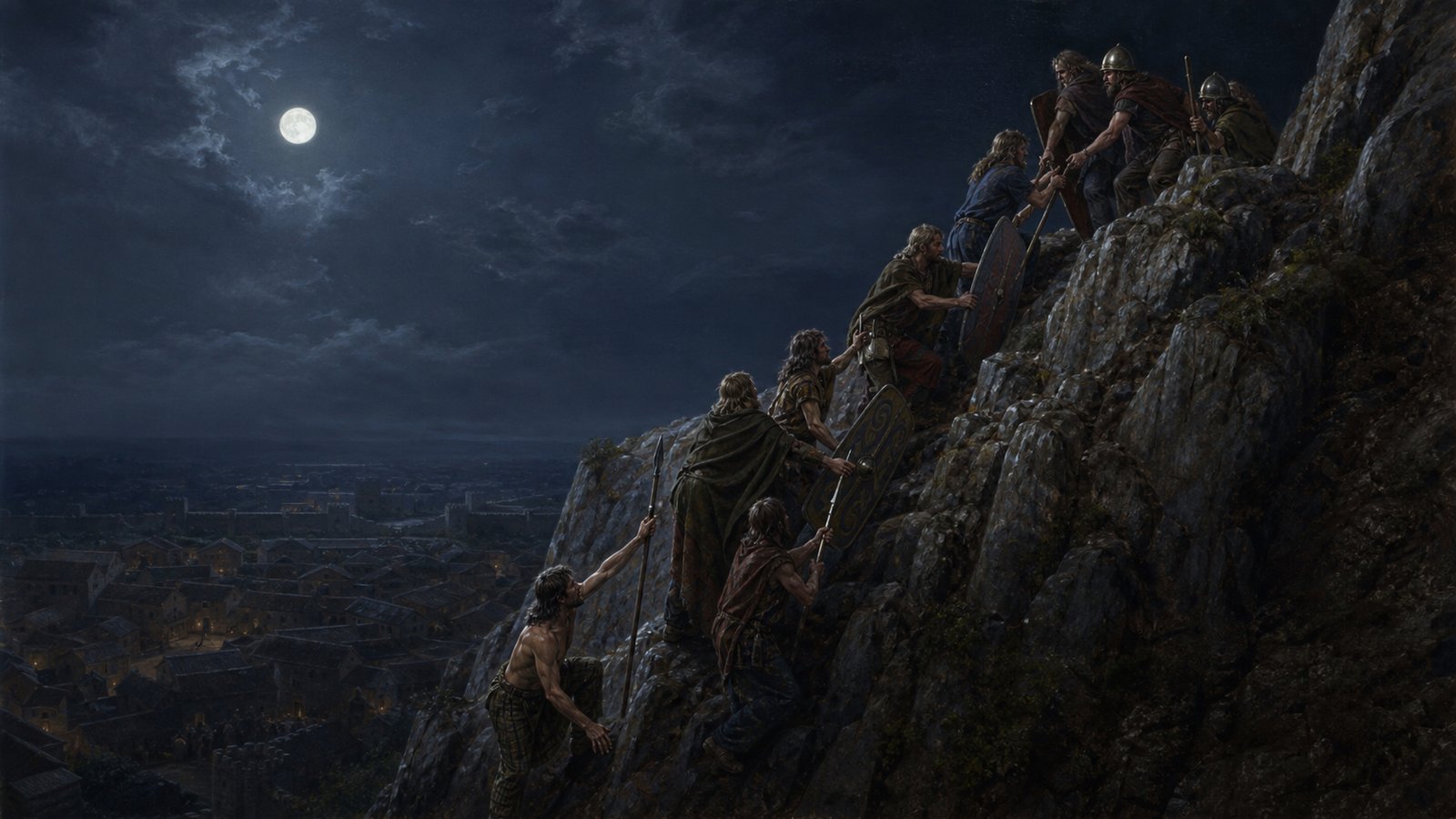
The Gauls sent a man ahead without weapons to test the passage. Others followed by handing up arms where the ground was difficult and supporting one another on the steep sections. Livy describes coordination rather than a reckless rush.
No shout announced them. The attackers reached so near the summit that they could have surprised the garrison if the last few movements remained undetected. The entire operation depended on preserving silence until enough men occupied usable ground.
The Dogs Missed What the Sacred Birds Heard
Livy makes the security failure explicit: the sentries were not awakened, and neither were the dogs. That detail creates the contrast on which the episode rests. Animals normally kept for warning failed, while birds preserved for ritual reasons succeeded.
Dogs patrol at ground level and respond to familiar patterns of sound and scent. Livy does not explain why these dogs stayed quiet, so any precise behavioral theory would exceed the source. What he emphasizes is the defenders’ reasonable safeguard producing no alarm.
The geese belonged to Juno. Even in extreme food shortage, Livy says, they had not been harmed because they were sacred. Their survival was therefore not an accidental detail of livestock management. Religious restraint kept the alarm system alive. The mechanism differs from the sacred chickens whose treatment turned naval defeat into scandal: here preservation, not rejected divination, supplied the practical consequence.
This does not mean Romans had installed geese as military equipment. The birds had a cultic place; their usefulness emerged under conditions no ritual keeper had designed. A rule about sacred life created a practical reserve at the instant other defenses failed.
Roman religion often worked through material routines rather than abstract belief alone. Feeding, housing, carrying, and preserving sacred animals put bodies and sounds into civic space. On this night, that physical presence mattered more than a formal watch schedule.
Manlius Turned Noise into Immediate Resistance
An alarm helps only if someone acts before surprise returns. Marcus Manlius woke to the clamor. Livy identifies him as a distinguished soldier who had previously held the consulship, giving the response an experienced figure rather than an anonymous sleeper.
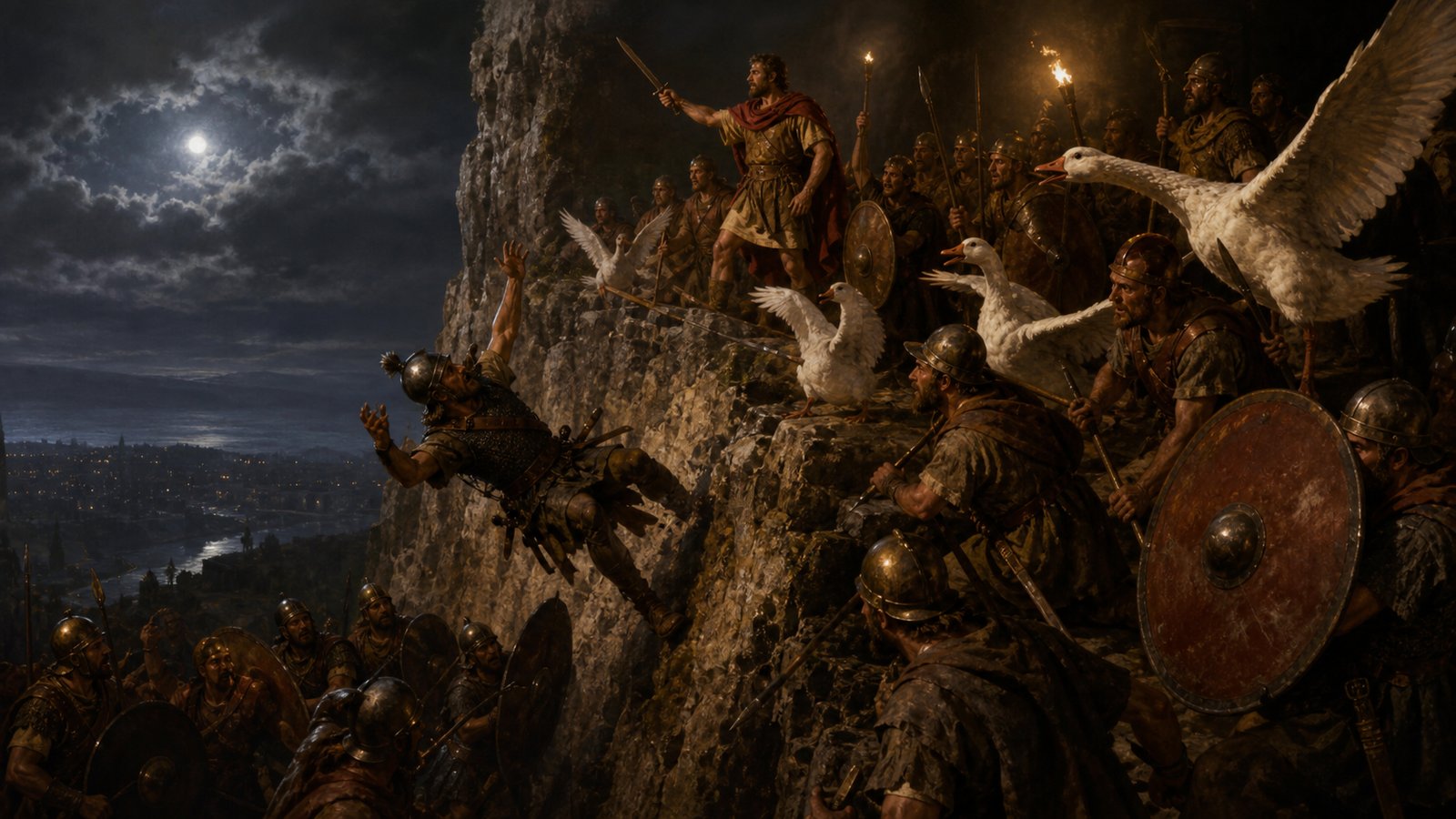
He armed himself and called others to their weapons. While companions hesitated in confusion, Manlius struck the first Gaul who had reached the top and sent him down the slope.
The confined terrain multiplied that blow. The falling man knocked into those climbing behind him. Other attackers dropped their weapons to grasp the rocks, making themselves vulnerable as the Romans gathered.
Manlius killed more climbers, and the defenders then used missiles and stones to drive the rest from the cliff. Livy’s sequence moves from one defender to collective action: alarm, first contact, reinforcement, and clearance of the approach.
The geometry is crucial. On open ground, one man could not stop a formed force. At the lip of a steep climb, the attackers could arrive only in a narrow sequence. Preventing the first foothold denied those below room to deploy.
The Garrison Punished Neglect and Rewarded Vigilance
Morning did not erase the failure that had allowed the ascent. The Romans investigated the sentries. Livy says the soldier responsible for the watch was thrown from the rock, an exemplary punishment shaped by the danger his neglect had created.
The severity belongs to a military story in which one missed duty nearly opened the last Roman stronghold. It also restores discipline by making responsibility visible after a night of confusion.
Manlius received a different public response. Each soldier contributed from his own ration—half a pound of grain and a measure of wine—despite the shortage. The individual portions were small, but together they created an honor that cost the hungry garrison something real.
The reward matched the conditions better than a decorative gift would have. Food and wine were survival resources. Sharing them acknowledged that Manlius had preserved the community consuming them.
Livy’s pairing of punishment and reward turns the episode into an argument about watchfulness. Sacred birds supplied the sound, but human discipline determined what happened before and after it.
Ritual Memory Kept the Alarm Alive
Later Roman tradition remembered the contrast between geese and dogs in annual ritual. Plutarch describes geese carried with honor while a dog was subjected to a humiliating punishment, linking the ceremony to the night attack.
Such retrospective ritual explanations can accumulate details over time. They should not be treated as a camera recording of the early fourth century BC. Their value lies in showing how Romans continued to organize memory around the animals’ opposed behavior.
The geese became symbols because the story joined divine protection to a mechanism listeners could understand. Sacred status kept the birds alive; their noise woke Manlius; the narrow climb made his quick response decisive. Roman night security later became an organized urban service, but the vigiles’ patrols and fire duties belonged to another era and another kind of threat.
No single link is sufficient. Without the climb, there is no crisis. Without silence, there is no surprise. Without preserved birds, there is no alarm. Without Manlius, noise may produce only confusion. The tale endures because every part tightens the next.
It also resists a simple claim that faith replaced military competence. Religion preserved the birds, but a veteran’s speed, the defenders’ stones, and the topography of the cliff completed the defense. Roman memory fused providence with readiness rather than choosing between them.
The Capitol was not saved by superior surveillance. Its sentries and dogs failed at the exact point an enemy exploited neglected terrain. The recovery began with an unscheduled sound from animals kept for another purpose.
That sound mattered because it altered timing by seconds or minutes. Before the geese called, the Gauls were climbers moving one by one. Had enough reached level ground, they could have become an armed group inside the defenses. Manlius met them while they were still trapped by the route.
Livy’s drama therefore rests on a narrow threshold. The first attacker had reached the top, but the infiltration had not yet become occupation. One shove sent him into the men below and bought the garrison the space to assemble.
The episode made sacred preservation look practical without reducing Juno’s birds to tools. It made individual courage decisive without pretending Manlius fought alone. Most of all, it showed how a defense can survive its own blind spot when an unexpected alarm reaches someone prepared to act.
Sources
Livy, History of Rome 5.47. Plutarch, Life of Camillus 27.