
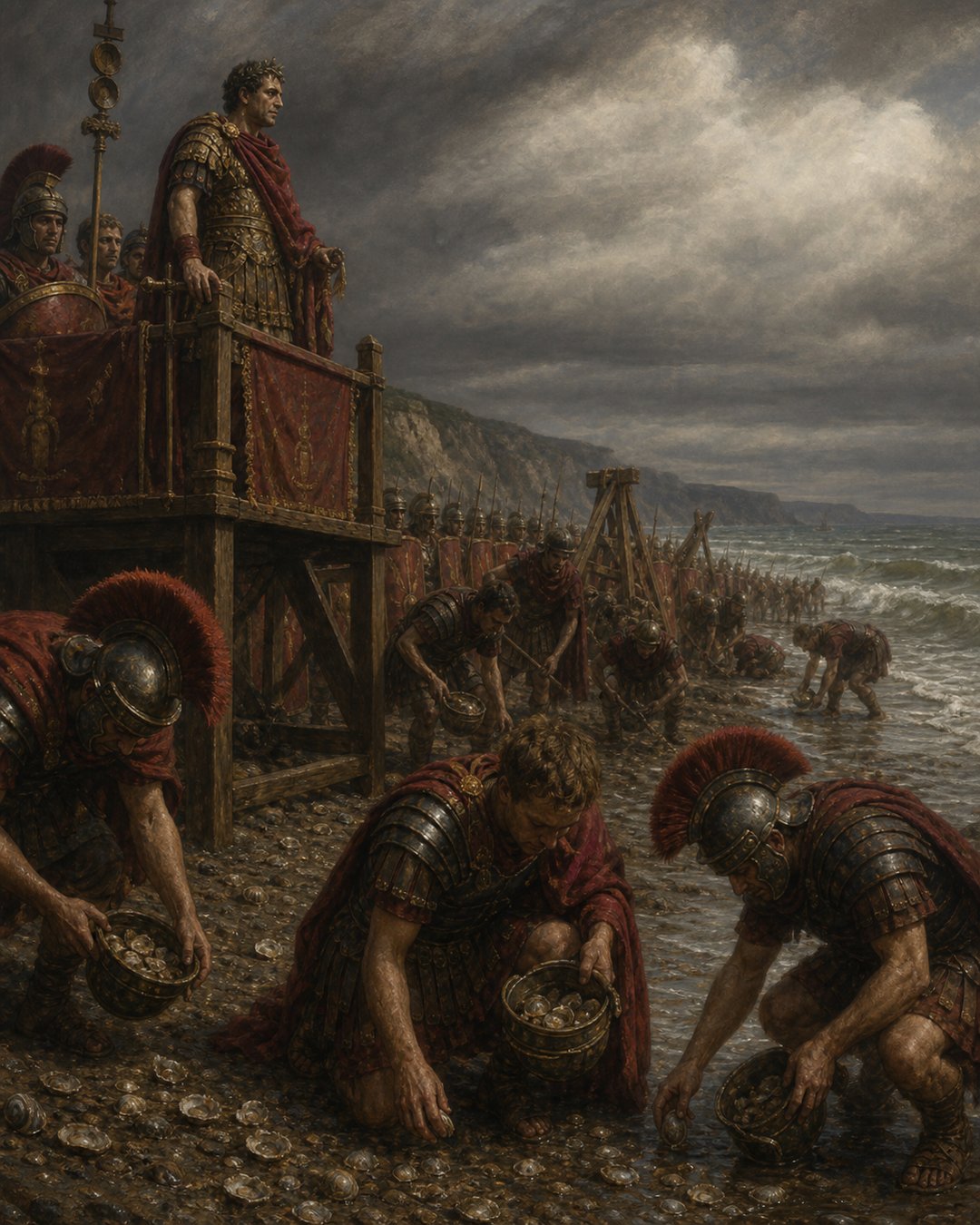
Roman soldiers formed on the shore facing the Channel. Artillery and siege engines were positioned as though an enemy waited beyond the water. Emperor Caligula boarded a warship, moved a short distance from land, returned, and took his place on a tribunal.
Then came the order that made the scene infamous. The troops were to gather shells and fill their helmets and clothing. Caligula called the shells spoils taken from the Ocean and announced that they belonged to the Capitol and imperial residence.
The episode survives through hostile ancient authors, and neither gives modern readers a secure key to the emperor’s intention. What their accounts do preserve is a precise machinery of performance: formation, command, collection, reward, acclamation, and monument. A beach produced no conquered province, yet military obedience allowed Caligula to stage the visible grammar of victory.
The Channel Became a Battlefield Without an Enemy
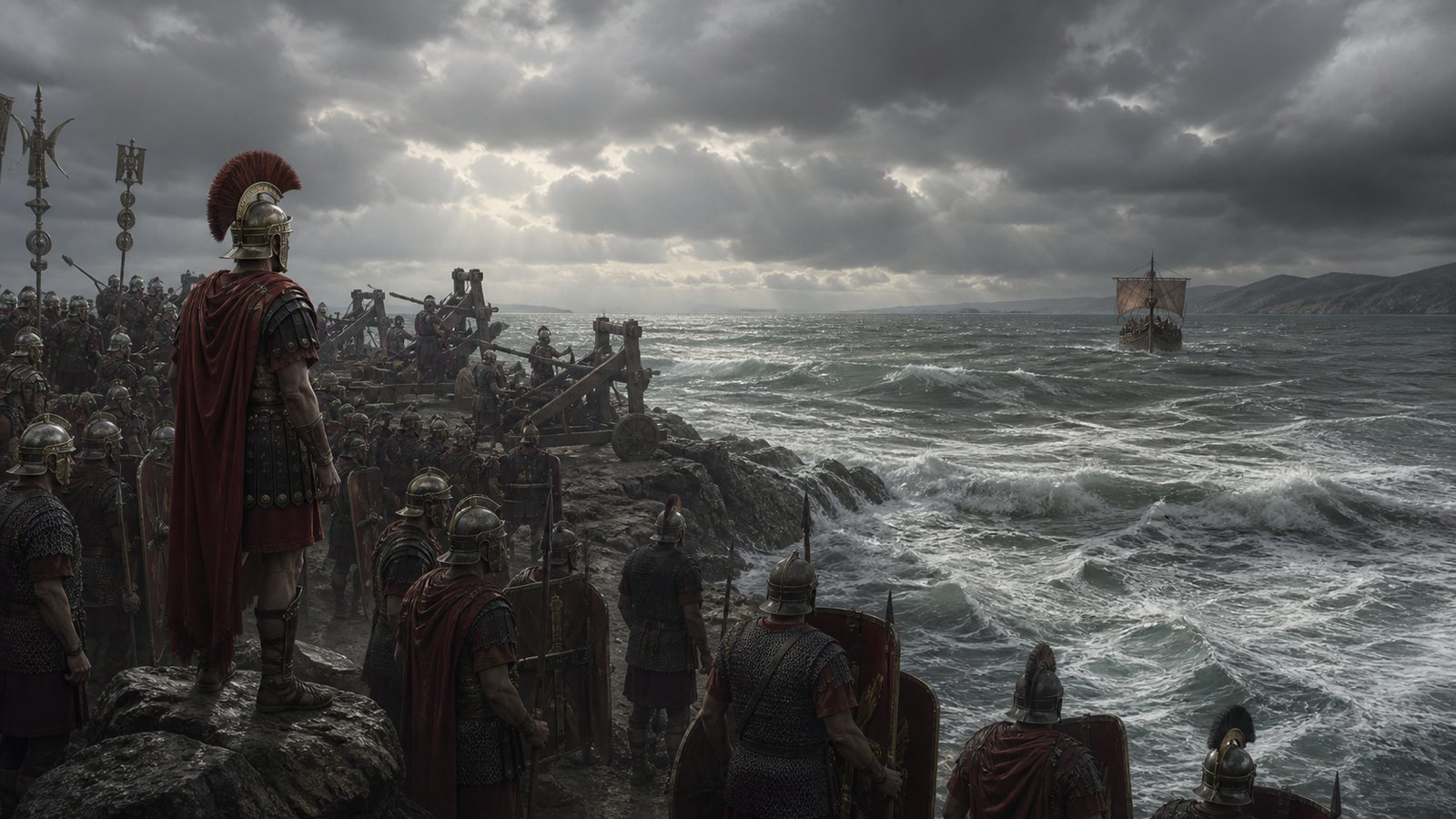
Suetonius places the scene after Caligula’s northern expedition. The emperor had moved through Gaul and reached the shore, where Britain lay across the water. Instead of describing a crossing, the biographer presents preparations that imitate combat.
Troops and engines stood in battle order. No opposing force appeared. Caligula went out to sea in a trireme, then returned to the beach and sat before the assembled army.
The arrangement mattered even if its strategic purpose remains obscure. A tribunal gave the emperor a raised place from which to issue commands and rewards. Engines and ranks converted ordinary sand into controlled military space. The sea itself occupied the position where an enemy army might otherwise stand.
Cassius Dio offers a related but not identical account. He says Caligula drew up his soldiers, embarked on a ship, sailed a little distance, came back, and mounted a high platform. The overlap between the authors supports the scene’s basic sequence while their hostility warns against pretending to recover every motive.
Neither narrative reports a battle. The action stopped at the boundary between land and water. That boundary gave the emperor a vast opponent that could neither negotiate nor visibly surrender.
Helmets and Tunics Became Containers for Victory
Suetonius says Caligula suddenly ordered the soldiers to collect shells. They were to fill their helmets and the folds of their garments. Equipment designed to protect bodies now carried the material proof of the exercise.
The physical detail makes the order memorable. A legionary could not gather shells while preserving the posture of battle. Men had to bend, search wet sand, pick through debris, and hold their finds in whatever cloth or armor could contain them.
Suetonius has Caligula name the collection “spoils from the Ocean.” The phrase did the ideological work. Roman spoils normally came from a defeated human enemy and could be dedicated to the gods or displayed in triumph. Here official naming converted common coastal objects into tokens of conquest.
The shells were not valuable in themselves. Their force came from the relationship between order and label. Thousands of soldiers could make a trivial command massive by obeying it at once.
The army’s organization therefore supplied the spectacle. Individual shells carried no story, but helmets full of them demonstrated that the emperor had made disciplined men collect and present them. The absurdity and the power came from the same source.
Money and Acclamation Closed the Performance
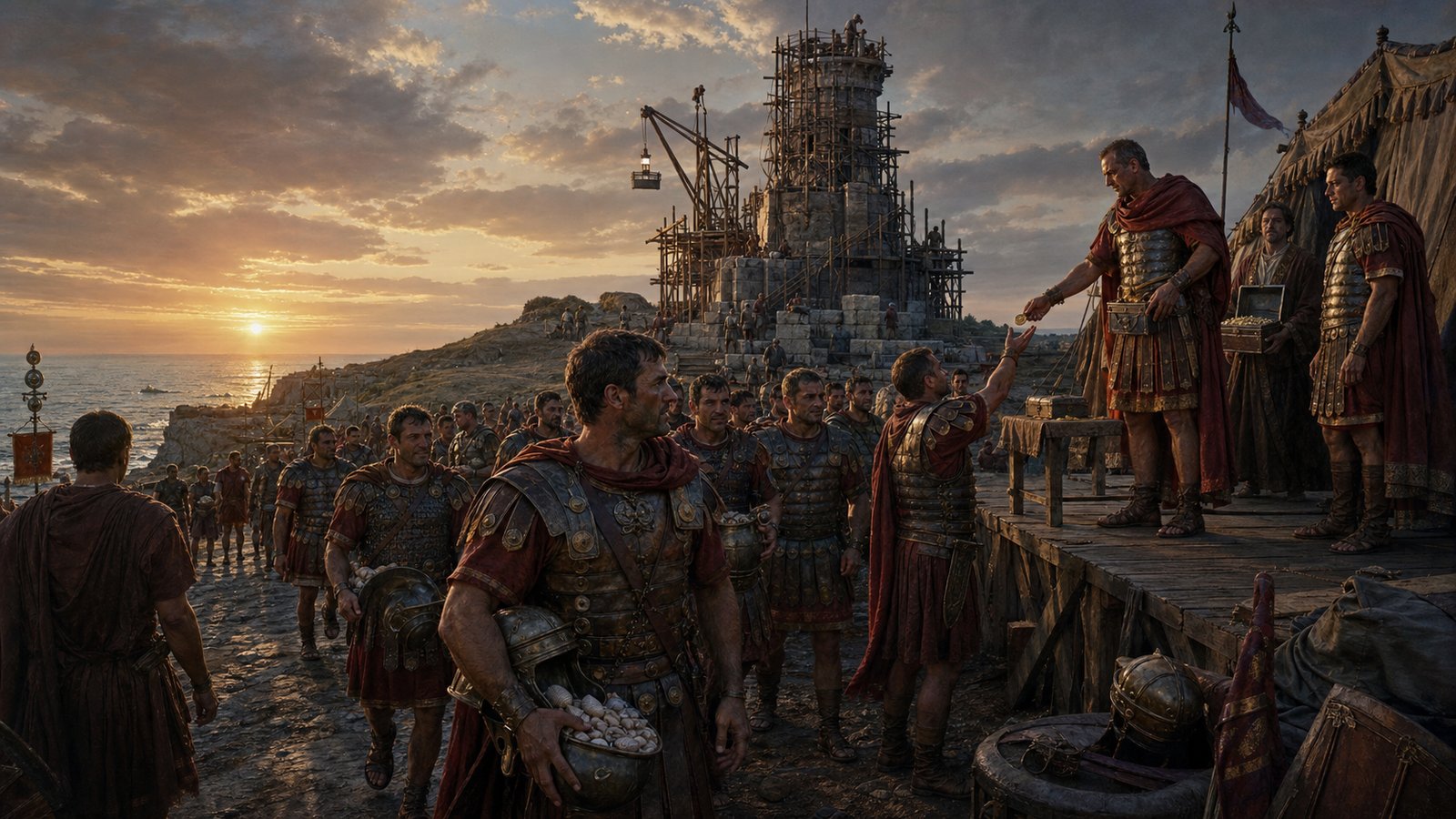
Caligula did not end with collection. Suetonius says he praised the troops as though they had won a victory. He granted each soldier one hundred denarii and told them to depart rich and happy.
Cassius Dio also records a distribution, although his wording and details belong to his own retelling. Reward completed the military pattern. A successful campaign should yield praise, money, and a public account of achievement; the shore exercise supplied each without a captured city.
One hundred denarii was not imaginary rhetoric. Whatever soldiers thought of the order, the payment gave participation a measurable consequence. Imperial authority could make a strange ceremony materially advantageous to those required to perform it.
The emperor also prepared victory messages. Suetonius says he dispatched a letter announcing the conquest and took care that messengers entered Rome conspicuously. Information had to arrive with the correct theatrical emphasis.
That communication resembles the wider Roman habit of making military success legible far from a battlefield. The wooden tablet that carried a camp password through guarded units solved an operational problem; Caligula’s dispatch solved a political one by telling the capital how the shore should be interpreted.
A Lighthouse Gave the Shore a Permanent Marker
The strangest action on the beach did not remain purely temporary. Suetonius says Caligula built a very high tower as a memorial of victory. Fires were to burn from it at night to guide ships, like the lighthouse at Alexandria.
A navigational structure could have genuine use while also carrying commemorative meaning. The tower linked imperial victory language to sailors approaching the coast after the soldiers and shells had gone.
This combination was characteristic of Roman display. Structures did practical work and advertised the ruler who ordered them. Caligula’s enormous maritime projects elsewhere likewise joined logistics to reputation; the vessel later reused beneath Claudius’s harbour belonged to the same imperial appetite for making power visible through engineering.
The ancient accounts do not permit a confident identification of every archaeological trace with Caligula’s tower. The literary claim is narrower: he ordered a beacon comparable in concept to Alexandria’s famous Pharos and attached it to his version of victory.
A tower also altered the scale of the episode. Shells could be scattered or discarded. Masonry transformed a day’s command into a landmark. It made the coast remember even if observers disagreed about what had happened there.
Hostile Historians Left the Motive Unresolved
Suetonius uses the shell order inside a biography designed to catalogue Caligula’s excesses. Cassius Dio writes with equal hostility toward the emperor. Their moral frames helped preserve the scene because it seemed to embody irrational rule.
Modern explanations have ranged from a symbolic attack on Neptune to punishment or humiliation of troops, aborted invasion plans, exercises connected with coastal engineering, and misunderstandings of military terminology. None can be treated as a fact supplied by the ancient narratives.
The safest reading separates intention from operation. We cannot know with confidence what Caligula privately wanted the order to mean. We can see how the reported action functioned in public: soldiers obeyed, objects were collected, the emperor named them spoils, money was distributed, victory was announced, and a tower marked the site.
That sequence reveals more than the familiar verdict that the emperor was mad. A ruler did not need an enemy’s surrender to command the external signs of success. He controlled the formation, the rewards, the dispatch, and the dedication.
The soldiers’ thoughts are absent. Neither Suetonius nor Dio gives an enlisted man a voice on the beach. Silence in the texts should not be filled with invented laughter, anger, or mutiny.
What remains is bodily obedience. Men trained to march, dig, build, and fight turned that discipline toward shells because an imperial order redirected it. Their compliance made the ceremony possible even if it could not make the Ocean conquered.
The episode’s durability comes from that contradiction. Roman victory culture depended on tangible objects and ordered movement. Caligula supplied both, but removed the defeated people who normally made them meaningful.
A helmet full of shells could be carried, counted, shown, and dedicated. It could not prove Britain had fallen or the sea had submitted. The gap between object and claim was visible on the very shore where the claim was staged.
Caligula nevertheless controlled the immediate ending. He praised the army, paid it, sent news toward Rome, and built upward. Hostile historians controlled the later ending by preserving the beach not as conquest, but as a warning about power’s ability to command the scenery of triumph.
The shells were ordinary. The extraordinary fact was that an emperor could assemble an army to gather them and then require the state’s military language to call them spoils.
Sources
Suetonius, Caligula 46–47. Cassius Dio, Roman History 59.25.